POPE LEO XIV RETURNS TO CHICLAYO AFTER CANCER SURGERY AS 1.5 MILLION WELCOME THEIR FORMER BISHOP
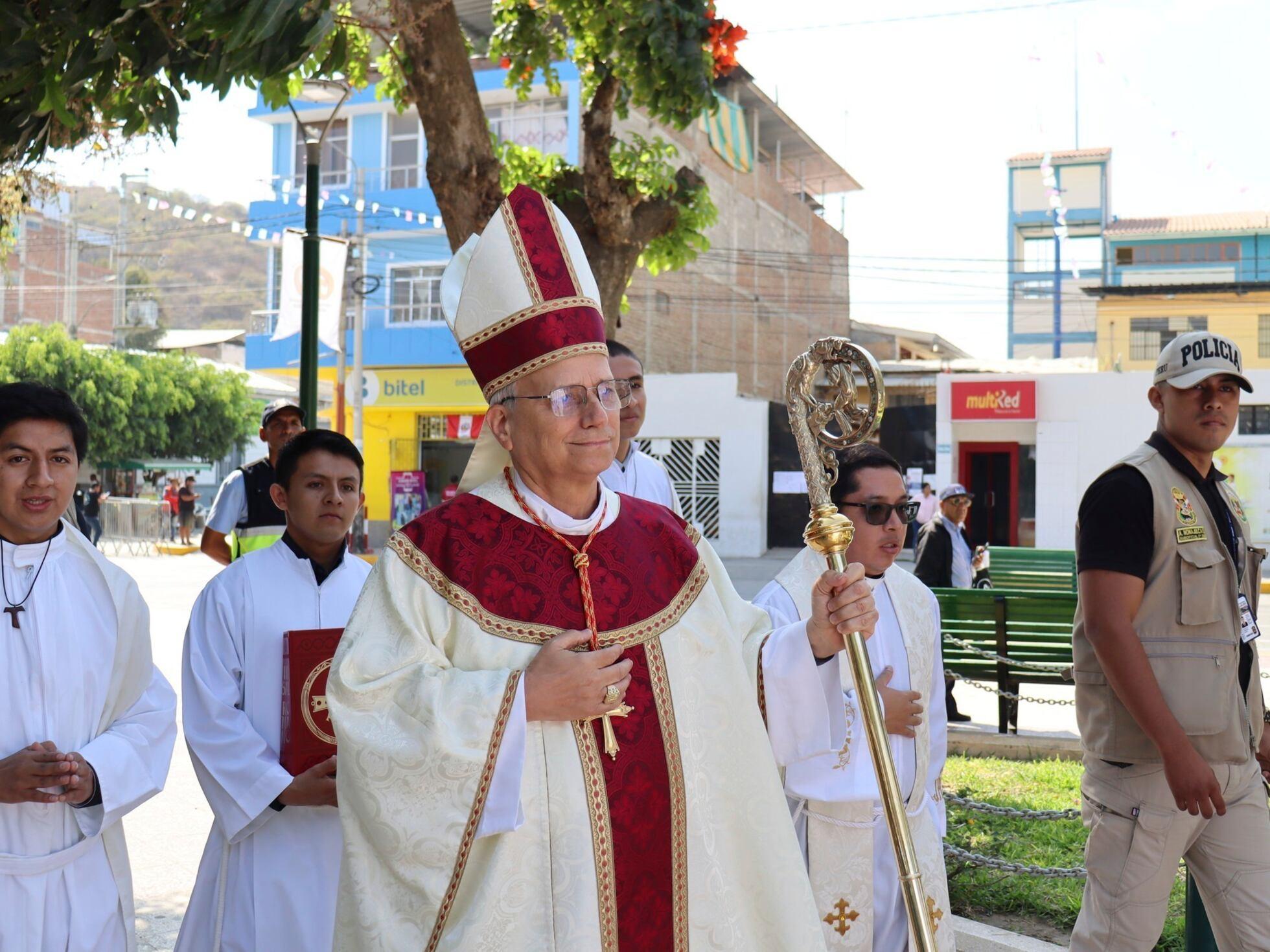
Pope Leo XIV has returned to Chiclayo, Peru, for an emotional homecoming only one month after undergoing surgery for lung cancer. Vatican officials said approximately one million people lined the streets along his route and another 500,000 attended an outdoor Mass at the Pampas de Pimentel, bringing the total participation to around 1.5 million. Leo thanked the faithful for their prayers and said he was overcoming what he called a “time of trial” with God’s help. The Vatican confirmed that surgeons removed the lower lobe of his right lung on October 13 after identifying a malignant nodule later diagnosed as adenocarcinoma, and his doctors subsequently cleared him for his November 6–17 journey through Uruguay, Argentina and Peru.
CHICLAYO, PERU — Pope Leo XIV returned Friday to Chiclayo, the northern Peruvian city that became his adopted home during decades of missionary and episcopal service, receiving an extraordinary welcome from an estimated 1.5 million people as he publicly acknowledged his recovery from lung cancer surgery performed just one month earlier. The 71-year-old pontiff, who served as bishop of Chiclayo before being called to Rome and later elected the first American pope in 2025, celebrated an open-air Mass at the Pampas de Pimentel on November 13, telling worshippers that he was overcoming what he described as a difficult period of illness with the help of God. Vatican figures said approximately one million people lined the streets along his route while another 500,000 attended the Mass, transforming the return of the former Bishop Robert Prevost into one of the largest public gatherings of his pontificate.
“What a joy it is to return to Chiclayo! It is a blessing for me to be with you once again,” Leo told the crowd at the beginning of his homily. He then addressed his health directly, thanking local Catholics for the support they had shown since news of his cancer diagnosis and surgery became public. “Thank you for your affection, support and prayers, especially for my health during this time of trial which, with God’s help, I am overcoming,” he said. The remark was one of the pope’s clearest personal comments on his condition since surgeons removed part of his right lung on October 13 after doctors identified a malignant nodule that was later confirmed as adenocarcinoma, the most common form of lung cancer.
The Vatican had confirmed in late October that Leo’s recovery was progressing sufficiently well for him to undertake the demanding 12-day journey through Uruguay, Argentina and Peru from November 6 to 17. His doctor, Luigi Carbone, said after a post-surgical examination that there was no medical reason to cancel the trip, despite an itinerary involving numerous flights, public events and travel through areas at varying elevations. The pontiff gradually resumed his public duties after the procedure and has maintained the scheduled Latin American programme without significant visible difficulty, although Vatican officials have continued to emphasize rest and medical monitoring.
The return to Chiclayo carried an emotional weight that went far beyond a conventional papal visit. Robert Francis Prevost spent much of his adult religious life in Peru, first arriving as an Augustinian missionary in the 1980s and later serving communities across the country. Pope Francis appointed him apostolic administrator of Chiclayo in November 2014, and he became bishop of the diocese the following year after obtaining Peruvian citizenship. He remained closely associated with the city until 2023, when Francis brought him to Rome to lead the powerful Dicastery for Bishops and the Pontifical Commission for Latin America.
For local Catholics, Leo’s election to the papacy in May 2025 was therefore experienced not simply as the elevation of an American-born churchman but as the rise of a pastor they regarded as one of their own. The pope has dual American and Peruvian nationality, and his extensive service in Peru shaped both his episcopal identity and his understanding of the church’s responsibilities toward the poor, migrants and communities affected by political and economic instability. During his years in northern Peru, residents came to know him as “Monseñor Roberto,” a bishop whose ministry was frequently described in local accounts as accessible, practical and closely connected to ordinary parish life.
Those personal ties were evident throughout Friday’s visit. Crowds gathered hours before the pope’s arrival and, according to reports from the scene, many had travelled from neighboring cities and regions to see him. People carried Peruvian flags, papal banners, images of local churches and signs welcoming the former bishop home. Some supporters spent the night near the Mass site despite the intense desert heat expected later in the day, while firefighters sprayed water over sections of the crowd as temperatures climbed. Chants identifying Leo with Chiclayo accompanied his motorcade, reflecting the unusually personal relationship between the city and a pope born thousands of miles away in Chicago.
Local authorities estimated that around one million people lined the roads as Leo travelled from the Chiclayo air base toward Pimentel, while the Vatican said roughly half a million worshippers gathered at the outdoor Mass itself. Those estimates mean more than 1.5 million people participated in some portion of the welcome, a remarkable turnout in a metropolitan area whose normal population is far smaller. The size of the gathering also required extensive security and logistical planning involving Peruvian police, local authorities, church officials and emergency services.
The pope’s return was particularly poignant because the trip had appeared uncertain only weeks earlier. On October 13, surgeons removed the lower lobe of Leo’s right lung after discovering a cancerous growth. Subsequent pathology confirmed adenocarcinoma. The diagnosis prompted immediate questions about whether a pontiff elected little more than a year earlier would be able to continue a demanding international schedule and whether the planned South American journey would need to be postponed.
The Vatican subsequently said Leo’s surgery had been successful and that doctors were satisfied with his recovery. His medical team cleared him to travel after a follow-up examination, and the pope chose to continue with the trip rather than postpone what had become a highly anticipated return to countries central to his pastoral history. The journey through Uruguay, Argentina and Peru has therefore served simultaneously as a major diplomatic and pastoral mission and as a visible demonstration that Leo remains capable of carrying out the physical responsibilities of the papacy while recovering from treatment.
His health comments in Chiclayo were carefully phrased. Leo did not declare himself fully recovered and did not provide new medical details, instead describing the illness as a “time of trial” that he was overcoming. The statement is consistent with the Vatican’s previous approach, which has disclosed the existence of the surgery and the cancer diagnosis while leaving longer-term treatment decisions and prognosis to the pope’s medical team. There has been no Vatican announcement indicating that his cancer has spread or that his current travel programme needs to be curtailed.
Friday’s Mass focused primarily on evangelization rather than the pope’s illness. Leo told worshippers that every baptized Christian has a responsibility to share the Gospel, whether ordained or lay, and said missionary work should be expressed through a coherent Christian life rather than imposed through coercion or mere persuasion. He emphasized the relationship between faith, charity and truth, warning that religious conviction detached from love can become rigid while love separated from truth can become sentimental.
The message reflected themes that have become increasingly associated with Leo’s papacy. Since his election, he has emphasized missionary work, social responsibility, dialogue and a church that remains close to people at the margins of society. His years in Peru have often been cited as central to that outlook because they exposed him directly to poverty, migration, political upheaval and natural disasters while requiring him to manage a diocese with significant social as well as religious responsibilities.
Chiclayo itself provided some of the formative experiences of his episcopal ministry. The region endured severe flooding, social disruption during the COVID-19 pandemic and pressure associated with Venezuelan migration into Peru. As bishop, Prevost worked with church organizations responding to those crises and became closely involved in initiatives supporting vulnerable families. His record in the diocese later became part of the profile examined by cardinals before his election as pope.
After the Mass, Leo continued a programme that deliberately revisited institutions and communities associated with his earlier ministry. His schedule included a private visit to the San Óscar A. Romero Chapel, followed later by meetings with bishops, priests, religious communities, seminarians and pastoral councils at the Shrine of Our Lady of Peace. He also met members of the university community at the Catholic University Santo Toribio de Mogrovejo, where he had previously received an honorary doctorate.
The visit to the Romero chapel carried its own symbolism. Saint Óscar Romero, the Salvadoran archbishop assassinated in 1980 after speaking forcefully against violence and injustice, has become an important figure within Latin American Catholicism and a model for church leaders emphasizing solidarity with the poor. Leo has repeatedly stressed that evangelization must include concrete concern for human dignity, justice and those most in need, themes consistent with the pastoral tradition represented by Romero.
The pope’s relationship with Peru stretches back four decades. He first served in the northern region of Piura in 1985 before later spending extended periods in Trujillo, where he worked in Augustinian formation, seminary education, parish ministry and church administration. After serving internationally as prior general of the Order of Saint Augustine, he returned to Peru as a bishop. His naturalization as a Peruvian citizen in August 2015 further deepened a connection that local Catholics increasingly describe in national rather than simply missionary terms.
His election as Leo XIV on May 8, 2025, made him the first pope born in the United States and the first Augustinian pope in the history of the Catholic Church. Yet Peru quickly claimed a share in the historic moment because of the years he spent there and the citizenship he had acquired. Images of celebrations in Chiclayo were broadcast around the world after his election, and residents repeatedly described his elevation as the election of a Peruvian pope as much as an American one.
That dual identity has become one of the distinctive characteristics of his pontificate. Leo was born in Chicago in September 1955, but much of his pastoral formation and episcopal leadership occurred in Latin America. He speaks Spanish fluently and has longstanding personal connections with clergy and lay communities throughout Peru. His return to Chiclayo as pope therefore represented a reversal of the journey he made in 2023, when he left the diocese for a senior Vatican appointment that ultimately positioned him to succeed Pope Francis.
The health challenge has added another dimension to that narrative. Papal illness inevitably attracts international attention because the pope holds both spiritual authority over the global Catholic Church and sovereign responsibility for Vatican City. Unlike ordinary diocesan bishops, there is no simple mechanism under canon law for transferring papal authority temporarily if a pope becomes seriously incapacitated. Leo’s cancer surgery therefore prompted renewed discussion among Vatican specialists about continuity of leadership, although his relatively rapid recovery has so far prevented that issue from becoming an immediate constitutional problem.
The Vatican has sought to balance transparency with medical privacy. Officials confirmed the diagnosis, the surgical procedure and the favourable assessment that permitted the Latin American journey, while avoiding speculation about long-term outcomes. Leo himself has presented the experience primarily in spiritual terms, repeatedly thanking Catholics for their prayers and describing his recovery as a period of testing rather than turning his illness into the central theme of his public appearances.
That approach was evident in Chiclayo. His health remarks lasted only a brief portion of a homily devoted overwhelmingly to missionary responsibility, and he quickly redirected attention toward the people who had shaped his life as a bishop. He told the congregation that seeing their faces prompted a prayer of gratitude for the blessings they had been to his life and ministry and asked them to continue praying that he would be able to strengthen others in the faith.
The response suggested that the connection remains intensely personal for both sides. Witnesses described people crying as the pope passed, while others displayed photographs from his years as bishop or held symbols associated with the diocese. Families traveled for hours to attend the Mass, and some elderly worshippers endured difficult conditions because they believed the visit might be their only opportunity to see the man they once knew as a local bishop return as leader of the global Catholic Church.
The enormous turnout also underscored the continuing strength of Catholic identity in Peru despite the religious changes affecting much of Latin America. Evangelical churches have expanded across the region, and the share of the population identifying as Catholic has declined in many countries, but papal visits still possess extraordinary cultural and religious significance. Leo’s personal history in Peru gave Friday’s gathering a dimension beyond institutional Catholic loyalty, turning it into a homecoming for a figure already embedded in the country’s contemporary religious history.
His South American tour is scheduled to continue until November 17 and remains one of the most demanding international journeys undertaken since his surgery. The Vatican has not announced significant changes to the itinerary, and the pope’s appearances during the first week have shown him participating fully in meetings, liturgies and public addresses. Medical officials nevertheless continue to monitor his recovery, and his recent operation ensures that his stamina will remain closely watched throughout the remainder of the trip.
For Chiclayo, however, Friday’s visit was less about medical speculation than reunion. The crowds that lined the streets welcomed a pope whose path to Rome passed through their parishes, schools and neighborhoods, while Leo repeatedly emphasized that the diocese continued to occupy a central place in his prayers and memory. His return as pontiff, only a month after cancer surgery, gave the encounter an added sense of vulnerability without changing the pastoral message he sought to deliver.
The immediate health outlook remains cautiously positive. The Vatican has said Leo’s recovery has progressed well enough for international travel, while the pope himself says he is overcoming the illness. Further medical monitoring will be necessary after the removal of a cancerous lung lobe, and the Holy See has not suggested that treatment or surveillance has ended simply because the pontiff has resumed a demanding schedule.
As Pope Leo continues the final stages of his journey through Peru, his return to Chiclayo is likely to stand among the defining images of the trip: a former missionary and bishop returning in papal white to the city that adopted him, surrounded by crowds measured in the hundreds of thousands and speaking openly about an illness that had threatened to disrupt the journey. The gathering combined the personal history of Robert Prevost, the global responsibilities of Leo XIV and the uncertainty that accompanies recovery from cancer, while giving the people of Chiclayo an opportunity to welcome back a pastor they had known long before the rest of the world knew his name.