FAA OUTAGE DISRUPTS MORE THAN 1.5 MILLION PASSENGERS AS U.S. FLIGHT BACKLOG SPREADS
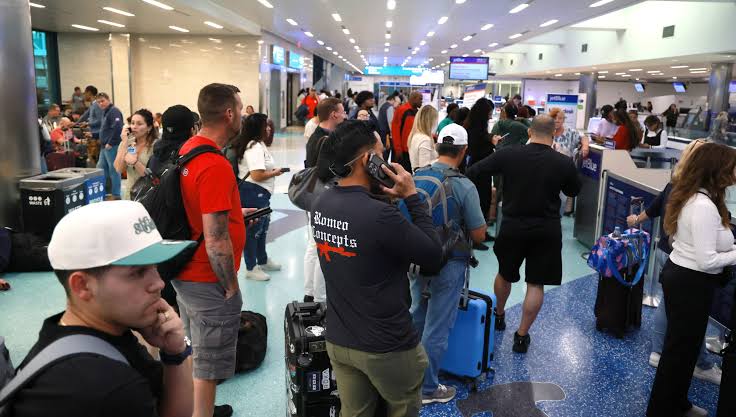
More than 1.5 million passengers faced potential disruption after a telecommunications failure affecting all 22 U.S. Air Route Traffic Control Centers prompted the FAA to impose a nationwide ground stop on Friday, November 13. About 11,000 flights carrying more than 1.5 million passengers were scheduled to depart U.S. airports after 4 p.m. Eastern, according to aviation analytics company Cirium. The FAA reopened U.S. airspace at 8:15 p.m. Eastern, but thousands of cancellations, delays and diversions left airlines with a major backlog of displaced aircraft, crews and passengers. Officials said there was no evidence of a cyberattack and linked the disruption to overloaded equipment within the FAA’s aging telecommunications network, although the precise cause of the overload remains under investigation.
WASHINGTON — More than 1.5 million passengers faced potential disruption across the United States after a nationwide Federal Aviation Administration communications failure forced authorities to halt departing flights at every U.S. airport on Friday, creating a massive backlog that continued to affect travelers after the country’s airspace reopened. The FAA lifted the nationwide ground stop at 8:15 p.m. Eastern Time, or 1:15 a.m. GMT on Saturday, after more than four hours of severe disruption, but aviation officials and airlines warned that normal operations would not return immediately because thousands of aircraft, crews and passengers had been displaced. Aviation analytics company Cirium estimated that approximately 11,000 flights carrying more than 1.5 million passengers had been scheduled to depart U.S. airports after 4 p.m. Eastern, shortly after the shutdown began, placing an unusually large portion of the country’s evening travel schedule directly in the path of the disruption.
The outage affected all 22 Air Route Traffic Control Centers that manage aircraft flying between major airports across the United States, prompting the FAA to impose the extraordinary nationwide ground stop at approximately 3:54 p.m. Eastern Time on November 13. Aircraft already airborne were generally allowed to continue toward their destinations and land, while planes still on the ground were prevented from departing except in limited circumstances coordinated with air traffic authorities. International flights were initially handled on a case-by-case basis as controllers attempted to maintain safe separation between aircraft and determine how much traffic the weakened communications system could safely accommodate. The FAA said the decision was taken for safety reasons after communications problems developed across the network rather than because aircraft themselves had suffered technical failures.
By the time the ground stop was lifted, the disruption had developed into one of the most serious breakdowns in U.S. commercial aviation in years. Thousands of flights were canceled or delayed, hundreds were diverted, arriving aircraft found gates occupied by planes unable to depart, and airport terminals from New York and Boston to Chicago, Los Angeles and Seattle filled with passengers trying to determine whether they would travel that night or need to make alternative arrangements. Updated flight-tracking figures later showed that the consequences extended well beyond the first wave of cancellations, with airlines canceling thousands of additional services as they attempted to rebuild schedules around aircraft and crews stranded far from where they were supposed to begin their next assignments.
Transportation Secretary Sean Duffy said the airspace was reopened only after technicians had restored sufficient stability and the FAA had tested its systems, but he cautioned that airlines would need time to unwind the disruption. The reopening did not mean that all 11,000 scheduled departures could simply leave at once because air traffic controllers had to manage the release of aircraft gradually while airports dealt with crowded gates, displaced crews and local weather restrictions. Several airlines requested additional ground stops at individual airports during the recovery period, underscoring the difference between restoring the national air traffic system and returning thousands of individual flights to their original schedules.
Officials said the failure originated in the FAA’s telecommunications infrastructure and affected the centers responsible for managing aircraft traveling through large sections of U.S. airspace. Duffy said switches and routers in the agency’s legacy network became overloaded with data and went down, creating instability in information being provided to controllers. The precise technical sequence that produced the overload remained under investigation, and officials had not established that the incident resulted from a deliberate attack. Homeland Security Secretary Markwayne Mullin said authorities had found no evidence of a cyberattack or other malicious action and described the event as a telecommunications outage, while investigators continued examining the underlying technical cause.
The distinction is significant because the timing of the outage immediately prompted speculation about new technology recently introduced into the FAA system. The agency had expanded its Strategic Management of Airspace, Routing and Trajectories system, known as SMART, across the same 22 Air Route Traffic Control Centers days before Friday’s disruption. Officials, however, said the new airspace management technology itself had not been identified as the cause, and Duffy rejected suggestions that the SMART system was directly responsible. Authorities instead focused on how newer technology interacted with an older telecommunications architecture, while emphasizing that the investigation into exactly why the network became overloaded was continuing.
That uncertainty has become an important part of the investigation because Friday’s failure exposed the scale of dependence on communications infrastructure that aviation officials have acknowledged is outdated. The FAA manages one of the largest and most complicated air traffic environments in the world, directing tens of thousands of commercial, cargo, private and government flights each day through a network of control centers, towers, radar facilities and telecommunications systems. Some of the underlying technology dates back decades, and repeated modernization programs have struggled with funding constraints, technical complexity, procurement delays and the difficulty of replacing essential systems while they remain in continuous operation.
The disruption quickly became visible in major terminals across the country. At Chicago O’Hare International Airport, passengers watched departure screens fill with delays while some travelers began considering whether to abandon flights and continue their journeys by road or train. At New York-area airports, Boston Logan International Airport and other major hubs, travelers waited at airline counters for information as cancellations accumulated. Some passengers remained aboard aircraft that had pushed away from gates before being told they could not take off, while others were required to deplane as airlines concluded there was no realistic prospect of departure before crews reached legal working-time limits.
Diversions further complicated the recovery. Cirium reported that at least 827 flights had been diverted by early Friday evening, including hundreds that returned to the airports from which they had departed and others that landed at alternative airports. When a flight is diverted, the consequences can extend far beyond the passengers aboard because the aircraft may no longer be positioned for its next scheduled service, its crew may exhaust legally permitted duty hours and passengers connecting to onward flights may find themselves hundreds of miles from the hub through which their itinerary was supposed to continue. Those operational consequences help explain why airlines warned that the effects of a relatively short nationwide shutdown could last through the weekend.
American Airlines said it would mobilize staff across its network to move customers once the FAA allowed departures to resume, while other major carriers began rebooking passengers and repositioning crews. United Airlines, Delta Air Lines, Southwest Airlines and other operators faced similar challenges as the evening schedule was compressed into a smaller operating window. The financial consequences for carriers can be substantial because cancellations generate costs associated with crew accommodation, aircraft repositioning, passenger handling and disrupted connections while also reducing the number of revenue-generating flights airlines can operate.
International carriers were also affected because the U.S. aviation network is deeply integrated into global schedules. Flights from Canada and Europe were canceled or delayed, while airlines in Asia issued advisories warning passengers traveling to the United States to expect possible disruptions. Long-haul services are particularly vulnerable to cascading delays because an aircraft arriving late from the United States may be unable to operate its next departure on schedule, creating problems many hours after the original ground stop has ended. Crew rest requirements, airport curfews and limited availability of substitute widebody aircraft can extend a single U.S. delay into multiple international cancellations.
The timing created additional pressure because the disruption occurred shortly before the Thanksgiving travel period, traditionally one of the busiest stretches of the U.S. aviation calendar. Airlines and airports had already been preparing for heavy passenger volumes, leaving relatively little spare capacity to absorb a disruption affecting much of the national network at once. Although officials said they expected operations to stabilize before the Thanksgiving peak, the incident highlighted how quickly the system can become congested when a technical failure interrupts departures at every airport simultaneously.
Cargo operations were also affected. FedEx and other logistics companies that depend heavily on overnight aircraft movements had to adjust operations while monitoring the ground stop, raising the possibility of delays for time-sensitive shipments. Large parcel companies typically build their networks around tightly timed overnight connections in which aircraft converge on central sorting hubs before departing again within hours. A nationwide restriction during that window can therefore disrupt cargo movements in much the same way that a passenger airline’s hub operation is affected, with delays potentially spreading into delivery networks the following day.
The disruption reached professional and college sports as teams attempted to travel for weekend games. A number of college football programs were delayed, forced to return to campus or switched to buses after their flights could not depart, while professional basketball and hockey teams also faced changes to their travel plans. The difficulties provided another illustration of how widely the ground stop reached beyond ordinary passenger itineraries, affecting charter operations, freight movements and organizations whose travel schedules depend on precise arrival times.
The nationwide nature of the shutdown was particularly unusual. The FAA regularly imposes ground stops at individual airports because of thunderstorms, snow, equipment problems, congestion or staffing shortages, but a halt covering departures across the entire country is extremely rare. Friday’s event was only the second nationwide departure ground stop since the September 11, 2001, terrorist attacks. The previous nationwide interruption occurred in January 2023 when a failure involving the FAA’s Notice to Air Missions system, which distributes critical safety information to pilots, forced the agency to suspend domestic departures for less than two hours and disrupted approximately 11,000 flights.
That 2023 failure was traced to contractors who inadvertently deleted files while working on the system, but Friday’s outage involved a different part of the air traffic infrastructure. The comparison nevertheless reinforces concerns that multiple critical components of the national aviation system remain vulnerable to technical failures capable of generating disruption on a national scale. The ability to continue operating safely when an individual system fails depends on redundant communications, backup equipment and alternative procedures, and Friday’s ground stop raised new questions about whether existing backup arrangements are sufficiently resilient when problems spread across multiple control centers.
Those concerns were already well documented before the latest outage. A Government Accountability Office review published in 2024 found that the FAA considered 51 of 138 air traffic control systems unsustainable and another 54 potentially unsustainable, meaning more than three-quarters of the systems examined raised concerns about their long-term condition. Some systems rely on technology that has been in service for decades, while replacement parts for older equipment have become increasingly difficult to obtain. FAA Administrator Bryan Bedford has described the agency’s hundreds of air traffic facilities as technological silos, with systems that do not always communicate seamlessly with one another.
The scale of the modernization challenge has produced unusual examples of just how old parts of the infrastructure have become. The FAA recently announced plans to eliminate floppy disks still used to provide weather and other operational information at more than 400 facilities by the end of 2028. Controllers at some airports have also continued using paper flight strips to track aircraft movements even as the agency works to introduce electronic replacements. The FAA has gradually removed the paper system from major airports, but officials have acknowledged that the transition will take several more years.
Telecommunications failures have created repeated disruptions during 2026. In September, thousands of flights were delayed or canceled across the northeastern United States after a telecommunications line was accidentally severed in New Jersey and a separate circuit problem affected an FAA facility serving the region. Incoming flights were halted at major New York airports, Philadelphia and Boston for hours, with more than 100 aircraft diverted before the system was restored. A separate fiber-optic cable cut later affected Houston operations, prompting the FAA to warn airports about the risks created when construction work damages critical communications lines.
Friday’s outage was far larger because the problem was not confined to one region. The communications failure reached all 22 en route control centers, which oversee aircraft flying between airport terminal areas and manage much of the country’s high-altitude traffic. When those centers cannot reliably exchange information, the FAA has limited options because maintaining safe separation between aircraft depends on controllers receiving accurate and timely radar, flight-plan and communications data. The nationwide ground stop therefore functioned as a safety measure intended to reduce traffic demand while technicians worked to restore confidence in the network.
At the time the ground stop began, thousands of aircraft were already airborne and headed toward U.S. airports. Those flights were not simply ordered out of the sky; controllers continued managing them and allowed aircraft to land while new departures were held. The result was a steadily shrinking number of aircraft in the air but a growing congestion problem on the ground as arriving planes occupied gates that had been expected to become available when departing aircraft left. At some airports, arriving aircraft were forced to wait on taxiways because there was nowhere immediately available for them to park.
The incident has also intensified political pressure over funding for aviation infrastructure. On the same day as the shutdown, the White House and Department of Transportation asked Congress to approve an additional $30.1 billion for airport and air traffic control upgrades. The request includes approximately $10.1 billion for air traffic control modernization, including a common automation platform, updated controller workstations and cloud computing, as well as $2 billion to replace or improve FAA control towers and billions more for airport infrastructure.
Congress had already approved $12.5 billion over five years in 2025 for air traffic control modernization and controller hiring, but the administration argues that substantially more money is required to complete the overhaul. Duffy has repeatedly said the current architecture cannot be modernized piecemeal indefinitely and has pushed for a more comprehensive replacement of aging communications and computing equipment. The Transportation Department says approximately 68 percent of the FAA’s legacy copper telecommunications network has already been converted to high-speed fiber, but Friday’s failure demonstrated that replacing individual components does not automatically eliminate weaknesses in the broader system.
The debate is not solely about technology. The FAA has also struggled with a shortage of thousands of qualified air traffic controllers, forcing many facilities to rely on overtime and creating staffing constraints that can amplify other disruptions. Training new controllers takes years, and the demanding certification process means recruitment increases do not immediately translate into fully staffed control facilities. The combination of workforce shortages and aging equipment has become a central concern for airlines, unions and lawmakers seeking to improve the reliability of the national airspace system.
Airlines have broadly supported additional modernization funding, arguing that delays caused by outdated air traffic infrastructure impose substantial costs on carriers and passengers. American, Delta, United and Southwest have backed calls for improvements, while industry groups have pressed the government to accelerate deployment of modern communications and automation tools. Airlines have also argued that investments should be accompanied by clear implementation schedules and accountability because previous modernization initiatives have frequently taken longer and cost more than originally expected.
Government auditors have similarly questioned whether the FAA has adequate planning mechanisms to manage a modernization project of such scale. Replacing a national air traffic system is fundamentally different from upgrading ordinary corporate technology because the existing network cannot simply be switched off while a replacement is installed. Controllers must continue handling thousands of aircraft safely every day while new hardware and software are introduced facility by facility, requiring old and new systems to operate together during lengthy transition periods. That complexity increases the risk that compatibility problems, configuration errors or unexpected data loads could emerge.
Friday’s failure will therefore be examined not only as an isolated telecommunications problem but also as a test of the FAA’s modernization strategy. Investigators will need to determine why switches and routers became overloaded, whether warning signs were detected before the system failed, how backup systems performed and whether new technology introduced additional demands that the legacy network was not designed to handle. Officials will also face questions about why a communications failure affecting multiple centers escalated into a nationwide shutdown rather than being contained within individual regions.
There is currently no verified evidence that the outage resulted from terrorism, a cyberattack or deliberate sabotage. Officials have repeatedly said investigators found no indication of malicious activity, and claims linking the incident directly to the FAA’s recently deployed SMART system have not been substantiated. The fact that officials are examining how newer systems interacted with legacy infrastructure does not establish that SMART caused the failure, and the investigation will need to distinguish between the technology generating data and the older network responsible for carrying that data between facilities.
For passengers, the more immediate concern remains the backlog. Even after national airspace restrictions were removed, airlines had to rebuild schedules around aircraft positioned at the wrong airports, flight crews who had exceeded legal duty limits and passengers who had missed connections. A plane scheduled to fly from New York to Los Angeles may have been stranded in Chicago, while the crew intended to operate the service could have been caught elsewhere in the network. Solving those problems requires more than reopening runways because airlines must restore thousands of interconnected aircraft and crew rotations.
Travelers whose flights were canceled are generally entitled to refunds if they choose not to accept alternative transportation, while airlines may offer rebooking depending on individual policies and circumstances. Additional compensation can be more complicated when disruption results from air traffic control restrictions outside an airline’s direct control. Passengers have therefore been advised to monitor airline applications and websites before traveling to airports, particularly because flight status can change rapidly as carriers adjust schedules during recovery.
The economic effects extend beyond direct airline costs. Airports lose retail and operating revenue when large numbers of passengers are stranded or flights are canceled, businesses can face delayed employees and shipments, and tourism and hospitality operators may experience sudden changes in bookings. At the same time, hotels around major hubs can see an immediate surge in demand from travelers unable to continue their journeys. The larger the disruption, the more those secondary effects spread through a transportation system that supports significant portions of the U.S. economy.
Friday’s shutdown also highlighted the global dependence on U.S. airspace. International carriers may operate their own aircraft and crews, but once a service enters American airspace it depends on FAA infrastructure. A nationwide failure can therefore affect passengers who never began their journey in the United States, including travelers departing London, Toronto, Mexico City, Delhi, Seoul or Hong Kong. For international airlines, the incident reinforces the need for contingency planning around a network over which they have little operational control.
The FAA’s immediate priority is restoring stable operations while technicians continue investigating the breakdown. The agency has kept operational hotlines open and warned that localized ground stops and traffic-management programs may continue as airports and airlines clear the backlog. Weather conditions at major airports can further complicate that process because wind, low cloud or storms reduce the number of aircraft controllers can safely handle each hour, leaving the system less capacity to absorb flights displaced by the earlier outage.
The next phase will center on determining whether the failure exposed a previously unidentified weakness or confirmed vulnerabilities that officials already knew existed. If overloaded legacy network equipment was the principal technical cause, investigators will have to establish what produced the sudden increase in data and why safeguards did not prevent the overload from spreading across all 22 centers. Those findings could influence how quickly the FAA deploys additional technology and whether modernization plans require more extensive replacement of the telecommunications backbone than previously anticipated.
For the more than 1.5 million passengers who had been scheduled to depart after the ground stop began, the event was experienced in much simpler terms: canceled trips, missed connections, crowded terminals and uncertainty over when they would reach their destinations. The national airspace is open again, but the effects of Friday’s failure are continuing because aviation networks cannot instantly recover from several hours in which departures across an entire country were brought to a halt. Airlines will need to reposition aircraft and crews while airports work through accumulated traffic and passengers compete for limited seats on replacement flights.
The larger significance of the shutdown lies in what it revealed about the resilience of the system responsible for safely coordinating U.S. aviation. The FAA successfully prevented the communications problem from becoming a safety catastrophe, and officials said every aircraft was accounted for while thousands already in the air were brought safely to their destinations. At the same time, the need to halt departures nationwide demonstrated how much disruption can result when core communications infrastructure becomes unreliable, turning what began as a technical problem into a transportation crisis affecting millions of travelers and aviation networks far beyond the United States.
As normal schedules are gradually restored, scrutiny will increasingly shift toward the investigation, the FAA’s aging infrastructure and the administration’s request for billions of dollars in additional modernization funding. Congress will have to decide how quickly to provide the resources officials say are necessary, while regulators and aviation executives will be looking for evidence that the technical weakness behind Friday’s shutdown can be corrected before another failure occurs. The immediate ground stop ended at 8:15 p.m. Eastern on November 13, but the operational backlog and the broader questions raised by the outage are likely to remain long after the last stranded passenger reaches a destination.