LEWIS HAMILTON URGES ISRAEL TO REOPEN RAFAH CROSSING AS GAZA FLOODS DEEPEN HUMANITARIAN CRISIS
Seven time Formula One champion Lewis Hamilton has urged Israel to allow humanitarian supplies into Gaza through the Rafah crossing after visiting Egyptian Red Crescent warehouses and the border facilities in northern Sinai. His appeal comes as winter rains flood displacement camps across Gaza and UN agencies warn that food, shelter and medical supplies remain insufficient. Israel rejects accusations that it is deliberately blocking humanitarian relief and says security inspections are necessary, while UN officials continue to call for greater and more consistent access.
Seven time Formula One world champion Lewis Hamilton has called on Israel to allow humanitarian aid to enter the Gaza Strip through the Rafah crossing after visiting Egypt’s side of the border and seeing warehouses filled with relief supplies waiting to reach Palestinians. The British racing driver travelled to El Arish and the Rafah crossing on Tuesday, where he met Egyptian Red Crescent workers, inspected aid storage facilities and observed trucks carrying food and other humanitarian supplies that had been prepared for delivery into Gaza. His appeal came as heavy rains and flooding worsened conditions for hundreds of thousands of displaced Palestinians living in tents and other temporary shelters across the enclave.
Hamilton said the scale of need inside Gaza made the continued delay of humanitarian supplies particularly difficult to accept. In a social media statement following his visit, he said people in Gaza and Palestine were in desperate need of the aid stored on the Egyptian side and urged greater international pressure to ensure that those supplies were allowed to reach civilians. He said his visit had made clear that substantial quantities of assistance were available but were not moving across the border at the level humanitarian organisations considered necessary.
During his visit, Hamilton toured facilities operated by the Egyptian Red Crescent in El Arish, the northern Sinai city that has become one of the principal logistics centres for aid destined for Gaza. The city has hosted warehouses, trucks, medical supplies and relief workers responsible for receiving international donations, preparing shipments and coordinating their movement toward the Rafah crossing. Egyptian authorities and humanitarian agencies have repeatedly said that large quantities of assistance can be assembled on the Egyptian side while restrictions, inspections and border procedures limit how quickly those supplies enter Gaza.
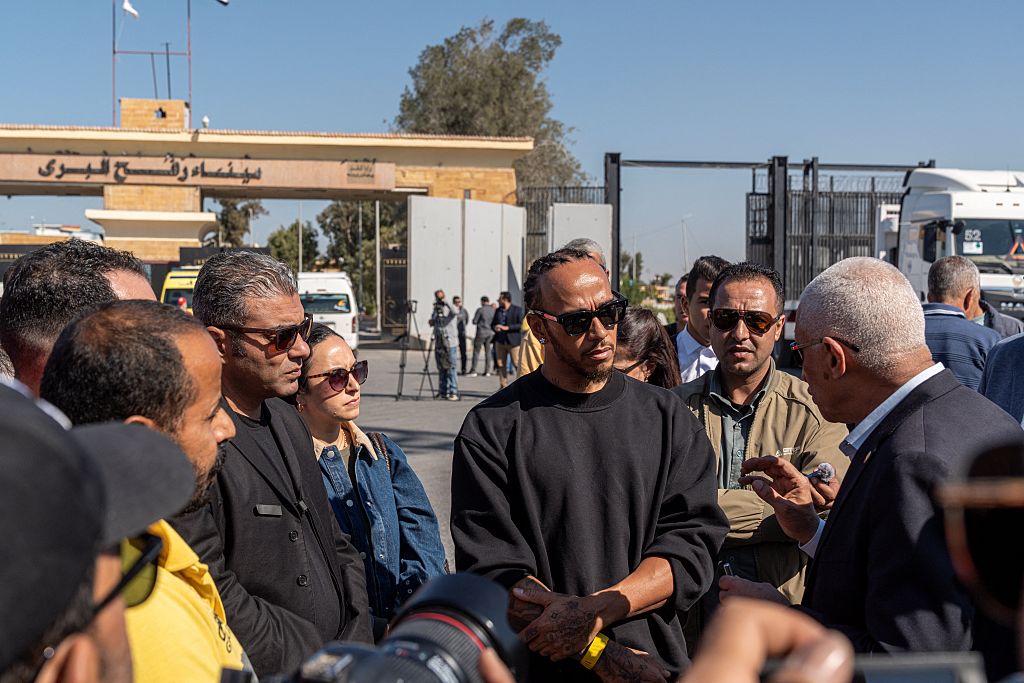
Hamilton also visited the Rafah crossing itself, where he met North Sinai officials and humanitarian personnel. Photographs from the visit showed the Ferrari driver standing with Egyptian Red Crescent workers and listening to briefings about the movement of humanitarian aid. North Sinai Governor Khaled Megawer said the visit was intended to give Hamilton a direct view of Egypt’s role in receiving, organising and preparing assistance for Palestinians.
The visit gave Hamilton an unusually close look at the logistics behind Gaza’s humanitarian supply chain. He described seeing trucks loaded with food waiting near the crossing and said he had been shown warehouses containing essential supplies intended for civilians. According to his account, some materials had faced repeated delays or rejection, including first aid equipment, medical supplies, wheelchairs, sleeping bags and other items needed by people living under extremely difficult conditions.
Hamilton said he found the situation deeply troubling because many of the goods he saw were basic humanitarian items rather than military equipment. He argued that civilians should not be deprived of essential supplies while aid workers and governments already have those goods positioned close to the border. His remarks added the voice of one of the world’s most prominent athletes to growing international pressure over humanitarian access into Gaza.
The Formula One champion has previously spoken publicly about the war and the suffering of Palestinian civilians. During his latest intervention, he described the situation as an injustice and said Palestinians should not be treated as though their lives were worth less than those of people elsewhere. He also referred to Israel’s actions in Gaza as genocide, a characterization Israel strongly rejects and says misrepresents its military campaign against Hamas.
Israel maintains that its military operations are aimed at Hamas and other armed groups and says controls on goods entering Gaza are necessary to prevent weapons or material with potential military use from reaching militants. Israeli officials have also rejected accusations that the government is deliberately withholding humanitarian aid from civilians, arguing that supplies are permitted to enter through approved crossings after security inspections.
Humanitarian organisations and United Nations officials have repeatedly disputed the adequacy of those arrangements. They say the volume of aid entering Gaza remains far below what is required to meet the needs of the population, particularly after years of conflict have destroyed homes, hospitals, water systems, roads and other essential infrastructure. Aid agencies say restrictions on items entering the territory, lengthy inspection procedures and intermittent border closures have repeatedly disrupted the supply chain.
The Rafah crossing has become one of the most politically sensitive points in that system. It connects Gaza directly with Egypt and historically served as an important route for passenger movement, medical evacuation and humanitarian access. Israel seized the Gaza side of the crossing in May 2024, and its operation has since been heavily restricted and periodically changed under ceasefire and security arrangements.
The crossing has at times reopened for limited movement of people, including medical evacuations and approved travellers, but humanitarian cargo entering Gaza has continued to rely heavily on Israeli controlled procedures and the Kerem Shalom crossing. That has meant aid arriving through Egypt can be transported toward Gaza but may still face delays before being admitted into the enclave.
United Nations humanitarian officials have warned that the problem is not merely the amount of aid available internationally but the ability to get those supplies physically into Gaza and distribute them safely. Warehouses may contain food, tents and medical supplies, but those goods have little value to displaced families if they remain outside the territory.
Hamilton’s appeal came at a particularly difficult moment because winter conditions are increasing the urgency of shelter deliveries. Heavy rain has flooded multiple displacement camps across Gaza, sending muddy water through tents and temporary shelters and leaving families struggling to protect mattresses, clothing, food and other possessions.
Images from Gaza show displaced residents wading through water around makeshift tents built from plastic sheeting, fabric and other temporary materials. Many camps were constructed on damaged roads, open land or rubble without proper drainage, making them especially vulnerable when heavy rain falls.
For families who have already been displaced repeatedly during the war, flooding creates another layer of hardship. Tents that provide only limited protection from wind and cold can become uninhabitable once water enters, forcing families to sleep on wet ground or seek shelter in overcrowded buildings.
Children, older people and those with medical conditions are particularly vulnerable during cold and wet weather. Humanitarian agencies have warned that damp shelters, limited heating and overcrowding can contribute to respiratory illnesses and other health problems at a time when Gaza’s medical system remains severely weakened.
The United Nations Office for the Coordination of Humanitarian Affairs has been working with shelter organisations to prepare displacement sites for winter, including drainage improvements, sandbagging and the distribution of plastic sheeting, blankets and winter clothing. However, aid agencies say the scale of need remains far greater than the supplies currently reaching families.
Shelter organisations have also warned that tens of thousands of tents and other winter items remain outside Gaza awaiting approval. UN humanitarian chief Tom Fletcher said the delays were unacceptable and argued that political or administrative uncertainty could not justify preventing essential winter supplies from reaching displaced civilians.
The issue of tents has become especially urgent because many families have been living in temporary shelters for months or years. Canvas and plastic structures deteriorate quickly under strong sun, wind and repeated rain, meaning tents that were initially usable may now provide little protection.
Humanitarian organisations say replacement tents, tarpaulins, blankets, mattresses and insulation materials are therefore essential. Those supplies are not simply about comfort but can reduce the risk of illness and protect children from exposure during colder weather.
Hamilton said the humanitarian facilities he visited contained exactly the kind of materials Gaza urgently needs. His frustration appeared to stem from the contrast between supplies sitting in warehouses and the images of flooded displacement camps just across the border.
The racing driver also said he saw humanitarian trucks waiting without being able to proceed. Trucks carrying food and relief materials have become a recurring symbol of the Gaza humanitarian crisis because long lines of vehicles have repeatedly accumulated near border crossings during periods when access is restricted.
The Egyptian Red Crescent has played a major role in managing those shipments. It receives aid from governments, charities and international organisations and coordinates the movement of supplies through northern Sinai toward Gaza.
Egypt has consistently said it wants humanitarian aid to enter Gaza in much larger quantities and has rejected suggestions that it is responsible for keeping the Rafah crossing closed. Cairo argues that the crossing cannot operate normally without arrangements involving control of the Palestinian side and has opposed any permanent displacement of Palestinians into Egyptian territory.
The status of Rafah has therefore become tied to larger political disputes over Gaza’s future, border control and postwar governance. Israel argues that any border arrangement must prevent weapons smuggling and ensure security, while Egypt wants Palestinian administration restored and has resisted arrangements that could make Israel’s military presence permanent.
Those negotiations have continued alongside ceasefire arrangements and discussions about reconstruction. Humanitarian agencies, however, argue that aid access should not depend on resolving every political dispute.
Their position is that food, medicine, shelter and other essential goods should move regardless of disagreements over Gaza’s long term administration. International humanitarian law requires parties to armed conflicts to facilitate relief for civilians in need, although disputes frequently arise over inspections, security and the definition of prohibited items.
The current humanitarian system remains heavily dependent on Kerem Shalom. OCHA reported that hundreds of humanitarian trucks had been manifested for entry during the final week of October and beginning of November, but not all were successfully offloaded into Gaza.
The United Nations also reported that Israeli authorities notified agencies on November 1 that humanitarian and commercial shipments from Egypt would be suspended with limited exceptions because of alleged smuggling concerns. Aid agencies warned that prolonged suspension could quickly affect food availability and other essential services.
Food programmes are already operating under pressure. Community kitchens have been preparing hundreds of thousands of meals each day, while subsidised bakeries continue producing bread for displaced households and other civilians.
A reduction in incoming supplies could force humanitarian organisations to decrease those operations. The Food Security Sector warned that the number of free cooked meals produced daily could fall substantially if access from Egypt remained restricted.
Bread production could also decline. Wheat flour and fuel are essential to keeping bakeries operating, and interruptions in either can quickly reduce availability.
Food access is especially important because many Gaza households have little or no regular income. Years of conflict and displacement have destroyed businesses, farms and jobs, leaving large numbers of families dependent on humanitarian assistance.
Even where commercial goods are available, prices can be beyond what families can afford. Aid therefore remains critical not only because food may be scarce but because many people no longer have the financial means to purchase sufficient quantities.
Medical supplies face similar constraints. Gaza’s healthcare system has experienced repeated damage to hospitals and clinics while shortages of medicines, equipment and fuel continue to limit treatment.
Hamilton specifically mentioned seeing first aid equipment and other medical supplies among goods waiting to enter. Wheelchairs were also reportedly among the items he was told had faced restrictions, an issue with obvious significance in a population where tens of thousands of people have suffered injuries.
The number of people living with disabilities has increased dramatically during the war. Amputees and patients with serious injuries require mobility equipment, rehabilitation and long term medical support that humanitarian agencies have struggled to provide consistently.
Medical evacuations remain another reason the Rafah crossing matters. Patients requiring treatment unavailable in Gaza have at times been transported through Rafah and Kerem Shalom before continuing to hospitals in Egypt or other countries.
OCHA reported that more than 100 patients, including dozens of children, were medically evacuated during a recent reporting period. Thousands of other patients are believed to require specialised care outside Gaza.
The crossing therefore affects both incoming humanitarian supplies and the movement of patients. When access is restricted, people requiring advanced surgery, cancer treatment or other specialised care can face lengthy delays.
Hamilton’s visit brought unusual global attention to these logistics. Formula One has a worldwide audience, and Hamilton is among the most recognisable athletes of his generation.
His intervention therefore reaches people who may not follow daily humanitarian reporting from Gaza. Athletes and other celebrities can sometimes amplify humanitarian issues far beyond the audiences reached by official UN statements.
Hamilton has used his platform on social and political issues throughout his career. He has spoken publicly about racism, inequality, human rights, education and environmental issues, often taking positions beyond the traditional boundaries of professional sport.
He founded Mission 44 in 2021 to expand opportunities for young people, particularly those facing inequality in education and employment. His humanitarian advocacy has increasingly included children affected by conflict.
Hamilton has previously posted messages about children killed in Gaza and called for peace and ceasefire arrangements. His visit to Egypt represents a more direct form of engagement because he travelled to the border region and met the humanitarian workers handling aid.
The decision also came shortly after he reached another major milestone in his racing career. Hamilton recently made his 400th Formula One start, becoming only the second driver in the sport’s history to reach that number after Fernando Alonso.
Despite his ongoing Formula One commitments, he used the period after the Sao Paulo Grand Prix to travel to Egypt and visit the Rafah humanitarian operations. That timing further increased attention around the trip.
Hamilton currently races for Ferrari after his long and highly successful career with Mercedes. He has won seven world championships, tying Michael Schumacher’s record, and remains one of the most famous drivers Formula One has ever produced.
His comments could therefore generate political reaction beyond sport. Supporters of Palestinian humanitarian advocacy welcomed his willingness to speak publicly, while critics of his characterization of Israel’s actions may challenge his language or accuse him of oversimplifying the conflict.
The most important distinction is between Hamilton’s personal political characterization and the underlying humanitarian facts. His use of the term genocide represents his own view, while the legal and political dispute over that term remains contested.
The humanitarian crisis itself is documented extensively by the United Nations and international aid organisations. Large numbers of Palestinians remain displaced, shelter conditions are inadequate and access to food, medicine and other essential goods continues to depend heavily on border arrangements.
Israel has repeatedly rejected accusations that it intentionally seeks to starve or collectively punish Gaza’s population. It says it allows humanitarian aid to enter and blames Hamas and other factors for some distribution problems.
UN agencies have repeatedly said the quantities and consistency of aid remain insufficient and have called for fewer restrictions, more crossing points and safer distribution conditions.
That disagreement has persisted throughout the war and has become central to international diplomatic pressure on Israel. Governments and humanitarian organisations have repeatedly argued that civilian aid must move at a scale consistent with the needs of Gaza’s population.
The severe weather has made those calls more urgent. Winter rains can transform displacement areas within hours because many camps lack drainage and solid foundations.
Residents often dig channels around tents or build makeshift barriers from sandbags and debris in an attempt to keep water out. Those measures provide limited protection during heavy storms.
When tents flood, families may lose blankets, mattresses and food stored inside. Wet bedding is difficult to dry when there is little electricity and limited access to heated indoor spaces.
Children can spend nights in damp clothing while temperatures fall. Parents already struggling to find food and clean water must then try to replace damaged shelter materials.
The humanitarian consequences extend beyond immediate discomfort. Standing water can increase sanitation problems, particularly where sewage systems have been damaged.
Floodwater can mix with waste and contaminated material, increasing the risk of disease. Gaza’s water and sanitation infrastructure has been badly weakened by the conflict, leaving humanitarian agencies concerned about outbreaks.
Displaced people are also frequently living in very crowded conditions, making infectious diseases easier to spread. Respiratory illnesses become more common during cold weather, particularly among children.
Hospitals and clinics may struggle to manage additional seasonal illness while continuing to treat war related injuries and chronic conditions. Medical supply restrictions therefore become even more consequential during winter.
The humanitarian agencies working in Gaza have attempted to prepare for these conditions by distributing winter clothing, plastic sheets, blankets and repair kits. OCHA reported recent distributions of tens of thousands of plastic sheets and thousands of winter clothing kits.
Those efforts have helped individual families but cannot meet the entire need. The number of displaced people remains extremely large, and many shelters require repeated replacement or repair.
Aid groups say sufficient stocks exist outside Gaza to expand the response significantly if access improves. That is the central point Hamilton highlighted after seeing the warehouses in Egypt.
His appeal was essentially that the international community should not accept a situation where humanitarian goods are available only kilometres away while civilians inside Gaza remain exposed to rain, hunger and medical shortages.
Hamilton also urged people not to become numb to the suffering. He said the length of the conflict should not make civilian hardship appear normal or inevitable.
That message reflects a concern shared by many humanitarian organisations. Long running crises can gradually receive less public attention even when conditions remain severe.
Aid funding can decline as political attention shifts elsewhere, leaving relief agencies with fewer resources just as communities become increasingly dependent on assistance.
OCHA has already reported funding constraints affecting the quantity of humanitarian cargo available for Gaza. Even where border access improves, aid operations require sufficient financial support to purchase and transport supplies.
The humanitarian crisis therefore involves multiple overlapping constraints. Supplies must be funded, purchased, transported to the region, inspected, admitted across borders and then safely distributed inside Gaza.
Problems at any stage can reduce what ultimately reaches families. Hamilton’s visit focused particularly on the border stage because he saw aid that had already been assembled but remained outside the enclave.
Israel says inspection procedures are required to prevent materials from being diverted to Hamas or used for military purposes. Humanitarian organisations argue that restrictions have sometimes extended to items whose civilian purpose is obvious.
Hamilton’s reference to wheelchairs, sleeping bags and children’s footballs reflected that frustration. He said some of the explanations he heard for why items were prevented from entering did not make sense to him.
Israel has not publicly responded in detail to every item Hamilton mentioned. Its broader position remains that humanitarian goods must comply with security rules.
The issue of dual use goods has been particularly contentious. Items that can theoretically have both civilian and military applications may face additional scrutiny or restrictions.
Aid organisations argue that overly broad interpretations can block essential infrastructure and medical equipment. They have called for clearer, faster and more predictable approval procedures.
Rafah remains symbolically important because it is Gaza’s only crossing that does not directly connect the territory with Israel. For Palestinians, it has historically represented a route to the wider Arab world through Egypt.
Control of the crossing therefore has political significance beyond aid logistics. Its closure or restricted operation affects questions of sovereignty, movement and Gaza’s relationship with neighbouring countries.
Egypt has been reluctant to open the crossing unilaterally under conditions it believes could facilitate permanent Palestinian displacement. Cairo has repeatedly said Palestinians should remain on their land and that humanitarian access should not become a mechanism for forcing civilians into Egypt.
Israel has said security control is necessary because of concerns about weapons smuggling and armed groups. Those competing positions make a full reopening politically complicated.
Hamilton’s statement simplifies the humanitarian demand by focusing on the immediate result rather than the diplomatic architecture. He wants aid that is already in Egypt to reach people in Gaza as quickly as possible.
That message is likely to resonate particularly strongly during the current winter flooding. Images of tents surrounded by muddy water create a visible contrast with warehouses filled with shelter and relief supplies.
Whether his intervention changes government policy is uncertain. High profile public statements can increase pressure but border decisions remain controlled by governments, security agencies and diplomatic agreements.
Nevertheless, celebrity advocacy can influence public attention and help humanitarian organisations maintain international focus on conditions that might otherwise receive less coverage.
Hamilton’s involvement also demonstrates the increasingly global nature of humanitarian activism around Gaza. Athletes, musicians, actors and other public figures have taken public positions throughout the conflict.
Some have called for ceasefires and expanded aid access, while others have emphasised Israel’s security concerns and the release of hostages. These interventions often generate intense political debate because the conflict remains deeply polarising.
Hamilton’s message was firmly focused on Palestinian civilian suffering. His comments contained no detailed policy proposal beyond reopening or expanding aid access and ensuring supplies move through Rafah.
The immediate humanitarian case for greater access is supported by current UN reporting. Gaza continues to require food, shelter, medical supplies and winter protection at a scale humanitarian agencies say current deliveries do not meet.
The rains have made shelter one of the most urgent priorities. Flooded camps show how vulnerable displaced people remain even during periods when the intensity of major combat has decreased.
A ceasefire can reduce bombing and fighting, but it does not automatically rebuild homes or restore water and sanitation systems. Humanitarian needs often remain severe long after major combat operations slow.
Reconstruction will take years and require large quantities of construction materials, machinery and financial assistance. In the meantime, hundreds of thousands of people may continue living in temporary accommodation.
That reality means humanitarian border access will remain important even if the ceasefire holds. Food, medicine and shelter supplies will continue to be needed while homes and infrastructure are rebuilt.
Hamilton’s visit therefore comes at a moment when Gaza is moving from one type of emergency into another. The immediate danger of active warfare remains, but the long term challenges of displacement, winter weather, destroyed infrastructure and economic collapse are becoming increasingly important.
For humanitarian workers in Egypt, the frustration is that many of the goods required to address those problems are already physically close to Gaza. The challenge is getting them across the border consistently and in sufficient quantities.
Hamilton said his experience at Rafah left him convinced that international pressure was necessary. He urged governments and the public to work together to make sure aid reached those who needed it.
The appeal places the Formula One champion alongside UN officials, aid agencies and international organisations calling for faster humanitarian access. It also reinforces his willingness to use his sporting profile for political and humanitarian causes.
For the displaced families living through Gaza’s winter storms, however, the significance of the visit will ultimately depend on whether conditions at the border change. Statements and photographs can draw attention, but families need tents, blankets, food, medicine and working sanitation systems.
The humanitarian question is therefore practical rather than symbolic. Supplies must cross the border and reach the people living in flooded camps.
Hamilton’s visit has helped place that issue before a global audience. After walking through aid warehouses and standing at the Rafah crossing, he left Egypt with a simple message that the assistance waiting there should not remain on the other side of the border while Palestinians continue struggling without it.
As winter conditions deteriorate, that argument is likely to become even more urgent. Gaza’s displaced population is facing rain, cold, damaged shelter and continuing shortages, while humanitarian organisations say large quantities of relief remain ready for delivery.
Hamilton’s intervention will not resolve the political disputes surrounding Rafah, but it has added another influential voice to the demand that humanitarian access be expanded immediately. For families living in waterlogged tents and damaged buildings, the question is no longer whether aid exists. It is whether those controlling the border will allow enough of it to reach them before winter conditions become even more dangerous.