TINUBU RAISED THREE HANDS IN IBADAN AND STAKED HIS HOME REGION ON THEM. IN 2027, THE SOUTH-WEST WILL DECIDE WHETHER THE PRESIDENT STILL CONTROLS HIS OWN BACKYARD
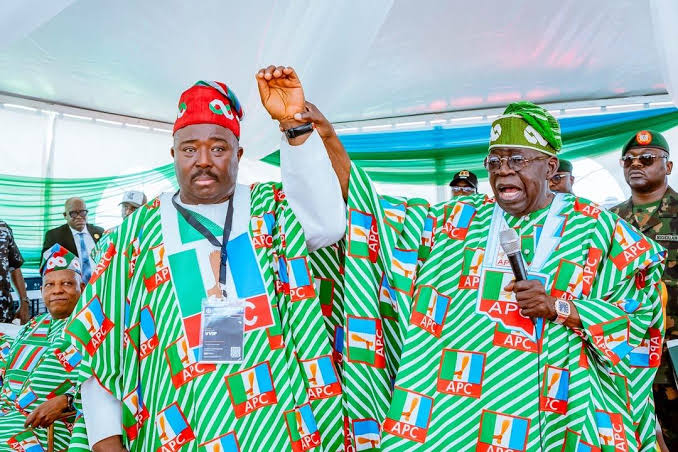
Mapo Hall is not a neutral stage. The colonial-era building sits on a hill in the heart of old Ibadan, its white columns looking down over one of the largest cities in Africa. For generations, it has been where power in Oyo State comes to be seen. On Saturday, President Bola Tinubu used it to send a message to the entire South-West. He did not hedge. Standing before APC supporters, Tinubu lifted the hands of three men, one after another, in the gesture that Nigerian voters know well. "The governor you will vote for, I will show you," he said, before presenting Senator Sharafadeen Alli to the crowd as the party's choice for Oyo State. He did the same for Senator Solomon Adeola, known across Ogun and Lagos as Yayi, the APC candidate in Ogun. Then he raised the hand of Obafemi Hamzat, the Lagos deputy governor and the party's candidate to succeed Babajide Sanwo-Olu. He also endorsed Remi Oseni, the APC's senatorial candidate for Oyo South. In the days since, APC leaders in Lagos, Ogun and Oyo have been regrouping and intensifying mobilization. Their task is to turn a presidential blessing into votes at the ward level. At the same time, seven opposition parties — the PDP, ADC, Labour Party, Nigeria Democratic Congress, SDP, APM and YPP — are working to shore up their own chances in the same three states. Opposition figures have dismissed the endorsements and insist the ruling party will be beaten. That sets up one of the most consequential regional contests of the 2027 cycle. It is not only about who governs Nigeria's commercial capital, its industrial corridor and its most populous South-West state. It is about whether the man who has dominated South-West politics for a quarter of a century can still deliver his own home region while sitting in Aso Rock.
Mapo Hall is not a neutral stage. The colonial-era building sits on a hill in the heart of old Ibadan, its white columns looking down over one of the largest cities in Africa. For generations, it has been where power in Oyo State comes to be seen. On Saturday, President Bola Tinubu used it to send a message to the entire South-West.
He did not hedge. Standing before APC supporters, Tinubu lifted the hands of three men, one after another, in the gesture that Nigerian voters know well. "The governor you will vote for, I will show you," he said, before presenting Senator Sharafadeen Alli to the crowd as the party's choice for Oyo State. He did the same for Senator Solomon Adeola, known across Ogun and Lagos as Yayi, the APC candidate in Ogun. Then he raised the hand of Obafemi Hamzat, the Lagos deputy governor and the party's candidate to succeed Babajide Sanwo-Olu. He also endorsed Remi Oseni, the APC's senatorial candidate for Oyo South.
The gesture lasted seconds. Its political meaning will last until the ballots are counted.
In the days since, APC leaders in Lagos, Ogun and Oyo have been regrouping and intensifying mobilization, according to reports. Their task is to turn a presidential blessing into votes at the ward level. At the same time, seven opposition parties, namely the PDP, ADC, Labour Party, Nigeria Democratic Congress, SDP, APM and YPP, are working to shore up their own chances in the same three states. Opposition figures have dismissed the endorsements and insist the ruling party will be beaten.
That sets up one of the most consequential regional contests of the 2027 cycle. It is not only about who governs Nigeria's commercial capital, its industrial corridor and its most populous South-West state. It is about whether the man who has dominated South-West politics for a quarter of a century can still deliver his own home region while sitting in Aso Rock.
To understand why Saturday mattered, start with the three names Tinubu chose.
Obafemi Hamzat is, in many ways, the most predictable pick. He has served as deputy governor of Lagos since 2019, alongside Sanwo-Olu. Before that, he held senior cabinet posts under former Governor Babatunde Fashola, including the commissioner portfolio for works and infrastructure. He has spent most of his public career inside the Lagos governing system that Tinubu designed when he was governor from 1999 to 2007. In 2018, Hamzat was among the aspirants for the APC governorship ticket before stepping aside to become Sanwo-Olu's running mate. That decision, widely seen as a show of party discipline, positioned him as a natural successor. His candidacy represents continuity: the same machine, the same networks, the same governing philosophy.
Solomon Adeola is a different kind of candidate. Yayi built his political profile in Lagos, where he served in the state House of Assembly and later represented Lagos West in the Senate. In 2023, he moved his Senate base to Ogun West, the district of his roots, and won. In the current Senate, he has chaired the powerful Appropriations Committee, a position that places him close to the budget process and the center of federal power. His candidacy in Ogun carries a regional message. Ogun West, home largely to the Yewa and Awori peoples, has long complained that it has been denied the state's top job. The "Ogun West agenda" has been a recurring theme in the state's politics. By backing Yayi, Tinubu and the APC appear to be embracing that agenda, or at least trying to profit from it.
Sharafadeen Alli is the boldest bet of the three. He represents Oyo South in the Senate and now carries the APC's hopes in a state the party lost in 2019 and failed to recover in 2023. Oyo is governed by Seyi Makinde of the PDP, who is completing his second and final term. Alli's job is not to defend a seat. It is to take one. That is why Tinubu presented him first at Mapo Hall, with the most emphatic words of the day. The President chose to stage the rally in Ibadan, not Lagos or Abeokuta. That choice signaled where he believes the real fight lies.
The endorsement of Remi Oseni for Oyo South adds another layer. Alli's Senate seat will become vacant if he runs for governor, and the APC wants to hold it. By backing Oseni from the same stage, Tinubu tied the Senate race to the governorship race, encouraging voters to treat them as a single package.
Why would a sitting president invest so much personal capital in three governorship contests?
The answer lies in the nature of Tinubu's power. Unlike most Nigerian presidents before him, Tinubu did not rise mainly through the military, the civil service or a national party machine. He rose through a regional political empire. After his time as Lagos governor, he built a network of loyal successors, lawmakers, commissioners, local government chairmen and party officials. In 2007, he backed Fashola, his chief of staff, as governor. When the old Action Congress of Nigeria spread across the South-West around 2010 and 2011, Tinubu was widely regarded as its leading strategist. In 2013, he was among the architects of the merger that produced the APC. In 2015, his support in the South-West helped deliver Muhammadu Buhari to the presidency.
That network gave him leverage. It also earned him the title critics and admirers both use: political godfather. In the South-West, the phrase "Jagaban" became shorthand for a figure whose nod could make or break a career.
The record shows that this power was real, but never absolute. In 2018, Tinubu's camp withdrew support from Governor Akinwunmi Ambode, who had fallen out with key figures in the Lagos APC establishment. Ambode lost the party primary to Sanwo-Olu and became the first elected Lagos governor since 1999 denied a second term. The episode proved that, within the Lagos APC, Tinubu's influence could end a sitting governor's career. Yet beyond Lagos, his reach has had limits. The APC lost Oyo in 2019 to Makinde. It lost Osun to the PDP's Ademola Adeleke in 2022. In Ekiti and Ondo, outcomes were shaped as much by local alliances and power brokers as by any single endorsement.
Then came 2023.
Tinubu won the presidency, but Lagos delivered a stunning rebuke. In the presidential election, Labour Party's Peter Obi won Lagos State, narrowly edging Tinubu in the city he had governed for eight years. The margin was small, but the symbolism was enormous. A wave of young, urban, middle-class and largely online voters, energized by Obi's campaign and frustrated by economic hardship, had broken through in the heart of Tinubu's empire. The result also fed bitter claims and counterclaims about ethnic tension, voter intimidation and the conduct of polling in parts of Lagos, many of which were never conclusively resolved.
The governorship election a few weeks later went the APC's way, with Sanwo-Olu re-elected and Labour Party's Gbadebo Rhodes-Vivour finishing second. But the presidential result left a lasting question mark. If Tinubu could lose Lagos while running for president himself, how secure is his machine without him on the governorship ballot?
That question is why Saturday's endorsements carry personal risk. In 2027, Tinubu is expected to seek a second term. Any setback in Lagos, Ogun or Oyo would be read nationally as a sign of weakness at home. A loss in Lagos would be especially damaging. It would suggest that the political structure he spent decades building can no longer guarantee its own survival. A loss in Ogun, his home state by family ties and the place where he famously declared "Emi lo kan" ("It is my turn") in Abeokuta in 2022, would sting just as much. A win in Oyo, on the other hand, would allow him to claim that his influence has grown, not shrunk, in office.
In other words, Tinubu is not only campaigning for three candidates. He is campaigning for his own reputation as the master of South-West politics.
What does a presidential endorsement actually mean in Nigeria?
On the surface, it is a simple gesture. In practice, it is a signal to several audiences at once. To party members, it settles internal debates and tells aggrieved aspirants that the decision is final. To financiers and business interests, it indicates where resources should flow. To traditional rulers and religious leaders whose blessings are sought before every major campaign, it signals that the presidency's weight is behind a particular candidate. To state and local government officials who control the administrative machinery used during elections, it communicates whose orders carry the most authority. And to ordinary voters, it is a cue, though not a command. Many vote their conscience, their pocket or their community ties over any president's raised hand.
The last point is worth stressing. The history of presidential endorsements in Nigeria is littered with failures. Former President Goodluck Jonathan campaigned vigorously in Edo State ahead of the 2016 governorship election, but the PDP's Osagie Ize-Iyamu still lost to Adams Oshiomhole. In 2019, President Muhammadu Buhari endorsed APC candidates in state after state, yet the opposition won Oyo, Adamawa, Benue and several other contests. Even Tinubu himself, in 2022, could not stop the Osun governorship from falling to Adeleke. These examples do not prove that presidential endorsements are worthless. They prove that an endorsement is a starting point, not a finishing line. It opens doors and loosens purse strings. It does not close ballots.
That reality shapes the challenge each of the three candidates now faces.
In Lagos, Hamzat inherits one of Africa's most elaborately structured state political machines. The Lagos APC has decades of experience in mobilizing voters, mapping polling units, coordinating local government structures and deploying resources. It has rarely lost a statewide election since 1999. But the 2023 results showed that mobilization alone cannot overcome a generational shift in voter sentiment. The same young, economically frustrated voters who backed Obi in 2023 have not suddenly become content. If anything, the removal of the petrol subsidy, which Tinubu announced on his first day in office, hit Lagos residents hard. Transport costs rose sharply. Food prices followed. Many young Lagosians who once dismissed partisan politics have become far more politically engaged, and many of them are not engaged in the APC's favor.
Hamzat's campaign will need more than loyalty. It will need a compelling answer to the most basic question Lagos voters are asking: what has the APC done for my daily life, and what will it do next? Pointing to infrastructure projects, the Blue and Red Line rail networks, the Eko Bridge and Third Mainland Bridge repairs and the expansion of the Lekki corridor, may work for some. It may not work for the resident of Bariga, Surulere or Ajegunle who still spends four hours a day commuting, whose neighbourhood floods every rain season, and whose generator fuel costs have doubled since the subsidy was removed.
In Ogun, Yayi faces a different set of complications. The state has long had three dominant zones with distinct interests: Ogun Central, home to the state capital Abeokuta and the Egba people; Ogun East, the Ijebu heartland; and Ogun West, the Yewa-Awori zone. Governors since the return to democracy in 1999 have come predominantly from the first two. The Yewa and Awori communities have harbored a sense of political exclusion. Yayi, as a son of Ogun West, would be the first governor from that zone, if elected. That carries real emotional weight. Many in the zone see it as long-overdue fairness. But a candidacy built heavily on zone sentiment must still win across the whole state. Some Egba and Ijebu voters may resist the change, especially if they see it as sidelining their own ambitions for the governorship. The internal APC reconciliation work in Ogun will be just as important as the battle against the opposition.
Ogun also has a credible opposition field. The PDP and other parties have candidates with roots in the state. Governor Dapo Abiodun, the outgoing APC governor completing his second term, has had a complicated relationship with the Tinubu camp at various points. How much of Abiodun's machinery Yayi can fully inherit, and whether any grievances from that internal history resurface during the campaign, remains to be seen.
In Oyo, the contest is the starkest.
Seyi Makinde is a singular figure in the opposition's South-West story. He beat the APC in 2019 when most of the region was going the other way. He won re-election in 2023 more convincingly. He has built a reputation as a relatively independent, competent governor who invested in road construction and education. His administration has had its critics and controversies, but he leaves office, when his second term ends, as one of the PDP's strongest performers in any state. His successor will inherit whatever goodwill he has accumulated, and also his rivalries.
The PDP's candidate in Oyo is not yet the story, since the party's primaries lie ahead. But the broader opposition coalition in the state, including PDP loyalists, aggrieved APC defectors and supporters of newer parties, has a proven track record of defeating the APC there. Alli's candidacy must overcome that history, the structural advantage of an incumbent party's machinery even without Makinde on the ballot, and the deeply embedded voter loyalties in Ibadan, Ogbomosho and other strongholds.
That said, an open governorship race is an opportunity. The absence of an incumbent on any ballot changes the dynamics. Voters who backed Makinde because they knew and trusted him personally may not transfer that loyalty automatically to whoever the PDP chooses. If the opposition primary produces a divisive outcome or a candidate with significant weaknesses, the APC has a real chance. Tinubu's choice to stage the rally in Ibadan was itself a statement: the APC is not conceding Oyo. It is fighting for it.
The seven opposition parties named in the story span a wide ideological and strategic range, and that breadth is both a strength and a weakness.
The PDP brings the most established opposition network in the South-West, with a serving governor in Oyo and a long history in Ogun. But the PDP is also Nigeria's most internally fractured major party, prone to primaries that leave deep wounds. Labour Party, which performed strongly in the 2023 presidential vote in Lagos and among urban youth across the country, could be a factor in state races if it recruits candidates capable of building on that momentum. The other parties named, the ADC, Nigeria Democratic Congress, SDP, APM and YPP, are smaller, though several have served as platforms for defectors from the APC and PDP and have surprised observers in state contests before.
The challenge for the opposition is coordination. If the seven parties each field a candidate in every race, they will almost certainly split their vote and gift the APC victories it might not otherwise win. If some of them agree to back a single candidate against the APC in key contests, they become far more competitive. That kind of alliance-building is notoriously difficult in Nigerian politics. Personal ambitions, financial interests, ethnic calculations and party pride all work against it. Some of the most promising opposition coalitions have collapsed weeks before an election when candidates refused to step aside.
For now, opposition figures have stuck to confident public statements. After the Ibadan rally, PDP and Labour Party sources were quoted dismissing the presidential endorsements as the panic of a party that cannot win on its performance record alone. They said voters would judge the APC on the economy, not on who the president raised his hand for. That message may resonate with the same urban voters who punished the APC in 2023. It is also a gamble. Performance-based campaigns require a credible alternative vision, not just a critique. Voters who are angry at the APC also need to be convinced of what the opposition will do differently. That case has not yet been made in full.
There is a wider national context to what is unfolding in the South-West.
The 2027 general elections will be the first full electoral test of Tinubu's presidency. The economic record is mixed. The removal of the petrol subsidy and the unification of the exchange rate were economically necessary, in the judgment of most independent analysts, but their short-term pain has been real and widespread. Inflation remains above where most Nigerians would like it. Food prices are still high. The naira has strengthened from its worst levels but is now under renewed pressure as Christmas and election-season dollar demand build. Some infrastructure projects are advancing, and foreign investment interest has picked up in certain sectors. But the growth has not yet translated into a broadly felt improvement in living standards for most of the population.
That economic context will hang over every governorship race, in the South-West and elsewhere. Governors aligned with Tinubu must run on a record that includes policies their state residents associate with economic hardship. The APC will argue that the pain is temporary and that the reforms will ultimately deliver prosperity. The opposition will argue that the people cannot afford to wait any longer. Both sides will be tested by how voters who live that reality respond.
The APC's decision to hold the rally at Mapo Hall also carried a message beyond the endorsements themselves. It was an assertion of dominance in the opposition's territory, a deliberate signal that the ruling party is confident enough to march into Ibadan and claim the South-West's most symbolic hill. That confidence may be real, or it may be a performance designed to demoralize opponents and impress wavering allies. In Nigerian politics, the two are often indistinguishable.
What happens next will reveal which.
In the weeks and months ahead, watch for three things. First, the opposition primaries. How the PDP, Labour Party and others in the South-West select their governorship candidates will shape the electoral map. A unified, credible opposition field could make all three states genuinely competitive. A divided one could hand Tinubu the victories he needs. Second, the ward-level mobilization. Presidential endorsements are announcements. Ward-level structures, local government networks and unit-by-unit voter registration and turnout drives are what actually decide state elections. The APC's depth in this area in Lagos is unmatched. In Ogun and Oyo, it is less certain. Third, the economic trajectory. If inflation eases meaningfully and voters begin to feel tangible economic improvement in the first half of 2027, the APC's campaign becomes easier. If hardship persists or deepens, no endorsement, however dramatic, will be enough to override the judgment voters make at the booth.
For now, the South-West is a contested political battleground at a level it has not been in years. The APC has a sitting president, three publicly chosen candidates and the institutional resources of a ruling party behind it. The opposition has seven parties, the memory of 2023 in Lagos and Oyo, a credible record of defeating the APC in this region before, and an economic story it believes will resonate with voters.
Tinubu raised three hands at Mapo Hall on Saturday. The question for the next eighteen months is whether the people of Lagos, Ogun and Oyo will raise those same hands in agreement, or whether they will decide that this time, the choice is theirs to make.