MACRON FACES FRESH STREET PRESSURE AS STUDENTS, UNIONS AND YELLOW VESTS MOBILISE ACROSS FRANCE OVER SOARING COSTS, PUBLIC SERVICES AND INEQUALITY
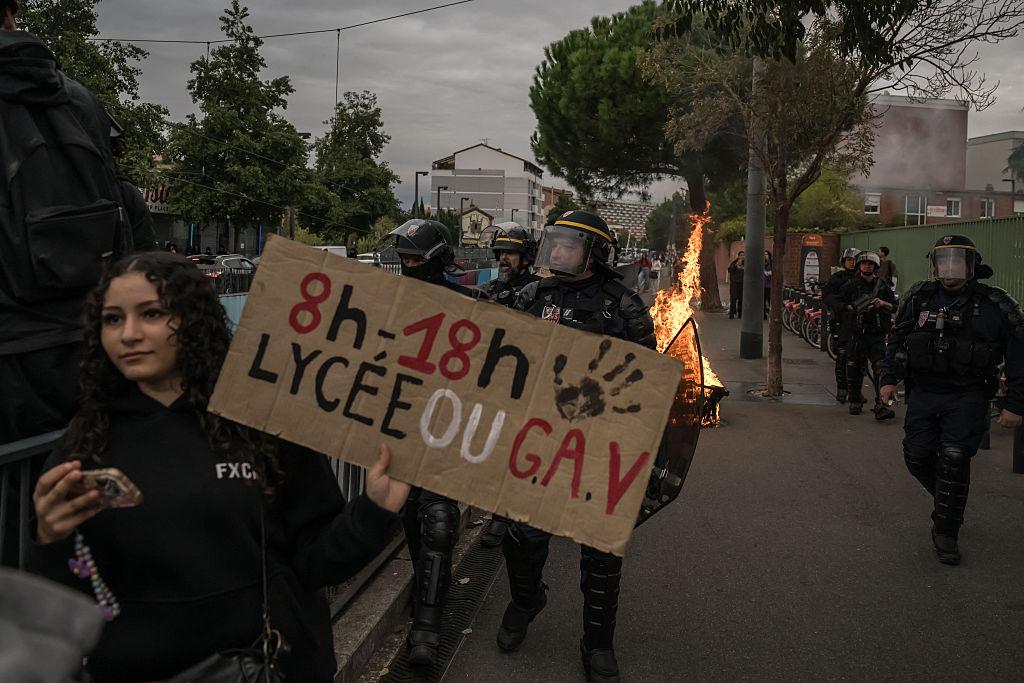
Students, trade union members and Yellow Vest activists are taking part in nationwide demonstrations across France over rising living costs, deteriorating public services and inequality. The mobilization grew out of weeks of student protests over teacher shortages, overcrowded classrooms and poor school facilities. Hundreds of actions were planned for October 17, with a heavy police presence deployed as authorities warned of possible violence. More than 900 police officers have been injured during recent unrest, while several serious injuries to young protesters have also triggered investigations into alleged police violence.
France is facing another major wave of street protests as students, trade union members and activists associated with the Yellow Vest movement mobilize across the country over rising living costs, deteriorating public services, education problems and widening economic inequality, placing fresh pressure on President Emmanuel Macron during the final stretch of his presidency. Tens of thousands of demonstrators were expected to take part in marches, rallies and road blockades on Saturday, October 17, with hundreds of actions planned nationwide and a heavy police presence deployed in Paris and other major cities amid government concerns that some demonstrations could descend into violence. What began several weeks ago as a student revolt over teacher shortages, overcrowded classrooms and deteriorating school facilities has now developed into a much broader expression of frustration involving workers, trade unions and veterans of the Yellow Vest protests that shook France during Macron’s first presidential term.
By Saturday morning, protesters had begun taking to the streets in several parts of France, meaning the demonstrations were no longer merely an anticipated mobilization. Reuters reported activity including marches and roadblocks as different groups attempted to turn weeks of student unrest into a nationwide protest against what they describe as a worsening social and economic climate. Authorities had been preparing for the possibility of a substantial turnout, although the final national attendance figures were not yet available at the time of reporting. The demonstrations bring together groups whose complaints are not identical but increasingly overlap around one central concern: many French citizens believe they are paying more while receiving less from public institutions that once formed the foundation of the country’s social model.
The latest movement began in French high schools, particularly in poorer northern suburbs of Paris, where students initially protested teacher absences, overcrowded classes, ageing school buildings and shortages of basic resources. Those demonstrations expanded rapidly, spreading across cities and drawing in teachers, parents and university students. What began as an argument about conditions inside classrooms soon widened into broader criticism of public spending, inequality and the cost of living. For many young protesters, the state of the education system became a symbol of what they see as a larger decline in public services and opportunities available to ordinary families.
That anger has now converged with a separate but related strain of discontent that has existed in France for years. Trade unions are joining the October 17 mobilization, while activists connected to the Yellow Vest movement have used social media and local networks to encourage former protesters to return to the streets. The Yellow Vests first emerged in 2018 in opposition to planned increases in fuel taxes before rapidly evolving into a nationwide movement against the cost of living, taxation and the perception that political elites in Paris were disconnected from the financial pressures faced by working and lower income households.
The original Yellow Vest demonstrations became one of the defining political crises of Macron’s presidency. Protesters wearing the fluorescent safety vests required in French vehicles occupied roundabouts, blocked motorways and organized weekly marches across the country. Some protests turned violent, particularly in Paris, where shops were looted, vehicles were burned and the Arc de Triomphe was damaged. Macron eventually introduced billions of euros in tax reductions and other concessions in an attempt to calm the movement, and the large weekly demonstrations gradually declined.
Eight years later, however, some of the economic complaints that helped create the Yellow Vest movement have returned to the Centre of French political debate. Fuel prices are once again a major grievance, alongside food, housing and other everyday expenses. One veteran Yellow Vest activist interviewed ahead of Saturday’s demonstrations pointed out that petrol cost around €1.40 per liter when he joined the movement in 2018, compared with approximately €2.20 now. That comparison has become symbolic of the frustration felt by households who say wages and public support have not kept pace with the rising cost of essential goods.
The current mobilization differs from the original Yellow Vest uprising because it is not controlled by one organization or built around a single issue. Instead, it brings together a loose coalition of students, workers, union members, pensioners and grassroots activists with a wide range of complaints. Education, health services, purchasing power, fuel costs, public spending, policing and inequality all appear prominently in the demonstrations. That diversity could increase turnout, but it also makes the movement difficult to define and potentially harder for the government to negotiate with because there is no single leadership capable of speaking for everyone involved.
French authorities were preparing for hundreds of demonstrations, gatherings and other forms of protest across the country. Sources close to the Interior Ministry indicated that roughly 500 actions and around 90 formal demonstrations had been anticipated ahead of Saturday’s mobilization. Other organizers and Yellow Vest networks publicized meeting points in cities including Paris, Bordeaux, Lille, Lyon, Marseille, Toulouse, Nantes, Strasbourg, Rennes, Montpellier and several others, making clear that the intention was to create national rather than isolated local pressure.
Paris has been placed under particularly heavy security. Authorities are determined to prevent protesters from reaching some of the capital’s most politically and symbolically sensitive locations, including the Champs Élysées and the Arc de Triomphe. Those sites became scenes of some of the most dramatic clashes during the original Yellow Vest movement, and police are keen to avoid a repeat of the images that travelled around the world showing fires, damaged businesses and fighting near one of France’s most recognizable monuments.
The government has said peaceful protest will be protected while warning that violence, destruction and attempts to block critical infrastructure will not be tolerated. Macron called for calm ahead of the demonstrations, saying the right to protest must exist alongside respect for people and property. The statement reflected the difficult position facing the French government. Authorities cannot simply suppress demonstrations protected under democratic rights, but recent weeks have already produced violent confrontations that have increased pressure on the government to restore order.
Prime Minister Sébastien Lecornu has described the political atmosphere as one of near permanent crisis, citing wars abroad, inflation and concerns surrounding purchasing power. He has also warned that the student movement has increasingly been accompanied by what he described as urban violence. Government officials fear that organized groups may use otherwise peaceful marches as an opportunity to attack police, damage property or provoke confrontations.
Those warnings are not occurring in a vacuum. More than 900 police officers and gendarmes have been injured since the latest protest cycle began, according to government figures. Lecornu said this week that 937 members of the security forces had suffered injuries during the unrest. The government has also recorded injuries among students and education workers, highlighting the scale of the clashes that have accompanied some demonstrations.
Police tactics have themselves become one of the major sources of anger driving the protests. French law enforcement agencies face mounting scrutiny over allegations of excessive force during student demonstrations. Several particularly serious injuries have generated national outrage. In one case, a teenager reportedly lost a hand after picking up a police stun grenade. Another young protester allegedly suffered a severe eye injury after being struck during a confrontation with police. The circumstances of individual incidents remain under investigation.
Interior Minister Laurent Nuñez told lawmakers that dozens of investigations into alleged police violence had been opened. Some involve serious injuries while others concern alleged assaults, insults or other misconduct. The government temporarily suspended the use of certain stun grenades during student protests following the most serious injuries, but Nuñez said ahead of the October 17 mobilization that police could use a broad range of intermediate weapons if serious urban violence developed.
His comments have intensified criticism from protest groups who believe police tactics have contributed to escalating tensions. Some Yellow Vest organizers said volunteer medical teams were preparing to accompany demonstrators because they feared further injuries. Rights groups and opposition politicians have also called for restraint from law enforcement.
Police unions, however, argue that officers themselves have been placed in increasingly dangerous situations. Alliance Police Nationale, one of France’s major police unions, has accused the government of issuing contradictory instructions and failing to provide officers with clear rules for dealing with violent groups. The union announced plans to file a complaint against the state for allegedly endangering police personnel, demonstrating that dissatisfaction is not confined to the protesters facing officers on the streets.
The government has also accused the hard-left France Unbowed party of inflaming unrest through its rhetoric. France Unbowed rejects the accusation and says it supports legitimate protest against inequality and police violence. Party leader Jean-Luc Mélenchon has strongly criticised the government’s policing strategy while publicly supporting student mobilization, though he has also said demonstrations should remain peaceful.
The political sensitivity of those accusations is heightened because France is approaching a major transition. Macron is nearing the end of his second and final consecutive presidential term, with an election scheduled for 2027. The country’s political system has become highly fragmented, with strong movements on both the hard left and the nationalist right competing against the weakened political Centre that Macron built his presidency around.
National Rally leader Jordan Bardella has said he is deeply concerned that Saturday’s protests could become violent, describing the possibility of serious disorder in stark terms. The right has sought to position itself as the political force most committed to restoring public order, while the left argues that the unrest cannot be separated from declining services, inequality and public frustration with Macron’s economic policies.
The competing political narratives mean virtually every confrontation during the protests is likely to be interpreted through an electoral lens. Government supporters will point to violence as evidence of the need for tougher policing. Opposition movements will point to injuries and restrictions as evidence of excessive state force. Meanwhile, ordinary demonstrators risk seeing their economic grievances overshadowed by clashes between smaller groups and police.
Economic conditions are central to the anger. France continues to face pressure over public debt and budget deficits, making it increasingly difficult for the government to respond to demands for more spending. Investors have shown concern about the country’s finances, with French borrowing costs recently reaching their highest levels in more than two decades. That creates a fundamental conflict between what protesters are demanding and what fiscal authorities say the government can afford.
Students want more teachers, improved schools and greater investment in education. Healthcare workers want resources for hospitals. Trade unions want wages and public services protected. Households want relief from high food, fuel and housing costs. Yet France’s debt position creates pressure for budget restraint rather than large new spending commitments.
The conflict is particularly visible in education. High school students say teacher absences have become so severe in some areas that classes regularly go without proper instruction. They complain of overcrowded classrooms, outdated buildings and uneven educational opportunities between wealthy areas and poorer suburbs. The unrest began primarily in communities where students already believed the education system was failing them.
Earlier nationwide student actions drew substantial numbers. One mobilization involved more than 160,000 demonstrators according to official estimates, while organizers have claimed significantly larger numbers during some earlier days of action. Hundreds of schools have experienced closures or blockades during the protests.
Swedish climate activist Greta Thunberg joined French students during a recent day of demonstrations, bringing additional international attention to the movement. The protests have increasingly combined educational demands with broader concerns about inequality, climate policy and the future facing younger generations.
For many of those now joining the October 17 demonstrations, however, the immediate concern is simply affordability. France’s social model has historically provided extensive public healthcare, education, pensions and income protections compared with many other countries. Protesters say that model is being gradually weakened while taxation and everyday costs remain high.
That perception helps explain why the Yellow Vest identity is reappearing. The fluorescent vest became powerful precisely because it represented people who did not necessarily belong to traditional unions or political parties. Many were workers living outside major city centers who depended heavily on cars and felt ignored by Paris-based institutions.
The present movement is attempting to connect that older anger with a younger generation frustrated by schools and public services. Whether that alliance lasts beyond one day remains uncertain. Yellow Vest activists themselves are divided over how closely they want to associate with trade unions or established political organizations, while students have their own priorities.
Saturday’s mobilization may therefore be a test of whether France is witnessing a temporary convergence of grievances or the beginning of a larger national protest movement capable of placing sustained pressure on the government.
Early scenes suggested that unrest was already developing in some cities. Reuters reported burning rubbish bins in Marseille as protests began, while roadblocks and demonstrations were reported elsewhere. Police deployments remained particularly visible in central Paris.
Authorities are monitoring transport hubs, motorways and other strategic infrastructure because blockades were one of the most disruptive tactics used by the original Yellow Vest movement. Officials have warned that attempts to completely shut down essential routes will be challenged by police.
The question of turnout will be closely watched. Organizers hope that tens of thousands, and potentially far more, will participate. Government estimates are generally lower than figures claimed by protest organizers in France, making attendance itself a recurring political argument after major demonstrations.
The significance of the day will also depend on whether demonstrations remain largely peaceful. A large peaceful turnout could strengthen claims that dissatisfaction extends far beyond militant activist groups. Serious riots, on the other hand, could shift political attention toward security and potentially reduce sympathy for the movement.
Macron has survived repeated periods of social unrest throughout his presidency, including Yellow Vest demonstrations, pension reform protests and strikes across public services. His government has frequently defended reforms as necessary to modernize France’s economy and protect public finances, even when those policies triggered enormous demonstrations.
The latest protests come at a time when Macron’s ability to shape domestic politics is already diminishing as potential successors position themselves for next year’s presidential election. With parliament fragmented and government finances under pressure, his administration has fewer easy options for addressing a movement built around demands for increased spending and economic relief.
The country’s debt problems further complicate the situation. Financial markets have become increasingly nervous about France’s ability to stabilize public finances, and any large concessions to protesters could raise concerns about additional spending. Conversely, aggressive austerity could fuel even greater street mobilization.
France therefore finds itself trapped between fiscal pressure from investors and social pressure from citizens. That tension is increasingly visible in public debate over schools, hospitals, pensions and the cost of living.
For younger protesters, the argument is not simply about current conditions but about their expectations for adulthood. Many students fear weaker employment prospects, high housing costs and declining public services. Their protests have attracted attention precisely because they involve teenagers who are ordinarily far less politically organized than university students or union members.
For older Yellow Vest activists, the issues are familiar. Fuel costs, purchasing power and resentment toward political elites are essentially the same grievances that drove thousands of people onto roundabouts in 2018.
Trade unions sit between those generations, bringing organizational infrastructure and experience from decades of strikes and demonstrations.
The combination makes October 17 unusually unpredictable. France has seen larger demonstrations in recent years, particularly during battles over pension reform, but the current mobilization brings together groups that do not usually march under the same banner.
Government officials are therefore watching not just how many people participate but what happens after Saturday. If students return to school and Yellow Vest activists go home, the protests may prove temporary. If unions announce new strikes, blockades continue and weekly demonstrations become established again, France could enter another prolonged period of social unrest.
Much will also depend on the government’s response. Heavy policing risks generating further accusations of brutality. Significant economic concessions could be costly and politically difficult. Limited promises may be dismissed as inadequate.
Macron’s appeal for calm reflects the narrow path available to the administration. He has defended the right to demonstrate while insisting that property destruction and attacks on police cannot be accepted.
The police face an equally difficult challenge. Officers have suffered hundreds of injuries during weeks of unrest, but their own conduct is now the subject of multiple investigations. Every deployment therefore takes place under intense public scrutiny.
Saturday’s demonstrations represent more than another protest over living costs. They bring together several of the deepest political and social tensions confronting modern France: dissatisfaction with public services, anxiety over household finances, mistrust of political institutions, accusations of excessive policing and growing polarization ahead of a presidential election.
The Yellow Vests once forced Macron into billions of euros in concessions. French students have now demonstrated that they can close schools and mobilize nationally. Trade unions remain capable of organizing large strikes. Bringing all three currents onto the streets on the same day creates a political challenge the government cannot easily dismiss.
What remains uncertain is how large the movement will become and whether it can maintain momentum beyond a single weekend. Final turnout figures will provide one indication, but the more important question may be what happens in the days that follow.
For now, France is once again seeing crowds in the streets, riot police deployed across major cities and political leaders warning of a nation under increasing strain. What began in overcrowded classrooms has expanded into something much larger, with students, workers and Yellow Vest activists all using October 17 to express a shared belief that the country’s social and economic system is no longer delivering what they expect from it.
Whether that anger fades or develops into another defining protest movement of the Macron era will become clearer only after the crowds go home.