FRANCE ERUPTS AS ARRESTS HIT 400, GOVERNMENT COUNTS 550,000 PROTESTERS AND YOUNG DEMONSTRATOR LOSES HAND IN SAINT ÉTIENNE
French authorities say approximately 400 people were arrested during nationwide demonstrations on October 17 as protests over living costs, education and public services drew about 550,000 people according to the government and roughly 800,000 according to organisers. Interior Minister Laurent Nuñez said 110 marches took place across France. Violence broke out in Paris, Lyon, Marseille, Limoges and other cities, with shops looted, vehicles set ablaze and public buildings damaged. Authorities have also opened an investigation after a young protester lost a hand in Saint Étienne. Nuñez declined to confirm media reports that the injury was caused by a police grenade.
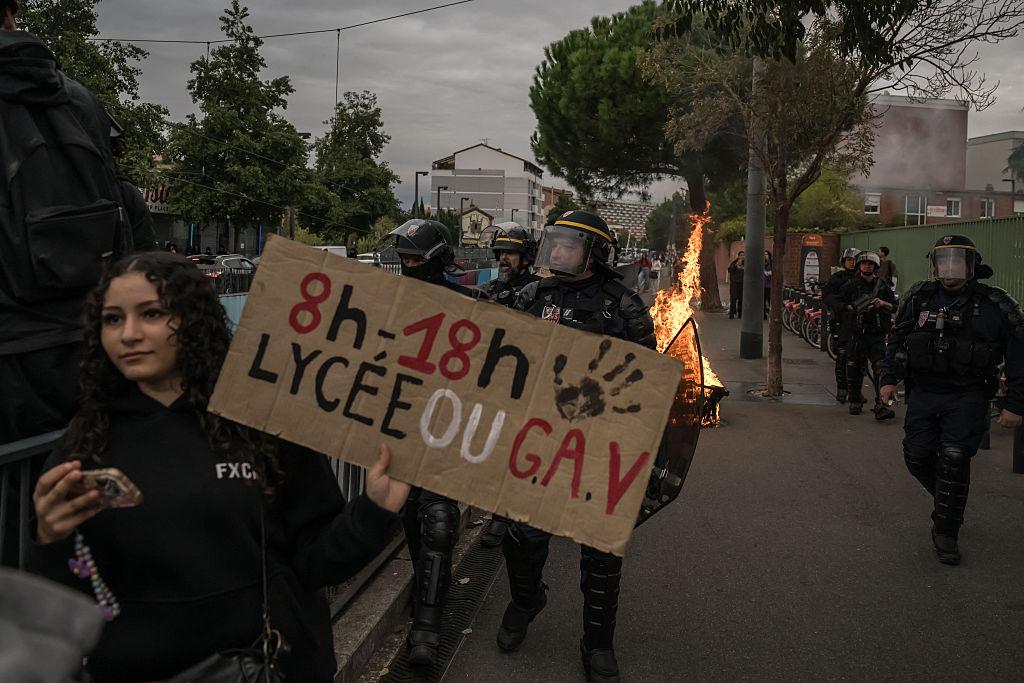
France’s nationwide protest movement has escalated into one of the most serious episodes of unrest of President Emmanuel Macron’s final term, with Interior Minister Laurent Nuñez confirming that about 400 people were arrested across the country as demonstrations over the cost of living, education and public services drew an estimated 550,000 people according to government figures and around 800,000 according to organizers. The demonstrations, held across 110 marches on Saturday, October 17, were largely peaceful in many cities but descended into violence in several major urban centers, where masked groups looted shops, set vehicles and public property on fire, attacked police officers and targeted government buildings. Authorities also opened an investigation after a young protester in Saint Étienne suffered catastrophic injuries and lost a hand during clashes, adding fresh scrutiny to police use of riot control weapons and deepening an already intense national debate over how France is policing a rapidly expanding social movement.
The latest figures mark a substantial increase from earlier estimates circulated during the day. Initial reporting had recorded at least 272 arrests while unions were claiming turnout of around 800,000. By Saturday evening, Nuñez said approximately 400 people had been arrested nationwide, with most of those detained described as adults. He said 110 marches had taken place and put total participation at around 550,000 people, while the CGT labor union and student organizations continued to insist the real number was closer to 800,000. The difference between official and organizer estimates is common during major French demonstrations, but even the government’s lower figure confirms that the protests have grown far beyond the student-led actions that began weeks earlier in suburban schools and have now evolved into a broader movement against rising prices, underfunded services and inequality.
The demonstrations were initially rooted in anger among high school students over overcrowded classrooms, teacher shortages and deteriorating school infrastructure. That movement spread rapidly from working-class suburbs around Paris into cities across the country and eventually attracted support from labor unions, parents, public sector workers and activists associated with the Yellow Vest movement. By October 17, the grievances had expanded well beyond education and were increasingly focused on the affordability of everyday life. Protesters cited food, fuel, energy and housing costs while accusing successive governments of asking ordinary households to absorb economic pressure while wealthy individuals and large corporations remain better protected.
The breadth of the demonstrations was one of the clearest signs that the movement has entered a new phase. People of different ages marched together, including students who have been blockading schools since September, trade union members calling for higher wages and pensions, older participants who had previously joined the Yellow Vest protests and families concerned about public services. In Paris, fluorescent yellow vests were visible again among demonstrators, reviving imagery from the mass movement that shook France beginning in 2018. Protesters described the current demonstrations as driven by a general sense of frustration with living standards and declining confidence that political institutions are responding effectively to the pressures faced by ordinary citizens.
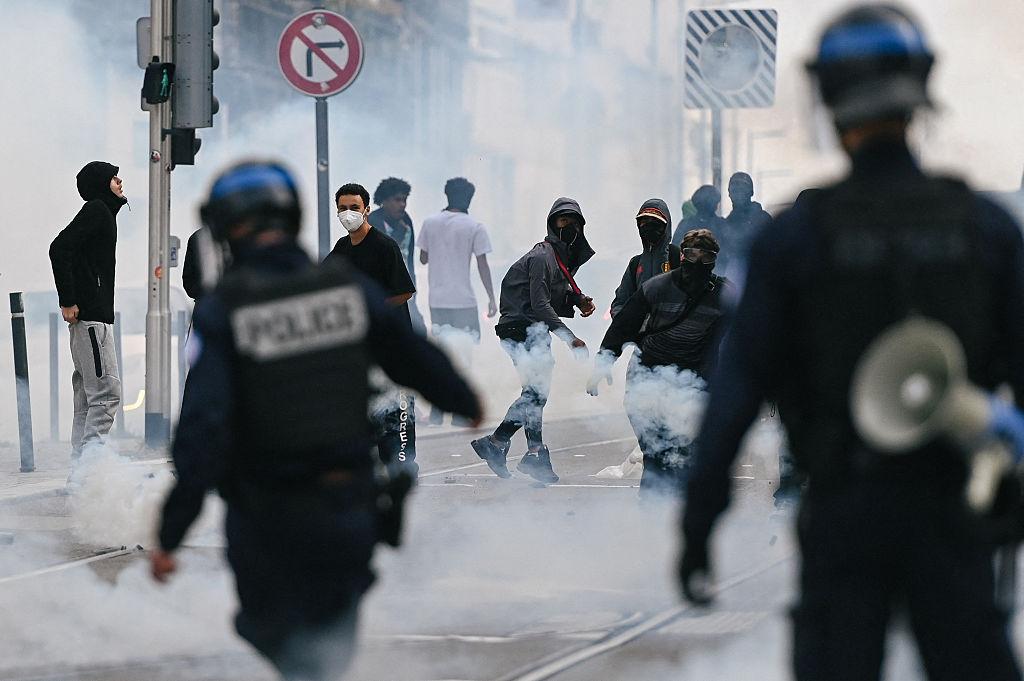
Most participants marched peacefully, but violent fringe groups caused serious disorder in several cities. In Paris, rioters smashed shopfronts, looted businesses, set cars and other objects on fire and clashed repeatedly with police. Security forces responded with tear gas and water cannons as parts of central Paris became engulfed in smoke and running confrontations. The unrest was particularly intense around major commercial areas, where rioters attempted to break into stores including Galleries Lafayette and looted outlets such as Lacoste and an SFR mobile phone shop. The violence continued into the evening, complicating efforts by police to separate peaceful protesters from those deliberately seeking confrontation.
The destruction extended well beyond the capital. In Limoges, city hall was set ablaze. In Marseille, black-clad protesters broke into the city hall and sprayed anarchist graffiti inside the building. In Lyon, the city’s tourist office was torched. Other incidents involved vandalism of banks, government buildings and transport infrastructure. Prime Minister Sébastien Lecornu accused violent far-left groups and criminals of exploiting the broader protests to attack institutions and loot shops, while insisting that the government would not be intimidated. His comments reflected the administration’s attempt to distinguish between the hundreds of thousands of peaceful demonstrators and the smaller number of people responsible for serious disorder.
President Emmanuel Macron also condemned the violence and said those responsible for attacks on public buildings, shops and security personnel would be prosecuted. He framed the unrest as an assault on democratic institutions while stressing that peaceful citizens must be allowed to express their grievances. The government’s message is that legitimate protest remains protected but rioting, looting and attacks on police cannot be accepted as part of normal political expression. That position is likely to be central to the government’s response over the coming days as authorities review arrests and prepare possible charges against those detained.
The most serious individual injury confirmed on Saturday occurred in Saint Étienne, where a young demonstrator lost a hand during clashes with police. Nuñez said authorities had opened an investigation into the incident and confirmed the severity of the injury but declined to endorse media reports that it had been caused by a police grenade. French media reported that the protester may have attempted to pick up a stun grenade before it exploded, but the exact circumstances remain under investigation. The distinction is important because police tactics have already become one of the most controversial issues surrounding the protest movement, and any confirmed link between riot control weapons and another life-changing injury could intensify public anger.
The Saint Étienne case comes after another teenage protester previously lost a hand during demonstrations involving stun grenades. That earlier incident prompted Nuñez to suspend the use of a particular type of stun grenade against high school demonstrators, although the restriction does not apply to all protest situations. Other students have suffered severe facial and eye injuries allegedly involving tear gas projectiles and other riot control weapons. The growing number of serious injuries has triggered investigations by police oversight authorities and demands from rights groups, students and opposition politicians for tighter rules governing the use of force.
Saturday’s injury therefore carries implications far beyond the individual victim. Protesters have increasingly adopted slogans condemning police violence, while student groups say aggressive tactics are helping sustain rather than suppress the movement. Football supporters have also expressed solidarity with students during matches, prompting the French football federation’s ethics body to urge fans to keep political messages out of stadiums. The spread of protest symbolism into sports, campuses and public spaces illustrates how the original education dispute has evolved into a broader national conversation about state authority, inequality and the treatment of young demonstrators.
Police unions, however, say officers are also facing extreme levels of violence. The UNSA police union circulated videos showing crowds attacking police vehicles with clubs, stones and bricks and warned that officers were being treated as targets across the country. The union said police forces were reaching breaking point after weeks of demonstrations and repeated confrontations. Lecornu has previously said more than 900 police officers have been injured during the recent wave of protests, while other reports indicate thousands of arrests have been made since the student movement began.
That competing picture complicates the political debate. Protesters point to severe injuries among young people and accuse police of disproportionate force. Police organizations point to repeated attacks on officers and property and argue that security personnel are being placed in dangerous situations. The government is therefore trying to maintain public order while avoiding the perception that it is suppressing legitimate dissent. Every major injury, viral video or controversial arrest has the potential to shift public opinion and increase political pressure.
The scale of the October 17 demonstrations is particularly important because it eclipsed the peak turnout seen during some stages of the original Yellow Vest movement, although it remained below the enormous numbers recorded during the 2023 protests against Macron’s pension reforms. That comparison demonstrates how quickly the current mobilization has grown. What began as a school-based campaign only weeks ago has become a nationwide protest involving labor unions, political activists, families and citizens who may not share identical political views but are united by dissatisfaction with living standards and public services.
The CGT has emerged as one of the most important organizational forces behind the expanded demonstrations. The union has called for higher wages and pensions, lower prices and stronger public services. Its involvement gives the movement organizational infrastructure that student groups alone could not easily provide and increases the possibility of sustained strike action if the government does not respond. The combination of youthful mobilization and traditional labor organization is particularly significant because France’s most powerful protest movements often become politically difficult when unions and grassroots movements operate simultaneously.
Far-left political leader Jean-Luc Mélenchon also joined the Paris demonstration and has publicly backed the student movement. His involvement gives the protests an electoral dimension as France approaches the 2027 presidential election. Lecornu has accused political forces on the far left of seeking to exploit unrest ahead of the vote, while opposition figures say the government is trying to discredit legitimate social anger by focusing on violent fringe groups. The result is a political contest over who gets to define the meaning of the demonstrations.
For the government, the danger is that economic grievances continue to merge with anger over policing. A protest movement focused solely on school conditions might have been easier to address through targeted funding or staffing measures. A movement that combines education, food prices, fuel costs, pensions, public services and police accountability is much harder to satisfy because each constituency has different demands.
Fuel prices are particularly sensitive because they helped ignite the Yellow Vest movement in 2018. Protesters interviewed during Saturday’s demonstrations repeatedly mentioned the high cost of gasoline and energy. Rising fuel costs affect commuters, rural workers and businesses, making them a powerful symbol of economic pressure. When combined with higher food and housing costs, they reinforce the perception among many households that their disposable income is shrinking even when headline economic indicators suggest stability.
Public services have become another central grievance. Students complain about rundown schools and shortages of teachers. Parents worry about the quality of education and overcrowded classrooms. Public sector workers argue that staffing and investment are inadequate. Protesters say the government’s efforts to reduce public spending are worsening those problems at the same time that families face higher prices.
France’s public finances complicate the government’s response. The country is under pressure to reduce debt and budget deficits, while borrowing costs have risen to their highest levels in decades. Any large package of new public spending could reassure protesters but alarm investors and make fiscal targets more difficult to achieve. That creates a classic political dilemma in which the government is being pushed toward greater social spending precisely when financial markets are demanding restraint.
Macron is also approaching the end of his presidency under difficult political circumstances. He cannot seek another consecutive term under current constitutional rules, and the battle to succeed him is already shaping French politics. Every major social movement therefore has implications for the 2027 campaign because candidates are positioning themselves around questions of public order, inequality, economic reform and the future of the welfare state.
Saturday’s unrest gives both the left and the right political material. Left-wing parties can argue that the protests demonstrate widespread frustration with austerity, inequality and declining services. Right-wing parties can point to looting, arson and attacks on police as evidence that France needs a tougher approach to public order. Centrist figures aligned with the government are trying to defend reform while separating legitimate demonstrations from violence.
The violence also risks overshadowing the demands of peaceful protesters. Hundreds of thousands of people who marched without attacking anyone may find their concerns displaced in news coverage by images of burning cars and smashed shops. Organizers have already accused violent groups of damaging the movement by giving the government an opportunity to focus on security instead of living costs and education.
Protesters themselves have repeatedly made that distinction. Many participants told reporters that they reject violence and believe small groups arrive specifically intending to provoke police or loot businesses. Some demonstrators accuse extremist groups of hijacking marches that are otherwise peaceful. Authorities agree that only a minority of participants were involved in serious disorder, although they blame radical networks for organizing confrontations across multiple cities.
The scale of the arrests will now become another area of scrutiny. Approximately 400 people were detained on Saturday alone, adding to thousands arrested during previous weeks of student protests. Legal outcomes will vary depending on the alleged conduct involved. Some people may face charges for violence, looting or property damage, while others may have been detained for violating protest restrictions or participating in unauthorized gatherings.
Civil liberties groups are likely to examine those cases closely because mass detention has already become controversial. Nearly 8,000 arrests had been recorded nationally during the earlier stages of the student protests as of October 15, according to AP. Critics argue that such numbers raise questions about whether police are using detention too broadly, while authorities say the figures reflect the scale and frequency of unauthorized blockades and violent incidents.
The government will also face pressure over how it communicates the Saint Étienne investigation. Nuñez’s refusal to confirm that a police grenade caused the demonstrator’s injury was legally cautious because the inquiry has not established responsibility. At the same time, the existence of earlier cases involving grenade-related injuries means activists are likely to assume a connection unless investigators produce a clear alternative explanation.
Independent findings will therefore be crucial. If the injury was caused by a police munition, questions will follow about why that weapon was being used and whether officers followed protocol. If the evidence shows something different, authorities will need to explain that clearly enough to withstand public skepticism.
Saturday’s demonstrations also had a regional European dimension. Smaller protests inspired partly by the unrest in France took place in Belgium, Portugal and Italy, while demonstrators in Albania continued separate actions over corruption, employment and education. In Brussels, several hundred mostly young people clashed with police after protesting education costs and reforms. Police used tear gas and water cannons after some demonstrators overturned a vehicle.
In Milan, a cost-of-living march also descended into disorder as masked protesters looted stores, set property on fire and fought with police. At least two officers were injured and around 50 demonstrators were detained, including minors. The simultaneous unrest does not mean Europe is experiencing one coordinated movement, but it demonstrates that concerns about affordability, education and public services are appearing across several countries at the same time.
France remains the center of the current wave because the scale of the demonstrations and violence is far greater. The government estimate of 550,000 participants represents one of the most significant national mobilizations of Macron’s final years in office. Organizers' estimate of 800,000 would make the protest larger still.
The exact turnout may never be universally agreed because French authorities and unions use different counting methods. What matters politically is that both figures confirm a mass national mobilization rather than a marginal protest. Hundreds of thousands of people were sufficiently dissatisfied to spend Saturday marching, and the demonstrations took place in more than a hundred locations.
The government must now decide how much of its response will focus on security and how much will focus on policy. Arresting rioters and prosecuting looters may restore order temporarily, but those measures do not address the underlying complaints about schools, prices and public services. Conversely, announcing major concessions while violence remains fresh could be interpreted by political opponents as rewarding disorder.
That balance will define the coming days. Ministers are likely to meet with education officials, unions and local authorities while police continue processing arrests. Opposition parties will demand parliamentary scrutiny of policing and government economic policy. Student groups will decide whether to continue school blockades and street demonstrations.
The strength of the movement may depend on whether Saturday’s violence discourages ordinary participants or convinces them that the government is failing to respond. Protest movements can lose momentum when disorder frightens families away, but they can also grow when injuries and aggressive policing create new grievances.
The Saint Étienne case could therefore become especially important. A single serious injury can become symbolic if protesters believe it represents broader state violence. The earlier teenager who lost a hand had already become a powerful symbol within the student movement. Another devastating injury risks reinforcing that narrative even before investigators establish exactly what happened.
Government officials are aware of that danger. Nuñez’s decision to announce an investigation immediately suggests authorities understand the sensitivity of the case. The credibility of that investigation will matter because anything perceived as an attempt to protect police from scrutiny could intensify unrest.
The same applies to accusations against violent protesters. Authorities will need evidence connecting individuals to specific offences rather than relying on broad political labels. Lecornu’s claim that far-left groups were behind much of the violence will likely be challenged by opposition politicians and civil liberties organizations, which will demand proof before accepting that characterization.
France has extensive experience managing mass protest, but the current movement contains several features that make it unusually difficult. It began with teenagers rather than unions, spread through schools before reaching the wider public, revived elements of the Yellow Vest movement and now includes both highly organized labor groups and decentralized activists.
That combination makes leadership difficult to identify. The government can negotiate with unions, but it cannot necessarily negotiate with every student group or unaffiliated protester. A concession accepted by one organization may not end demonstrations organized by another.
The issue of living costs also lacks a simple solution. Lowering fuel or food prices involves global commodity markets, taxation and government spending. Improving schools requires recruitment and long-term investment. Increasing wages involves both public and private employers. Strengthening public services requires money at a time when France is under pressure to reduce debt.
Those structural problems mean the demonstrations could continue even if the government announces short-term relief. Protesters increasingly describe their complaints as part of a larger model of inequality rather than a single policy that can be reversed.
Saturday’s events therefore represent more than a violent day on French streets. They demonstrate that a movement once centered on classroom conditions has become a national political crisis combining economic frustration, institutional distrust and anger over policing.
The updated figures make the scale unmistakable. Approximately 400 people arrested. Around 550,000 demonstrators according to the government. Roughly 800,000 according to organizers. One hundred and ten marches nationwide. Public buildings attacked in several cities. Shops looted and cars burned. Another young protester left with a life-changing injury.
France now faces the difficult task of separating those facts from the competing political narratives surrounding them.
The overwhelming majority of demonstrators did not riot.
A minority caused serious destruction.
Police officers faced violent attacks.
Protesters have also suffered severe injuries.
The government must respond to both public order and public anger.
How successfully it manages those competing responsibilities may determine whether October 17 becomes the peak of the movement or the beginning of something even larger.