ISWAP-LINKED LANDMINE KILLS EIGHT NIGERIAN SOLDIERS NEAR GAMBORU AS ARMY CHIEF VISITS BORNO
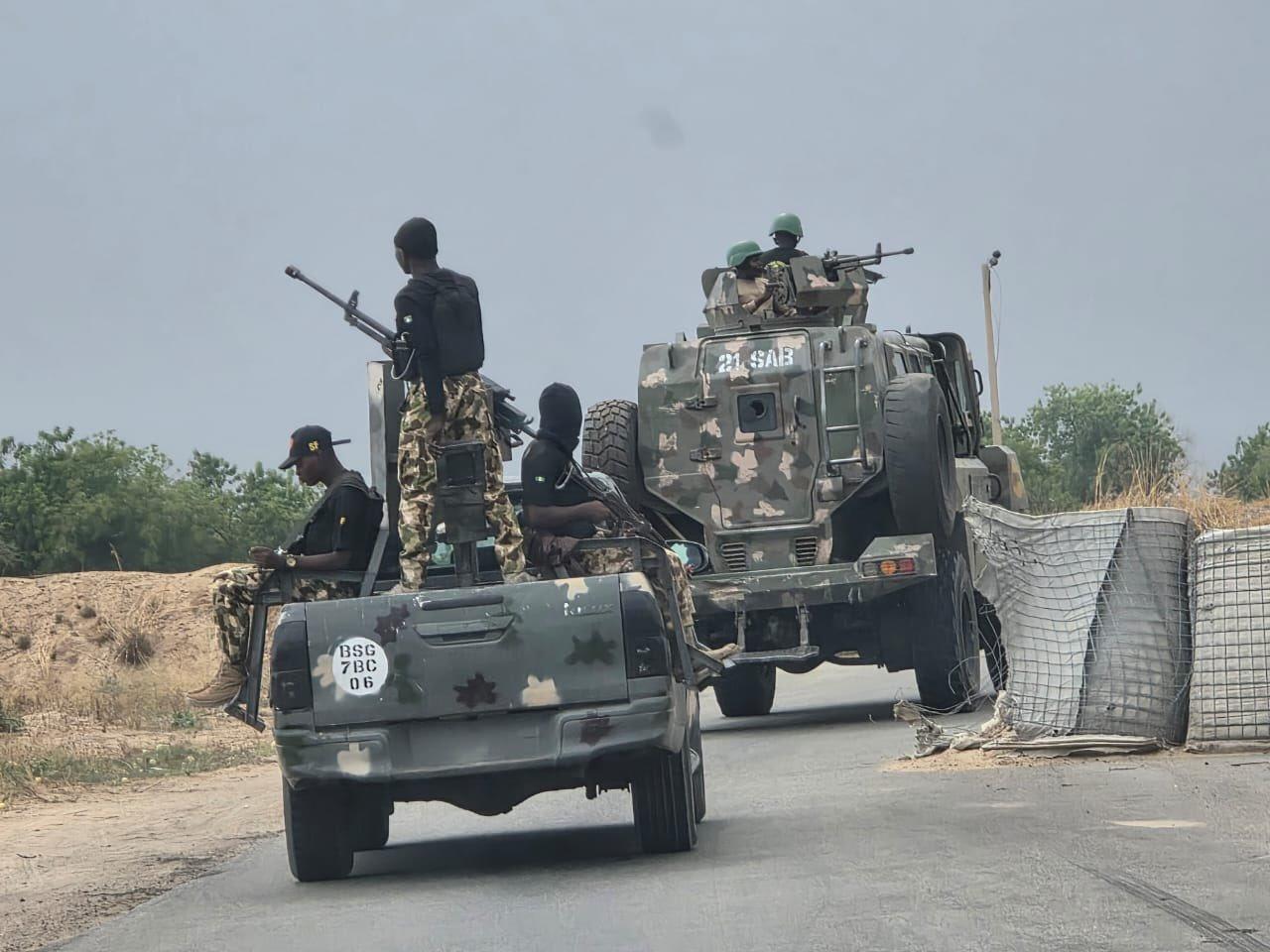
Eight Nigerian soldiers have been killed after their patrol vehicle struck a landmine near Gamboru in Borno State. The blast occurred in Kinuba village, about 25 kilometres from Gamboru, while the soldiers were monitoring militia members clearing roadside vegetation. Security and militia sources blamed Islamic State West Africa Province, although the Nigerian military had not publicly announced a definitive attribution at the time of reporting. A militia member was also injured by shrapnel. The attack occurred on the same day Chief of Army Staff Lieutenant General Waidi Shuaibu was visiting Maiduguri amid intensified military operations against insurgents.
Eight Nigerian soldiers have been killed after their patrol vehicle struck a landmine near Gamboru in Borno State, in the latest deadly attack blamed by security sources on Islamic State West Africa Province. The explosion occurred on Saturday in Kinuba village, about 25 kilometres from Gamboru and close to Nigeria’s border with Cameroon, while the soldiers were monitoring members of an anti-jihadist militia clearing thick vegetation along a highway. Defence sources cited by AFP said all eight soldiers inside the vehicle were killed when the explosive detonated, while a militia member supervising the bush-clearing operation suffered shrapnel injuries.
The incident happened on the same day Chief of Army Staff Lieutenant General Waidi Shuaibu was in Maiduguri on an operational visit to Borno, following a series of recent attacks against military positions in the state. Channels Television and Punch confirmed that Shuaibu arrived in Maiduguri on Saturday and visited the headquarters of Operation Hadin Kai, where he met troops and commanders and urged personnel to intensify operations against insurgent groups. His visit followed a directive from President Bola Tinubu ordering security agencies to rescue abducted persons and ensure that terrorist and bandit camps are cleared.
The latest explosion occurred as troops were accompanying or supervising members of local anti-jihadist militia groups who were clearing thickets beside the road. Such vegetation can provide cover for insurgents seeking to observe military movements, set ambushes or conceal improvised explosive devices. Security sources said the patrol vehicle moved over the explosive while operating near Kinuba, causing a blast powerful enough to kill every soldier on board.
Ibrahim Liman, a militia member assisting Nigerian forces in the region, independently confirmed the death toll. He said the explosive had been planted on an unpaved section of road and was remotely detonated using a detonating cord. According to his account, a militia member involved in supervising the vegetation-clearing operation was also injured by shrapnel from the explosion.
The attack has been attributed by military and militia sources to ISWAP, which remains active across parts of Borno State and the wider Lake Chad region. At the time of the latest reporting, however, the Nigerian military had not issued a detailed public statement formally claiming that investigators had conclusively established responsibility for the blast. For that reason, ISWAP involvement is best described as the assessment of security sources rather than an independently confirmed claim of responsibility.
ISWAP and Boko Haram have increasingly relied on improvised explosive devices and roadside mines as part of their insurgency in northeastern Nigeria. Such weapons allow fighters to attack military patrols without engaging troops directly and can be placed along roads regularly used by soldiers, local militias and civilian travellers. The tactics are particularly dangerous in remote areas where troops must use predictable supply and patrol routes between towns, military positions and border communities.
The use of landmines and improvised explosive devices also places civilians at considerable risk because the same roads used by the military often serve traders, farmers and other travellers. Explosives can remain hidden after insurgents leave an area, and devices intended for military convoys can also strike civilian vehicles. This has made route clearance and roadside surveillance an important part of Operation Hadin Kai’s efforts to secure northeastern Nigeria.
Kinuba’s proximity to Gamboru adds another strategic dimension to the attack. Gamboru lies close to the Cameroon border and has repeatedly been affected by insurgent activity because the surrounding region connects Nigerian communities with routes leading into neighbouring Cameroon and the wider Lake Chad basin. Cross-border terrain can provide insurgent groups with opportunities to move fighters, supplies and weapons between remote areas while avoiding heavily guarded urban centres.
The border region has been one of the most challenging areas for Nigerian and regional forces since the insurgency began. Nigeria, Cameroon, Chad and Niger have cooperated through the Multinational Joint Task Force in an effort to restrict militant movements and disrupt safe havens across national boundaries. Despite those operations, ISWAP and Boko Haram factions have maintained the ability to carry out attacks on both military formations and civilian communities.
Saturday’s explosion comes amid a particularly violent period in Borno. Only days earlier, militants attacked a military base in Mairari, Guzamala Local Government Area, in an assault that security sources said killed 15 soldiers and five members of the Civilian Joint Task Force. The military did not immediately publish its own detailed casualty figure for that attack, but local officials confirmed that a major assault had taken place and that troops fought the attackers for an extended period.
Earlier in October, troops also suffered casualties while repelling an ISWAP attack against the 101 Special Forces Battalion in Kukawa. Operation Hadin Kai confirmed that soldiers were killed during that engagement, although it did not publicly state the number. Other security reports put the military death toll at eight. The military said more than 25 ISWAP fighters were killed during the battle and weapons were recovered after troops, supported by the Nigerian Air Force, repelled the assault.
Those incidents show that the security situation in northeastern Nigeria remains highly contested despite sustained military operations. Nigerian forces continue to conduct air strikes, ground patrols and intelligence-led missions against insurgent camps, while ISWAP and Boko Haram retain the ability to stage ambushes, attack bases and deploy explosives on roads.
On October 10, the Air Component of Operation Hadin Kai said it killed more than 40 ISWAP fighters during an air strike on an enclave at Badu village, south of Gudumbali in Guzamala Local Government Area. The military said the operation followed intelligence that militants were gathering in preparation for coordinated attacks against troops operating in Sector 3.
The combination of successful military strikes and continuing insurgent attacks illustrates the nature of the conflict. Losses inflicted on militant groups do not necessarily prevent them from conducting smaller, asymmetric operations. A roadside explosive requires fewer personnel and resources than a large assault on a military base, making it a useful tactic for insurgents operating under pressure.
Improvised explosive devices also allow militant groups to exploit the geography of Borno. The state contains vast stretches of open land, bush, forest and rural roads that are difficult to monitor continuously. Troops can clear an area during one operation only for insurgents to return later and place explosives once patrols move elsewhere.
This creates a constant requirement for route-clearance teams, intelligence gathering and surveillance. Military engineers may be required to inspect roads before convoys travel, while troops often clear vegetation to reduce opportunities for militants to conceal explosives or stage ambushes. Saturday’s attack appears to have occurred during precisely such an operation, demonstrating the danger faced even when forces are taking steps intended to improve route security.
The killing of eight soldiers is therefore not simply a battlefield casualty event but also a reminder of the challenge posed by low-cost explosive warfare. An armoured or patrol vehicle can be disabled instantly by a sufficiently powerful device, and troops may have little warning before detonation.
The military has previously warned that insurgent groups increasingly adapt their tactics in response to pressure. When heavily fortified bases become difficult to overrun, militants may focus more heavily on convoys, roads and isolated patrols. This forces security forces to spread personnel across a much wider area and creates constant pressure on logistics.
The timing of the attack also places additional scrutiny on the military leadership because it occurred while the Army Chief was physically present in Borno. Shuaibu arrived in Maiduguri at about 11 a.m. on Saturday as part of an operational visit following President Tinubu’s directive for security agencies to intensify efforts against terrorism and kidnapping.
During his visit, Shuaibu addressed troops of Operation Hadin Kai and urged them to translate recent improvements in welfare and salary into stronger performance against insurgents. He praised their dedication and assured them that military leadership would continue providing equipment and other operational support.
The Army Chief also stressed discipline and obedience to commanders, indicating that military leadership is seeking to sustain morale while operations intensify. His visit came against a backdrop of repeated attacks that have caused significant casualties among soldiers and local militia members in a short period.
President Tinubu has instructed security agencies to eliminate terrorist and bandit camps and rescue people being held by armed groups. Defence Minister Christopher Musa said the directive was issued during a high-level security meeting in Abuja and required security chiefs to take a more aggressive approach to insurgency and kidnapping across the country.
The Borno attacks demonstrate how difficult that directive will be to implement. Insurgent groups do not rely solely on fixed camps that can be identified and destroyed. They also operate through mobile units, hidden explosives, informal support networks and temporary positions that can be abandoned before military forces arrive.
ISWAP in particular has shown an ability to combine conventional attacks on military positions with guerrilla tactics. The group has previously used motorcycle units, vehicle-mounted weapons, suicide bombers, improvised explosive devices and coordinated assaults involving fighters approaching from multiple directions.
Its focus on military and government targets distinguishes some of its tactics from those historically associated with Boko Haram, although both groups have attacked civilians and caused large-scale humanitarian suffering. ISWAP emerged from a split within Boko Haram and later became recognised as an affiliate of the Islamic State organisation.
The rivalry between ISWAP and Boko Haram has itself complicated the conflict. The groups have fought each other for territory and influence while simultaneously attacking Nigerian security forces. Their competition has contributed to shifting alliances and changing control over parts of the Lake Chad region.
The wider insurgency began in 2009 and has killed tens of thousands of people while forcing millions from their homes across northeastern Nigeria and neighbouring countries. Although the insurgents no longer control the large territorial areas they once held at the height of the conflict, the continuing attacks demonstrate that they retain significant operational capability.
Borno remains the centre of the conflict because many of the insurgent networks, camps and supply routes are located within the state or nearby Lake Chad areas. The state capital, Maiduguri, is heavily defended, but rural communities and military positions face more persistent risks.
Gamboru itself has a long history of insurgent violence. Its location near Cameroon makes it strategically important for trade and movement, but that same geography has made the area vulnerable to militants operating across the border region. Securing roads leading into and out of the town is therefore essential for both military operations and civilian economic activity.
Saturday’s attack could lead to further route-clearance operations around Kinuba and Gamboru. Security forces may increase patrols, inspect roads for additional explosives and search nearby bush areas for militants or equipment linked to the attack.
Military responses to IED attacks typically involve securing the blast site, checking for secondary devices and gathering evidence that can help identify the type of explosive and how it was triggered. Investigators may also examine whether the device was newly planted or had been hidden earlier.
The report that the mine was remotely detonated is particularly important because it suggests attackers may have been close enough to observe the patrol. If confirmed, that would indicate the incident involved not only a buried explosive but also active surveillance by militants waiting for the vehicle to enter the blast zone.
Remote detonation can give attackers greater control over which vehicle is hit. It also means security personnel must search surrounding areas quickly after an explosion because the individuals who triggered the device may still be nearby.
The injury to a militia member supervising the vegetation-clearing operation further demonstrates the role local vigilante and anti-jihadist groups continue to play alongside Nigerian troops. The Civilian Joint Task Force and similar groups have provided intelligence, local knowledge and manpower since the early years of the insurgency.
Their involvement has often been valuable because members understand local terrain and can identify suspicious movements. However, their participation also places them directly in danger. Militants have repeatedly targeted militia members and their families in retaliation for cooperation with government forces.
The recent Mairari attack, in which five militia members were reportedly killed alongside 15 soldiers, reinforced that risk.
Nigeria’s military has responded to recent attacks by increasing air operations against suspected ISWAP positions. Air power has become a central component of Operation Hadin Kai because aircraft can strike remote camps that ground troops would find difficult or dangerous to reach.
However, air strikes alone cannot secure highways or prevent landmines from being planted. Ground forces remain responsible for holding territory, protecting communities and keeping transport routes open.
This is where the conflict becomes especially demanding. Every kilometre of road secured by troops requires regular patrols and intelligence. Militants only need a brief period of access to bury an explosive that may remain dangerous for days or weeks.
The Nigerian military has repeatedly emphasised the importance of civilian intelligence in detecting such threats. Residents may notice strangers moving through an area, unusual digging near roads or suspicious objects placed beside transport routes. Rapid reporting can sometimes allow explosives to be discovered before they cause casualties.
Fear can prevent residents from cooperating, however. Insurgents have historically punished communities suspected of helping security forces, making civilians reluctant to provide information unless they trust the state to protect them.
This creates a difficult cycle in which military success depends partly on local cooperation, while local cooperation depends on confidence that troops can prevent retaliation.
The current wave of attacks also raises broader questions about military equipment. Vehicles operating in areas with significant IED threats require protection against blasts, while troops need mine-detection equipment and engineering support.
Armoured vehicles designed with V-shaped hulls can provide better protection against explosions beneath the vehicle, but no platform is completely invulnerable to powerful devices. Insurgents can also increase explosive size when they know heavily protected vehicles are being used.
Technology such as drones and aerial surveillance can help detect suspicious activity along roads, but large areas remain difficult to monitor continuously. Nigeria’s military must therefore combine technology with human intelligence and physical patrols.
The attack near Gamboru is likely to intensify calls for more investment in counter-IED capability. Mine-resistant vehicles, electronic detection equipment, trained explosive-ordnance teams and better route surveillance can reduce risks, although none can eliminate them entirely.
For the families of the eight soldiers, the strategic discussion will be secondary to the immediate loss. Military authorities had not publicly released the identities of those killed at the time of the latest reporting, which is common while next of kin are being notified.
The army traditionally contacts families before publicly naming personnel killed during operations. Formal tributes and burial arrangements may follow once notifications have been completed.
The deaths come only days after other military casualties in Borno, meaning several families across the country are mourning soldiers lost during the same period. This can also affect morale within units whose personnel have experienced repeated attacks in a short period.
Shuaibu’s presence in the theatre may allow senior commanders to review these incidents directly and assess whether operational adjustments are necessary. Commanders could consider changes to convoy procedures, patrol routes, intelligence coverage or engineering support depending on what investigations reveal.
The military may also intensify offensive operations around known ISWAP positions in the area. Previous attacks have often been followed by air strikes or ground sweeps designed to prevent militants from exploiting their success.
However, retaliation alone will not necessarily stop future landmine attacks. The broader challenge is preventing militants from accessing roads long enough to plant explosives and ensuring devices are detected before vehicles reach them.
That requires long-term control rather than temporary patrols.
The Gamboru attack therefore reflects one of the most persistent problems in Nigeria’s counter-insurgency campaign. The military has succeeded in preventing insurgents from holding major cities as they once did, but controlling remote roads and rural terrain remains far more difficult.
ISWAP can exploit that gap by avoiding large direct confrontations and targeting troops where their movement is predictable.
The latest incident also demonstrates why claims that the insurgency has been defeated must be treated carefully. The scale of militant territorial control may have fallen substantially from its peak, but groups capable of killing eight soldiers with a roadside explosive and attacking military bases remain a serious security threat.
Nigeria’s government has recognised this through its latest orders for intensified operations. Tinubu’s demand that terrorist camps be cleared reflects pressure on security agencies to show stronger results as violence continues in the northeast and other forms of insecurity affect different parts of the country.
The military’s recent success in killing more than 40 ISWAP fighters at Badu shows that security forces can inflict serious losses on the group. The deaths near Gamboru show that ISWAP can still respond with lethal asymmetric attacks.
That cycle of offensive operations followed by ambushes and roadside explosions has characterised much of the later phase of the insurgency.
For communities along the Nigeria-Cameroon border, the immediate concern will be whether the attack leads to new restrictions on road movement. Security forces sometimes temporarily close or limit access to routes after IED incidents while engineers inspect them for additional devices.
Such restrictions can disrupt trade and daily life but may be necessary if commanders believe more explosives have been planted.
The military and Borno authorities had not announced a broader road closure connected to Saturday’s blast at the time of the latest reporting.
There was also no publicly confirmed statement indicating that ISWAP had formally claimed responsibility. Defence and militia sources blamed the group because of its presence and operational history in the area.
For accurate reporting, that distinction should remain clear until the military releases additional findings or the group issues an independently verifiable claim.
The confirmed facts are that eight soldiers died when their patrol vehicle struck an explosive near Kinuba village, roughly 25 kilometres from Gamboru; a militia member was injured; security sources attribute the device to ISWAP; and the attack occurred on the same day the Army Chief was visiting Borno.
The coincidence of the Army Chief’s visit with the deadly blast underlines the scale of the challenge confronting Operation Hadin Kai. Senior commanders were in Maiduguri discussing how to intensify the campaign against insurgents while soldiers elsewhere in the state were being targeted through one of the oldest and most effective tools of guerrilla warfare.
For Nigeria’s military, the immediate response will involve securing the route, investigating the device and pursuing those responsible. The longer-term challenge remains much larger: denying ISWAP and Boko Haram the freedom to plant explosives, attack military positions and move through the remote terrain of northeastern Nigeria.
Until that capability is significantly reduced, Borno’s roads will remain part of the battlefield as much as the insurgents’ camps and military bases themselves.