IRAN SAYS THREE US-ESCORTED TANKERS HIT MINES IN HORMUZ. WASHINGTON IS SILENT, OIL MARKETS ARE NERVOUS, AND THE WORLD'S MOST DANGEROUS WATERWAY IS BACK ON EDGE
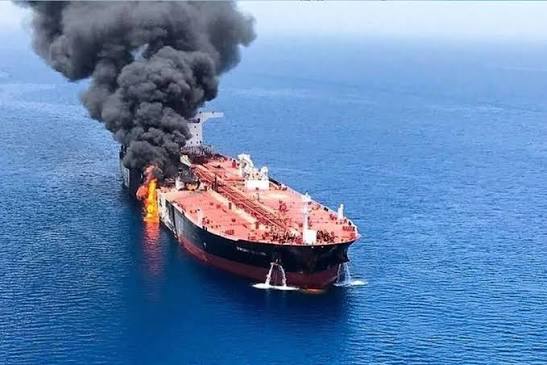
Iran's Islamic Revolutionary Guard Corps (IRGC) says three oil tankers suffered "severe explosions and fire" after hitting naval mines in the Strait of Hormuz on Sunday, November 23, 2026. The IRGC says all three were sailing under US military air cover and escort at the time. It called the ships "violating oil tankers" but did not publicly explain what rules they had supposedly broken. The US military's Central Command (CENTCOM) has not responded to the claim, according to reports. The accounts also differ. Some reports, citing Iran's navy, say two tankers caught fire after hitting mines east of the strait, not three. As far as public reporting shows, the ships have not been named. Their flags, owners, cargo and crews have not been identified, and no casualty figures have been released. Nobody has confirmed who laid the mines, or whether mines caused the damage at all. Until independent sources confirm what happened, the IRGC's account should be read as a claim. Even so, the claim alone matters. About a fifth of the world's oil passes through the Strait of Hormuz. Any credible threat to that flow can move prices, raise shipping and insurance costs, and shake economies far from the Gulf. That includes Nigeria, whose budget depends on crude sales and whose fuel prices now move with world markets, and Ghana, which imports most of its refined fuel while working through a hard economic recovery.
The message from Tehran was short and sharp. Three oil tankers, the IRGC said, had hit naval mines in the Strait of Hormuz and suffered "severe explosions and fire." All three, it added, had been moving under extensive US military air cover and escort, and that protection had failed to prevent the blasts.
If true, it would be one of the most serious incidents in the strait in decades. It would mean mines are active in the world's most important oil chokepoint. It would mean commercial ships under US protection were hit anyway. And it would mean the long contest between Iran and the United States over these waters has entered a dangerous new phase.
That is a big "if."
The account comes from the IRGC, the hardline military force that answers to Iran's Supreme Leader and controls much of Iran's naval activity in the Gulf. It is a party to the tensions it describes, not a neutral observer. As of the latest reports, CENTCOM, which oversees US forces in the Middle East, had not responded publicly. No shipping company had come forward to say one of its vessels was damaged. No flag state, port authority or maritime security agency had publicly confirmed the explosions.
The details are not consistent either. The IRGC statement refers to three tankers. Reports citing Iran's navy describe two tankers catching fire after hitting mines east of the strait. That gap could reflect a fast-moving situation, a difference between early and later statements, or simple confusion. It could also mean the full story is different from either version. As far as public reporting shows, the vessels have not been named, no casualty figures have been released and no images have been independently verified.
Then there is the language. The IRGC called the ships "violating oil tankers." It did not say publicly what they had violated. In the past, Iranian authorities have used similar terms for vessels they accused of smuggling, of ignoring IRGC instructions, or of breaking rules Iran says apply in waters it claims the right to police. The United States and most maritime nations reject the idea that Iran can set rules for ships using an international strait. The word "violating" may be meant for audiences at home, presenting any damage as the result of rule-breaking rather than an attack on innocent shipping.
The most important open question is who laid the mines, if mines were involved at all. The IRGC statement says the tankers struck "naval mines." It does not say whose. It does not claim responsibility. It does not deny it. That silence will draw attention. Iran has one of the largest mine stockpiles in the region and has used mines in these waters before. But no evidence has yet been made public tying any mine in this incident to any specific party. Suspicion is not proof, and in the Gulf, suspicion has a long record of running ahead of the facts.
Some facts are not disputed. Reports describe the vessels as sailing under US military escort. That alone shows how far tensions in the Gulf have risen. Navies do not escort commercial tankers through a strait unless they believe the risk is real. The IRGC's message seems designed to drive home one point: your escorts cannot keep you safe here.
To understand why this matters, you have to look at the map.
The Strait of Hormuz is a narrow, curved channel between Iran to the north and the Musandam Peninsula of Oman to the south. It connects the Persian Gulf to the Gulf of Oman and from there to the Arabian Sea and the open ocean. At its narrowest point, it is only about 21 nautical miles wide, roughly 33 kilometers. The shipping lanes are far narrower. Inbound and outbound traffic each use a lane about two miles wide, separated by a two-mile buffer.
Through that slim corridor flows a huge share of the world's energy. According to the US Energy Information Administration, about 20 million barrels of oil and petroleum products a day passed through the strait in 2024. That is roughly a fifth of global petroleum consumption. Saudi Arabia, Iraq, the United Arab Emirates, Kuwait, Qatar and Iran all ship crude through it. So does much of the region's refined fuel. Qatar, one of the world's largest exporters of liquefied natural gas, sends nearly all of its LNG through Hormuz, accounting for about a fifth of global LNG trade.
Most of that energy goes east. China, India, Japan and South Korea are the biggest buyers of oil moving through the strait. But because oil is traded on a global market, a shock in Hormuz moves prices everywhere, from Shanghai to Lagos.
There are few alternatives. Saudi Arabia operates the East-West pipeline, which can carry crude across the kingdom to the Red Sea port of Yanbu. The UAE has a pipeline from its oil fields to the port of Fujairah, outside the strait. The EIA has estimated that only about 2.6 million barrels a day of unused pipeline capacity could bypass Hormuz in a crisis. That is a fraction of what normally flows through it. Kuwait, Qatar, Bahrain and most of Iraq's exports have no real bypass at all.
That is why the strait is often called the world's most important oil chokepoint. And it is why Iran's ability to threaten it has been one of Tehran's most powerful strategic cards for more than four decades.
Iran's leaders have warned many times that if the country's oil exports were blocked, no one's oil would leave the Gulf. Iranian officials made such threats in 2011 and 2012, when Western sanctions on Iranian crude tightened. They repeated them in 2018 and 2019, after President Donald Trump withdrew the United States from the 2015 nuclear deal and launched a "maximum pressure" campaign. In June 2025, after Israel and the United States struck Iranian nuclear sites, Iran's parliament backed a motion supporting closure of the strait. The final decision rested with Iran's Supreme National Security Council, and the strait stayed open. But the threat was clear.
Closing the strait completely would be hard and costly for Iran. Iran itself depends on the strait to export oil, mostly to China. A full closure would hurt Iran's main customer and could bring overwhelming military retaliation. That is why many analysts have argued that Iran's more likely strategy is not a full closure, but harassment. That means making the strait dangerous enough to raise costs, scare shippers and send a message, without crossing a line that triggers all-out war.
Mines fit that strategy almost perfectly.
Naval mines are among the oldest, cheapest and most effective weapons at sea. A mine can cost a few thousand dollars. The ship it damages can be worth tens of millions, and its cargo many millions more. Mines do not need a crew. They can wait for days, weeks or months. They can be hard to find and slow to clear. And because they are often laid in secret, they can be hard to trace.
There are several main types. Contact mines explode when a ship's hull touches them. Influence mines are triggered by a ship's magnetic field, the sound of its engines or the change in water pressure as it passes. Limpet mines are attached directly to a ship's hull, often by divers or small boats, and detonated later. Moored mines float below the surface on a cable. Bottom mines rest on the seabed in shallow water. The Gulf, which is relatively shallow, is well suited to many of these designs.
US and Western defense estimates have long credited Iran with a large mine stockpile, often put at several thousand mines, including older contact mines and more modern influence mines. Iran also has many ways to lay them, including small boats, submarines, fishing vessels and commercial-looking craft. Its IRGC Navy has built its doctrine around swarming fast boats, missiles and mines, an approach meant to offset the power of larger navies in narrow waters.
Clearing mines is painfully slow. Mine countermeasure ships, helicopters and underwater drones must search an area carefully, often meter by meter. Even a small number of mines, or simply the belief that mines are present, can halt traffic while navies work. The US Navy has been phasing out its ageing Avenger-class minesweepers based in Bahrain in favor of newer ships with mine-hunting equipment, a shift some naval analysts have questioned. Britain and other allies keep mine-hunting capability in the region too. But no navy can sweep a busy strait clean in a day.
The Gulf has seen this before, and the history explains why this claim strikes such a nerve.
During the Iran-Iraq war from 1980 to 1988, both sides attacked shipping in what became known as the Tanker War. Iraq struck tankers carrying Iranian oil. Iran struck ships trading with Iraq's Gulf allies, especially Kuwait. Hundreds of commercial vessels were hit. Kuwait asked for protection. In 1987, the United States agreed to reflag Kuwaiti tankers under the American flag and escort them through the Gulf. The operation was called Earnest Will.
The parallel with today's reported events is striking. On July 24, 1987, during the first Earnest Will convoy, the reflagged supertanker Bridgeton hit a mine near Iran's Farsi Island. The tanker survived, but the embarrassment was enormous. The giant ship, being protected by American warships, had struck a mine. In one widely told detail, the much smaller US escorts then lined up behind the tanker, because its massive hull was better able to absorb another blast. A mine that cost very little had exposed the limits of the world's most powerful navy.
In September 1987, US forces caught the Iranian ship Iran Ajr laying mines in international waters and seized it. In April 1988, the US frigate Samuel B. Roberts hit an Iranian mine and was nearly sunk. Its crew fought fires and flooding for hours to save it. Four days later, the United States launched Operation Praying Mantis, its largest naval battle since the Second World War. US forces destroyed Iranian oil platforms and sank or damaged several Iranian vessels.
The violence of that era had a terrible coda. In July 1988, the US cruiser Vincennes, operating in tense conditions in the strait, shot down Iran Air Flight 655, a civilian airliner, killing all 290 people on board. The United States said its crew mistook the plane for an attacking fighter jet. Iran called it a deliberate crime. The United States later paid compensation without admitting legal liability. The memory remains raw in Iran to this day, and it shapes how Iranians view any American military presence in the strait.
Mines returned during the 1991 Gulf War, when Iraqi mines damaged the US warships Tripoli and Princeton off Kuwait. They returned again, in a different form, in 2019.
In May 2019, four commercial vessels were damaged by explosions off the UAE port of Fujairah, just outside the strait. In June, two more tankers, the Front Altair and the Kokuka Courageous, were hit in the Gulf of Oman. The United States blamed Iran and released a video it said showed IRGC personnel removing an unexploded limpet mine from the Kokuka Courageous. Iran denied involvement. Weeks later, Iran shot down a US surveillance drone over the strait. In July, the IRGC seized the British-flagged tanker Stena Impero, holding it for about two months. In September, drones and missiles struck Saudi oil facilities at Abqaiq and Khurais, briefly knocking out about half of Saudi oil output. Yemen's Houthis claimed responsibility. The United States and Saudi Arabia blamed Iran, which denied it.
Seizures have continued in the years since. Iranian forces have detained tankers they accused of smuggling fuel or breaching maritime rules, and in some cases have taken ships in what Western governments described as retaliation for US seizures of Iranian oil cargoes. In April 2024, the IRGC seized the container ship MSC Aries near the strait, citing its links to Israel. Each incident followed a pattern: a sudden move at sea, a short official statement, conflicting claims and a long fight over the facts.
That pattern is one reason the current claim deserves care. In the Gulf, the first account is often not the full account. Iran has denied attacks Western governments blamed on it. Western governments have made claims Iran disputed. Some incidents have never been fully explained. Both sides have strong reasons to shape the story.
This time, Iran is not denying an attack. It is announcing one, while carefully avoiding saying who laid the mines. That itself is unusual and revealing. By publicizing the explosions, the IRGC sends a warning to shippers, insurers and Washington: the escort system is not enough. By not claiming responsibility, it may hope to avoid the direct retaliation that an open admission would invite. Analysts often call this "plausible deniability," and the Gulf has seen plenty of it.
There are other possibilities that investigators will need to rule in or out. Mines can drift. Old mines from past conflicts sometimes turn up in strange places, though that is less likely in a heavily traveled lane. Explosions on tankers can have many causes, including onboard accidents, limpet mines attached in port or at sea, and drone or missile strikes. Until the ships are identified and examined, and until navies or independent investigators report their findings, the cause should be treated as unconfirmed.
The IRGC's "violating" label also points toward one of the murkiest corners of the global oil trade: the shadow fleet.
The term describes hundreds of tankers that operate outside the normal rules of shipping. Many are old, often more than 20 years, past the age when major companies usually scrap them. They are often registered in countries with weak oversight, under so-called flags of convenience. Their ownership is hidden behind shell companies. They frequently switch off their automatic identification system (AIS) transponders, which broadcast a ship's location. They transfer oil from ship to ship at sea to disguise its origin. Many lack proper insurance from mainstream providers.
The shadow fleet grew rapidly as sanctions tightened on oil from Iran, Venezuela and, after its full-scale invasion of Ukraine in 2022, Russia. Iran has relied on such vessels for years to sell oil, mostly to independent refineries in China. Russia built a large fleet of its own to get around Western price caps. Some of these tankers carry oil for more than one sanctioned country.
The shadow fleet creates serious dangers. Old ships are more likely to break down, leak or catch fire. When they switch off transponders, they become harder for other vessels to track. If one is involved in an accident or a spill, it may be unclear who is responsible and who will pay for the cleanup. Coastal states from the Baltic Sea to the Gulf of Oman have raised alarms about these risks.
It is not clear whether the tankers in the IRGC's account had anything to do with the shadow fleet. But the existence of that fleet makes incidents like this one harder to verify. If a damaged ship sails under an obscure flag, with hidden owners and a transponder that was switched off, the world may learn very little about what happened to it. Ships under US escort would not normally fit that profile. That makes the eventual identification of these vessels, if it comes, especially important.
There is also a legal dimension. The Strait of Hormuz is an international strait. Under the UN Convention on the Law of the Sea, ships of all nations enjoy the right of "transit passage" through such straits, and coastal states may not suspend it. Iran signed the convention but has never ratified it. Tehran has argued that transit passage rights apply only to countries that are parties to the treaty, a position the United States, which has also not ratified it, rejects. Washington says the rule is part of customary international law that binds everyone.
International law on mines in straits has a famous precedent. In 1946, two British warships were damaged by mines in the Corfu Channel, off Albania, killing 44 sailors. In 1949, the International Court of Justice ruled that Albania was responsible because it knew or should have known about the mines and failed to warn shipping. The ruling established that a state has a duty not to knowingly allow its waters to be used to harm other countries' ships. If mines are confirmed in the Strait of Hormuz, that principle will be at the center of the diplomatic fight that follows.
The economic fallout, even from an unconfirmed claim, can be swift.
Oil markets react to risk, not just to lost barrels. When traders see a threat to Hormuz, they price in the chance of a wider disruption. Shipping companies may delay voyages, reroute vessels or demand higher pay for crews. Insurers raise war-risk premiums, the extra cover ships need to enter danger zones. Those premiums can jump many times over in days. During the Red Sea crisis that began in late 2023, when Yemen's Houthis attacked commercial ships, war-risk costs soared and many shipping lines diverted around Africa's Cape of Good Hope, adding weeks to voyages and big costs to global trade.
A sustained mine threat in Hormuz would be far more serious than the Red Sea disruption, because there is no real detour. Ships can avoid the Red Sea by sailing around Africa. They cannot avoid Hormuz if they need to load oil in the Gulf. If insurers balk, shipowners refuse, or navies close lanes for clearing, oil supplies could tighten fast.
Strategic stockpiles offer some cushion. The United States, Japan, South Korea, China and European countries hold reserves of crude and fuel for emergencies. The International Energy Agency can coordinate releases. Gulf producers could push more oil through bypass pipelines. But none of those tools can fully replace the flow through the strait for long.
So far, the reported incident appears to be limited, and markets often calm once facts emerge. But every claim of this kind adds to what traders call the "risk premium" in oil prices. And a pattern of incidents, real or claimed, can keep that premium elevated for months.
For Nigeria, the effects cut both ways.
Nigeria is Africa's largest oil producer, pumping roughly 1.5 million to 1.7 million barrels of crude a day in recent years. Oil still provides a large share of government revenue and most of its foreign exchange. Higher world prices, in theory, mean more money for the federal government, the states and local councils that share oil revenue. They can help support the naira and strengthen foreign reserves. Nigerian crude grades such as Bonny Light and Forcados, sold mainly to Europe and Asia, would become more attractive if Gulf supplies were disrupted, since they do not pass through Hormuz.
But Nigeria's oil windfalls have often been smaller than they look. Production has been held back for years by crude theft, pipeline vandalism and underinvestment, especially in the Niger Delta. Higher prices do little good if barrels are not flowing.
And Nigerians pay for higher oil prices at home. Since the removal of the petrol subsidy in May 2023, pump prices have been tied more closely to global markets and the exchange rate. When crude rises, petrol and diesel prices tend to follow. The Dangote Petroleum Refinery in Lekki, with a capacity of 650,000 barrels a day, has changed the domestic fuel market by reducing reliance on imported petrol. But the refinery buys crude at market-linked prices, so a global price spike still feeds through to what Nigerians pay. Diesel and aviation fuel prices affect transport, food distribution and manufacturing. Inflation, already a heavy burden on households, can rise further.
Shipping costs matter too. Nigeria imports large quantities of food, machinery and consumer goods. If tensions in the Gulf push up insurance and freight costs worldwide, those costs eventually show up in Nigerian markets.
There is also a strategic lesson. Nigeria's Gulf of Guinea waters have their own history of maritime insecurity, including piracy, kidnapping of crews and oil theft at sea. The country has invested in maritime security, including the Deep Blue Project launched in 2021, and attacks have declined in recent years. The Hormuz claim shows how quickly one incident in a vital waterway can ripple through the world economy. Secure sea lanes are not a luxury for an oil exporter. They are a foundation.
Ghana's exposure is different and, in some ways, more direct.
Ghana produces oil from offshore fields such as Jubilee, TEN and Sankofa, though output has fallen from its peak and now runs well below 200,000 barrels a day. Like Nigeria, it earns more when crude prices rise. But Ghana imports most of the refined petroleum products it uses, including petrol, diesel and LPG. The Tema Oil Refinery has struggled for years to operate at full capacity. That makes Ghana highly sensitive to global fuel prices.
When world prices rise, Ghana's fuel import bill grows. That puts pressure on the cedi and on foreign reserves. Ghana has spent the past few years rebuilding after a severe economic crisis that led to a debt default in 2022 and a $3 billion International Monetary Fund program in 2023. Inflation, which peaked above 50 percent in late 2022, has come down sharply, and the cedi has stabilized. A new oil shock could threaten that hard-won progress.
Fuel prices in Ghana are adjusted regularly through a pricing window system that reflects international prices and the exchange rate. A sustained rise in global oil prices would push pump prices up, and with them, the cost of trotro fares, food and goods. In the past, fuel price increases have sparked protests and strikes by transport unions.
Ghana's government has tried creative approaches to reduce the strain, including a gold-for-oil program launched in 2022 to pay for fuel imports with gold rather than scarce dollars. Such measures can help at the margins. They cannot fully protect the economy from a major global shock.
For both countries, there is also an opportunity buried in the risk. If buyers grow more worried about Gulf supplies, West African crude and gas could become more valuable as alternative sources that avoid Hormuz. Europe, which has already shifted away from Russian energy since 2022, is especially interested in diverse supplies. Nigeria's and Ghana's offshore gas projects, and Nigeria's long-discussed gas pipeline ambitions, could draw more attention. But capturing that opportunity depends on stable production, credible regulation and investment that both countries have struggled to secure consistently.
The larger strategic picture is just as important as the market math.
The United States has protected shipping in the Gulf for decades. Its Fifth Fleet is based in Bahrain. It has led multinational maritime coalitions and carried out escorts in times of crisis. American power in these waters rests partly on a promise: that commercial ships under US protection will get through. The IRGC's claim is a direct challenge to that promise. Whether or not every detail holds up, the message is aimed at shipowners, insurers and allies who rely on American guarantees.
CENTCOM's silence, at least so far, may reflect caution. Militaries often take time to confirm facts before speaking, especially when early claims come from an adversary. A rushed response can backfire if details later change. But silence can also allow the other side's version to dominate the news cycle. When CENTCOM does speak, its account will carry great weight. It may confirm, deny or complicate the IRGC's story. It may also, if mines are confirmed, point to evidence of who laid them.
The risk of escalation is real. In 1988, a mine strike on a US warship led within days to the largest US naval battle in decades. In 2019, a series of tanker attacks and a downed drone brought the two countries close to direct conflict. If commercial ships under US escort have truly been damaged, Washington will face pressure to respond. Tehran, for its part, has shown it is willing to take risks at sea to show it cannot be ignored.
The Gulf's Arab states will also be watching closely. Saudi Arabia and the UAE restored diplomatic ties with Iran in recent years, partly to reduce the risk of attacks on their oil infrastructure. Qatar shares a giant gas field with Iran and has tried to maintain working relations with Tehran. Oman, which borders the strait, has long acted as a mediator between Iran and the West. All of them depend on safe passage through Hormuz. None of them wants a war on their doorstep.
China's role matters too. It is the largest buyer of oil passing through the strait and the main buyer of Iranian crude. Beijing has generally avoided taking sides in Iran-US disputes, but it has a strong interest in keeping the strait open. Any serious disruption would hit Chinese refiners and the Chinese economy. That gives China quiet influence over Tehran, influence it has rarely used in public.
Several developments will show where this goes next.
The first is CENTCOM's response. A clear statement confirming or denying the incident, and describing what US forces observed, would do more than anything else to settle the facts.
The second is the identity of the ships. If the vessels are named, their owners, flags, cargo and condition can be checked. Damage surveys, crew accounts and satellite imagery could show what really happened.
The third is maritime security warnings. Organizations such as the UK Maritime Trade Operations center and the Joint Maritime Information Center issue alerts to shipping in the region. Any warnings about mines or new threats in the strait would signal how seriously the industry is taking the claim.
The fourth is the market. Watch oil prices, tanker freight rates and war-risk insurance premiums. Sharp, lasting increases would show that traders believe the risk is real and ongoing.
The fifth is the response from Washington and Tehran. A US military reply, new sanctions, diplomatic moves through intermediaries such as Oman or Qatar, or further IRGC statements could either calm the situation or push it toward a wider confrontation.
For now, the facts that can be stated are limited. The IRGC says three oil tankers suffered "severe explosions and fire" after hitting naval mines in the Strait of Hormuz on November 23, 2026, while under US military air cover and escort. It described the ships as "violating oil tankers." Some reports, citing Iran's navy, refer to two tankers catching fire east of the strait. CENTCOM has not responded publicly, according to reports. The vessels have not been publicly identified. Who laid the mines, and whether mines caused the damage at all, has not been confirmed.
Nearly four decades ago, a single mine in these waters struck a tanker under American protection and exposed how fragile that protection could be. Now Iran's Revolutionary Guards say it has happened again. The claim may prove true, partly true or misleading. But the lesson of the Bridgeton still holds. In the Strait of Hormuz, the cheapest weapon at sea can shake the most powerful navy on Earth, and the price of that shock is paid at fuel pumps and market stalls from Tokyo to Lagos and Accra.