EISENKOT SAYS NETANYAHU ‘CANNOT REMAIN’ IN OFFICE AS ELECTION INTERFERENCE ALLEGATIONS DEEPEN ISRAEL’S POLITICAL CRISIS
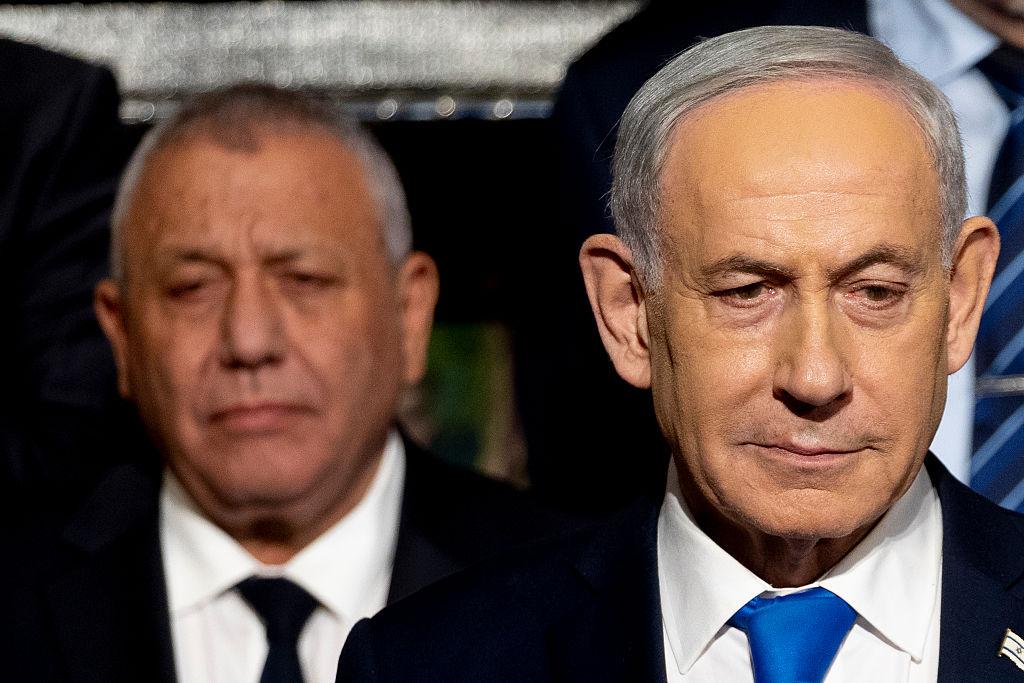
Gadi Eisenkot said Benjamin Netanyahu “cannot remain at the head of the government for a minute longer” after an Israeli television investigation raised allegations that Netanyahu’s chief of staff helped pass information to police that contributed to the arrest of three Ra’am activists around election day.
JERUSALEM — Israeli opposition leader and prime ministerial hopeful Gadi Eisenkot has dramatically escalated his confrontation with caretaker Prime Minister Benjamin Netanyahu, declaring that Netanyahu “cannot remain at the head of the government for a minute longer” after a television investigation raised allegations that figures connected to the Prime Minister’s Office helped trigger the arrest of Arab political activists on election day using information later found to be unfounded. Eisenkot, the former Israel Defense Forces chief of staff who has been formally tasked by President Isaac Herzog with trying to form Israel’s next government, described the conduct alleged in the report as a direct threat to Israeli democracy and called for an immediate investigation into the role of Netanyahu’s office, the police and the Shin Bet. Netanyahu’s office has rejected the accusations, saying its chief of staff merely passed information to police and had no further involvement in the investigation, while Likud accused Eisenkot of inflammatory rhetoric. The confrontation has transformed an already tense post-election coalition struggle into a broader dispute over the integrity of Israel’s democratic institutions, the treatment of Arab voters and whether Netanyahu should remain caretaker prime minister while a new government is being formed.
The immediate trigger was an investigative report by Israel’s Channel 12, which alleged that Netanyahu’s chief of staff, Ido Norden, contacted senior police channels shortly before the October 27 election with information accusing members of the Arab-led Ra’am party of involvement in vote-buying. According to the report, Norden referred police to a source who had previously worked in the Prime Minister’s Office and who supplied information that investigators initially treated as credible. That intelligence contributed to police raids on the homes of three Ra’am activists in southern Israel, including physician Sayaf Abu Riyash, and their arrest on suspicion of bribing voters. Channel 12 reported that officers searched homes without warrants, that the information used to justify the operation later proved baseless or greatly exaggerated, and that the three activists were ultimately released. The report also raised questions about whether the arrests were politically useful to Netanyahu’s campaign because the prime minister repeatedly cited them on election day while alleging widespread irregularities in Arab voting.
Those allegations remain under examination and have not been proven in court. Netanyahu’s office issued a categorical denial of any attempt to manufacture a scandal, saying criminal information had reached Norden and that he fulfilled what the office described as his civic duty by connecting the source with police. The Prime Minister’s Office said any suggestion that Norden then directed police intelligence officers or participated further in the investigation was false and potentially defamatory. Likud has separately argued that questions surrounding Arab voting irregularities were legitimate and has continued to dispute attempts to portray Netanyahu’s concerns as fabricated, while election officials have said no evidence has emerged that undermines the certified result of the October 27 vote.
Eisenkot responded to the Channel 12 report with unusually forceful language, saying the conduct attributed to Netanyahu and his inner circle represented a “tangible, direct and immediate threat” to Israeli democracy. He called for an immediate investigation and said the affair reinforced his view that Netanyahu should not remain caretaker prime minister while coalition negotiations continue. Eisenkot argued that the possibility of another election being conducted under Netanyahu’s premiership would be unacceptable if allegations of political interference in law-enforcement activity are not fully investigated, and he said the issue would now become a central consideration in the coalition negotiations he is conducting.
The statement marks a significant escalation because it came only hours after representatives of Eisenkot’s Yashar party and Netanyahu’s Likud held discussions about the possibility of a national unity government. Netanyahu has repeatedly urged Eisenkot to consider such an arrangement, arguing that Israel faces serious security threats from Iran, instability in Gaza and wider regional challenges that require political unity. Eisenkot has acknowledged that talks have taken place but has repeatedly questioned whether Netanyahu’s unity proposals are genuine, accusing him of attempting to preserve political power after losing the automatic parliamentary majority previously enjoyed by his bloc.
The October 27 election produced one of the most fragmented Knessets in Israel’s recent history. Netanyahu’s Likud remained a major force, but his traditional allies did not secure the 61 seats required for a governing majority. Eisenkot’s Yashar-led opposition also lacks an independent majority, meaning Arab-majority parties have emerged as potentially decisive players in government formation. President Herzog formally tasked Eisenkot with trying to form the next government after factions representing 67 members of the 120-seat Knesset recommended him, compared with 46 who recommended Netanyahu. Eisenkot now has 28 days from the November 8 mandate, with the possibility of a 14-day extension, to assemble a coalition capable of winning parliamentary confidence.
That arithmetic has intensified political arguments over Arab participation. The Joint List and Ra’am together hold 19 seats, enough to influence whether Eisenkot can assemble a majority. Netanyahu has repeatedly attacked the prospect of a government dependent on those parties and has accused Arab political forces of seeking to weaken Israel’s Jewish character, while Eisenkot and other opposition leaders have accused him of delegitimizing Arab citizens and their votes. The dispute became especially intense during and after the election, when Netanyahu publicly alleged that Arab voting irregularities and possible foreign interference had distorted the result.
Election officials and law-enforcement figures, however, have not established that the certified election result was compromised. Central Elections Committee chairman Justice Noam Sohlberg has said the allegations being investigated did not undermine the integrity of the election, while reporting from Israeli media indicates that the cases initially cited by Netanyahu involved questionable police and intelligence conduct and did not produce evidence supporting claims of a broad effort to steal the election. The three Ra’am activists at the center of the Channel 12 investigation were released, and authorities reportedly found no evidence establishing the original allegations against them.
The Channel 12 report added another extraordinary element by alleging that Shin Bet chief David Zini sought approval on election day to wiretap five Palestinian-Israeli members of the Knesset as part of an investigation into suspected foreign interference. According to the report, the Attorney General’s Office rejected that request, and investigators later determined there was no evidence of foreign interference serious enough to undermine the election. The Shin Bet has defended its actions in general terms, saying it acted within its legal mandate to investigate suspicions of subversion and outside influence and cautioning against reports purporting to reveal classified operational details.
The combination of the Ra’am arrests and the reported wiretap request has prompted growing concern among opposition figures and some current and former law-enforcement officials. Channel 12 quoted a senior official familiar with the case warning that another period in which security agencies were drawn into politically sensitive election disputes could damage public confidence in future elections. Eisenkot has seized on those concerns to argue that the issue is larger than the fate of the three activists and instead raises questions about whether institutions designed to operate independently of partisan politics were pressured or manipulated at a critical moment.
Netanyahu’s supporters reject that interpretation and accuse the opposition of using unproven media allegations to remove a prime minister who remains constitutionally in office until a successor is sworn in. Likud described Eisenkot’s statement as “outrageous incitement” and argues that Netanyahu continues to possess full legal authority as caretaker prime minister while coalition negotiations proceed. Under Israeli law, the outgoing government remains in office until a new government is approved by the Knesset, meaning Eisenkot cannot simply remove Netanyahu by declaring him unfit to remain.
That legal reality creates a sharp distinction between Eisenkot’s political demand and Netanyahu’s formal status. Eisenkot can argue that Netanyahu should resign or that political parties should refuse to support his continuation in office, but Netanyahu remains prime minister unless he resigns, is replaced through the formation of a new government or becomes legally disqualified under circumstances established by Israeli law. The current confrontation is therefore fundamentally political even though the allegations at its center involve potential law-enforcement misconduct.
Eisenkot’s demand also reflects a deeper breakdown in trust between the two men despite their recent security consultations. Only days before the latest confrontation, Eisenkot accused Netanyahu of refusing to provide him with necessary security briefings even though President Herzog had tasked him with forming a government. He asked Attorney General Gali Baharav-Miara to intervene and warned Netanyahu not to initiate non-urgent military action during the transition that could bind a future government or influence coalition negotiations. Netanyahu’s allies accused Eisenkot of politicizing national security, but the two men later held a two-hour briefing in which Eisenkot was updated on diplomatic and security challenges and both sides agreed to continue exchanging information when necessary.
That temporary cooperation now appears increasingly fragile. Eisenkot had already attacked Netanyahu after the opening of the 26th Knesset, calling his parliamentary speech divisive and accusing him of using Arab parties as political targets rather than seeking national reconciliation. He canceled one round of coalition negotiations with Likud after Netanyahu attacked the Joint List and Ra’am from the Knesset podium, saying those remarks convinced him that Netanyahu was attempting to preserve power by deepening divisions between Jewish and Arab citizens.
The latest allegations therefore reinforce an argument Eisenkot was already making before the Channel 12 investigation aired: that Netanyahu’s political strategy relies on presenting Arab political participation as illegitimate. Eisenkot has not embraced every position taken by the Joint List or Ra’am and remains substantially more hawkish on national security than many Arab lawmakers, but he has argued that Arab citizens’ votes must count in determining parliamentary majorities and that elected Arab parties cannot simply be dismissed from coalition mathematics because Netanyahu objects to their participation.
That issue has become central because the October election produced unusually strong Arab representation. Joint List and Ra’am together control 19 seats, and both supported giving Eisenkot the first opportunity to form a government. Their support does not automatically mean they will enter his coalition. Some Jewish-led parties aligned with Eisenkot remain reluctant to sit formally with the Arab factions, while Arab leaders themselves have indicated that outside support could be preferable to full cabinet participation.
Eisenkot is therefore pursuing several coalition paths at once. His negotiations have included possible cooperation with ultra-Orthodox parties, centrist and right-wing opposition factions, and discussions with Likud over a potential national unity government. The more sharply he attacks Netanyahu personally, however, the harder it becomes to imagine a coalition in which the two men share power without significant changes in leadership or conditions.
Netanyahu has proposed unity as a response to what he describes as exceptional national-security threats, particularly Iran. Eisenkot, a former military chief who has spent much of his political career emphasizing security competence, has not dismissed the principle of national unity but has questioned Netanyahu’s credibility and motives. His latest statement suggests that any unity arrangement headed by Netanyahu has become significantly less likely unless the allegations surrounding election-day conduct are resolved in a way that changes Eisenkot’s assessment.
The political crisis is especially sensitive because Israel remains engaged in unresolved regional conflicts and security negotiations. Iran continues to dominate strategic planning, Gaza remains politically and militarily unsettled, and Israel is simultaneously managing tensions involving Lebanon, Syria and the occupied Palestinian territories. President Herzog explicitly referred to those challenges when he tasked Eisenkot with forming a government, warning that Israel required stable leadership capable of addressing immediate security threats while rebuilding political trust at home.
Netanyahu’s allies argue that those circumstances make experienced continuity essential and that removing him during a sensitive transition could create instability. Eisenkot counters that institutional trust is itself a security issue and that a prime minister accused of undermining the fairness of elections cannot provide the legitimacy Israel needs. That disagreement illustrates how domestic democratic concerns and national security have become intertwined rather than separate issues in the current coalition crisis.
The allegations involving the Prime Minister’s Office are particularly explosive because of the timing of the arrests. The three Ra’am activists were detained around election day, when every development involving voting irregularities carried enormous political consequences. Netanyahu and Likud publicly highlighted those arrests as evidence supporting claims that Arab parties were involved in improper efforts to influence the election. If investigators were eventually to establish that information leading to the arrests was deliberately fabricated or politically planted, the issue would move far beyond an ordinary campaign dispute and could become one of the most serious political scandals of Netanyahu’s career.
There is, however, no such finding at this stage. The Prime Minister’s Office says Norden simply received information that appeared criminal in nature and passed it to police, as any citizen might be expected to do. The office denies he instructed investigators, coordinated arrests or manipulated police procedures. Determining whether that account is accurate will require investigators to reconstruct communications between the Prime Minister’s Office, police officials, the purported source and the security agencies involved.
The police and Attorney General’s Office are reportedly examining precisely that question. Investigators are expected to consider when the information originated, who provided it, whether officials knew it was unreliable, why warrantless searches were conducted and whether political actors influenced operational decisions. They may also examine how quickly the allegations were communicated publicly and whether campaign officials possessed information about the arrests before ordinary law-enforcement procedures were completed.
The role of the Shin Bet could also face scrutiny. Intelligence services operate under strict legal constraints when their activities intersect with domestic politics because even the appearance of partisan involvement can damage confidence in democratic institutions. The reported request to wiretap Arab members of parliament is therefore highly sensitive, particularly because the Attorney General’s Office reportedly rejected it and because the underlying foreign-interference concerns did not ultimately invalidate the election.
Eisenkot’s call for a formal commission of inquiry reflects the seriousness with which he wants the affair treated. A commission could examine both the Prime Minister’s Office and the conduct of security agencies, potentially moving the controversy beyond ordinary police investigation into a wider institutional review. Netanyahu and Likud are likely to resist any mechanism they regard as politically controlled by opponents, making the composition and authority of any inquiry another possible battleground.
The affair also raises questions about how Israel handles political speech during elections. Netanyahu’s repeated claims that Arab parties were stealing or contaminating the election were made before authorities established evidence supporting such broad accusations. Opposition figures argue those claims were designed to suppress the legitimacy of Arab participation and prepare supporters to question an unfavorable result. Netanyahu’s camp argues it was legitimate to raise concerns about irregularities and foreign influence when law-enforcement agencies themselves were investigating them.
Those competing narratives matter because democratic legitimacy depends heavily on whether political leaders accept certified results. Israel has experienced deep political polarization for years, including repeated elections, battles over judicial reform and mass protests. Allegations that government institutions were used to shape election-day narratives therefore strike at an already fragile area of public trust.
The October election itself left Netanyahu politically weakened but not removed. His bloc won 53 seats, while Eisenkot’s Zionist opposition bloc secured 48 and Arab-majority parties took 19. That distribution means no purely Jewish political bloc holds a majority, forcing parties to choose between cooperation across ideological boundaries, another election or some form of national unity arrangement.
President Herzog’s consultations underscored that dilemma. Sixty-seven lawmakers recommended Eisenkot, giving him the first opportunity to form a government, but those recommendations include parties that do not necessarily agree to sit together in one coalition. Herzog acknowledged the mutual vetoes and ideological contradictions but decided Eisenkot had the strongest initial claim to try.
Netanyahu therefore remains politically relevant even without the first mandate. If Eisenkot fails to assemble a government within the legal timeframe, Herzog could give another lawmaker an opportunity or the process could ultimately lead to another election. That possibility makes Eisenkot’s warning against allowing Netanyahu to remain prime minister through a new election cycle especially important. He is effectively arguing that the current controversy should shape not only the government now being negotiated but also the rules under which any future election would take place.
For Netanyahu, the accusation represents another challenge to a political career defined by repeated survival in moments when rivals believed his time in office was ending. He has survived corruption charges, coalition collapses, mass protests, security crises and previous election defeats or deadlocks. His supporters argue that opponents repeatedly attempt to remove him through institutions when they cannot defeat him politically, while critics say his longevity has come partly from relentless attacks on those institutions whenever they constrain him.
The latest dispute will likely deepen that divide. Netanyahu’s base is unlikely to accept Eisenkot’s characterization of him as an immediate threat to democracy without clear investigative findings, while Eisenkot’s supporters will point to the released Ra’am activists and the reported warrantless raids as evidence that the affair requires far more than routine explanation.
Arab political leaders have their own stake in the outcome. The arrests and allegations reinforced fears among Palestinian citizens of Israel that state institutions can treat their political participation with suspicion, especially when turnout is high enough to alter the parliamentary balance. Joint List and Ra’am leaders have demanded that their voters be treated as equal citizens whose ballots carry the same legitimacy as those cast for Jewish-led parties.
The affair therefore has consequences extending beyond Netanyahu and Eisenkot. If investigators conclude that partisan actors manipulated security institutions to influence public perception of Arab voting, trust between Arab citizens and the state could deteriorate sharply. If the allegations against Netanyahu’s office are disproven, opposition figures will face criticism for escalating claims before investigations were complete.
The next several weeks will determine which direction the crisis takes. Eisenkot must continue negotiating a government while simultaneously pushing for an investigation into the man whose party remains one of the largest forces in parliament. Netanyahu must defend his office against allegations of interference while remaining responsible for Israel’s security as caretaker prime minister. Police, the Shin Bet and the attorney general must examine conduct involving their own institutions without appearing to favor either side.
That combination makes the controversy unusually volatile. Coalition talks are normally about budgets, ministries and policy agreements. Israel’s current negotiations are now also about whether the caretaker prime minister can be trusted to oversee democratic institutions while his rival attempts to replace him.
Eisenkot’s words should therefore be understood as both a political judgment and a strategic declaration. He has not produced a legal mechanism that automatically removes Netanyahu, and no court has ruled that Netanyahu participated in election interference. What Eisenkot has done is make Netanyahu’s removal from the premiership a central condition shaping his coalition strategy and explicitly connect it to the integrity of future elections.
Netanyahu, for his part, remains in office and continues to reject the premise that he or his aides acted improperly. His office’s position is that an individual reported potentially criminal information and that law-enforcement authorities independently decided what to do with it. That explanation will now face scrutiny from investigators examining whether the source was credible and whether the arrests were influenced by political actors.
The central question is therefore no longer simply whether Eisenkot can form a government. It is whether Israel can navigate a transfer-of-power process while major political actors accuse one another of threatening the democratic system itself.
The immediate legal and political facts remain distinct. Netanyahu is still caretaker prime minister. Eisenkot has the presidential mandate to try to form a government. The Ra’am activists were released after the information underlying their arrests failed to produce the expected evidence. Netanyahu’s office denies manufacturing the case. Police and legal authorities are examining the circumstances, and no final finding has established deliberate wrongdoing by the prime minister or his staff.
What has unquestionably changed is the political atmosphere. Eisenkot’s statement has pushed the post-election confrontation beyond coalition arithmetic and into a fight over democratic legitimacy, while the allegations surrounding election-day law-enforcement activity have created a new test for institutions already under pressure from years of polarization.
If investigators substantiate claims of deliberate political interference, the consequences for Netanyahu could be severe and could reshape coalition negotiations dramatically. If they reject the allegations, Eisenkot’s decision to demand Netanyahu’s immediate departure will itself become a major political issue. Until that investigation is completed, however, both possibilities remain open.
For now, Israel is entering a period in which two competing leaders are operating simultaneously from very different positions of authority: Netanyahu remains prime minister under law, while Eisenkot holds the presidential mandate to replace him. Their confrontation has become sharper precisely because neither has yet defeated the other institutionally.
Eisenkot’s declaration that Netanyahu cannot stay in office “for even one more minute” captures the depth of that breakdown. It is not a statement that has legal force by itself, but it signals that the opposition leader increasingly views Netanyahu’s continued premiership not simply as a political obstacle but as a democratic risk. Netanyahu and Likud reject that accusation outright.
The investigation into the Ra’am arrests may now determine whether that argument remains a matter of partisan rhetoric or develops into a deeper institutional crisis. With government formation still unresolved, Arab parties holding potentially decisive votes and law-enforcement agencies facing questions about election-day conduct, Israel’s post-election struggle has become about far more than who assembles 61 seats. It is now also about whether the country’s political and security institutions can maintain public trust while the battle for power continues.