
TRUMP CALLS KIM JONG UN HIS FRIEND WHEN ASKED WHY NORTH KOREA CAN HAVE NUCLEAR WEAPONS BUT IRAN CANNOT
President Donald Trump has described North Korean leader Kim Jong Un as his friend while responding to a question about why Washington accepts the reality of a nuclear armed North Korea while insisting that Iran must not obtain nuclear weapons. Trump said Kim likes and respects him and suggested the North Korean leader would be fine as long as he remains president.
President Donald Trump has again described North Korean leader Kim Jong Un as his friend after being questioned about the apparent contrast between Washington's approach to North Korea's nuclear arsenal and its determination to prevent Iran from acquiring nuclear weapons.
Asked Tuesday why North Korea can possess nuclear weapons while Iran cannot, Trump focused his response on his personal relationship with Kim.
“He happens to be a friend of mine,” Trump said of the North Korean leader.
Trump went on to say that he believes he is one of the few international figures with whom Kim has a positive relationship.
“I'm about the only person in the entire world that he likes, and I like him,” Trump said.
The President then emphasized what he described as mutual respect between the two leaders.
“As long as I'm around, he's going to be fine,” Trump said. “You know why? Because he respects me and he likes me.”
TRUMP'S ANSWER HIGHLIGHTS HIS RELATIONSHIP WITH KIM
Trump has repeatedly portrayed his personal relationship with Kim as an important factor in managing tensions between Washington and Pyongyang.
During Trump's first presidency, relations between the two countries moved from threats and escalating tensions to unprecedented direct diplomacy.
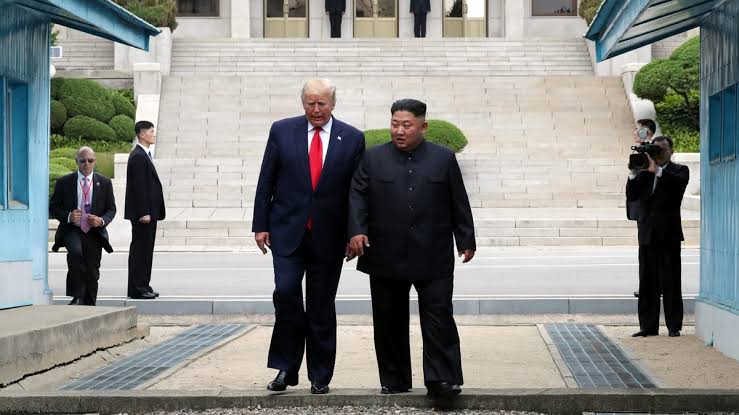
Trump and Kim met three times between 2018 and 2019, including summits in Singapore and Hanoi and a meeting at the Korean Demilitarized Zone.
Trump became the first sitting U.S. president to step into North Korea during the 2019 meeting.
The diplomacy did not ultimately produce an agreement eliminating North Korea's nuclear arsenal.
Pyongyang has continued developing nuclear weapons and ballistic missile capabilities while maintaining that its nuclear deterrent is essential to national security.
WHY NORTH KOREA AND IRAN ARE TREATED DIFFERENTLY
The question put to Trump reflects a longstanding difference in the nuclear situations involving North Korea and Iran.
North Korea has already developed and tested nuclear weapons.
Iran maintains that its nuclear program is intended for peaceful purposes and has denied seeking a nuclear weapon.
The United States and Israel have challenged Tehran's assurances and have sought to prevent Iran from developing the capability to produce a nuclear weapon.
Washington's approach toward Iran has therefore focused heavily on preventing Tehran from crossing that threshold.
North Korea presents a different strategic reality because Pyongyang already possesses nuclear weapons and has conducted multiple nuclear tests.
Trump's comments did not amount to a new U.S. policy recognizing or formally accepting North Korea as a legitimate nuclear weapons state.
Instead, his answer centered largely on his personal relationship with Kim.
TRUMP HAS LONG SPOKEN WARMLY ABOUT KIM
Trump's latest remarks are consistent with language he has used about Kim for years.
After a period of intense confrontation early in his first presidency, Trump began emphasizing the relationship he developed with the North Korean leader.
He has repeatedly said that the two men get along and that Kim respects him.
Trump has argued that his relationship with Kim reduced the risk of direct military confrontation between the United States and North Korea.
Critics of Trump's approach have argued that his warm language toward Kim gives political legitimacy to an authoritarian leader without securing North Korea's denuclearization.
Supporters of direct engagement have argued that communication between the two leaders can reduce tensions and create opportunities for diplomacy.
IRAN REMAINS AT CENTER OF NUCLEAR DISPUTE
Trump's comments come as Iran's nuclear program remains one of the most consequential issues in U.S. foreign policy.
Washington has maintained that Iran must not acquire a nuclear weapon, while Tehran insists it does not seek one.
The comparison with North Korea highlights one of the central challenges confronting nuclear nonproliferation policy.
North Korea already possesses nuclear weapons, while U.S. policy toward Iran is intended to prevent another country from reaching that stage.
Trump's answer Tuesday did not provide a detailed policy explanation for that distinction.
Instead, he returned to an argument that has defined much of his approach to North Korea: that his personal relationship with Kim Jong Un provides an important channel for managing one of the world's most heavily armed and isolated states.