
STRASBOURG STUDENT PROTESTS TURN TENSE AS CROWDS CONFRONT POLICE AT PONT GALLIA
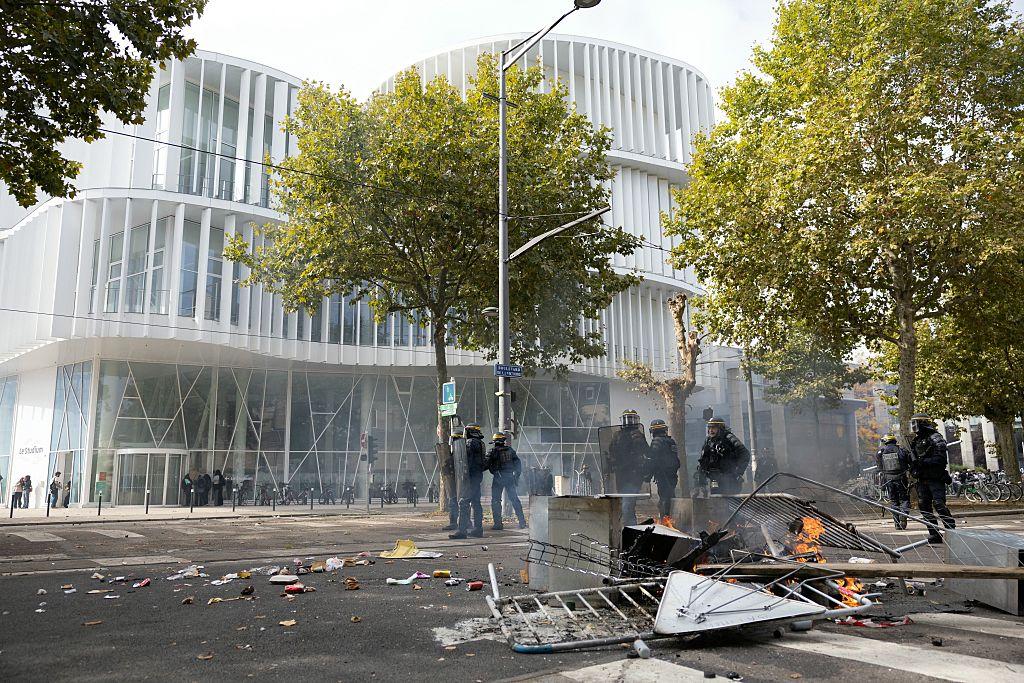
Viral footage from Pont Gallia shows student protesters confronting police in Strasbourg as France’s education protest movement expands nationwide amid anger over school conditions, staffing shortages and public spending.
Fresh tensions broke out in Strasbourg on Tuesday as high school students, university students and education workers joined a nationwide day of protest over conditions in France’s education system, with viral footage from Pont Gallia showing demonstrators facing police during one of the most closely watched confrontations of the day.
The video circulating online shows a dense crowd of protesters approaching a police line on the bridge while officers attempt to hold their position. In another sequence, demonstrators appear to move forward together, forcing officers to give ground by several meters as the confrontation becomes increasingly tense. The footage has spread rapidly across social media because it captures the pressure now building around a protest movement that began over deteriorating school conditions and has since developed into a much wider national crisis involving students, teachers, parents, unions and police.
The precise order of events in every viral clip cannot always be established from social media footage alone, but the wider confrontation in Strasbourg is consistent with independently reported clashes across France on October 6. Riot police and demonstrators faced each other in several cities as the student movement held its largest nationwide mobilization so far, with authorities deploying tear gas and other crowd control measures in locations where protests turned violent.
The Strasbourg confrontation comes after days of tension around schools and university campuses in Alsace. High school students have been blocking entrances, organizing demonstrations and joining wider marches as anger over overcrowded classrooms, teacher shortages, deteriorating buildings and poor maintenance continues to spread. Some schools have reported problems ranging from leaking roofs and damaged facilities to broader complaints that students are being asked to sit important examinations without receiving consistent teaching because of staff shortages.
The movement began in disadvantaged areas around Paris but expanded rapidly into a national protest involving hundreds of schools. By Tuesday, demonstrations were taking place across major French cities, with students joined in some areas by teachers, parents and trade union members. The scale of the mobilization has forced the government to respond to what has become one of the most serious education-related protest movements in France in years.
More than 250,000 people were reported to have taken part in demonstrations across the country on Tuesday. Authorities also reported hundreds of arrests during the day, while injuries have been recorded among students, school staff and police officers during the wider unrest. The violence has added pressure to the government because the original complaints about education funding and school conditions are now being discussed alongside questions about policing, public order and the treatment of minors during demonstrations.
Strasbourg has emerged as one of the most sensitive areas in that wider confrontation. Schools in the city and surrounding municipalities have been affected by blockades, closures and repeated gatherings, while university authorities have also taken precautions. Sciences Po Strasbourg moved teaching online for October 5 and 6 after tensions around the university campus and concerns that further escalation could disrupt classes or threaten the safety of students and staff.
Local authorities had attempted to restrict gatherings around several secondary schools in Strasbourg and nearby municipalities, but that effort was challenged in court. The prefect of Bas-Rhin issued an order banning gatherings near 15 high schools between October 3 and October 6, while a separate order authorized the use of camera-equipped drones to monitor demonstrations in Strasbourg, Schiltigheim and Bischheim.
The Strasbourg Administrative Court later suspended the ban on gatherings after concluding that the restriction was too imprecise in defining the areas where demonstrations would be prohibited. The court also found that authorities had not sufficiently demonstrated that available police resources were inadequate to manage the protests without imposing such a broad restriction.
The same court, however, allowed the use of surveillance drones to continue. Judges accepted that there was a demonstrated risk of public disorder after several days of spontaneous gatherings, the use of fireworks and projectiles, injuries and damage to property. Because the drone surveillance was limited in both time and geographic scope, the court considered it proportionate to the security situation.
That ruling created an unusual situation in Strasbourg on Tuesday. Demonstrators were legally able to gather around several of the schools previously covered by the ban, while police retained enhanced surveillance powers and a large security presence remained in place. The confrontation at Pont Gallia unfolded against that background, with both protesters and security forces already operating in an atmosphere shaped by several days of disorder.
Unions had tried to reduce the risk of another round of uncontrolled clashes by helping organize more structured demonstrations in Strasbourg and Mulhouse. Local labor groups had called for de-escalation and urged authorities to take account of the fact that many participants were minors. They also stressed that police force should remain necessary and proportionate to the circumstances.
Student groups, meanwhile, continued to argue that their original demands were being overshadowed by images of violence. Some participants in Alsace have publicly complained that media coverage has concentrated heavily on property damage and confrontations with police while giving less attention to the issues that brought students into the streets in the first place.
Those grievances include deteriorating school infrastructure, large class sizes, shortages of teachers and concerns that education spending is not keeping pace with the needs of schools. The movement has also become linked to anxiety over the French government’s broader budget plans, which include significant pressure to reduce public spending as the country struggles with high debt and rising borrowing costs.
The government has proposed an increase in education spending, but protesters and unions argue that it is insufficient once inflation, staffing shortages and years of underinvestment are taken into account. That disagreement has helped turn what began as localized school blockades into a national argument about whether France is investing enough in its education system and whether students in poorer areas are being asked to absorb a disproportionate share of the consequences.
The political environment has made the protests even more sensitive. France is heading toward a presidential election next year, while the government is simultaneously trying to reassure financial markets that it can control public spending. That leaves officials facing pressure from two directions. Increasing education spending could help answer the protesters’ demands, but large new commitments would make it harder for the government to meet its deficit and debt targets.
Prime Minister Sébastien Lecornu has acknowledged the seriousness of the school crisis and has promised reforms, but the demonstrations have continued because many students and teachers say they want concrete action rather than general assurances. Education officials have also announced plans for further consultations and measures addressing school conditions, yet the movement has shown little sign of disappearing quickly.
The protest has also become increasingly difficult to manage because it is no longer controlled by a single organization. Student unions, teachers, parents and established labor groups are taking part, but spontaneous gatherings and groups of young people outside formal union structures have also been involved. Police authorities have said that some demonstrations have been joined by people seeking confrontation rather than education reform, while protesters and rights groups have accused police of using excessive force against teenagers.
Those competing claims are now part of the national debate surrounding the movement. Authorities have pointed to attacks on police officers, fires, vandalism and other serious incidents as evidence that strong crowd control measures are sometimes necessary. Student groups and civil liberties organizations have responded that the presence of violent individuals should not be used to justify indiscriminate force against largely peaceful demonstrators.
One of the most serious incidents occurred before Tuesday’s nationwide mobilization when a 15-year-old boy suffered devastating injuries after picking up a police grenade during unrest in Lens. The teenager lost a hand and part of his lower arm. The incident intensified scrutiny of police tactics and added to calls for investigations into the use of crowd control weapons around demonstrations involving large numbers of minors.
The Strasbourg court ruling reflects the difficulty authorities now face in balancing those competing concerns. Judges accepted that there was a genuine risk of disorder but concluded that the blanket restriction around several schools went too far. At the same time, they allowed drone surveillance to remain in place because they considered it sufficiently targeted and justified by the circumstances.
That balance between public order and freedom of assembly is likely to remain central if demonstrations continue. French authorities have extensive experience policing large protests, but the age of many participants in the current movement makes the situation particularly sensitive. A heavy-handed response risks increasing anger and drawing more students into the streets, while insufficient control could allow further violence or property damage.
For Strasbourg, Tuesday’s scenes at Pont Gallia have become one of the most visible illustrations of that tension. The viral footage does not by itself explain what happened before every confrontation or establish responsibility for each movement by protesters and police, but it shows how quickly a student demonstration can move from organized protest into a direct standoff with security forces.
The images are also likely to intensify scrutiny of the way police are handling demonstrations in the city. When crowds move toward officers and police lines retreat, the footage can create the impression that authorities have lost control, even when the movement may be part of a tactical decision to create space or avoid immediate confrontation. That is why video evidence must be considered alongside verified reporting about the wider event rather than interpreted in isolation.
What is clear is that the Strasbourg demonstration is part of a much larger national movement rather than a local dispute. Students across France are challenging the condition of the education system, while teachers and parents in many areas have expressed sympathy with their complaints. The government is attempting to address those demands while also containing violence and protecting schools, transport systems and public property.
The next phase will depend partly on whether the government can persuade student groups that meaningful changes are coming. If the demonstrations continue to produce violent clashes, however, political attention may shift further away from classroom conditions and toward policing and public order, making a negotiated resolution more difficult.
For now, Strasbourg remains one of the cities where those two stories are colliding. Students are pressing demands over schools and public investment, while police are trying to prevent demonstrations from becoming another round of urban disorder. The confrontation at Pont Gallia captured that conflict in a few tense minutes, which is why the footage has traveled far beyond Alsace and become one of the defining images of France’s latest student mobilization.