
FRANCE FIRES M51.3 MISSILE FROM NUCLEAR SUBMARINE AS MACRON PUTS DETERRENCE AT CENTER OF SECURITY MESSAGE
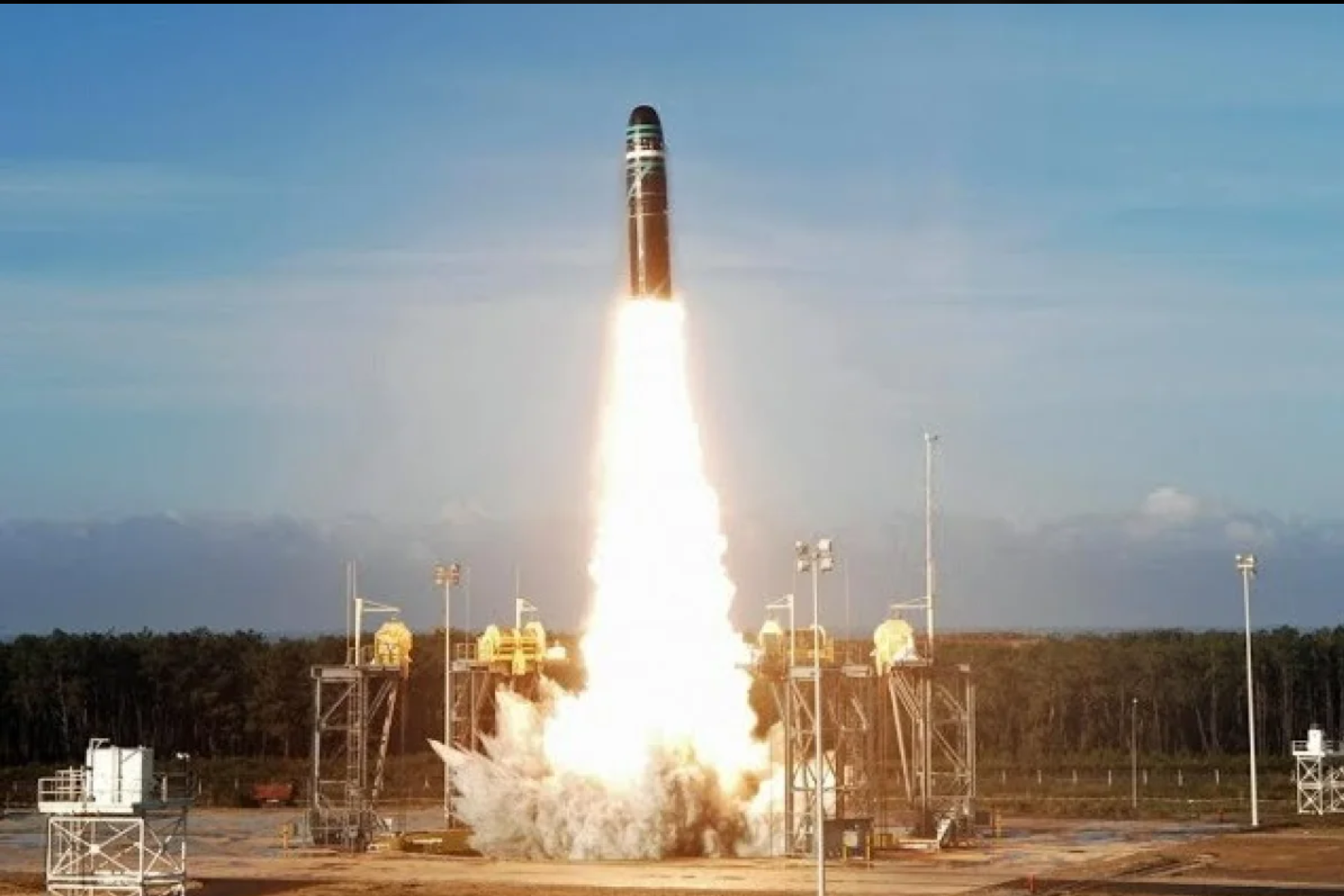
France has successfully launched its upgraded M51.3 strategic ballistic missile from the nuclear-powered submarine Le Vigilant, with President Emmanuel Macron using the test to reinforce France’s commitment to maintaining and modernizing its independent nuclear deterrent.
France has successfully fired its upgraded M51.3 strategic ballistic missile from the nuclear-powered submarine Le Vigilant, completing a major acceptance test for one of the most important weapons in the country’s nuclear deterrent and giving President Emmanuel Macron a highly visible moment to restate France’s determination to remain an independent military and nuclear power.
The missile was launched on October 6 from waters off Finistère in western France, with Macron observing the operation from the French Navy’s multi-mission frigate Auvergne. The missile was not carrying a nuclear warhead, and French authorities said the operation was conducted as part of the certification of Le Vigilant following an extensive period of maintenance and technical work.
The immediate purpose of the launch was operational. Le Vigilant had undergone a scheduled overhaul, and the French Navy needed to demonstrate that the submarine could once again operate its strategic missile system under realistic conditions. The test therefore involved much more than the missile itself. It was also a check on the submarine, its launch infrastructure, communications systems, command chain and the technical network that supports France’s sea-based nuclear force.
France’s Direction générale de l’armement monitored the missile throughout its flight, including through the country’s specialized test and measurement systems. The projectile eventually came down in a designated area of the North Atlantic, several hundred kilometers from any coastline. French authorities stressed that no nuclear payload was used and said the firing was conducted in accordance with France’s international obligations.
The technical explanation was straightforward. The political message was much broader.
Macron used the successful firing to underline what he sees as the continuing importance of French military power in a period of growing instability across Europe and beyond. He praised the DGA, the Atomic Energy Commission, ArianeGroup, Naval Group and the French Navy, describing the operation as an exceptional achievement and pointing out that only a small number of countries possess the industrial, scientific and military expertise required to develop and maintain such a system.
For Macron, the significance of the launch went beyond whether a missile flew correctly. He presented it as another demonstration that France’s nuclear deterrent remains credible, modern and capable of operating for decades to come.
The M51.3 is the latest evolution of France’s submarine-launched strategic missile and entered operational service in 2025. It is believed to have a range exceeding 9,000 kilometers, giving French ballistic missile submarines the ability to remain far from hostile territory while retaining the capacity to strike targets across intercontinental distances.
That distance matters because survivability is central to the logic of nuclear deterrence.
France’s strategic submarines are designed to remain hidden at sea for extended periods, making them extremely difficult for an adversary to locate. Unlike land-based weapons that can be identified and targeted, a submarine operating beneath the ocean gives France the ability to preserve a retaliatory force even if military bases, command centers or other installations were attacked first.
That is the foundation of what military planners call a second-strike capability. The idea is not that France expects to launch nuclear weapons in ordinary conflict. The idea is that any adversary considering a major attack must assume that France would retain the ability to respond even after suffering severe damage.
The M51.3 strengthens that calculation.
Its exact technical capabilities are not fully public, as would be expected with a strategic weapons system, but the upgraded missile is intended to extend the effectiveness of France’s submarine-based deterrent as missile defenses, detection systems and military technologies continue to improve.
The weapon is part of a much larger system that includes the submarines that carry it, specialized communications networks, command infrastructure, nuclear warheads, bases, crews, maintenance facilities and an industrial network capable of keeping the entire structure operational for decades.
France has invested heavily in that system for generations.
The country currently maintains both sea-based and air-delivered nuclear forces, giving it two distinct components of deterrence. The submarine force is widely regarded as the more survivable of the two because the location of an operational ballistic missile submarine is intended to remain secret.
France has traditionally sought to keep at least one strategic submarine available at sea, ensuring that a retaliatory capability remains present at all times.
The country currently operates four Triomphant-class ballistic missile submarines, including Le Vigilant. These vessels are expected eventually to be replaced by a new generation of strategic submarines already under development.
Macron pointed directly to those future submarines after Tuesday’s launch.
He said France’s next generation of strategic vessels is already being built and linked their development to the broader renewal of the country’s nuclear forces. He also highlighted work on future strategic missiles for France’s airborne deterrent, including weapons intended to be faster, more maneuverable and harder to intercept.
The scale of those projects shows that France is not treating nuclear deterrence as a declining Cold War legacy.
It is planning for it to remain central to national defense for decades.
Macron said he began renewing France’s strategic military capabilities after taking office in 2017 and argued that the worsening international security environment has justified that decision.
His language after the M51.3 launch was unusually direct. He connected power with independence, arguing that France must remain strong if it intends to remain free and protect its citizens against future threats.
That argument sits at the center of Macron’s wider defense policy.
France has increased military spending sharply in recent years, and Macron says the country’s defense budget will have doubled over a 10-year period. The money is being directed not only toward nuclear systems but also toward ammunition, aircraft, intelligence, cyber capabilities, space assets, conventional forces and the rebuilding of industrial capacity.
The change reflects a wider transformation happening across Europe.
For much of the period after the Cold War, many European countries reduced military spending, cut troop numbers and allowed weapons stockpiles to shrink. Russia’s invasion of Ukraine radically changed that calculation.
European governments are now rebuilding ammunition reserves, strengthening air defenses, increasing troop readiness and reconsidering how much military support they can assume will always come from the United States.
France has been one of the strongest advocates of what Macron calls European strategic autonomy.
The phrase does not mean abandoning NATO or ending cooperation with Washington. It refers to the idea that Europe should be capable of defending its interests even if American support becomes less certain or less immediate.
France’s nuclear arsenal gives Paris a unique position in that debate.
Since the United Kingdom left the European Union, France has remained the EU’s only nuclear-armed member state. Its weapons are controlled nationally. They are not operated by Brussels, and the final authority over their use rests with the French president.
That independence has always been important to French nuclear doctrine.
France developed its own nuclear deterrent in part because successive governments did not want the country’s ultimate security to depend entirely on the decisions of another nuclear power. The principle was that France needed the ability to defend what it considered its vital interests even if allies were unwilling to act.
That doctrine survived the end of the Cold War.
What has changed is the environment around it.
The war in Ukraine has returned large-scale conventional conflict to Europe. Russia has repeatedly emphasized its own nuclear forces. NATO members have reinforced their eastern defenses. The United States, China and Russia are all investing in next-generation strategic systems, including hypersonic weapons and advanced missile technology.
Against that background, France has decided that allowing its nuclear forces to age without replacement would weaken the very deterrence they are supposed to provide.
The M51.3 is part of that response.
The missile is not important simply because it is newer. It is important because France wants potential adversaries to believe that its submarine force can continue operating against increasingly sophisticated surveillance and missile defense systems.
Range gives the submarine more freedom over where it can patrol. Reliability matters because strategic systems may spend years in service before ever being tested under real conditions. Penetration capability matters because a modern adversary may attempt to detect or intercept incoming warheads.
The entire system has to remain credible.
A nuclear deterrent that exists on paper but cannot be relied upon in practice would carry far less strategic value.
That is why France continues to conduct missile tests.
The October 6 firing was not a nuclear explosion. France did not detonate a nuclear weapon. It launched a missile designed to carry France’s strategic nuclear capability, but the missile itself was unarmed.
That distinction is important because strategic missile tests can easily be described more dramatically than the facts justify.
The official purpose of the test was to validate Le Vigilant’s return to operational capability after maintenance. France did not announce that it was responding to a specific Russian action, and it did not present the firing as preparation for an immediate conflict.
At the same time, the broader geopolitical environment cannot be ignored.
The launch took place at a moment when relations between France and Russia remain tense, European countries are expanding their defense budgets and governments across the continent are openly discussing how they would respond if the United States became less willing to carry the largest share of Europe’s defense burden.
That gives every strategic weapons test a political audience beyond the military personnel conducting it.
Macron clearly understood that.
His remarks after the launch were not limited to engineers, sailors or technical success. He spoke about the durability of France’s deterrent, future submarines, new missiles and the need for military power.
That transformed an acceptance test into a broader statement of strategy.
France wants its allies to see that it is investing for the long term.
It wants potential adversaries to understand that its nuclear force is not being allowed to become obsolete.
And it wants the French public to understand why billions of euros continue to be committed to weapons that the government hopes will never actually be used.
That contradiction sits at the heart of nuclear deterrence.
The weapons are built so that they do not have to be fired in war.
Supporters of deterrence argue that the possibility of catastrophic retaliation discourages major powers from attacking one another. They say nuclear weapons have helped prevent direct large-scale conflict between nuclear states because the cost of escalation is too high.
Critics see a different danger.
They argue that maintaining and modernizing nuclear arsenals creates the possibility of catastrophic destruction through miscalculation, accident or escalation, while continued investment by one nuclear power encourages others to do the same.
France has shown little sign of changing course because of that criticism.
Instead, Paris is modernizing almost every element of its strategic force.
ArianeGroup plays a major role in the M51 program. Naval Group is central to the construction and maintenance of France’s submarines. The Atomic Energy Commission provides scientific and nuclear expertise. The DGA oversees testing, procurement and certification, while the French Navy is responsible for operating the submarine force.
The M51.3 launch was therefore the visible end of a much larger national system involving military personnel, scientists, engineers and major defense companies.
That system is expensive because France intends it to survive under the worst possible conditions.
A strategic submarine has to remain hidden.
Its communications have to work.
Its crew has to be able to receive commands.
The missile has to launch.
The warhead has to reach its intended destination.
And an adversary has to believe all of those things are possible.
Tuesday’s launch addressed one part of that chain.
Le Vigilant had undergone maintenance and needed to prove that its missile system remained operational. The successful firing demonstrated that the submarine could once again perform one of the central missions for which it was built.
France regards that as a technical requirement.
Macron presented it as strategic credibility.
The two are closely connected.
Nuclear deterrence depends as much on perception as hardware. A government can publish military doctrine and threaten retaliation, but the threat has less value if another state doubts whether the weapons will actually function.
A successful launch reduces that doubt.
That is why missile tests are watched carefully by governments far beyond the country conducting them.
The M51.3 launch also comes as France prepares for the next generation of its nuclear force.
The future ballistic missile submarine program is already underway and is intended to replace the current Triomphant-class vessels over the coming decades.
Those submarines are being designed for a strategic environment that may look very different from the one France faces today.
New sensors, autonomous systems, underwater surveillance technologies, advanced missile defenses and increasingly powerful computing systems could all affect the ability of submarines to remain hidden.
France is therefore trying to build not for the next election cycle, but for the middle of the century and beyond.
The same is true of its missile programs.
Strategic weapons take years to design, test, certify and deploy. By the time a new system becomes operational, the threat it was designed to counter may already have evolved.
France is attempting to stay ahead of that cycle.
Macron’s comments about hypersonic and maneuverable future strategic missiles fit into that effort. A weapon that can travel at extreme speed and change trajectory is significantly more difficult to intercept than a conventional ballistic system following a more predictable flight path.
France is not alone in pursuing such technology.
The United States, Russia and China are all investing in hypersonic weapons, while several other powers are developing their own capabilities.
That competition is steadily reshaping strategic planning.
For France, the aim is not necessarily to match every weapon developed by larger nuclear powers in numbers.
Its doctrine is built around maintaining enough capability to impose unacceptable damage on any state that threatens its vital interests.
That is why France does not need the same size arsenal as the United States or Russia to maintain the deterrence it seeks.
It needs an arsenal it believes is survivable, reliable and credible.
The M51.3 is part of that calculation.
The successful firing from Le Vigilant does not suddenly transform France into a more powerful nuclear state than it was the day before.
France already possessed nuclear weapons, ballistic missile submarines and long-range strategic missiles.
What the test does is demonstrate that one important part of the existing system remains functional after maintenance and that the newest version of the missile can be operated from an active submarine.
That matters to military planners.
It also gives Macron evidence for the political case he has been making for years.
France, in his view, should not allow its freedom of action to depend entirely on another country.
It should maintain its own industrial base.
It should build its own strategic systems.
It should spend enough to keep them operational.
And it should retain the ultimate means of deterrence under national control.
The October 6 launch fits neatly into that argument.
The missile flew from a French submarine.
It was monitored by French military infrastructure.
It was supported by French industrial and scientific institutions.
And the operation was observed by the French president.
That combination made the test more than a technical event.
It became an image of the kind of strategic independence Macron has spent much of his presidency advocating.
There will still be debate over the cost, necessity and danger of nuclear weapons.
There will still be questions about how far France intends to extend discussions about its deterrent to other European countries.
There will still be arguments over whether Europe should rely more heavily on French nuclear capability as uncertainty grows around the future of transatlantic security.
But on one point, Macron is leaving little room for ambiguity.
France does not intend to give up its deterrent.
It intends to modernize it.
Its future submarines are being built. Its missiles are being upgraded. Its airborne strategic weapons are being renewed. Its defense budget is rising.
And on October 6, one of the clearest demonstrations of that strategy came from beneath the Atlantic when Le Vigilant launched the M51.3.
The missile carried no nuclear warhead, and the operation was officially an acceptance firing following maintenance.
But the political meaning was larger.
France wanted to know that the system still worked.
Macron wanted the world to know it too.