
SOUTH KOREA LOADED DIESEL FOR RUSSIA ON SANCTIONED TANKERS WHILE SEOUL PLEDGED AID TO UKRAINE
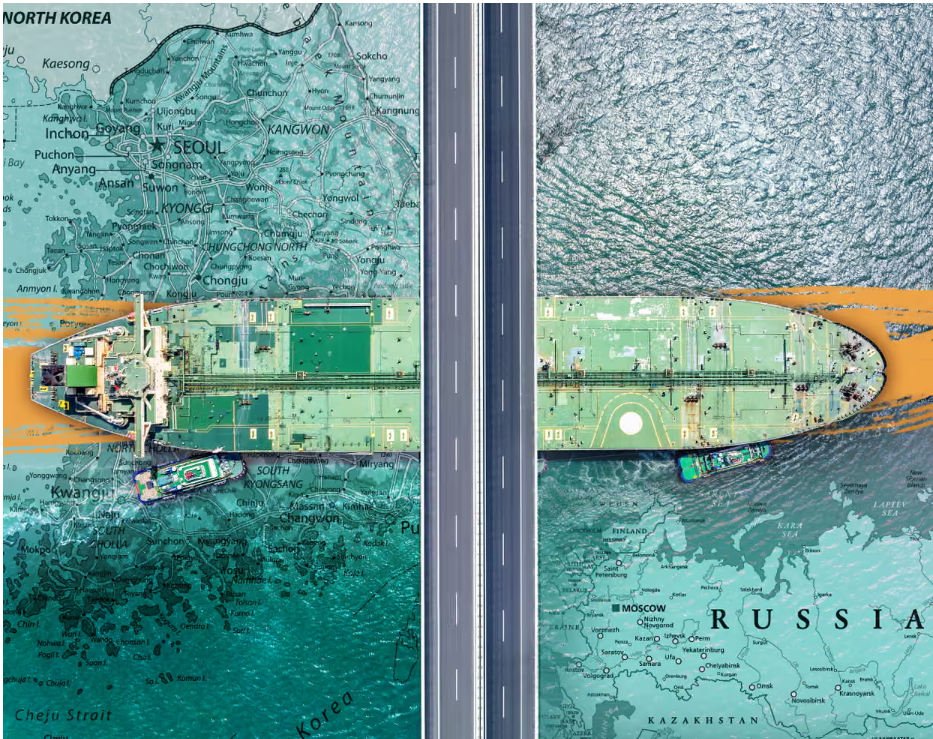
The Guardian found seven tankers made 14 voyages from South Korean ports to the Russian far east in July and August, carrying more than 176,000 tonnes of fuel, mostly diesel. The sanctioned Layla carried 57,000 tonnes from Ulsan to Vladivostok. Astoria and Chongchon also declared other destinations and sailed to Vladivostok. CREA says South Korea supplied 31 percent of Russia’s August seaborne oil product imports. Seoul’s foreign ministry did not discuss the tankers.
Fuel loaded in South Korea has been carried to Russian ports on tankers sanctioned by Britain and the European Union, a Guardian analysis published on 6 October has found, in the same summer Seoul promised more money for Ukraine’s reconstruction.
The paper’s review of port records and ship tracking data put the volume at more than 176,000 tonnes in July and August, mostly diesel. The headline figure on the investigation was more than 150,000 tonnes. The body of the analysis is the higher number. Seven tankers made 14 voyages to Russia’s far east. Three of the ships were under UK and EU sanctions. One took its cargo in a ship to ship transfer in South Korean waters, a method that can hide where a load came from and lets a vessel avoid the terminal.
Isaac Levi, an analyst at the Centre for Research on Energy and Clean Air in Finland, called it shocking that EU sanctioned tankers loaded fuel at South Korean ports and carried it to Russia. “This undermines the sanctions regime and South Korea’s support for Ukraine,” he said.
The largest carrier was the sanctioned tanker Layla. It left the south eastern port of Ulsan for Vladivostok on 19 July and again on 10 August, with 57,000 tonnes of diesel in total. On the first trip it told South Korean authorities the destination was Vladivostok. On the second it said Niigata in Japan. The Russian flagged Astoria, also under Australian sanctions, loaded nearly 11,000 tonnes at Ulsan on 1 August, declared Japan, and sailed to Vladivostok. The Chongchon never berthed. In early August it took about 26,000 tonnes from the unsanctioned tanker Celeste I at an anchorage off Yeosu, declared Singapore, and went to Vladivostok. The owners and managers of the four tankers did not respond to the Guardian.
Port records do not show who owned or sold the fuel. That gap matters. A loading is not a government sale. Kpler data cited in the investigation named buyers on the Russian side, including Rosneft, the state controlled oil company under UK, US, EU and Australian sanctions, and NNK, whose owner Eduard Khudainatov and whose company NNK Oil are under UK sanctions. Those are commercial counterparties in the data, not a Seoul decree.
The timing sits against Ukraine’s campaign on Russian refineries. The International Energy Agency says Russian refinery throughput fell in June to its lowest in more than 20 years, and diesel output is down nearly 30 percent on last year. Ukraine’s military intelligence agency says Moscow has had to import fuel for the war. Kpler data analysed by CREA put Russia’s seaborne imports of oil products in August at 368,000 tonnes, more than seven times July and the highest monthly total since the full scale invasion. South Korea accounted for 112,000 tonnes, or 31 percent, second only to India. Loadings at Korean ports began to surge in July, the month President Lee Jae Myung pledged 100 million dollars for Ukraine’s reconstruction at a Nato summit in Turkey.
Seoul has sent humanitarian aid and non lethal supplies, including helmets, body armour and demining vehicles, and in 2023 pledged 2.3 billion dollars, most of it in loans. It has refused to send weapons, in line with a policy against lethal arms to countries at war. It has also tried to keep a line open to Moscow. The fuel trade does not appear to breach South Korean law. Korean measures against Russia are mainly export controls on industrial machinery, electronics and vehicles, not a ban on diesel leaving Ulsan on a foreign flagged tanker. A ship sanctioned in London can still be legal in Busan if Seoul has not listed it.
The foreign ministry, asked about the shipments, did not address them or the sanctioned tankers. It said that as a responsible member of the international community the government supports efforts to end the war and bring a peaceful recovery. It said export controls under the Foreign Trade Act now cover 1,402 non strategic items with a high potential for diversion to military use, beyond the strategic list, and that those controls are strictly enforced. The UK Foreign Office also did not answer questions about UK sanctioned tankers in Korean ports, or say whether the shipments had been raised with Seoul. A spokesperson said Britain remains committed to monitoring sanctions and to working with partners to cut the revenues funding the war.
Other exceptions already exist. In March, with the Strait of Hormuz disrupted by the war involving Iran, South Korea capped exports of some fuels and imported Russian naphtha under a US sanctions waiver. On 1 October the UK temporarily exempted South Korea’s existing gas contracts from a ban on maritime services for Russian liquefied natural gas that takes effect in January 2027. A 2025 trade association survey found nearly 80 percent of Korean firms that had stopped exporting to Russia were open to resuming. The diesel voyages are a separate trade. They show how a sanctions list that is not shared becomes a route.
The political cost is the one Levi named. Seoul wants credit in Kyiv and in Nato, and it wants trade with a neighbor that still matters in the far east. Relations with Ukraine are already strained over the transfer of two North Korean prisoners of war to South Korea, which Seoul said was meant to stay secret. Fuel on a sanctioned hull, declared for Japan or Singapore and tracked to Vladivostok, is a harder fact than a communique. It is not proof that the Korean state sold the cargo. It is proof that the ports, the anchorage off Yeosu and the paperwork accepted the ships.
What the Guardian has documented is the movements. More than 176,000 tonnes in two months. Fourteen voyages. Three sanctioned tankers. False or switched destinations on Layla, Astoria and Chongchon. A ship to ship transfer. Buyers in the Kpler data that include sanctioned Russian oil firms. A foreign ministry statement that talks about export controls and does not mention the tankers. Until Seoul lists the ships or the sellers are named, the diesel can keep moving inside Korean law and outside the lists kept in London and Brussels.