JORDAN SENTENCES THREE MEN TO DEATH OVER DEADLY KARAK CHURCH ATTACK
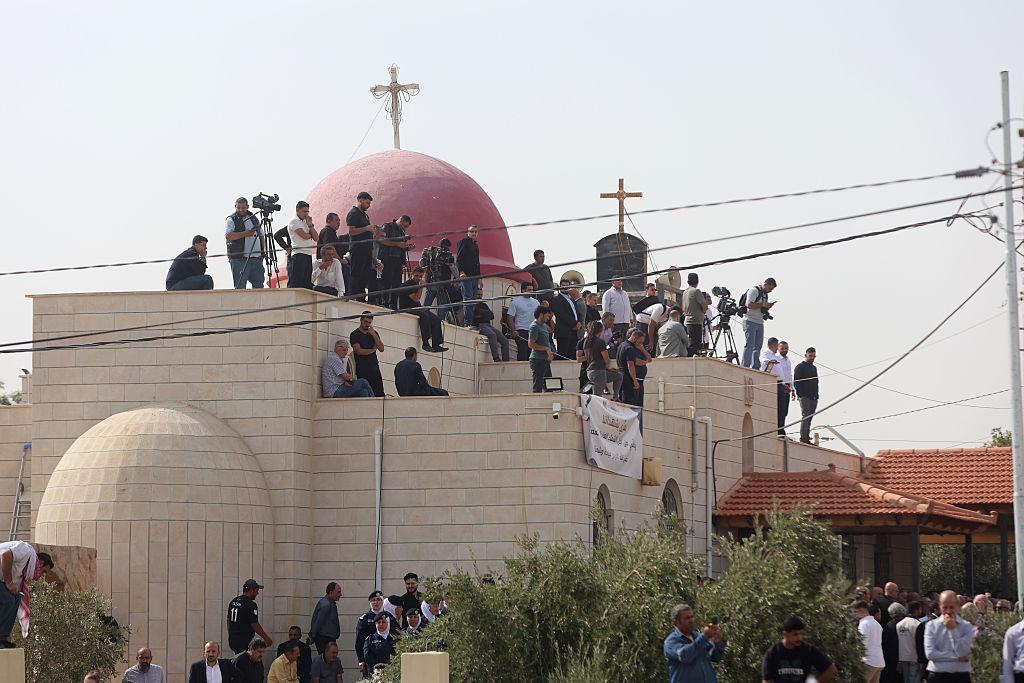
Jordan’s State Security Court has sentenced three men to death for the October 23 terrorist attack on St. George’s Greek Orthodox Church in Hmoud, Karak Governorate, where nine people were killed and 34 injured during a funeral. The defendants were convicted of terrorism resulting in death, using and possessing weapons for terrorist purposes, conspiracy and promoting terrorist ideology. One was also convicted of financing terrorism.
AMMAN, JORDAN — Jordan’s State Security Court has sentenced three men to death for carrying out the October 23 gun attack on St. George’s Greek Orthodox Church in Hmoud village, Karak Governorate, where nine people were killed and dozens more wounded during a funeral service in one of the deadliest attacks on a Christian gathering in the kingdom in years. The verdict, delivered on Sunday, November 15, brings a rapid judicial conclusion at the trial-court level less than a month after the attack shocked Jordan, triggered three days of national mourning and prompted King Abdullah II to order security forces to respond to the perpetrators with what he described as an “iron fist.”
The three men were convicted on multiple terrorism-related charges, including jointly carrying out terrorist acts that resulted in nine deaths, using weapons and ammunition in terrorist attacks, possessing weapons with terrorist intent, conspiring to commit terrorist acts and promoting the ideology of a terrorist group. One of the defendants was also convicted of financing terrorist activity under Jordan’s anti-money laundering and counter-terrorism financing legislation. The State Security Court imposed the death penalty, which in Jordan is carried out by hanging, although the ruling will now be automatically reviewed by the Court of Cassation before any execution can take place.
Jordanian authorities have not publicly released the defendants’ names in the official verdict announcement reviewed by VNTV, but security officials previously said the three principal suspects were two brothers and their brother-in-law. They were captured on October 26 after an extensive manhunt that ended at an abandoned house in Karak, where police said the suspects refused to surrender and opened fire on security forces before being wounded and arrested.
The speed of the case reflects the political and national-security significance Jordan attached to the attack. Prosecutors completed their investigation by November 3, filed a broad package of terrorism charges and moved the case before the State Security Court the following day. The prosecution said it had gathered witness testimony, crime-scene evidence, weapons and ammunition linked to the attack and statements from the defendants before filing the charges.
The October 23 shooting unfolded in broad daylight as mourners gathered at St. George’s Greek Orthodox Church for a funeral in Hmoud, a village in Karak roughly 90 kilometers south of Amman. Surveillance footage reviewed by international news organizations showed armed men approaching the church and opening fire as people scrambled for cover. Witnesses described intense bursts of gunfire and scenes of panic as worshippers tried to escape, hide behind vehicles or take cover inside and around the church compound.
Initial government figures placed the death toll lower, but it later rose to nine as some wounded victims died. Jordanian officials ultimately said 34 people had been injured. International news organizations reported roughly 40 wounded during the first days after the attack, reflecting figures that changed as hospitals and authorities updated the casualty count.
The attack was particularly shocking because it targeted mourners attending a funeral rather than a political or military gathering. Survivors described gunmen firing repeatedly at civilians, including people who had already been hit. One witness told Reuters that an attacker pointed a handgun at him from only a short distance away and fired, while other survivors described people crawling across the ground as shots continued around them.
Jordanian authorities quickly classified the shooting as a terrorist attack. Interior Minister Mazen Al-Faraya said the violence represented an extremist operation against Jordanian society, while Prime Minister Jafar Hassan said the attack reflected what he called blind extremist ideology. King Abdullah II convened senior security officials and declared that protecting Jordanian lives was a red line, promising the strongest response against those responsible.
The government declared three days of national mourning, with flags lowered at public institutions across the kingdom. Thousands of people later attended funeral ceremonies for the victims, where coffins draped in Jordanian flags were carried through Hmoud as Christian clergy, government officials, security personnel and residents gathered in a show of national solidarity.
The funerals became an important symbol in the aftermath of the attack because both the royal family and church leaders framed the shooting as an assault on Jordanian unity rather than on Christians alone. Crown Prince Hussein attended condolence events and described the attack as an assault on all Jordanians, while Christian leaders emphasized the country’s long history of coexistence between Muslims and Christians.
That message has been central to the government’s response. Christians make up a small minority of Jordan’s population but have historically played a visible role in politics, commerce and public life. Churches operate openly, Christian holidays are widely recognized and the country hosts several important biblical and pilgrimage sites. A mass-casualty shooting at a Greek Orthodox church therefore touched a particularly sensitive part of Jordan’s identity as a state that frequently presents itself as a defender of religious coexistence in a region scarred by sectarian conflict.
No major militant organization publicly claimed responsibility for the attack. Jordanian authorities said the defendants followed extremist ideology, but officials initially stopped short of saying they were members of a recognized organization. That distinction remains important. The court convicted the men of promoting terrorist-group ideology and engaging in terrorism, but public reporting has not established that they operated as a formal cell under direct orders from a named organization.
That uncertainty did not prevent Jordan from moving aggressively against networks it believed might have assisted the attackers. On October 26, the same day the three suspects were captured, the Jordanian air force struck sites in southern Syria that Amman said were militant hideouts connected to those responsible for the church attack.
Those strikes created a separate diplomatic crisis. Jordan said the operations were directed against extremist networks operating across the border and initially described them as coordinated with Syrian authorities. Damascus disputed that account, saying it had not approved the attacks and later investigated reports that civilians had been killed.
Syrian Civil Defence said seven people, including three children and a woman, died in the strikes across areas of Daraa and Sweida. Syria subsequently closed the Nassib border crossing, disrupting one of the most important commercial and passenger routes between the two countries.
The confrontation was later partially defused. Jordanian and Syrian officials met in Damascus on November 9 and agreed to establish a joint security and technical committee to examine the airstrikes and broader border-security concerns. Jordan expressed condolences over civilian casualties and pledged to address damage, while the two governments signed a series of cooperation agreements and signaled a desire to prevent the church attack from destabilizing bilateral relations.
The cross-border dimension illustrates why the Karak shooting was treated not merely as a domestic crime but as a national-security threat. Jordan shares long and difficult borders with Syria and Iraq, both of which have experienced years of militant activity. Jordanian security agencies have repeatedly disrupted suspected extremist cells, weapons-smuggling routes and infiltration attempts linked to regional armed groups.
The kingdom has generally remained more stable than many of its neighbors, but it has suffered major terrorist attacks before. Karak itself was the scene of a deadly 2016 attack in which militants killed 10 people, including police officers and a Canadian tourist, during shootings around the city and its historic castle.
That earlier attack remains part of the security memory surrounding the October church shooting. The fact that Karak had once again become the location of a large-scale terrorist incident intensified public concern and placed immediate pressure on security services to find the attackers quickly.
The October 26 arrests were therefore presented as a major operational success. Public Security Directorate officials said specialized units used intelligence gathering, drones and searches of abandoned buildings to track the suspects. Police said officers eventually came under heavy fire from inside one house, surrounded the building and arrested the three men after an exchange in which all three were wounded.
Officials said no security personnel were killed during the arrest operation. The suspects were taken to hospital before interrogation and later transferred into the judicial process.
The prosecution moved rapidly. By November 3, State Security Court Prosecutor Brigadier General Ahmad Shahltough announced that investigators had completed the case file and filed multiple charges under Jordan’s Anti-Terrorism Law and Penal Code.
Those charges were broader than murder alone. Prosecutors alleged not only that the men participated in the attack that caused nine deaths, but that they possessed weapons and ammunition for terrorist purposes, conspired to carry out terrorist acts, promoted extremist ideology and engaged in conduct threatening public order and national security.
The financing conviction against one defendant added another layer to the case. Authorities said one of the men had provided funds used to support terrorist activity, bringing the prosecution within Jordan’s anti-money laundering and counter-terrorism financing framework as well as its general anti-terror laws.
The trial opened on November 4, and the compressed timetable drew attention because of the severity and complexity of the case. Jordan’s State Security Court has jurisdiction over terrorism and other offenses considered threats to national security, and the government has historically used the tribunal in cases involving militant plots, espionage and attacks on security institutions.
Sunday’s death sentences are among the harshest punishments available under Jordanian law. Capital punishment remains legal in the kingdom, although the pace of executions has varied over time and every death sentence is subject to review by the Court of Cassation.
The automatic appeal is legally significant. The Court of Cassation can examine the trial record, legal reasoning and application of the law before the judgments become final. That means Sunday’s ruling represents a major milestone in the case but not the final procedural stage.
International human-rights organizations have long criticized Jordan’s retention of the death penalty and have called on the kingdom to reinstate periods in which executions were effectively suspended. Jordanian officials, however, have defended capital punishment for particularly severe crimes, including terrorism and multiple murder, arguing that it remains part of the country’s criminal-law framework.
Public anger surrounding the Hmoud attack is likely to make the case especially sensitive. The killings occurred at a funeral, targeted civilians and struck a religious community in a country where authorities place major emphasis on national unity and coexistence. Government officials repeatedly promised that those responsible would face the severest penalties available.
The verdict therefore fulfills, at least at the first judicial level, the commitment King Abdullah and senior ministers made immediately after the shooting. Yet the legal process also serves a broader government objective: demonstrating that security threats will be handled through arrest, prosecution and court proceedings rather than solely through military retaliation.
That point matters because Jordan’s regional security environment has become increasingly difficult. The kingdom has had to contend with militant infiltration, narcotics smuggling, weapons trafficking and instability along its Syrian frontier while also managing the broader effects of conflict in Israel, the Palestinian territories and surrounding states.
The church attack added a sectarian dimension that Jordanian officials were particularly determined to prevent from spreading. Government communications repeatedly warned against rumors, inflammatory posts and attempts to exploit the shooting to divide communities.
The Public Security Directorate’s cybercrime unit monitored online material related to the attack, while the government urged citizens and media organizations to rely on official information rather than circulate unverified claims. Prosecutors also imposed restrictions on publication of certain investigative details during the early phase of the case.
Jordanian officials said the purpose was partly to protect evidence and partly to prevent extremists from achieving through propaganda what they had failed to achieve through violence. That communication strategy was reinforced by images from the victims’ funerals showing Muslims and Christians attending together.
Church leaders similarly emphasized national solidarity. The Council of Church Heads in Jordan said the relationship between Christians and Muslims in the kingdom was rooted in shared history rather than being merely symbolic and rejected efforts to use the attack to create sectarian fear.
The killings also drew condemnation from governments across the Middle East and beyond. Egypt, Lebanon, Iraq, Oman and Syria were among states that condemned the attack, while United Nations Secretary-General António Guterres described violence targeting civilians and a funeral gathering as particularly reprehensible.
The U.S. Embassy in Amman increased security precautions after the attack and advised American citizens to remain alert, particularly around public locations and places of worship. Jordanian security was also tightened at embassies, shopping centers and other high-profile sites while the gunmen remained at large.
Although the three principal attackers are now convicted, the broader security investigation may not necessarily end with the verdict. Jordanian officials said after the arrests that investigators were examining whether other individuals provided logistical, ideological or financial support.
Authorities have not announced a large network directly responsible for the church shooting. Public Security officials said the three arrested men represented themselves rather than a broader Jordanian community and were determined to prevent speculation from stigmatizing particular groups.
That restraint is important in a country where officials view social cohesion as a major defense against extremist recruitment. Jordan has for years participated in international coalitions against Islamic State and other jihadist groups while simultaneously promoting religious moderation through royal and clerical institutions.
The kingdom has also been targeted by Islamic State before, including attacks on military personnel and security facilities. However, Sunday’s court reporting did not state that the three men acted under Islamic State orders, and no responsible account should attribute the Hmoud attack to the group without evidence establishing that connection.
The unresolved question of organization will remain relevant even after the defendants’ convictions. Security agencies will want to know whether the attackers developed their ideology independently, received support from militant networks in Syria or elsewhere, or were part of a wider extremist ecosystem that could produce future attacks.
Jordan’s airstrikes in southern Syria indicate that authorities believed cross-border militant infrastructure was relevant to their investigation. The later diplomatic negotiations with Damascus also show how quickly a domestic attack can create regional consequences when suspected support networks operate across borders.
The October shooting has already changed Jordan’s security posture in other ways. Authorities have increased monitoring around churches and other places of worship, particularly during large services and national religious events. Those measures may become especially visible during the Christmas period, when Christian churches traditionally hold large public celebrations.
Church leaders in Jordan have already decided to scale back Christmas festivities following the Karak killings, while maintaining religious services and prayers. The move reflects continuing grief among Christian communities and a desire to honor the nine victims.
The victims themselves have become symbols of national mourning. Their funeral on October 25 drew thousands of people, including senior political figures, clergy and security officials, and photographs of Jordanian-flag-draped coffins moving through the crowd became some of the defining images of the attack’s aftermath.
Those images also demonstrate why the case resonated beyond Jordan’s Christian minority. The state deliberately framed the dead as national victims rather than members of an isolated religious group, and public ceremonies emphasized Jordanian identity alongside Christian funeral rites.
For the families, however, Sunday’s verdict cannot reverse what happened at the church. Survivors have described relatives dying in front of them and the terror of gunmen firing among people gathered to mourn someone else. Several victims spent days in hospital after the attack, and some families experienced both bereavement and serious injury within the same household or extended family.
The court’s judgment provides a measure of legal accountability but does not answer every question about how the attackers became radicalized or why they selected that particular funeral. Authorities have released limited detail about motive beyond describing the men as adherents of extremist ideology.
Those questions will remain important for preventing future attacks. Understanding whether the violence developed through online radicalization, local networks, foreign contacts or other channels could shape Jordan’s counterterrorism strategy more significantly than the punishment imposed after the fact.
The rapid timeline from attack to arrests, prosecution and verdict will likely be cited by Jordanian officials as evidence of state capacity. From the shooting on October 23 to the death sentences on November 15, barely three weeks passed.
That speed is likely to be welcomed by many Jordanians demanding accountability, but capital cases also attract scrutiny over procedural safeguards. The automatic Court of Cassation review will therefore be particularly important in demonstrating that the severe sentences are examined at the highest relevant judicial level before becoming final.
If the Court of Cassation upholds the ruling, the three men would face execution by hanging. The timing of any execution would then depend on additional legal and administrative procedures under Jordanian law.
For the government, the case has become a test of both security and national cohesion. Officials have sought to show that the attackers were isolated extremists who failed to trigger the religious division they apparently sought to exploit.
The public response has largely reinforced that narrative. Muslim and Christian leaders condemned the violence together, national mourning ceremonies drew broad participation and government messaging repeatedly emphasized that the attack targeted Jordan as a whole.
Yet the threat that produced the shooting has not disappeared simply because three men have been sentenced. Jordan remains surrounded by instability and continues to face domestic radicalization risks, cross-border militant movement and weapons smuggling.
The November 5 stabbing of two security officers in Amman, one of whom died, reinforced that concern. Authorities described that separate incident as a suspected terrorist attack but did not establish any connection to the Karak church shooting. It nevertheless demonstrated how quickly one major security event can be followed by another.
Jordan’s challenge will therefore be to respond firmly without allowing exceptional security measures to permanently erode legal safeguards or deepen social tensions. Counterterrorism policy must identify genuine threats while avoiding the creation of broader suspicion toward communities not involved in extremist activity.
Sunday’s verdict is a decisive moment in the Hmoud church case, but it is not the final legal word and not the end of the wider security questions raised by the attack. Three men have now been found guilty of carrying out a massacre that killed nine mourners, wounded dozens and shook one of the Middle East’s more stable states.
The automatic appeal will determine whether the death sentences stand. Beyond the courtroom, Jordanian authorities will continue investigating extremist networks, strengthening protection around religious sites and attempting to preserve the Muslim-Christian coexistence that officials say the attackers sought to undermine.
For families in Hmoud, the attack will remain inseparable from the ordinary act that brought people to St. George’s Church on October 23: gathering to bury someone they had lost. What began as a funeral became a national tragedy. Less than a month later, Jordan’s security court has imposed its harshest punishment on the three men convicted of turning that ceremony into an attack that killed nine people and left a country confronting both grief and the continuing threat of extremism.