

DEATH TOLL FROM RUSSIA’S MASSIVE UKRAINE ATTACK RISES TO AT LEAST 21 AS RESCUERS SEARCH PRYLUKY RUINS
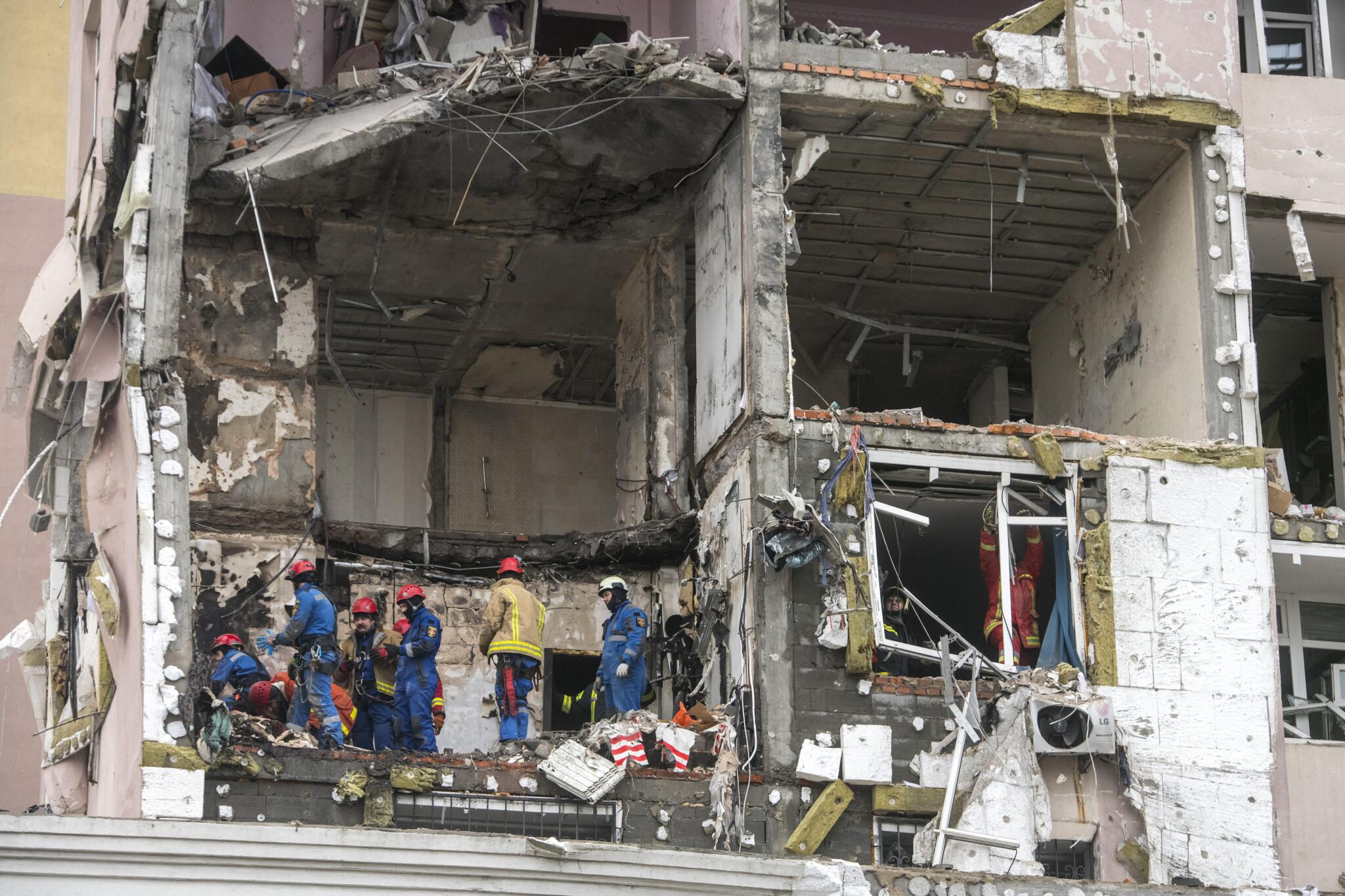
The death toll from Russia’s October 7 missile and drone attack on Ukraine has risen to at least 21 civilians, including four children, with around 60 people reported injured. Pryluky remains the worst-hit location, where the latest assessment puts the death toll from a strike on an apartment building at 15 as rescue operations continue.
The civilian death toll from Russia’s massive overnight missile and drone attack on Ukraine has risen to at least 21, including four children, as emergency crews continue searching through the ruins of residential buildings and authorities warn that casualty figures may rise further. Around 60 people have been reported injured across the country, while the northern city of Pryluky has emerged as the scene of the deadliest single strike after a missile tore through a residential apartment building while many residents were still inside.
The latest casualty assessment represents another sharp increase from earlier figures released as rescue operations unfolded Wednesday morning. Initial reports counted fewer than 10 deaths nationwide before the toll rose to at least 19 and then 21 as bodies were recovered from damaged buildings and regional authorities received updated information from hospitals and emergency teams. The continuing revisions underline the scale of the destruction and the difficulty of establishing a final count while rescuers are still clearing collapsed structures in several parts of the country.
Pryluky, in Ukraine’s northern Chernihiv region, has suffered the heaviest loss of life. The reported death toll there has risen to 15, with children among those killed after a Russian missile struck a multi-story apartment building during the early morning hours. Rescue workers have spent much of Wednesday removing concrete, broken walls and other debris from sections of the building that collapsed during the attack, while residents and emergency personnel searched for people who may still have been trapped.
The missile struck at a time when many residents were believed to have been sleeping or preparing for the day, increasing the likelihood that entire families were inside apartments when the blast occurred. Photographs and video from the scene show large sections of the residential structure destroyed, with several floors exposed and rescue crews working through unstable piles of debris. Nearby buildings, vehicles and other structures were also damaged.
The attack on Pryluky did not hit the apartment building alone. Ukrainian authorities reported strikes affecting a children’s and youth center and an industrial facility in the city, adding to damage across residential and commercial areas. Emergency crews continued working through the morning as the casualty count changed repeatedly, reflecting new discoveries beneath the rubble.
The number of deaths reported by major international news organizations was not identical by Wednesday afternoon. One current assessment placed the nationwide toll at at least 21 civilians, while another counted at least 20 based on the information available at the time of publication. The difference appears to reflect the speed at which regional casualty figures are being updated rather than a fundamental disagreement over the scale of the attack. With rescue operations still active, all current figures should be treated as provisional.
The strike came only hours after President Volodymyr Zelenskyy publicly warned that Ukrainian intelligence had detected Russian preparations for what he called a “massive attack.” In his Tuesday evening address, Zelenskyy said Ukrainian defense forces and the air force had been instructed to prepare and urged citizens to respond seriously to air-raid warnings. He also renewed his appeal to international partners for additional air-defense weapons, saying Ukraine could defend itself only to the extent that its available systems and ammunition allowed.
By early Wednesday, that warning had become reality. Russia launched missiles and drones toward Kyiv and numerous other Ukrainian regions, with explosions reported across the country and damage recorded in residential districts, industrial areas and critical infrastructure. The assault affected Kyiv, Chernihiv, Dnipropetrovsk, Poltava, Kirovohrad and other regions, making it one of the most extensive Russian aerial attacks Ukraine has faced in recent months.
Russia later acknowledged conducting what its Defense Ministry described as a “massive” strike, saying its forces targeted Ukrainian military-industrial facilities, weapons production sites and other infrastructure associated with the Ukrainian armed forces. Moscow said precision weapons launched from land, sea and air were used alongside attack drones. Ukrainian authorities disputed the characterization of the operation as narrowly focused on military targets, pointing to the destruction of residential buildings and the deaths of civilians.
The attack on the Pryluky apartment block has become the clearest evidence of the civilian consequences. Ukrainian officials say a missile directly hit the residential structure, destroying sections of the building and killing people inside. The presence of children among the dead has intensified condemnation from Kyiv and European leaders as images of rescue workers searching collapsed apartments spread internationally.
Ukraine’s emergency services have continued operating at the site despite the danger posed by unstable structures. Search teams have been using ladders, heavy machinery and manual tools to reach damaged floors and clear collapsed sections. In large missile-strike scenes, rescue operations can continue for many hours because crews must remove debris carefully to avoid further collapse and preserve the possibility of finding survivors.
The widening death toll also shows why early casualty figures from major attacks often change substantially. Local police, hospitals, emergency services and regional administrations release information at different times, and people initially listed as missing may later be found dead, hospitalized or safe. Some victims can remain beneath rubble for hours before rescuers are able to reach them.
Wednesday’s attack struck far beyond Pryluky. Kyiv came under another heavy night of explosions as missiles and drones approached the capital and air-defense systems engaged targets overhead. Mayor Vitali Klitschko reported damage to buildings and warehouse facilities, while residents spent parts of the night in shelters and underground metro stations as air-raid warnings remained active.
Damage was also reported in Dnipro, where an industrial facility was struck, as well as in Kremenchuk, Zaporizhzhia and other areas. Critical infrastructure was hit in some regions, and authorities announced electricity restrictions in several parts of the country as engineers assessed damage to the power system.
The targeting of energy infrastructure has become one of the defining features of Russia’s long-range campaign against Ukraine. Moscow has repeatedly attacked electricity generation, transmission networks and other energy facilities, particularly as Ukraine approaches colder months. Ukrainian officials say the strategy is intended to undermine civilian life and weaken the country’s economy, while Russia maintains that its strikes are directed at infrastructure connected to Ukraine’s military capability.
The distinction has been repeatedly contested throughout the war because energy, transport and industrial systems often serve both civilian and military purposes. Railways can transport civilians and military equipment, power grids serve households and defense factories, and industrial facilities may produce both commercial and military products. International humanitarian law prohibits deliberate attacks on civilians and requires military operations to distinguish between civilian objects and legitimate military targets.
The destruction in Pryluky will therefore receive particular scrutiny because the most heavily damaged structure was residential. Ukrainian prosecutors have opened investigations into strikes on civilian sites under the country’s war-crimes statutes, gathering evidence from missile fragments, photographs, witness statements and damage patterns.
Russia has not publicly accepted responsibility for intentionally targeting the apartment building. Moscow generally says that its long-range strikes are directed at military, energy or defense-industrial targets and has accused Ukrainian air defenses of contributing to some damage in populated areas. Ukraine rejects that explanation in cases where authorities say Russian weapons directly struck civilian structures.
The timing of Wednesday’s operation has also attracted attention because it came on Russian President Vladimir Putin’s birthday. Ukrainian officials highlighted the date in their public reactions and accused Moscow of marking it with another deadly attack. Russia did not describe the operation as connected to Putin’s birthday and instead presented it as part of its continuing military campaign.
European Commission President Ursula von der Leyen condemned the attacks and accused Russia of pursuing a deliberate strategy of terror against Ukrainian civilians. European governments have repeatedly pledged continued military and financial assistance to Kyiv, though Ukraine says the most urgent requirement remains additional air-defense ammunition.
The latest attack has again exposed weaknesses in Ukraine’s ability to intercept ballistic missiles and newer Russian drones. Ukrainian defenses have become substantially more sophisticated since the beginning of the full-scale invasion in February 2022, but the country must defend an enormous area against weapons approaching from several directions at different speeds and altitudes.
Russia has increasingly used mixed attack packages to complicate that task. Large numbers of comparatively inexpensive drones can force Ukrainian air-defense teams to reveal positions and use ammunition before cruise or ballistic missiles arrive. Some drones function as decoys, while others carry explosive payloads. More recently, Russia has expanded its use of faster jet-powered drones that present additional challenges for conventional anti-drone systems.
Ukraine says it has improved its ability to intercept drones significantly. During Wednesday’s assault, Ukrainian officials reported destroying a large proportion of incoming unmanned aircraft, including many of the newer high-speed systems. Missile interception remains more difficult, particularly when Russia launches ballistic weapons that travel too quickly for most Ukrainian air-defense systems.
The U.S.-made Patriot system is one of the few weapons Ukraine possesses that has demonstrated an ability to intercept advanced ballistic missiles. Zelenskyy has repeatedly asked the United States and European partners for additional Patriot batteries and interceptor missiles, arguing that shortages leave Ukrainian cities vulnerable even when intelligence provides advance warning of an attack.
Wednesday’s events illustrate that problem clearly. Ukrainian intelligence appears to have identified Russian preparations before the attack took place, allowing the president to issue a public warning on Tuesday evening. Advance knowledge, however, does not automatically provide the weapons needed to stop the incoming missiles.
Ukraine can disperse aircraft, alert air-defense crews, move some equipment and warn civilians when intelligence suggests an attack is coming. Large residential buildings, electricity substations, factories and other fixed infrastructure cannot be moved. The ability to protect those targets ultimately depends on the number, location and capability of air-defense systems.
Zelenskyy has increasingly framed the issue in those terms when speaking to allied governments. His argument is that Ukraine’s partners already possess many of the defensive systems and missiles capable of reducing civilian casualties and that the remaining obstacle is political willingness and production capacity.
Western governments have transferred substantial quantities of air-defense equipment since 2022, including Patriots and European systems, but Ukraine consumes interceptors rapidly during sustained Russian attacks. Manufacturing replacement missiles can take significantly longer than launching them, creating a persistent imbalance between defensive demand and available supply.
The problem becomes particularly severe during attacks involving hundreds of aerial targets. Using an expensive interceptor against every drone is economically and militarily unsustainable, which is why Ukraine has invested heavily in cheaper solutions including electronic warfare, mobile machine-gun teams and interceptor drones.
Those systems have improved Ukraine’s ability to destroy slower attack drones without wasting strategic missiles. Ballistic weapons remain the most difficult threat because they require specialized defenses, leaving cities exposed whenever the number of incoming missiles exceeds available interception capacity.
Wednesday’s nationwide attack also followed an extraordinary escalation in Ukraine’s own long-range campaign against Russia. Russian authorities said Ukraine launched hundreds of drones toward Russian territory during the previous day, including one of the largest attacks directed toward Moscow and the surrounding region since the war began.
A major fuel facility in the Moscow region was reportedly struck during that operation, while Russian officials reported deaths, injuries and damage in several locations. Ukraine has increasingly targeted Russian refineries, fuel depots, weapons facilities and logistics infrastructure in an effort to disrupt the resources supporting Moscow’s military campaign.
Kyiv argues that such targets are legitimate because Russian energy revenues and industrial infrastructure directly support the war. Russia describes Ukrainian long-range attacks as terrorism when they affect civilian areas and has frequently promised retaliation.
It is difficult to establish whether Wednesday’s Russian barrage was directly ordered in response to the previous Ukrainian drone operation. The scale of the attack, and Zelenskyy’s warning several hours before it began, suggests Russian forces had already been preparing missiles and drones before the full consequences of Ukraine’s strikes became known.
Large missile operations generally require substantial planning, including the positioning of aircraft and launch platforms, mission programming and coordination across several branches of the armed forces. That means retaliation narratives announced after an attack do not necessarily describe when the operation was originally prepared.
The wider pattern is nevertheless clear. Russia and Ukraine are increasingly capable of striking far behind each other’s front lines, creating a conflict in which major cities and industrial areas hundreds of kilometers from ground fighting remain exposed to regular attack.
Russia retains the much larger missile arsenal and defense-industrial base, but Ukraine’s long-range drone program has grown rapidly. Kyiv has built domestically produced systems capable of reaching deep inside Russia, allowing it to threaten oil facilities and military sites that were once considered safely beyond the battlefield.
That development has forced Russia to expand air defenses around Moscow, refineries and industrial sites. It has also contributed to a cycle in which each side uses strikes on infrastructure to impose economic costs without achieving decisive territorial gains on the ground.
The aerial campaign has become especially important because much of the land front remains difficult to move. Russian forces continue pressing in parts of eastern and southern Ukraine, while Ukrainian units defend an extensive front line stretching more than a thousand kilometers. Progress is generally slow and costly, making long-range weapons one of the main tools available to both sides for reaching strategic targets beyond the trenches.
For civilians, the consequence is that distance from the front provides limited protection. Kyiv, Lviv, Odesa, Dnipro and other cities far from the most intense ground combat have all suffered repeated missile and drone strikes. Pryluky, a smaller city in northern Ukraine, has now joined the list of places where a single successful missile strike has produced a major civilian death toll.
The attack also comes as Ukraine prepares for winter, increasing concern over power generation and heating. Repeated Russian strikes during previous winters damaged electricity networks and forced rolling blackouts across the country. Ukrainian authorities have spent months repairing infrastructure, building backup capacity and strengthening physical protection around critical facilities, but a sustained campaign can overwhelm even hardened systems.
Wednesday’s strikes caused fresh energy disruptions and prompted restrictions in several regions. Engineers will need to determine whether the damage can be repaired quickly or whether some areas face longer interruptions. The consequences become more serious as temperatures fall because electricity is required not only for household power but for heating systems, water pumping, hospitals and telecommunications.
The civilian toll is likely to remain the immediate focus. At least four children are now among those reported killed nationwide, with Pryluky accounting for most of the deaths. Around 60 people have been injured, and that figure may also change as hospitals update authorities and rescue crews complete searches.
Ukraine’s leadership has used the casualty figures to renew appeals for additional Western support. Zelenskyy argues that sanctions against Russia and air-defense deliveries must be strengthened simultaneously, with economic pressure intended to limit Moscow’s ability to manufacture weapons while additional interceptors protect Ukrainian cities from the missiles already available.
European countries have continued announcing new aid packages and sanctions, but the scale and timing of support remain politically contentious. Some governments want faster weapons deliveries, while others face pressure over costs, domestic stockpiles and the risk of deeper involvement in the war.
Russia, meanwhile, has shown no indication that it intends to scale back its long-range campaign. Moscow says the attacks are part of its effort to destroy Ukraine’s military-industrial capacity, weapons production and infrastructure used by the armed forces. The Russian Defense Ministry said Wednesday’s operation hit targets in Kyiv and several other regions using precision-guided weapons and drones.
The description does not resolve what happened in Pryluky. A five-story residential building suffered catastrophic damage, civilians were killed inside it and children were among the bodies recovered. Ukrainian investigators are documenting the scene while emergency workers continue clearing rubble.
Those rescue operations are essential before any final national casualty figure can be considered reliable. Earlier on Wednesday, Pryluky authorities reported five deaths, then nine, then 13 as more victims were recovered. The latest broader assessment places the city’s toll at 15, demonstrating how quickly the numbers have changed as crews move deeper into the collapsed structure.
The difference between current national estimates should therefore be understood in that context. One international assessment counted at least 21 civilians dead and around 60 wounded, while another placed the confirmed death toll at 20 based on slightly earlier information. Both describe an evolving casualty picture in which the number of victims has increased throughout the day.
For VNTV’s earlier coverage, the change is substantial. The initial overnight bulletin reported the beginning of Russian strikes against Kyiv and Dnipro shortly after they started. A later assessment placed the death toll at at least 19. The newest information shows that the attack was considerably deadlier than first understood and that Pryluky, rather than Kyiv, became the center of the human toll.
The progression also demonstrates why developing war coverage requires caution with early numbers. The first hours of an attack reveal where explosions occurred, but the full consequences often become apparent only after daylight, when emergency crews gain access to damaged buildings and authorities begin consolidating information from different regions.
By Wednesday afternoon, the central facts were clearer even if the final numbers were not. Russia carried out a large coordinated missile and drone attack across Ukraine. Residential and infrastructure targets were damaged in multiple regions. At least 21 civilians were reported killed in the latest available assessment, including four children, and roughly 60 were wounded. Pryluky suffered the worst known loss of life, with a residential building becoming the focus of an intensive search-and-recovery operation.
What remains uncertain is how much further the death toll may rise and whether Russia intends to follow the overnight barrage with additional large-scale attacks. Ukrainian forces remain on alert, and Zelenskyy’s government continues to warn that Russia retains substantial missile and drone stocks despite the scale of Wednesday’s operation.
The attack has also renewed the argument over whether Ukraine’s partners can increase air-defense deliveries quickly enough to change the outcome of future strikes. Intelligence gave Kyiv warning this time, but warning alone did not prevent a missile from destroying part of an apartment building in Pryluky. For Ukrainian officials, that gap between knowing an attack is coming and possessing enough weapons to stop it is now at the center of their diplomatic push.
As rescue crews continue searching the Pryluky ruins and authorities reconcile casualty reports from other regions, the final scale of the October 7 attack remains unsettled. What is already clear is that the barrage has become one of the deadliest Russian aerial attacks on Ukrainian civilians in recent months, with the number of confirmed victims continuing to rise long after the final missiles and drones had crossed the country’s airspace.