
THREE IN FOUR FAMILIES GOING HUNGRY IN PARTS OF YEMEN AS FIGHTING INTENSIFIES
Yemen's hunger crisis is worsening rapidly as renewed fighting displaces families, disrupts markets and blocks humanitarian access, according to the United Nations World Food Programme. WFP monitoring in accessible government controlled areas found that 74% of households were unable to meet their basic food needs, effectively meaning roughly three in every four families surveyed were going hungry. More than 149,000 people have been displaced by the latest escalation, while food prices are rising and aid agencies are struggling to reach frontline areas. Across Yemen, 18.3 million people face acute food insecurity and 2.2 million children under five are acutely malnourished, including about 500,000 suffering from severe acute malnutrition.
Hunger is worsening sharply across parts of Yemen as renewed fighting forces families from their homes, disrupts food markets and makes it increasingly difficult for humanitarian agencies to reach communities caught near the front lines.
The United Nations World Food Programme warned on Friday that recent monitoring in accessible government controlled areas found 74% of households were unable to meet their basic food needs.
That amounts to nearly three out of every four families surveyed.
WFP described the deterioration as severe and said the latest escalation is putting additional pressure on a country that was already facing one of the world's most prolonged humanitarian crises.
MORE THAN 149,000 PEOPLE DISPLACED
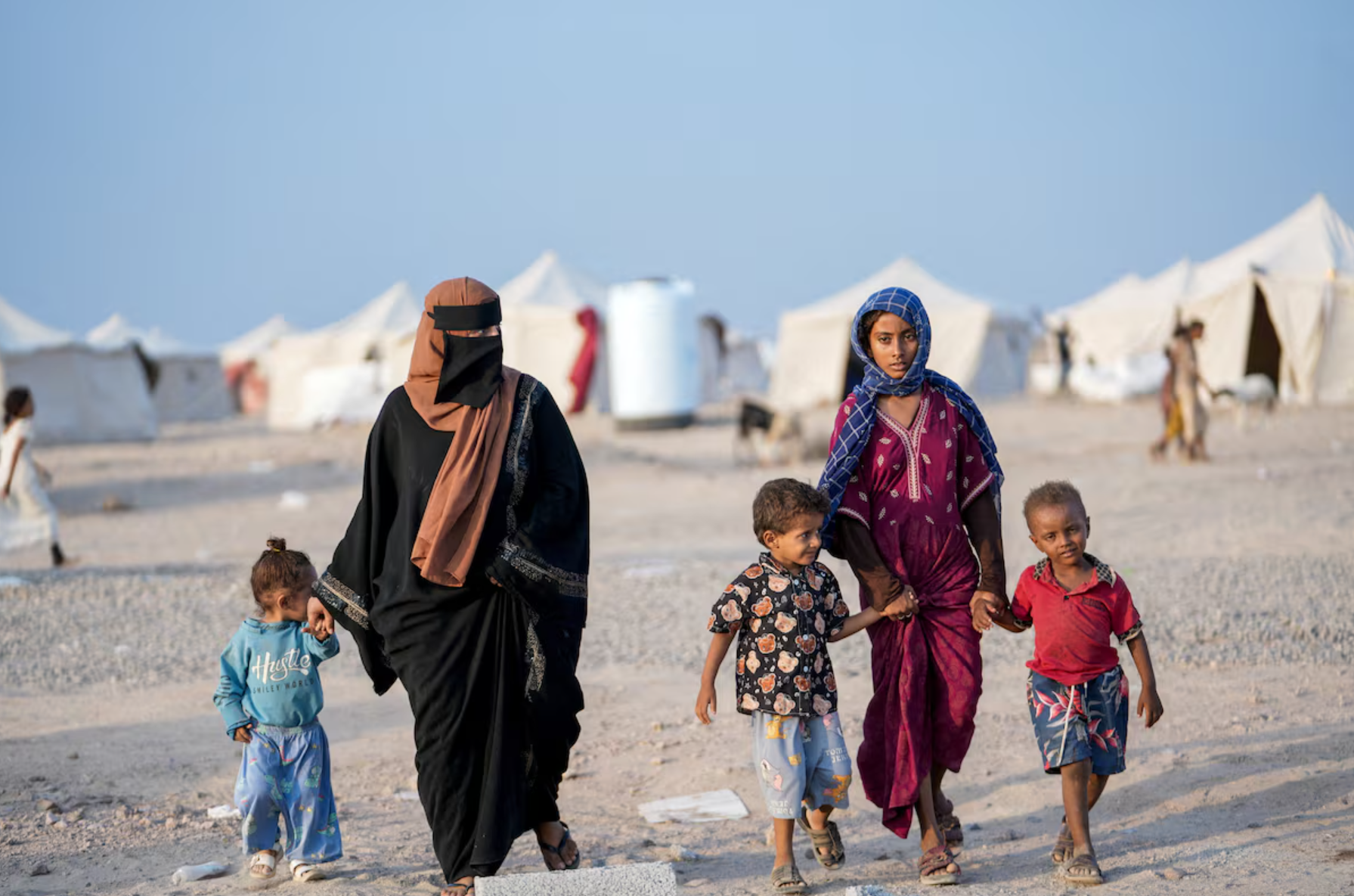
The renewed fighting has displaced more than 149,000 people, according to figures cited by WFP from the International Organization for Migration.
Many of those families had already experienced displacement during earlier phases of Yemen's conflict.
Some have now been forced to flee again.
Families arriving around Aden and Taiz have reported leaving their homes with little or no food, water or other basic supplies.
For many displaced households, obtaining food has become the most immediate concern.
HUNGER RATE REACHES RECORD LEVEL FOR 2026
WFP said the 74% figure is the highest level recorded this year in the areas where it has been able to conduct monitoring.
The figure applies to accessible areas under the internationally recognized Yemeni government's control.
It should not be interpreted as meaning exactly 74% of all households across the entire country are going hungry.
However, the wider national picture is also extremely serious.
Across Yemen, approximately 18.3 million people are currently facing acute food insecurity.
CHILD MALNUTRITION REMAINS EXTREMELY HIGH
Children are among the most vulnerable.
WFP estimates that about 2.2 million children under five are acutely malnourished.
Around 500,000 of them are suffering from severe acute malnutrition.
Severe acute malnutrition is the most dangerous form of malnutrition and can become life threatening without timely treatment.
Children suffering from the condition have weakened immune systems and are at greater risk from diseases that might otherwise be treatable.
FOOD PRICES ARE RISING RAPIDLY
The conflict is also pushing food prices higher.
In parts of Taiz, wheat flour prices have increased by about 10% in only two weeks.
Traders have estimated that wheat stocks in some areas may cover only around two months of demand.
Vegetable oil supplies have also been disrupted.
These increases are particularly damaging in Yemen because household incomes are already extremely weak.
Families that were barely able to afford food before the latest fighting are now seeing staple prices move further out of reach.
YEMEN IMPORTS ABOUT 90% OF ITS FOOD
Yemen is highly vulnerable to disruptions in shipping and trade because the country imports about 90% of its food.
That means instability affecting ports, roads or maritime routes can quickly affect the availability and price of basic goods.
Any disruption around the Red Sea or Bab al Mandab corridor can therefore have immediate consequences for Yemeni households.
The Bab al Mandab Strait is one of the world's most important shipping routes.
It connects the Red Sea with the Gulf of Aden and the wider Indian Ocean.
FIGHTING IS MAKING AID ACCESS HARDER
Humanitarian agencies are also facing growing difficulty reaching people.
Conflict has cut off access to parts of Taiz and Hodeidah.
WFP estimates that around 350,000 people in those areas cannot currently be reached by the agency and its partners.
Road closures, insecurity and higher transport costs are making food deliveries increasingly difficult.
Frontline areas are particularly challenging.
Even when food is available in warehouses, getting it safely to affected communities can become impossible.
WFP IS EXPANDING ITS RESPONSE
WFP says it is scaling up food assistance for newly displaced families.
The agency has already assisted more than 70,000 people across major displacement areas in Taiz and Lahj.
It is also preparing to support as many as 1.5 million people if the conflict worsens and displacement increases.
In September, WFP distributed ready to eat food rations to more people than in any previous month of 2026.
The agency is also positioning food stocks closer to likely displacement hotspots.
FUNDING PRESSURE COULD REDUCE ASSISTANCE
The humanitarian response is under severe financial pressure.
WFP says it has already moved resources away from distributions that had been planned for November in order to respond to the current emergency.
Without new funding, assistance gaps could begin appearing within weeks.
That would affect families already struggling with severe hunger.
WFP is currently assisting around 2.4 million people facing severe hunger in government controlled parts of Yemen.
RENEWED FIGHTING HAS TRANSFORMED THE SITUATION
Yemen had experienced a relative reduction in large scale cross border fighting following a UN brokered truce in 2022.
The political conflict was never fully resolved.
Recent fighting has now escalated sharply.
Government forces and the Iran aligned Houthi movement have intensified military operations in several areas.
The internationally recognized government is based in Aden.
The Houthis control Sanaa and much of northern Yemen.
The Houthis also seized additional territory along Yemen's Red Sea coast during the latest escalation.
TAIZ HAS BECOME A MAJOR FRONT
Taiz has again become one of the central areas of conflict.
The city and surrounding province have been contested for years.
Road closures and military operations have repeatedly disrupted movement of people and goods.
Recent fighting has made conditions more difficult.
Yemeni government forces said they carried out multiple airstrikes against Houthi positions in Taiz on Friday.
The Houthis and government forces have each blamed the other for renewed escalation.
CIVILIANS ARE AGAIN PAYING THE PRICE
For civilians, the political and military arguments matter less than the immediate consequences.
Families are losing access to food.
Children are being pulled from school.
Homes are being abandoned.
Medical treatment becomes harder to obtain.
Displaced people often arrive in camps or temporary shelters with almost nothing.
Some have already moved several times during the conflict.
RED SEA INSTABILITY COULD WORSEN FOOD PRICES
The humanitarian crisis also connects directly to global shipping.
Yemen sits beside the Bab al Mandab Strait.
The route is essential for vessels traveling between Asia, Europe and the Mediterranean through the Suez Canal.
Fighting near the coast can raise insurance costs and force ships to alter routes.
That can make food and fuel more expensive.
For Yemen, the impact can be particularly severe because of its dependence on imports.
DISRUPTION COULD HAVE EFFECTS BEYOND YEMEN
WFP has also warned that disruptions around Bab al Mandab could contribute to higher food and fuel prices elsewhere.
Global supply chains are already under pressure from conflicts affecting other major trade routes.
Problems in the Red Sea can add further transport costs.
Longer shipping routes mean more fuel consumption.
Those costs are often passed on through higher prices.
PEOPLE ARE ALSO FLEEING ACROSS THE SEA
The crisis is beginning to affect neighboring countries.
More than 3,700 people had crossed from Yemen into Djibouti by late September, according to WFP.
Many made the journey across the Bab al Mandab Strait seeking safety.
Djibouti already has limited humanitarian resources.
A larger refugee flow could place additional pressure on reception facilities and local communities.
AID WORKERS FACE THEIR OWN RISKS
Humanitarian operations in Yemen remain dangerous.
WFP says 73 United Nations personnel are being detained by Houthi authorities.
That number includes 38 WFP employees.
The UN has repeatedly called for their immediate release.
Detentions of humanitarian workers can also make it more difficult for agencies to operate in areas where needs are highest.
HUNGER IS NOT CAUSED BY ONE FACTOR
Yemen's food crisis is the result of several overlapping problems.
Conflict remains the largest driver.
But rising prices, weak household incomes, damaged infrastructure, disrupted trade and lack of humanitarian funding all contribute.
When roads close, food becomes harder to move.
When ports or shipping routes are disrupted, import costs increase.
When families lose jobs or income, they can no longer afford what remains available.
The effects reinforce each other.
FOOD MAY EXIST BUT STILL BE UNAFFORDABLE
One of the important realities of food insecurity is that hunger does not always mean there is no food in local markets.
Food may be present.
Families may simply be unable to afford it.
Inflation can therefore create hunger even without a complete breakdown in supply.
In Yemen, both problems are occurring.
Prices are increasing at the same time that transportation and market access are becoming more difficult.
DISPLACED FAMILIES ARE ESPECIALLY VULNERABLE
People forced from their homes often lose their income at the same time.
Farmers may leave land behind.
Shopkeepers may abandon businesses.
Workers can lose access to jobs.
Families may also leave behind stored food, household goods and livestock.
When they arrive in displacement camps, they often depend heavily on humanitarian assistance.
Any reduction in aid can therefore have immediate consequences.
MALNUTRITION CAN LEAVE LASTING DAMAGE
For young children, prolonged malnutrition can affect physical and cognitive development.
Severe malnutrition can also increase the likelihood of death from common illnesses.
Even children who survive can suffer lasting developmental consequences.
Pregnant and breastfeeding women are also highly vulnerable.
Poor maternal nutrition can affect both mothers and infants.
YEMEN'S CRISIS HAS LASTED MORE THAN A DECADE
Yemen's wider conflict began more than a decade ago.
The Houthis seized Sanaa in 2014.
A Saudi led coalition intervened in 2015 in support of the internationally recognized government.
Years of fighting damaged infrastructure, weakened the economy and displaced millions.
The 2022 truce significantly reduced large scale cross border attacks.
But it did not produce a comprehensive political settlement.
The latest fighting demonstrates how fragile that pause remained.
THE RISK IS THAT GAINS ARE QUICKLY REVERSED
Humanitarian agencies had hoped that reduced fighting would allow communities to rebuild.
Some roads reopened.
Aid access improved in certain areas.
Families began returning to normal economic activity.
Renewed conflict threatens to reverse that progress.
Once supply routes close and families flee again, rebuilding becomes much more difficult.
WHAT WFP IS WARNING ABOUT NOW
The central warning is not simply that Yemen remains poor or food insecure.
The concern is that conditions are deteriorating quickly.
The percentage of households unable to meet their food needs has jumped.
More people are being displaced.
Prices are rising.
Aid agencies are losing access.
Funding is running out.
Those trends are all moving in the wrong direction at the same time.
WHAT HAPPENS NEXT
The humanitarian outlook will depend heavily on whether the fighting continues.
If hostilities spread further, displacement could increase rapidly.
More roads could close.
Food prices could rise again.
Humanitarian agencies could lose access to additional communities.
A reduction in fighting would make it easier to reopen supply routes and move aid.
Funding will also be critical.
WFP says it is prepared to expand assistance to as many as 1.5 million newly affected people if necessary.
But preparedness depends on resources.
For millions of Yemenis, the latest escalation is not simply another chapter in a long political conflict.
It is becoming a struggle to obtain the next meal.
And in the areas currently being monitored by WFP, roughly three out of every four households are already unable to meet their basic food needs.