THREE DEAD, SEVEN INJURED IN TWO OGUN ROAD CRASHES AS TRACE WARNS MOTORISTS OVER VEHICLE MAINTENANCE
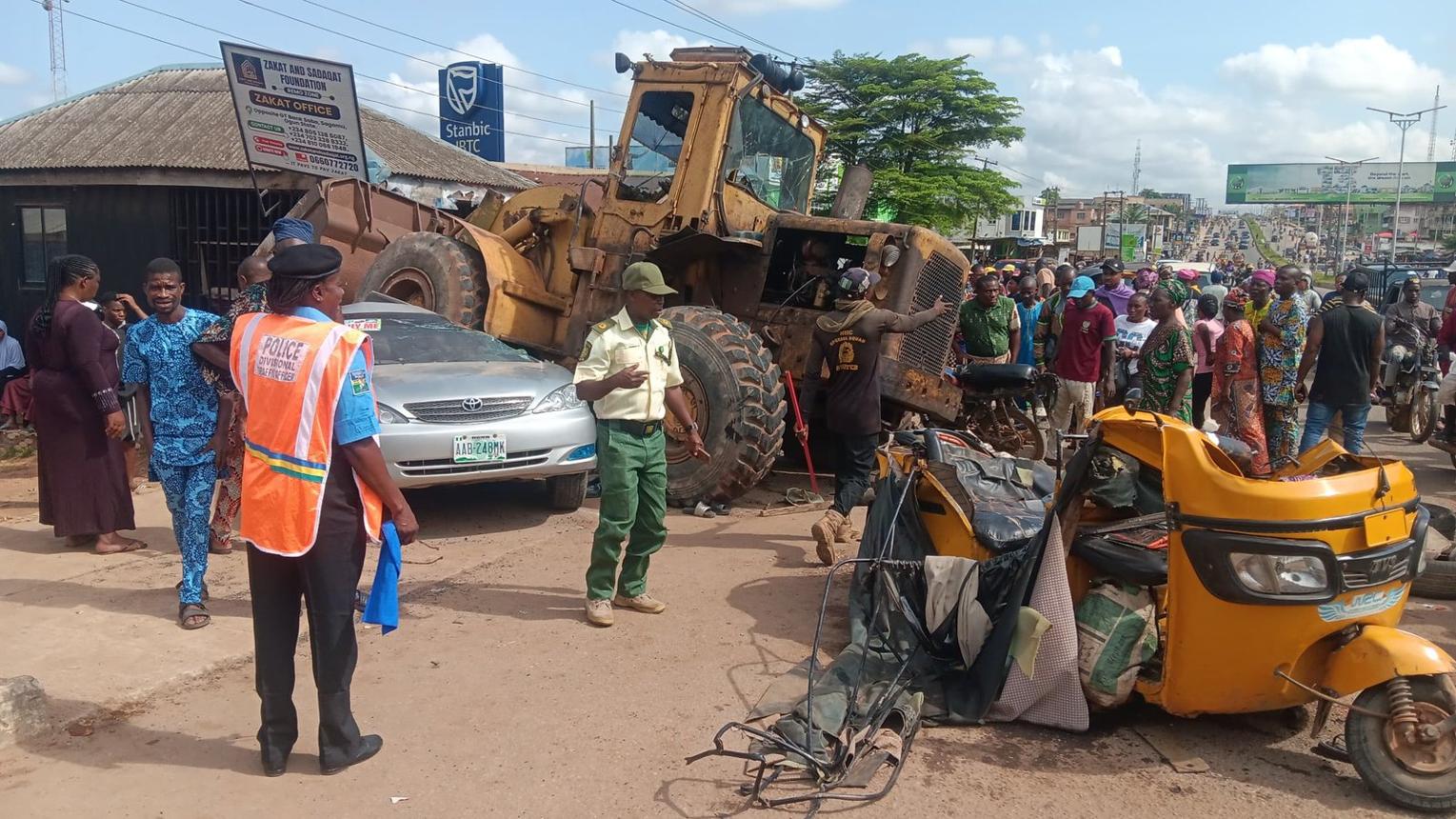
Three people have died and seven others were injured in two separate road crashes in Ogun State on November 7. At the Kam Steel axis of the Sagamu–Ikorodu Expressway, a patrol van reportedly entered the highway and collided with a tricycle, killing one woman and injuring two others. At the Agarawu, Winners axis of the Ota–Idiroko Road, a Howo truck reportedly suffered brake failure and struck another tricycle, killing a man and a woman and injuring five others. TRACE, FRSC and police responded to both scenes and warned motorists to maintain their vehicles properly.
Three people have been killed and seven others injured in two separate road crashes in Ogun State after collisions involving tricycles, a patrol van and a heavy-duty truck along the Sagamu–Ikorodu Expressway and the Ota–Idiroko Road. The accidents occurred on Saturday at the Kam Steel axis of the Sagamu–Ikorodu Expressway and the Agarawu, Winners axis of the Ota–Idiroko Road, prompting renewed warnings from the Ogun State Traffic Compliance and Enforcement Agency, TRACE, about the dangers of poor vehicle maintenance and unsafe road entry. The agency said emergency responders from TRACE, the Federal Road Safety Corps and the Nigeria Police Force intervened at both scenes, while injured victims were evacuated to hospitals and the bodies of those killed were transferred to morgues or released to relatives.
The first crash occurred at about 4:10 p.m. at the Kam Steel axis of the Sagamu–Ikorodu Expressway. According to TRACE spokesperson Babatunde Akinbiyi, a pickup patrol van emerged from the Kam Steel access road onto the highway and collided with a tricycle, causing the tricycle to somersault. Eight people were said to have been involved in the incident, with one adult woman killed and two other women sustaining varying degrees of injury. The injured victims were taken to the Olabisi Onabanjo University Teaching Hospital in Sagamu, while the body of the deceased was deposited at the same hospital’s morgue.
The circumstances described by TRACE suggest that the crash occurred as the pickup entered the expressway from a side access road, creating a conflict with the tricycle already travelling on the highway. Investigators have not publicly announced a criminal charge or final determination of fault, so the account remains the agency’s preliminary description of how the collision occurred. Road-entry crashes of this type can become especially dangerous when smaller commercial tricycles collide with larger vehicles because occupants of the lighter vehicle have comparatively limited protection against impact.
The second crash happened earlier, at about 3:25 p.m., at the Agarawu, Winners axis of the Ota–Idiroko Road. TRACE said a yellow Howo truck suffered what eyewitnesses described as brake failure, causing the driver to lose control and collide with a TVS tricycle. Two people, an adult man and an adult woman, died in the crash, while five others were injured according to the overall casualty breakdown reported by Punch and other outlets. The injured victims had already been taken to hospital before emergency responders arrived. One of the deceased was released to relatives, while the other body was deposited at the General Hospital morgue in Ifo.
There is a discrepancy in one line of the TRACE account carried by several news organisations. A quoted sentence says nine people were involved and that two died while seven were injured, but the same reports state that the total toll from both crashes was three deaths and seven injuries, with the first crash already accounting for two injured people. The narrative immediately before the quote also says five people were injured in the second crash. The mathematically consistent and more reliable breakdown is therefore one death and two injuries in the Sagamu–Ikorodu crash, followed by two deaths and five injuries in the Ota–Idiroko crash.
The apparent brake failure in the Ota–Idiroko crash has again drawn attention to the mechanical condition of heavy commercial vehicles operating on major roads. Trucks such as the Howo involved in Saturday’s incident carry substantial weight and require effective braking systems to stop safely, particularly in busy corridors where tricycles, buses, motorcycles and private vehicles frequently share the roadway. A failure involving brakes on a loaded heavy-duty vehicle can leave a driver with little ability to avoid a collision once control is lost.
TRACE used the two incidents to repeat its warning that motorists and commercial operators must service and maintain vehicles regularly. Akinbiyi said road users should make safety a priority because mechanical neglect can have fatal consequences. The agency’s message is particularly relevant in the second crash, where the reported brake failure appears to have been the immediate trigger for a collision that killed two people.
Vehicle maintenance is one of the most basic components of road safety because many defects are detectable before they become catastrophic. Braking systems, tyres, steering components, suspension and lights all deteriorate with use, and commercial vehicles operating daily may require especially frequent inspection. When drivers or operators postpone repairs, a defect that initially appears minor can become a serious hazard under load or at speed.
The first crash raises a different but equally important road-safety issue: how vehicles enter major highways from industrial or commercial access roads. Drivers joining an expressway must accurately judge the speed and distance of approaching traffic and ensure sufficient space before merging. A misjudged entry can force other road users into sudden evasive manoeuvres or create direct side-impact collisions such as the one TRACE described at Kam Steel.
Tricycles are particularly vulnerable in such crashes because their structure provides less protection than conventional cars or trucks. In many parts of Ogun State and neighbouring Lagos, commercial tricycles remain an important form of short-distance transportation, carrying passengers through urban and semi-urban communities. Their widespread use means they frequently share roads with heavy trucks and other large vehicles, making safe driving and enforcement essential.
Saturday’s incidents also illustrate how quickly separate crashes can stretch emergency resources. The two accidents occurred less than an hour apart at different locations, requiring simultaneous response by traffic, road-safety and police personnel. TRACE said emergency teams intervened to clear the scenes and restore traffic flow, reducing the risk of secondary collisions or prolonged congestion.
Secondary crashes are a serious concern after major road accidents because damaged vehicles, debris and crowds can obstruct carriageways. Drivers approaching an accident scene may not immediately realise traffic has stopped or lanes are blocked, especially where visibility is poor. Rapid traffic control by emergency officials can therefore prevent one crash from producing additional casualties.
The Sagamu–Ikorodu Expressway and Ota–Idiroko Road are both important transport corridors carrying commercial and private traffic across Ogun State. They connect major communities and industrial areas while also serving commuters travelling between Ogun and Lagos. The high volume of vehicles means mechanical failures and unsafe manoeuvres can have consequences beyond the immediate vehicles involved.
Road safety agencies in Ogun have repeatedly warned motorists about speeding, dangerous overtaking, fatigue and poorly maintained vehicles. Saturday’s crashes reinforce the reality that not every serious collision is caused by excessive speed alone. Mechanical failure, unsafe entry onto highways and driver judgment can be equally deadly.
For the families of those killed, the accidents represent sudden losses during otherwise ordinary journeys. One woman died in the Sagamu–Ikorodu crash, while a man and a woman were killed in the Ota–Idiroko collision. Their identities had not been publicly released in the initial TRACE update, leaving the immediate focus on notification of relatives and treatment of the injured.
The seven people injured across the two crashes may also face varying recovery periods depending on the severity of their injuries. Traffic-collision injuries can include fractures, internal trauma, head injuries and soft-tissue damage even when victims survive the initial impact. Hospital treatment can therefore continue long after the accident scene has been cleared.
The first crash victims were taken to Olabisi Onabanjo University Teaching Hospital in Sagamu, one of the major referral hospitals serving Ogun State. The second group of injured people had reportedly been evacuated before TRACE officials arrived, although the specific receiving hospital was not identified in the initial account.
The presence of multiple emergency agencies at the scenes reflects the collaborative structure used for serious road incidents in Ogun. TRACE manages traffic and rescue coordination, FRSC has responsibility for road safety and emergency response on major corridors, while police may become involved where investigations, traffic control or criminal responsibility need to be established.
Further investigation could examine whether the Howo truck involved in the Ota–Idiroko crash had recent maintenance records, whether its brakes had shown previous defects and whether the vehicle was carrying a load at the time. Mechanical inspection could also determine whether the reported brake failure was sudden or linked to maintenance problems.
The patrol van collision may similarly require examination of right-of-way, sightlines and vehicle speed. CCTV footage, eyewitness statements or physical evidence from the road could help establish exactly how the vehicles met and whether either driver had an opportunity to avoid the impact.
No criminal charges had been announced in the immediate aftermath of either crash. It would therefore be premature to assign legal blame beyond the preliminary accounts provided by TRACE. The agency’s purpose in Saturday’s update was primarily to confirm casualties and describe the apparent circumstances while urging safer driving.
The warning on maintenance is likely to remain central because mechanical failure on a heavy truck can produce consequences far beyond the driver. A truck that loses braking ability may strike several smaller vehicles before stopping, especially on crowded roads. That risk makes preventive servicing a public-safety issue rather than only a private responsibility for the vehicle owner.
Ogun State has experienced repeated serious crashes on routes linking Lagos, Sagamu, Abeokuta, Ota and border communities. The combination of heavy commercial traffic, motorcycles, tricycles and inter-state vehicles creates a complex road environment where minor mistakes can quickly become fatal.
The incidents also highlight the need for regular enforcement of roadworthiness requirements. Vehicle inspection systems are intended to identify dangerous mechanical defects before vehicles are allowed to continue operating, but enforcement must be consistent if those systems are to reduce crashes.
Commercial transport associations and fleet owners have a role as well. Drivers may identify faults but still be pressured to remain on the road if taking a vehicle out of service means lost income. Strong maintenance culture requires owners to prioritise repair even when it temporarily reduces earnings.
The same applies to drivers of government, company or industrial patrol vehicles. Vehicles emerging from private premises or industrial access roads must follow the same road-safety rules as every other road user. Familiarity with a route should not create complacency at busy junctions.
The fact that both accidents involved tricycles is notable. Commercial tricycles are often among the most exposed vehicles in mixed traffic because they have limited crash protection and are frequently used on roads designed primarily for larger vehicles. Policy decisions about where tricycles may operate therefore have significant safety implications.
Authorities may also need to examine infrastructure around the Kam Steel access point if crashes have occurred there previously. Junction design, warning signs, road markings and visibility can influence whether drivers entering an expressway can do so safely.
Similarly, the Ota–Idiroko corridor carries substantial heavy-vehicle traffic linked to industries, border commerce and regional transport. Regular enforcement against unsafe trucks could reduce the risk of brake-related crashes if authorities identify vehicles with obvious defects before accidents occur.
Saturday’s two crashes produced a combined toll of three deaths and seven injuries, a significant human cost within less than an hour. The proximity in time underscores how common serious traffic incidents can become on heavily travelled roads.
TRACE’s closing message was therefore straightforward: motorists should maintain their vehicles and treat road safety as a daily responsibility rather than something considered only after a crash. Regular servicing cannot eliminate every accident, but it can prevent mechanical failures that are predictable and avoidable.
For the families involved, that warning comes too late. Three people are dead, seven others are recovering from injuries and two separate communities are dealing with the consequences of crashes that unfolded within minutes.
The immediate investigations may determine whether maintenance failure, driver judgment or other factors contributed more significantly to each incident. But the broader lesson is already clear: road safety depends on both the mechanical condition of vehicles and the decisions drivers make when entering or travelling along busy highways.
As TRACE, FRSC and police continue monitoring Ogun’s major roads, the challenge is to prevent Saturday’s pattern from becoming another routine statistic. Three lives were lost in two separate crashes on the same afternoon, and the agency’s own account shows how quickly preventable risks can turn into fatal outcomes.