
THE UN SAYS LIBYA MUST NOT BECOME A BATTLEGROUND FOR FOREIGN WARS. THE SEA DRONES OFF BENGHAZI SUGGEST IT MAY ALREADY BE ONE
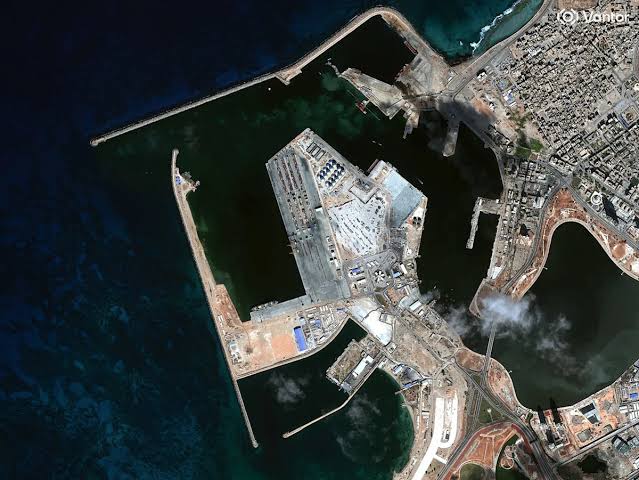
The United Nations Support Mission in Libya (UNSMIL) expressed "serious concern" on Monday, November 23, 2026, over drone attacks the previous day on two ships off the eastern port city of Benghazi. It called for "an immediate, independent and transparent investigation." One of the vessels was Russian. Reports say the other sailed under a Maltese flag. Authorities in eastern Libya said a "merchant vessel was targeted this evening by explosive-laden sea drones off the coast of Benghazi," and that all crew members were rescued and treated for minor injuries. Libya Alhadath television reported that naval and air force units intercepted more than 12 explosive-laden sea drones. Satellite images released after the strike appear to show a Russian ship capsized at Benghazi port. No one has claimed responsibility. The attacks, however, are being widely viewed as a possible spillover from the war in Ukraine. They came one day after a drone hit a Russian cargo ship in the eastern Baltic Sea, a strike Finland's border guard attributed to Ukraine. In March, a Russian liquefied natural gas carrier sank off Libya after an attack that President Vladimir Putin blamed on Ukraine. Kyiv has at times admitted to targeting Russia's "shadow fleet," including in the Mediterranean last December. Libya's eastern administration, backed by commander Khalifa Haftar, said Libya is "not a party to the Russian-Ukrainian war" and announced a joint investigation with Russia. The rival UN-recognized government in Tripoli voiced alarm over civilian ports being drawn into foreign conflicts. "Libya cannot afford, and must not become a battleground for foreign conflicts," UNSMIL said. The incident raises hard questions about maritime security in the Mediterranean, Russia's military footprint in eastern Libya and the safety of shipping routes that matter to Nigeria, Ghana and the wider West African economy.
The first reports out of Benghazi on Sunday evening described a fire at a military facility. Civil defense teams were sent to contain a blaze after a reported blast, according to Libyan broadcaster Al-Masar TV. Some early accounts said an ammunition depot at a naval base had caught fire. Within hours, the story changed. Authorities in Libya's east said the explosion had not happened on land at all. "The explosion occurred on board a Russian ship docked in the port," an official statement said. "It is suspected that the ship was attacked by drones."
By Monday, a second vessel had entered the picture. Officials said a "merchant vessel was targeted this evening by explosive-laden sea drones off the coast of Benghazi." Reports said that ship was sailing under a Maltese flag. Libya Alhadath television, a channel aligned with the eastern authorities, reported that naval and air force units had intercepted more than 12 explosive-laden sea drones off the city. Authorities said all crew members on the two ships were rescued and were being treated for minor injuries. Satellite images taken before and after the strike, released through the imagery firm Vantor, appear to show a Russian ship docked at Benghazi port on November 21 and capsized at the same port on November 22.
Then came the United Nations. On Monday, UNSMIL said it had "serious concern" over the attacks and called for "an immediate, independent and transparent investigation." In a post on X, it added a line that may prove more important than the call for a probe itself: "Libya cannot afford, and must not become a battleground for foreign conflicts."
That warning lands on a country that has been a stage for other people's wars for most of the past fifteen years. It also lands at a moment when the war between Russia and Ukraine is stretching far beyond the plains of Donbas and the waters of the Black Sea. If the suspicion now circulating is correct, and the Benghazi strikes were part of that conflict, then a Ukrainian-Russian maritime war has reached the southern shore of the Mediterranean. If the suspicion is wrong, then someone else has carried out a sophisticated sea-drone attack on a Russian ship inside a port controlled by one of Moscow's closest partners in Africa. Neither possibility is reassuring.
The most important fact, for now, is what is not known. There has been no claim of responsibility for either strike. The eastern Libyan authorities have not named a culprit. Russia, as of the AFP reporting, had not publicly attributed the attack. Ukraine had not commented on it. The phrase being used in early international coverage is "suspected spillover from the Ukraine war," and that phrase should be read with care. It reflects a pattern of recent incidents, the nationality of the main target and the timing. It is not a finding. The investigation UNSMIL is demanding exists precisely because the answer is not yet established.
Some details also remain unclear or inconsistent. Officials described one vessel as being hit "off the coast," while the eastern authorities' statement and the satellite images point to a Russian ship docked inside the port. It is not yet clear whether the two ships were attacked at the same time, in the same way, or whether the Maltese-flagged vessel was a deliberate target or caught up in a wider assault. The identity, owner, operator and cargo of both vessels have not been fully disclosed in public reporting. The eastern administration said the Russian ship was "en route back to Russia and its stop was for refuelling and resupply." It did not say what the ship had been carrying or where it had been.
Those gaps matter. In maritime incidents, the details of a ship's flag, ownership, insurance, route and cargo often tell investigators more than the explosion itself. They also shape the politics. A Russian merchant ship stopping in Benghazi for fuel and supplies is one thing. A Russian vessel linked to military logistics or sanctioned energy shipments would be another. Until credible information emerges, the right approach is to treat every theory as a theory.
The timing, however, is impossible to ignore.
On Saturday, the day before the Benghazi strikes, a drone hit a Russian cargo ship in the eastern Baltic Sea, close to the waters of Finland. Finland's border guard said the strike was Ukrainian. That is a notable statement from a European Union and NATO member state. It suggests that Ukraine's campaign against Russian shipping is no longer limited to the Black Sea and is now reaching vessels in waters far from the front line.
The Baltic and the Mediterranean are more than 3,000 kilometers apart. Two attacks on Russian ships in two seas on consecutive days do not prove a single campaign. They do, however, fit a broader picture that analysts have been tracking for more than a year: Ukrainian forces stepping up attacks against Russia far from the battlefield, aimed at the economic arteries that keep Russia's war effort funded.
Chief among those arteries is the so-called shadow fleet.
When Western countries imposed sanctions and a price cap on Russian oil after the full-scale invasion of Ukraine in February 2022, Moscow adapted. It assembled a large fleet of tankers, many of them old, with opaque ownership structures, registered in countries with light oversight, and often operating without mainstream Western insurance. These ships carry Russian crude, refined fuel and gas to buyers around the world, helping Moscow work around Western restrictions. The European Union and the United Kingdom have sanctioned hundreds of these vessels. Russia rejects the sanctions as illegal. The fleet has continued to operate.
For Ukraine, the shadow fleet is a legitimate economic target in a war of national survival. Energy exports pay for Russian missiles, drones and soldiers. Ukraine has spent nearly five years absorbing strikes on its cities, power plants and ports. On Monday, the same day the UN spoke on Libya, Ukrainian officials said Russian strikes had killed at least 12 people in the Kyiv region, including in a block of flats and at a supermarket. Later reports put the toll higher. The war, which began with Moscow's 2022 invasion, has killed hundreds of thousands of people and displaced millions.
Kyiv has at times openly admitted to attacking shadow fleet vessels, including in the Mediterranean last December. That admission marked a turning point. It confirmed that the Mediterranean, one of the world's busiest seas and the shipping link between Europe, North Africa, the Middle East and Asia, had become part of the operational map of the Russia-Ukraine war.
The March 2026 sinking off Libya sharpened that reality. A Russian liquefied natural gas carrier went down off the Libyan coast after an attack. President Vladimir Putin blamed Ukraine. According to AFP, the vessel was part of Russia's shadow fleet. The incident received less global attention than it deserved, perhaps because it happened far from Europe's main capitals and in a country already associated with chaos. But it showed that Libyan waters were now a place where Russian energy shipments could be hit.
Sunday's strikes are the next chapter. If they were indeed carried out with explosive-laden sea drones, as Libyan officials say, they represent a significant escalation in method. A sea drone is an uncrewed surface vessel, typically a fast, low-profile boat packed with explosives and guided remotely toward a target. Ukraine has used such drones with striking effect in the Black Sea since 2022, hitting Russian warships, damaging the Crimean Bridge and helping push much of Russia's Black Sea Fleet away from occupied Crimea. Those successes made Ukraine a global pioneer in naval drone warfare. They also showed every state and armed group watching that a relatively cheap weapon can threaten a large, expensive ship.
That last point is important, because Ukraine is not the only actor capable of using sea drones. Yemen's Houthis have used explosive boats alongside missiles and aerial drones against shipping in the Red Sea since late 2023. Other armed groups and states have studied the technology. The basic tools are increasingly available. Attribution based on method alone would be a mistake.
Still, a strike involving more than a dozen sea drones, if the Alhadath report is accurate, would not be a casual operation. It would require planning, intelligence about ship movements, a launch platform and the ability to guide the drones over long distances or launch them from somewhere relatively close. The Black Sea is far from Benghazi, and Ukrainian sea drones are not known to travel such distances directly. That raises questions any credible investigation will need to answer. Where were the drones launched from? Were they deployed from another vessel at sea? Did anyone on land in Libya or elsewhere help? What intelligence identified the targets? Those answers would go a long way toward establishing who was responsible. They would also reveal how exposed the Mediterranean has become.
To understand why Benghazi, of all places, matters so much, it helps to look at who controls it.
Libya has been divided and unstable since the uprising that toppled Muammar Gaddafi in 2011, backed by a NATO air campaign. What followed was not a smooth transition but a long fracture. Rival governments, militias, tribal forces, Islamist groups and foreign powers fought over the country's oil wealth and political future. The Islamic State briefly seized territory, including the coastal city of Sirte, before being driven out in 2016.
Today the country remains split between two main centers of power. In the west, the Government of National Unity in Tripoli, led by Prime Minister Abdulhamid Dbeibah, is recognized by the United Nations. In the east, a rival administration operates under the protection of military commander Khalifa Haftar and his Libyan National Army. Haftar's forces control Benghazi, much of eastern Libya and large parts of the south, including key oil fields and export terminals.
The two camps fought a major war in 2019 and 2020, when Haftar launched an offensive to seize Tripoli. That war became a proxy contest. Haftar received support from the United Arab Emirates, Egypt and Russia, including fighters from the Wagner Group, the Russian private military company. Turkey intervened on the side of Tripoli, sending military advisers, Syrian fighters and armed drones that helped turn the tide. Haftar's offensive collapsed. A ceasefire was signed in October 2020. Since then, Libya has lived in an uneasy, frozen division, with elections repeatedly promised and repeatedly delayed.
Russia never left. After the 2020 ceasefire, Wagner personnel remained at bases in eastern and central Libya. After Wagner's founder, Yevgeny Prigozhin, died in a plane crash in 2023, Moscow moved to bring Wagner's African operations under more direct state control, under the banner of what became known as the Africa Corps. Eastern Libya has served as a logistics hub for Russian operations across the Sahel, connecting Russian forces to partners in Mali, Burkina Faso, Niger, the Central African Republic and Sudan.
That role grew after December 2024, when Russia's ally Bashar al-Assad fell from power in Syria. Russia's naval base at Tartus and air base at Hmeimim had long anchored its presence in the Mediterranean. With their future in doubt, numerous reports described Russian equipment and personnel being moved toward Libya. For years, analysts have also discussed Moscow's interest in gaining naval access to ports in eastern Libya, possibly including Benghazi or Tobruk. Such an arrangement would give Russia a foothold on NATO's southern flank. The full extent of Russia's current presence in eastern Libya is not publicly documented, and Haftar's camp has generally been careful in how it describes the relationship.
This is the backdrop against which a Russian ship stopped in Benghazi for fuel and supplies, according to the eastern authorities. It is also the backdrop against which the eastern administration announced it would launch a joint investigation with Russia. From Haftar's perspective, that is logical. Russia is a partner, its ship was hit, and Moscow has an obvious interest in the findings. From the perspective of an independent observer, it is a problem. A joint Libyan-Russian probe led by authorities aligned with Moscow is unlikely to be viewed as neutral by Ukraine, by Western governments or, perhaps, by Tripoli. Its findings, whatever they are, may be dismissed in advance by those who distrust the investigators.
That is why UNSMIL's wording is so pointed. "Immediate, independent and transparent" are not random adjectives. "Immediate" because evidence at sea and in ports can disappear quickly. "Independent" because the parties with the strongest interest in the outcome, including Russia, should not control the investigation alone. "Transparent" because, in a country where rival governments compete for legitimacy, findings that are hidden or selectively released will only deepen suspicion. Without saying so directly, the UN appears to be signaling that a joint probe between eastern authorities and Moscow, on its own, will not be enough.
The eastern administration's own statement also reflects anxiety. It insisted that Libya was "not a party to the Russian-Ukrainian war." That is a significant line. It is an attempt to separate Libya from the conflict even as a Russian ship sinks in one of its main ports. But neutrality is hard to claim when a foreign power uses your harbor for refueling and resupply while it is at war. Whoever attacked the ship, assuming it was a deliberate strike on a Russian target, may have viewed Benghazi as part of Russia's logistical network rather than as neutral ground. That is precisely the danger the UN mission is warning about.
The government in Tripoli seized on the same point, but with a different emphasis. It said it was alarmed by "risks posed by involving civilian ports and facilities in activities linked to external conflicts." It rejected any attempt to turn Libya into "an arena for international conflicts" and the use of its territory "for any military or logistical activities that could jeopardise" national security or sovereignty.
Read closely, that statement is not only a condemnation of the attack. It is also an implicit criticism of the eastern authorities. Tripoli's language about civilian ports being involved in "activities linked to external conflicts" points toward the presence of Russian vessels in Benghazi. In Libya's divided politics, almost every statement serves two purposes: responding to an event and scoring a point against the rival camp. Dbeibah's government has its own foreign partners, especially Turkey, and its own vulnerabilities. But on this issue, it can present itself as the defender of Libyan sovereignty against all outside wars, while hinting that its rivals invited the danger in.
For ordinary Libyans, the political sparring matters less than the risk. Benghazi is a city of roughly a million people. It suffered years of fighting between Haftar's forces and Islamist militias after 2014, leaving whole neighborhoods in ruins. Reconstruction has been a central part of the eastern authorities' message in recent years. A sea-drone attack inside its port, and an explosion first mistaken for a blast at an ammunition depot, will revive fears that the city could again become a target.
Ports are economic lifelines. Benghazi's harbor handles fuel, food, building materials and goods for eastern Libya. If shipping companies and insurers decide the port is now a potential war zone, costs will rise. War-risk insurance premiums, which shipowners pay to cover vessels entering dangerous areas, can increase sharply after attacks. Some operators may avoid the port altogether. Libyans would ultimately pay through higher prices and possible shortages.
Libya's oil sector adds another layer. The country holds Africa's largest proven crude oil reserves, and oil revenues fund almost the entire state, including salaries on both sides of the political divide. Its oil infrastructure has repeatedly been disrupted by blockades and fighting. The major export terminals are concentrated in the east and in the so-called oil crescent along the central coast, much of it under Haftar's control. An attack inside Benghazi port does not directly threaten those terminals. But it shows that hostile actors can reach the eastern Libyan coast with explosive drones. That is a new risk factor for an oil industry that global markets watch closely.
The second vessel, the Maltese-flagged ship, deserves more attention than it has received. Malta operates one of the largest ship registries in the world. Many vessels flying its flag are owned and operated by companies based elsewhere. A Maltese-flagged ship is therefore not necessarily Maltese in any practical sense. Its owners, managers, crew and cargo could come from anywhere. That is why investigators will need to determine what the vessel was doing near Benghazi, who controlled it, and whether it was intentionally targeted.
There are several possibilities, and none has been confirmed. The ship might have had links to Russian trade, which some attackers could have viewed as a justification. It might have been hit by mistake, which would raise urgent concerns about the accuracy of sea drones in crowded waters. It might have been targeted for reasons entirely unrelated to the Russia-Ukraine war. Each scenario carries different implications. If a ship with no Russian connection was hit, the attack would represent a far more serious threat to neutral commercial shipping. The European Union, of which Malta is a member, would face pressure to respond. Valletta has not, in the reporting available, issued a detailed public account.
That European angle is important. The Mediterranean is not a distant sea for the European Union. It borders Italy, Greece, Spain, France, Malta and Cyprus. EU naval forces patrol it through Operation Irini, which was launched in 2020 to help enforce the UN arms embargo on Libya. European governments have spent years worrying about Libya as a source of irregular migration across the central Mediterranean. Now they must also worry about Libyan waters as a possible zone of naval drone warfare involving Russia, one of Europe's chief security concerns.
At the same time, many European states strongly support Ukraine and have tightened sanctions on the shadow fleet. That creates an uncomfortable tension. Europe wants the shadow fleet constrained. It does not want explosions in Mediterranean ports, environmental disasters from damaged tankers or neutral ships caught in the crossfire. Old, poorly maintained tankers carrying oil or gas already pose a serious environmental risk. A successful attack on a fully loaded tanker in the wrong place could cause a spill affecting the coastlines of several countries. The Mediterranean is a semi-enclosed sea, and pollution there spreads and lingers.
The legal questions are also difficult. Attacks on merchant ships in wartime are governed by complex rules of international law. Even in an armed conflict, parties are bound by principles such as distinction and proportionality. Civilian vessels and civilian crews are protected unless they meet specific criteria that make them legitimate military targets. Attacks in the ports or territorial waters of a third country that is not a party to the conflict raise further questions about sovereignty and neutrality. Russia will argue that any Ukrainian strike on its merchant ships in foreign waters is terrorism or piracy. Ukraine has argued that shadow fleet vessels are part of the Russian war machine, financing aggression and, in some cases, potentially carrying military cargo. Independent legal experts will likely disagree on how these principles apply to specific cases. An independent investigation could at least establish the facts on which any legal assessment must rest.
None of this means the suspicion about Ukraine is wrong. The pattern of incidents is real. Ukraine has been open about some of its long-range operations against Russian energy infrastructure and shipping. The Finnish border guard's attribution of the Baltic strike is a significant data point. Putin publicly blamed Ukraine for the March sinking off Libya. But a pattern is not proof, and an attack on Russian interests in a port controlled by a Russian partner could, in theory, attract interest from other actors as well. Responsible reporting requires holding that line until the evidence is clear.
There is also a strategic question about what such attacks achieve. If the aim is to disrupt Russia's energy exports and raise the costs of its war, every successful strike adds to the risk premium Russia pays to move oil and gas. Insurers, shipowners, crews and buyers become more nervous. Some may demand higher payments or refuse certain voyages. Over time, that could reduce Russia's revenues. If the aim is to pressure Russia's military logistics in Africa, an attack in Benghazi would send a message that the routes linking Russia to its partners in Libya and the Sahel are not safe.
But there are risks for anyone who expands a war in this way. Attacks far from the front lines can alienate countries that want to stay neutral. They can provoke retaliation in kind. Russia has its own ability to strike at Ukrainian-linked shipping and has repeatedly attacked Ukrainian ports and grain export routes. A maritime war spreading across multiple seas would raise costs for everyone who depends on global shipping, including countries with no stake in the conflict.
That brings the story to West Africa.
For readers in Nigeria and Ghana, a sea-drone attack in Benghazi may sound like a remote event in a remote war. It is closer than it seems. West African economies depend heavily on maritime trade. The vast majority of goods entering and leaving Nigeria and Ghana travel by sea, through ports such as Lagos, Onne, Tin Can Island, Lekki, Tema and Takoradi. Fuel, wheat, fertilizer, vehicles, machinery, consumer goods and raw materials arrive by ship. Crude oil, cocoa, gold-linked supplies, cashew and manufactured exports leave by ship. When shipping costs rise anywhere along major routes, West African consumers and businesses eventually feel it.
The Mediterranean is part of that system. Ships moving between West Africa and Southern Europe, the Middle East and parts of Asia often pass through it, entering or leaving through the Strait of Gibraltar and, for Asian routes, the Suez Canal. Since late 2023, attacks on shipping in the Red Sea pushed many carriers to avoid Suez and sail around the Cape of Good Hope instead. That shift sent more traffic down the West African coast, increasing vessel movements in the Atlantic near the Gulf of Guinea. It also showed how quickly a regional security crisis can redraw global trade routes and raise freight and insurance costs. If the Mediterranean becomes a zone of rising risk too, with attacks spreading from the Black Sea to Libya, global shipping faces yet another pressure point. Freight rates and insurance premiums tend to respond to perceived risk, not only to actual damage.
Russian energy trade is also directly connected to West Africa. Since the Western sanctions of 2022, Russia has redirected large volumes of refined fuel to new markets. West Africa became one of them. Industry trackers and analysts have reported significant flows of Russian diesel, gasoline and other products to countries along the coast, including Nigeria, Ghana, Togo, Cameroon and Senegal, though volumes have shifted over time. Ship-to-ship transfers off the coast of West Africa, including near Lomé, have been reported as one way Russian-origin cargoes are moved and blended. Nigeria's Dangote refinery was also reported to have purchased Russian crude at times as it ramped up operations. Not every tanker carrying Russian-origin products is part of the shadow fleet, and not every such trade breaks any law. But the overlap between Russia's export networks and West African fuel markets is real.
That creates a direct link between the Benghazi attacks and West African interests. If Russian-linked tankers become regular targets beyond the Black Sea, the vessels that carry fuel toward West Africa could face higher insurance costs and greater scrutiny. Some traders might reroute or delay cargoes. Others might charge more for the added risk. In countries where fuel prices are politically sensitive and closely tied to living costs, even small increases matter. Nigeria has already gone through the painful removal of petrol subsidies. Ghana is still rebuilding after a severe debt crisis. Neither needs another external shock to energy costs.
There is also a security lesson. The Gulf of Guinea spent years as one of the world's worst piracy hotspots. Armed gangs, many based in the creeks of Nigeria's Niger Delta, attacked ships far offshore and kidnapped crew members for ransom. Coordinated regional efforts, including the Yaoundé Code of Conduct signed in 2013, Nigeria's Deep Blue Project, increased naval patrols and international support, brought those attacks down sharply. That success was hard-won. But it was built around a specific threat: armed men in fast boats boarding ships.
The rise of explosive sea drones represents a different kind of threat. A drone boat does not need to board a vessel. It needs only to reach it. It can be launched from far away, guided remotely and used to strike ships at anchor, in port or underway. West African navies, coast guards and port authorities have not historically prepared for that kind of attack. The technology is spreading. Groups that once relied on boarding and kidnapping could, in the future, seek to adopt cheap uncrewed systems. Port security plans in Lagos, Tema and other West African hubs need to consider that possibility before, not after, it arrives.
Libya's instability also affects West Africa in human terms. For years, Libya has been a central transit point for migrants from across Africa, including Nigerians and Ghanaians, seeking to reach Europe by crossing the Mediterranean. Many have suffered abuse, extortion, detention and forced labor in Libya, documented by UN agencies and human rights groups. Nigeria and other West African governments have repeatedly organized repatriation flights for stranded citizens. Any new layer of insecurity in Libya, including foreign military activity in its ports, can worsen conditions for migrants already caught in dangerous circumstances. It can also complicate the cooperation between Libyan authorities, international agencies and African governments that make returns possible.
And there is the Sahel link. Russia's presence in eastern Libya is tied to its operations across the Sahel, where Moscow has become a key security partner for the military governments in Mali, Burkina Faso and Niger. Those countries border or sit close to coastal West African states, including Ghana, Togo, Benin and Nigeria. If Russian logistics through Libya come under sustained attack, that could affect the supply lines supporting Russian forces in the Sahel. Whether that would weaken or harden Moscow's commitment to its partners there is uncertain. Either outcome would matter for a region already struggling with jihadist violence that is pushing south toward the Gulf of Guinea.
The broader lesson for Nigeria and Ghana is about neutrality. Like Libya's eastern authorities, many African governments have tried to stay out of the Russia-Ukraine war. They have abstained on some UN votes, avoided joining sanctions and maintained trade with both sides. That stance reflects real economic interests and a long tradition of non-alignment. But the Benghazi strikes show the limits of neutrality when foreign powers use local ports, shipping lanes and logistics networks. A country can declare it is "not a party" to a conflict. If its harbors become part of one side's supply chain, the other side may not respect that declaration.
African governments therefore have strong reasons to support the UN's call for an independent and transparent investigation. They also have reasons to speak more loudly about protecting commercial shipping and civilian infrastructure from the spread of distant wars. The African Union and regional bodies such as ECOWAS have tended to focus on conflicts within the continent. Maritime security in a world of drone warfare may require a broader view.
What should happen next?
First, the facts must be established. That means a credible account of what happened in Benghazi on Sunday: how many drones were involved, where they came from, which vessels were hit, what the ships were carrying, how the Russian ship capsized and how the crews were rescued. The eastern authorities' claim that more than 12 sea drones were intercepted, reported by Alhadath television, should be backed by evidence, including recovered wreckage, if possible. Debris from sea drones can reveal manufacturing details, components and guidance systems, all of which can help with attribution.
Second, the investigation should be genuinely independent. A joint probe between eastern Libyan authorities and Russia may produce useful information. It cannot, on its own, meet the standard UNSMIL has set. International maritime experts, the flag states involved and possibly UN bodies should have a role. Malta, as the flag state of the second vessel, has a clear interest. The International Maritime Organization, which sets global shipping safety standards, may also be relevant. Whether Libya's divided authorities will allow such involvement is uncertain. Haftar's camp may resist outside scrutiny of activity in its ports. Tripoli may seek to use the incident to assert its national authority. The politics will be messy.
Third, Libya's rival authorities need to address the underlying issue: foreign military activity on Libyan soil and in Libyan waters. The UN arms embargo on Libya has been widely violated for years by multiple foreign states. Foreign fighters and military personnel from several countries remain in the country despite repeated calls for their withdrawal under the 2020 ceasefire agreement. As long as Libya hosts foreign forces linked to wider conflicts, it will remain exposed to those conflicts. The UN mission's warning that Libya "must not become a battleground for foreign conflicts" is, in that sense, a reminder of a problem that predates Sunday's attack by many years.
Fourth, the international community needs to think seriously about the spread of maritime drone warfare. Explosive sea drones have changed naval conflict in the Black Sea. They have been used in the Red Sea. They have now reportedly appeared off Benghazi. There are few clear international rules governing their use beyond the general laws of armed conflict. Shipping companies, insurers, port authorities and navies will all need to adapt. That includes better surveillance, faster information sharing and defenses suited to small, fast, low-profile targets.
For Russia, the incident is a reminder that its expanding footprint in Africa and the Mediterranean comes with vulnerabilities. Its ships, bases and logistics routes are spread across a wide area, far from home and from its strongest air and naval defenses. For Ukraine, if it is ultimately shown to be responsible, the operation would demonstrate reach and capability but also risk friction with countries that want no part in the war. For Libya, it is a warning that years of division, foreign interference and weak institutions have left the country open to becoming a theater for wars that are not its own.
There is a quiet irony in the UN's statement. "Libya cannot afford" a new conflict. That is true. A country with huge oil wealth, a small population and enormous potential has spent more than a decade unable to agree on a single government, a constitution or a date for national elections. Its institutions are split. Its armed forces are divided. Its economy depends almost entirely on oil revenue that rival factions compete to control. Ordinary Libyans have endured war, displacement, power cuts, currency crises and the flood disaster in Derna in 2023, when collapsed dams killed thousands. They need stability, reconstruction and reconciliation. They do not need explosions in their ports linked to a war on the other side of Europe.
Yet "must not become" also implies that it could. The phrase is a warning, not a description. Whether it remains a warning will depend on choices made in many capitals: in Moscow, which has made eastern Libya part of its strategic network; in Kyiv, which is fighting to cut Russia's revenues wherever they flow; in Benghazi and Tripoli, where rival leaders must decide whether to protect their sovereignty or trade it for foreign support; and in Brussels, Washington, Ankara, Cairo and Abu Dhabi, where governments have shaped Libya's war for years.
The crew members rescued on Sunday were fortunate. Authorities said they suffered only minor injuries. The next attack, wherever it happens, may not end so cleanly. A larger explosion in a crowded port, a strike on a loaded tanker or a mistaken attack on a neutral vessel could cause loss of life, environmental damage and a diplomatic crisis. The Mediterranean has seen many wars. It has rarely seen one fought by remote-controlled boats across thousands of kilometers, aimed at the economic lifelines of a major power.
For now, the facts are limited but serious. Two ships were attacked off Benghazi on Sunday, according to Libyan authorities. One was Russian. Another reportedly flew the flag of Malta. A Russian ship appears to have capsized in the port, based on satellite images. More than a dozen sea drones were intercepted, according to a Libyan broadcaster. All crew members were rescued. No one has claimed responsibility. The eastern authorities say Libya is not a party to the Russia-Ukraine war and will investigate jointly with Moscow. Tripoli says it rejects Libya's use as an arena for international conflicts. The United Nations wants an immediate, independent and transparent investigation.
What remains to be seen is whether anyone will provide one, and whether the answer will arrive before the next sea drone does.