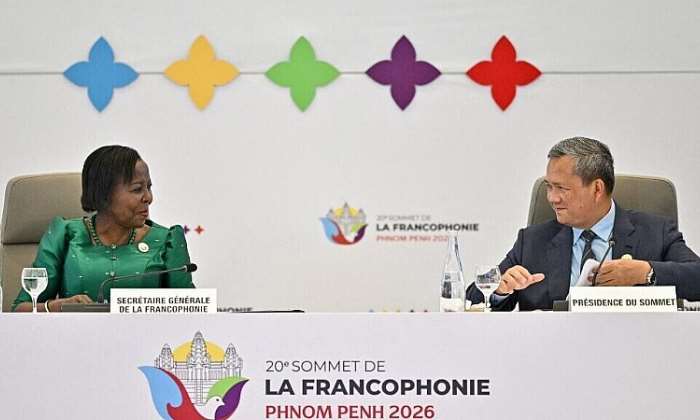
The leaders of the French-speaking world gathered for their summit expecting to choose a new head for their organization. They left without one. The International Organisation of La Francophonie, a body that brings together dozens of states and governments across five continents, has postponed the election of its next Secretary-General until 2027. The reason had little to do with language, culture or education, the issues the organization was built to champion. It came down to war. The long and bloody confrontation between the Democratic Republic of Congo and Rwanda, fought in the hills and towns of eastern Congo, followed delegates into the summit hall and brought the leadership process to a halt. Members failed to reach consensus. DR Congo threatened to walk out. Faced with the prospect of a public collapse, delegates decided to push the vote back by a full year. Within days, Rwanda was accusing France of bowing to pressure from Kinshasa, and what began as a procedural delay had turned into one of the sharpest diplomatic rows the Francophonie has faced in years.
To understand why a leadership vote could unravel so dramatically, it helps to understand how the Francophonie works. The organization traces its roots to 1970, when the Agency for Cultural and Technical Cooperation was founded in Niamey, Niger. Its early champions included African leaders such as Senegal's Léopold Sédar Senghor, Tunisia's Habib Bourguiba and Niger's Hamani Diori, who saw the French language as a shared bridge between newly independent states and the wider world. Over the decades, the body grew into a political organization with a Secretary-General, regular summits of heads of state and government, and programs covering education, culture, democracy, human rights, the digital economy and the status of women. Today it counts around 88 member states and governments, including full members, associate members and observers. Its reach stretches from Canada and Belgium to Vietnam, Armenia and the islands of the Indian Ocean.
Africa, however, is the heart of the Francophonie. Most of its member states are African, and the continent is home to the majority of the world's French speakers. Demographers project that this share will keep growing as Africa's population expands. The DRC alone is often described as the largest French-speaking country in the world by population, with well over 100 million people. Any decision that divides African members therefore strikes at the core of the organization's identity. And the Francophonie, like many multilateral bodies, chooses its Secretary-General by consensus rather than by a simple vote. In practice, that means no candidate can be installed over the firm objection of a major member. Consensus is designed to protect unity. When members are deeply divided, it can produce paralysis instead.
That is exactly what happened. Accounts from the summit describe a process that broke down as Kinshasa made clear it would not accept an outcome it viewed as favoring Rwanda's interests. The threat of a walkout by the DRC carried real weight. A walkout by the most populous French-speaking nation would have embarrassed the summit's hosts, undermined the legitimacy of any leader chosen in its absence and exposed the organization's divisions to the world. Delegates opted for delay. Postponing the election by a year bought time. It did not resolve the underlying dispute.
The dispute is personal as well as political. The outgoing Secretary-General, Louise Mushikiwabo, is a former foreign minister of Rwanda and one of President Paul Kagame's most trusted diplomats. She was elected in 2018 at the Yerevan summit in Armenia, with strong backing from French President Emmanuel Macron, defeating the incumbent, Canada's Michaëlle Jean. Her selection surprised many observers at the time. Rwanda had switched its school system's main language of instruction from French to English in 2008 and joined the Commonwealth in 2009, moves widely seen as a rejection of French influence after years of tension with Paris over France's role before and during the 1994 genocide against the Tutsi. Critics questioned why a country that had turned away from French should lead the organization dedicated to promoting it. Supporters argued that her appointment signaled reconciliation between France and Rwanda and gave Africa a strong voice at the top of the institution. She was re-elected in 2022 at the Djerba summit in Tunisia.
For Kinshasa, Mushikiwabo's leadership has long been hard to accept. Congolese officials have accused the Francophonie of staying silent while Rwanda, in their view, waged a proxy war on Congolese soil. That frustration boiled over at the 2024 summit in France, when President Félix Tshisekedi skipped a closed-door session to protest what he saw as a failure to address the crisis in eastern Congo. The message from Kinshasa was clear: an organization that claims to defend democracy, human rights and peace among its members could not look away from the suffering of millions of Congolese. The fight over who leads the Francophonie next is, in many ways, a continuation of that grievance.
The war behind that grievance is one of the most complex and deadly conflicts in the world. Eastern Congo, rich in minerals such as gold, tin, tantalum and coltan, has been torn by violence for three decades. Its roots lie in the aftermath of the 1994 genocide in Rwanda, when hundreds of thousands of Hutu refugees, including many of those responsible for the killings, fled into what was then Zaire. The presence of armed génocidaires near Rwanda's border helped trigger two regional wars in the late 1990s that drew in multiple African armies and left millions dead from violence, hunger and disease. Even after those wars formally ended, armed groups multiplied. More than a hundred militias are believed to operate in the eastern provinces today.
Among them, the M23 has become the most powerful and the most politically explosive. The group takes its name from a March 23, 2009, peace agreement that its fighters say the Congolese government failed to honor. It first rose to prominence in 2012, when it briefly captured Goma before being pushed back by Congolese forces and a United Nations intervention brigade. After years of relative quiet, the M23 re-emerged in late 2021 and expanded rapidly. In January 2025, its fighters seized Goma, the capital of North Kivu, a city of more than a million people. Weeks later, they took Bukavu, the capital of South Kivu. Thousands of people were killed and hundreds of thousands displaced. The rebels set up their own administration in the areas they controlled, through a political coalition known as the Congo River Alliance.
The DRC, the United Nations and many Western governments have accused Rwanda of backing the M23. UN experts have reported the presence of thousands of Rwandan troops in eastern Congo and documented support in weapons, logistics and command. Kigali has rejected those accusations, or framed its actions as defensive. Rwanda points to the Democratic Forces for the Liberation of Rwanda, or FDLR, a militia founded by people linked to the genocide, which still operates in eastern Congo. Rwandan officials say Kinshasa has collaborated with the FDLR and that the international community ignores the threat it poses to Rwanda's security and to Congolese Tutsi communities. Each side sees itself as the victim. That clash of narratives has made compromise extraordinarily difficult.
Diplomacy has produced moments of hope. In June 2025, the foreign ministers of the DRC and Rwanda signed a peace agreement in Washington, brokered by the United States, which committed both sides to respect each other's territorial integrity and to work toward ending support for armed groups. Qatar, meanwhile, mediated talks between Kinshasa and the M23, leading to a declaration of principles and later a framework for peace. These efforts were tied in part to wider economic interests, including access to Congo's vast mineral wealth. Yet agreements on paper have struggled to change realities on the ground. Fighting has continued in several areas, accusations of violations have flowed in both directions, and displaced families remain unable to return home. The mistrust that fills the battlefield also fills conference rooms. The Francophonie summit simply became the latest stage where that mistrust played out.
Rwanda's reaction to the postponement has added a new layer of tension. Kigali has accused France of bowing to pressure from the DRC, suggesting that Paris either encouraged or accepted the delay to avoid angering Kinshasa. The accusation carries historical weight. Relations between France and Rwanda were deeply strained for decades over France's support for the Hutu-led government before the genocide. A French historical commission led by Vincent Duclert concluded in 2021 that France bore "heavy and overwhelming responsibilities" for its role, while stopping short of finding complicity in the genocide itself. Macron traveled to Kigali that year and acknowledged France's responsibility, opening a new chapter in the relationship. Mushikiwabo's election three years earlier had already been part of that rapprochement. For Rwanda to now accuse France of siding with its rival suggests that the reconciliation is more fragile than it looked.
France faces a genuine dilemma. Paris has strong reasons to keep good relations with Kinshasa. The DRC is the demographic giant of the French-speaking world, and its future will shape the future of the language itself. France also has economic and strategic interests in Central Africa, and it cannot afford to be seen as indifferent to one of the continent's worst humanitarian crises. At the same time, France has invested heavily in its renewed partnership with Rwanda, a country admired in many Western capitals for its stability, development gains and role in peacekeeping, including its deployment in Mozambique's Cabo Delgado province, where French energy interests are significant. Macron has at times called on Rwanda to withdraw its forces from Congo and on the M23 to halt its advance. Kinshasa has often complained that those calls were too mild. Kigali now complains that France has gone too far the other way. Paris, in trying to balance both relationships, risks satisfying neither.
The French position also has to be read against a wider backdrop. France's influence in Africa has weakened sharply in recent years. Military governments in Mali, Burkina Faso and Niger expelled French troops and turned toward partners such as Russia. In March 2025, those three countries announced their withdrawal from the Francophonie, describing it as a tool of French influence. Chad and Senegal also moved to end the presence of French forces on their soil. Across French-speaking Africa, many young people view the language and its institutions with ambivalence, linking them to colonial history and to unequal relationships that persisted long after independence. The Francophonie has worked hard to present itself as a partnership of equals rather than a French project. A crisis in which France is accused of steering the organization's leadership decisions undermines that message.
The leadership vacancy, or at least the uncertainty around it, now leaves the organization in a difficult position. A Secretary-General does more than run an administration. The role involves political mediation, election observation, crisis diplomacy and representing the French-speaking world in global forums. Mushikiwabo herself has spoken about the need to modernize the organization, strengthen its economic agenda and make it more relevant to young people. How the organization will be led during the extra year, and with what authority, will be closely watched. A caretaker leadership, however capable, may struggle to launch bold initiatives or speak forcefully on divisive issues. Member states may be reluctant to commit resources to long-term programs while the question of leadership remains open. Rival camps may spend the year lobbying rather than cooperating.
There is also the question of what changes before 2027. A delay only helps if it creates space for compromise. That could mean the emergence of a consensus candidate from a country seen as neutral in the DRC–Rwanda dispute. It could mean progress in the peace process that reduces the temperature between Kinshasa and Kigali. Or it could mean stronger guarantees that the next Secretary-General will address the crisis in eastern Congo more directly. Without such shifts, the 2027 summit risks repeating the same standoff. Another failure would do even greater damage to the organization's credibility.
The Francophonie's troubles reflect a pattern seen across African and global institutions. The East African Community, which includes both the DRC and Rwanda, has struggled to manage the conflict between its own members. The Southern African Development Community sent troops to eastern Congo, only to withdraw after heavy losses in the fighting around Goma. The African Union has repeatedly called for ceasefires, while its own processes have been slowed by competing loyalties among member states. At the United Nations, the Security Council has passed resolutions and issued statements, but enforcement has been limited. In each case, a dispute between two neighbors has exposed how hard it is for collective bodies to act when members are themselves parties to the conflict.
Consensus-based decision-making sits at the center of this problem. It is valued across African diplomacy because it gives every member a voice and avoids the bitterness of majority rule. It reflects a political culture that prizes dialogue and unity. But consensus also hands an effective veto to any member willing to block progress. In calm times, that veto is rarely used. In times of conflict, it can freeze an institution entirely. The Francophonie's postponement is a vivid example. One member's threat to walk out was enough to delay a leadership decision for the entire organization. Reformers have long argued that multilateral bodies need fallback mechanisms, such as qualified majority voting, for situations where consensus fails. Others warn that such changes could deepen divisions and push unhappy members out altogether.
For African diplomacy more broadly, the episode raises uncomfortable questions. African states have pushed hard for greater influence in global institutions, from permanent seats on the UN Security Council to top positions in international agencies. Those campaigns are strongest when the continent speaks with one voice. Public splits between African members, especially ones that invite outside powers to take sides, weaken that voice. When Rwanda accuses France of siding with the DRC, and when the DRC accuses the organization of protecting Rwanda, the story becomes one of Africans divided and Europeans arbitrating. That is precisely the image many African leaders have tried to leave behind.
There is a human cost behind the diplomatic maneuvering that should not be forgotten. In eastern Congo, millions of people have been displaced, many of them several times. Camps around Goma were emptied and destroyed during the M23 advance, sending families back into areas without food, shelter or medical care. Sexual violence, forced recruitment of children and attacks on civilians have been documented by humanitarian groups. Aid agencies have warned of severe funding shortfalls as global humanitarian budgets shrink. For a woman in a displacement site near Goma or a farmer who has lost his land in South Kivu, the question of who leads the Francophonie may seem remote. Yet the paralysis of international institutions is part of why the conflict has dragged on for so long. Every forum that fails to act becomes another place where the suffering is acknowledged and then set aside.
Defenders of the postponement argue that it was the least bad option available. Forcing a vote over the DRC's objection could have triggered a walkout, a boycott of the organization's activities or even calls for withdrawal. Electing a leader rejected by the most populous member would have weakened that leader from the start. By delaying, the organization kept everyone in the room. That has value. Institutions often survive crises by buying time, letting tempers cool and allowing quiet diplomacy to work. Critics counter that delay rewards brinkmanship. If threatening a walkout works once, members may use the tactic again. The organization may become hostage to whichever state is most willing to escalate.
The next twelve months will test the Francophonie's resilience. Its leaders will need to show that the organization can still deliver on its core missions in education, culture, democracy and economic cooperation while its leadership question remains unresolved. They will need to find a path to consensus that addresses the DRC's grievances without humiliating Rwanda. France will need to clarify its position and reassure both Kinshasa and Kigali that it is acting as a partner rather than a patron. And the DRC and Rwanda themselves will face pressure to show that the commitments they signed in Washington and Doha mean something beyond the page.
The French language connects hundreds of millions of people, from the markets of Kinshasa to the streets of Montreal and the classrooms of Dakar. The Francophonie was built on the idea that a shared language could also foster shared values and peaceful cooperation. The postponement of its leadership election shows how fragile that idea becomes when members are at war. The organization has a year to prove that it can rise above the conflict rather than be consumed by it. If it succeeds, 2027 could mark a fresh start. If it fails, the delay will be remembered not as a pause for wisdom but as the moment the Francophonie admitted it could not hold its own family together.