SPAIN CLEARS CEUTA’S LAST MAJOR MIGRANT CAMP 48 HOURS BEFORE KING FELIPE’S ROYAL VISIT
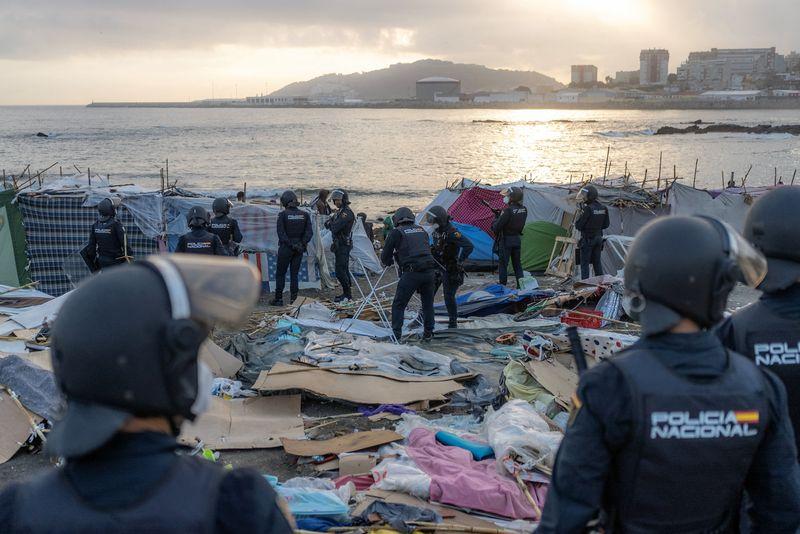
Spanish authorities have cleared El Guano, the last major informal migrant camp in Ceuta, roughly 48 hours before King Felipe VI and Queen Letizia’s visit to the Spanish territory. More than 300 police and military personnel participated in the operation, with migrants transported to reception and processing centers while some fled toward nearby hills. The camp emerged following the extraordinary July migration surge in which more than 70,000 people crossed from Morocco. Thousands of migrants remain in Ceuta despite the removal of the major beach camps.
Spanish authorities have cleared the last major informal migrant camp in Ceuta just two days before King Felipe VI and Queen Letizia are due to make a politically sensitive visit to the Spanish territory in North Africa, removing hundreds of migrants from an encampment that had become one of the most visible symbols of the unprecedented migration crisis that overwhelmed the enclave after tens of thousands of people crossed from neighboring Morocco in late July.
The operation began early Sunday at the El Guano area, where migrants had been living in tents and improvised shelters following the mass border crossings of July 30 and 31. More than 300 police officers, soldiers and other security personnel were deployed as authorities dismantled the settlement, registered migrants and transported groups by bus to temporary reception facilities. Municipal cleaning crews then moved into the area, removing tents, mattresses, rubbish and other remains of the camp as part of an operation that effectively removed the last large organized encampment still standing along Ceuta’s coastline.
The timing has drawn particular attention because King Felipe and Queen Letizia are scheduled to arrive in Ceuta on October 13, making the clearance difficult to separate from preparations for the royal visit. Spanish authorities have maintained that the operation formed part of an ongoing effort to remove unsafe informal settlements and transfer migrants into official accommodation, but the final clearance occurred roughly 48 hours before the monarch and queen were expected in the city.
The El Guano operation followed earlier clearances at other major migrant settlements, including beaches at Benítez and El Trampolín. Those camps emerged after the extraordinary movement of people from Morocco into Ceuta during the summer, when Spanish authorities said more than 70,000 people crossed into the enclave within a short period. Reuters placed the figure at more than 72,000, while other estimates have approached 80,000 depending on how repeat crossings and departures were counted.
Although many migrants subsequently returned to Morocco, were transferred elsewhere or entered Spain’s reception system, thousands remained in Ceuta, placing extraordinary pressure on a territory with a population of only about 80,000. Reception centers filled rapidly, while migrants who could not obtain accommodation established makeshift camps on beaches, vacant land and other public spaces.
El Guano became the final major concentration after authorities dismantled the larger Trampolín camp, where around 3,000 migrants had at one point been living in tents and improvised structures. Some people displaced from earlier clearances moved to El Guano, while others began sleeping in hills, streets and other parts of the city.
Accounts differ over exactly how many people were at El Guano immediately before Sunday’s operation. Some local reporting estimated about 400 migrants remained at the site, while other reports placed the number higher in the days before the clearance. Spanish newspaper El País reported that around 150 people were ultimately transported for identification during the operation after many residents left before police arrived.
Some migrants reportedly fled toward nearby hills rather than enter the official processing system. Others voluntarily gathered their belongings and boarded buses that transported adults to temporary assistance and identification facilities, while minors were separated and directed toward child protection and reception services.
The presence of unaccompanied minors has been among the most difficult aspects of the crisis. Spanish law requires authorities to provide special protection and accommodation for minors, but Ceuta’s facilities have struggled with the volume of arrivals. Humanitarian organizations and media reports have documented teenagers sleeping outdoors while national and local authorities debated responsibility for transfers, funding and accommodation.
The clearance of El Guano therefore does not mean the migration crisis in Ceuta has ended. Informal encampments along the coastline may have been removed, but migrants continue to sleep outdoors in other parts of the enclave, while reception facilities remain under pressure and authorities continue processing thousands of cases.
That distinction is important because descriptions of the operation as the removal of Ceuta’s last migrant camp could create the impression that the broader humanitarian problem has been resolved. What authorities dismantled was the last major organized coastal settlement, not the entire population of migrants still without permanent accommodation.
The royal visit will place those unresolved problems under international attention. Felipe and Letizia are expected to visit Ceuta before traveling to Melilla, Spain’s other territory on the North African coast. It will be King Felipe’s first visit to Ceuta as monarch and comes during one of the most politically sensitive periods the enclave has faced in years.
Ceuta occupies a unique geopolitical position. Although administered by Spain and incorporated into the European Union, it lies physically on the African continent and shares a land border with Morocco. Rabat has historically maintained a sovereignty claim over both Ceuta and Melilla, while Madrid insists that the cities are integral parts of Spain.
Migration has repeatedly complicated that relationship. Morocco plays a crucial role in controlling movement toward Spain, and changes in the level of Moroccan border enforcement can have immediate consequences for Ceuta and Melilla. The sudden July crossing therefore quickly developed into both a humanitarian emergency and a diplomatic issue between Madrid and Rabat.
Spanish Prime Minister Pedro Sánchez disclosed on Monday that Moroccan naval vessels had also entered Spanish waters near Ceuta without authorization during the July crisis. Sánchez described the incidents as isolated and emphasized the importance of Spain’s relationship with Morocco, but the revelation added another layer to tensions surrounding the mass crossings.
Spanish authorities said a frigate intercepted Moroccan vessels after they entered territorial waters. Morocco has not publicly provided a detailed account matching Madrid’s description of the incidents, and Sánchez sought to avoid presenting them as evidence of a broader military confrontation.
The migration relationship was already under strain. Morocco’s King Mohammed VI recently said the existing model of migration cooperation with Spain had reached its limits and argued that the two countries needed a new approach. He nevertheless described cooperation with Spain as strategically important, suggesting Rabat wants changes in migration policy without abandoning the broader bilateral relationship.
Morocco has complained that legal restrictions and court rulings in Spain have complicated the repatriation of migrants, while Spanish authorities rely heavily on Moroccan cooperation to prevent irregular crossings before they reach Spanish territory. The two countries have maintained close security and economic ties even while disagreeing over migration and sovereignty.
The July surge exposed how quickly that system can come under pressure. Tens of thousands of people crossed by land or sea within days, overwhelming border facilities and emergency accommodation. False claims circulating online that the border was effectively open were reported to have encouraged some of the movement, while broader economic and social frustrations in Morocco also contributed to the willingness of young people to attempt the crossing.
Once inside Ceuta, many migrants found themselves trapped between overcrowded reception systems and limited options for onward movement. The enclave’s small geographic size made the crisis particularly visible, with temporary shelters spreading across beaches and public areas close to residential neighborhoods.
Residents increasingly complained about pressure on public spaces, sanitation and security. Demonstrations were held demanding that migrants be removed or transferred, while humanitarian groups warned against treating desperate migrants as a public order problem rather than people requiring protection and legal processing.
The crisis has also exposed existing social divisions within Ceuta. The city has long promoted itself as a place of coexistence among Christian, Muslim, Jewish and Hindu communities, but the migration surge placed additional strain on neighborhoods already affected by poverty and unemployment. Muslim majority areas have been particularly involved in providing informal assistance while also experiencing some of the strongest effects of overcrowding and public service pressure.
Authorities have defended the successive camp clearances on health, environmental and security grounds. El Guano had accumulated large quantities of rubbish, temporary structures and damaged materials over several weeks, prompting concerns about sanitation and environmental damage along the coastline. Officials said specialists would assess the environmental impact after the site was cleared.
The settlement had also been associated with fights, thefts and other incidents, including the deaths of two people, according to local reporting. Those incidents increased political pressure on authorities to dismantle the camp and move occupants into controlled reception facilities.
The manner in which the camp was cleared has nevertheless generated questions about what happens to migrants who avoid official processing. Some fled before the operation and others reportedly moved into nearby hills, raising the possibility that clearing visible camps could simply disperse people into less visible and potentially more dangerous locations.
Spain faces the additional challenge of determining who is eligible for asylum or other protection, who can legally be transferred elsewhere in the country and who may be returned to Morocco. Those decisions can take time and are subject to Spanish and European law, meaning police operations alone cannot resolve the backlog.
The royal visit is likely to highlight the human cost of the crisis as well as its political implications. Felipe and Letizia are expected to participate in events recognizing migrants who died attempting to reach Ceuta, including a tribute connected to victims of the July crossings.
More than 140 migrants are reported to have died during the crisis, according to reporting surrounding the royal visit. The deaths underscore the dangers faced by people attempting to swim, use small boats or navigate coastal areas while trying to enter Spanish territory.
The visit also carries symbolic importance because of Morocco’s territorial claims. A Spanish monarch appearing officially in Ceuta is inherently politically sensitive, and doing so while the enclave remains at the center of a migration dispute gives the trip additional diplomatic weight.
Spain has consistently rejected Morocco’s claims to Ceuta and Melilla and treats both territories as fully Spanish. Morocco has generally avoided allowing the sovereignty dispute to derail broader cooperation, particularly after Madrid shifted its position in 2022 to support Morocco’s autonomy proposal for Western Sahara, but the issue has never disappeared.
The latest migration crisis has again demonstrated how border security, migration policy and diplomatic relations are intertwined. Spain depends on Morocco to reduce irregular migration while Morocco expects political, economic and legal cooperation in return. When that relationship becomes strained, Ceuta can quickly become the point where the consequences are most visible.
Domestic politics in Spain have also intensified the debate. Immigration has become an increasingly divisive issue, with opposition parties accusing the government of failing to control the border while humanitarian groups accuse authorities of prioritizing political appearances over durable solutions.
The fact that El Guano was cleared just before the royal visit will likely strengthen accusations from critics who believe the authorities wanted to remove the most visible signs of the crisis before Felipe and Letizia arrived. The Spanish government has not said the operation was ordered simply to improve appearances for the royal visit, and authorities had already been dismantling other camps for weeks.
The sequence nevertheless creates an unavoidable political image. Hundreds of migrants were removed, excavators and cleaning crews erased the remains of their shelters and the coastline was cleared days before the monarch was scheduled to tour a territory still struggling with the consequences of mass migration.
The more substantive question is whether those migrants now have sustainable accommodation and access to proper legal processing. Moving people from beaches into reception facilities can improve sanitation and security, but only if the system has sufficient capacity to provide shelter, food, medical care and legal assistance.
Spain has allocated additional resources to Ceuta, including tens of millions of euros for emergency support, but local authorities continue arguing that the territory cannot absorb the burden alone. Madrid has sought to transfer migrants to mainland Spain and distribute responsibility more widely, although those efforts have faced logistical and political difficulties.
The European dimension is equally important because Ceuta effectively represents one of the European Union’s external land borders in Africa. Large scale crossings there can affect migration policy across the bloc, particularly because migrants who eventually reach mainland Spain may travel onward to other European countries.
The July surge previously prompted additional border measures elsewhere in Europe and renewed debate about how responsibility for irregular migration should be shared. Spain has argued that protecting Ceuta is not solely a Spanish issue because the enclave forms part of the EU’s external frontier.
Sunday’s clearance therefore closes one visible chapter of the crisis without resolving the underlying pressures that created it. The large beach settlements that dominated images of Ceuta over the past two months have largely disappeared, but thousands of migrants remain, reception centers are still under strain and relations with Morocco continue to shape what happens at the border.
King Felipe and Queen Letizia will arrive in a city that may look significantly different from the images of sprawling migrant camps seen only weeks ago, but the humanitarian and political consequences remain. The removal of El Guano gives Spanish authorities greater control over one of the most visible public spaces affected by the influx, yet it does not answer how long migrants will remain in temporary accommodation or what will happen to those still sleeping outside the formal reception system.
The next phase will depend on whether Spain and Morocco can stabilize migration cooperation, whether Madrid can reduce pressure on Ceuta through transfers and repatriations conducted within the law, and whether adequate protection can be provided to unaccompanied minors and other vulnerable migrants. The royal visit will place international attention on those questions at a moment when the immediate emergency has become less visible but remains unresolved.
For now, Spain can say that Ceuta’s last major organized migrant camp has been dismantled, but not that the migration crisis itself is over. The events of July transformed a city of about 80,000 people almost overnight, and clearing the final large encampment is only one step in addressing the thousands of migrants, strained public services, political tensions and diplomatic disputes that remain.