PARIS’S OLDEST COVERED MARKET BURNS TO THE GROUND AND NOTHING REMAINS OF A 400 YEAR HALL
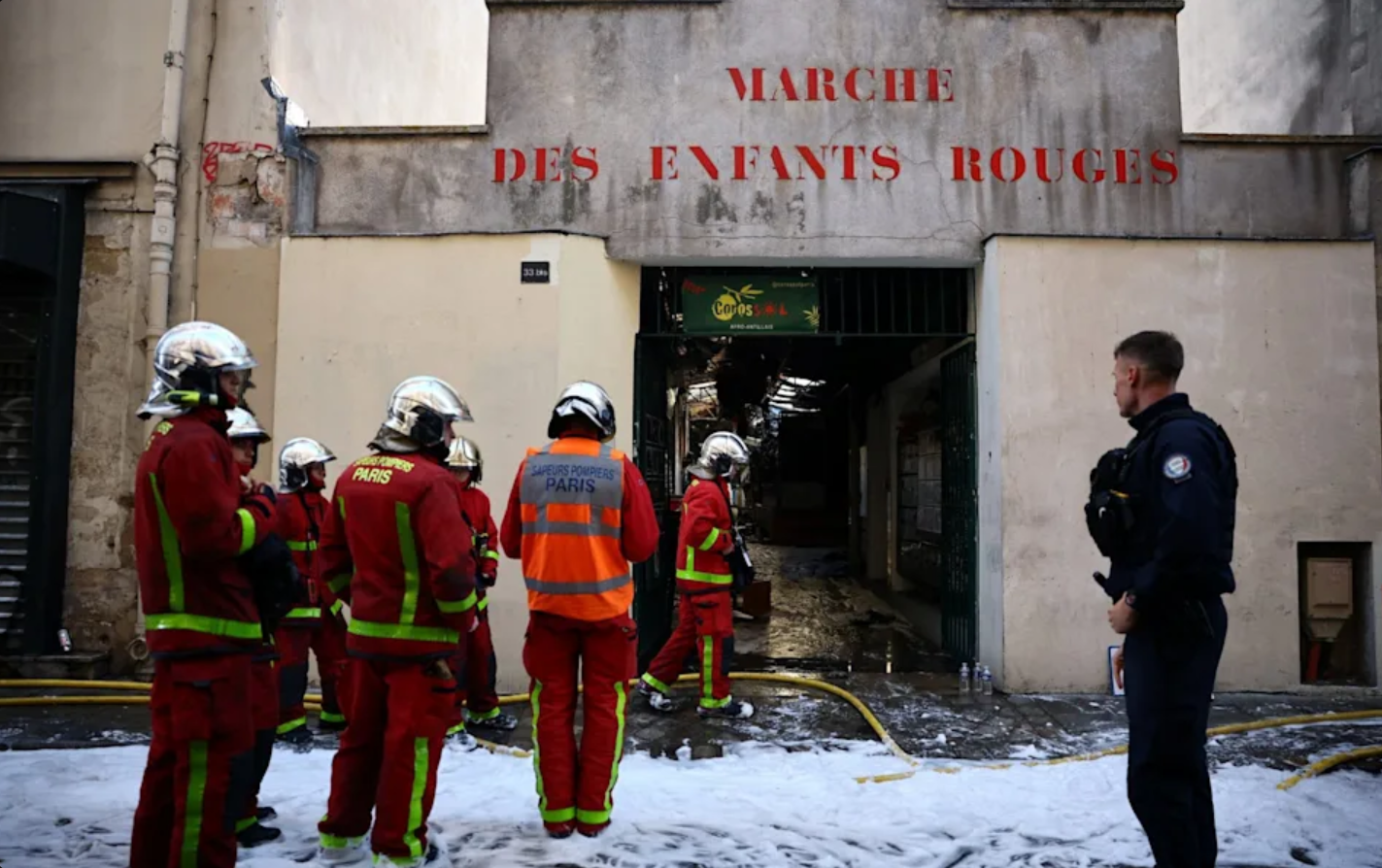
The Marché des Enfants Rouges, Paris’s oldest surviving covered food market, was completely destroyed in an overnight blaze. Firefighters were alerted at 4.15 a.m. The metal structure partly collapsed and about 1,000 square metres of stalls were lost. Central Paris mayor Ariel Weil said the worst was avoided because the fire did not spread. Lt Col Pierre de Bouvier said nothing remains. The market dated to 1615 and was listed as a historic monument in 1982. It had been saved from demolition in the 1980s and 1990s by local residents.
A fire completely destroyed the Marché des Enfants Rouges, Paris’s oldest surviving covered food market, in the early hours of Monday, leaving the 17th-century landmark in the Marais a gutted ruin after flames consumed its stalls and brought down much of its metal structure.
The blaze broke out around 3 a.m. in the 3rd arrondissement hall on rue de Bretagne. Paris firefighters received the alert at 4:15 a.m. and deployed more than 150 personnel with about 50 vehicles. By the time crews arrived the fire was already well advanced across roughly 1,000 square meters. Lieutenant Colonel Pierre de Bouvier of the Paris fire service said the metal framework had partly collapsed, the stalls had burned, and nothing remained of the covered market. No injuries were reported among the public. One firefighter suffered a minor malaise. The fire did not spread to neighboring buildings.
Ariel Weil, mayor of central Paris, confirmed that the market had been totally destroyed. “The worst was avoided: the fire did not spread to the surrounding buildings,” he said. “But there is a lot of emotion. A lot of sadness.” He noted that firefighters, who knew the site well, had brought the blaze under control. The market had closed the previous evening. Neighbors reported being woken by noise and visible flames shortly after 4 a.m. Crews were still damping the smoldering remains hours later. Investigators have not determined the cause.
The market was established in 1615 during the reign of Louis XIII and is sometimes dated to 1628 by historians. It took its name from the nearby Hospice des Enfants Rouges, an orphanage founded in 1536 by King Francis I and his sister Marguerite de Navarre. The children there were dressed in red, the color associated with Christian charity. The orphanage closed in 1772, but the market retained the name. The City of Paris acquired the site in 1912. It was inscribed as a historic monument on March 8, 1982.
In the early 1980s city authorities considered redeveloping the aging hall for other uses, including commercial space, a day-care center, social facilities and a garage. Residents, traders and heritage advocates formed a defense association. A more direct threat emerged in the 1990s under then-mayor Jacques Chirac and the 3rd arrondissement mayor Jacques Dominati, who backed plans that included an underground parking garage. Local residents, merchants and public figures, among them filmmaker Bertrand Tavernier, campaigned against demolition. The plans were abandoned. Instead of tearing the structure down, the city carried out a multi-year renovation that restored the historic wood-and-iron frame and glass roof. The market reopened in 2000 as a food hall.
In recent years it housed roughly twenty stalls selling French produce alongside Caribbean, North African, Levantine and other dishes. It drew daily crowds of residents and tourists and ranked among notable global street-food destinations. A green-painted metal arch marked the entrance. The late-19th-century metal-and-glass structure that sheltered the stalls is now partly collapsed. City officials have indicated they will seek temporary premises so traders can resume activity. No schedule has been set for any restoration or replacement of the historic hall.
The destruction removes a working market that had survived earlier demolition threats and had become one of the Marais’s most visited food sites. The fire service response contained the blaze to the market itself, and no civilian casualties were recorded. The cause remains unknown, and officials have not released a timeline for clearing the site or for any decision on rebuilding. Traders face an immediate loss of premises while the city examines temporary options. The Marché des Enfants Rouges no longer exists as a covered hall, and any return of activity will depend on decisions that have not yet been made public.