SAMSUNG SHARES SLIDE DESPITE RECORD PROFITS AS AI SPENDING FEARS SHAKE GLOBAL MARKETS
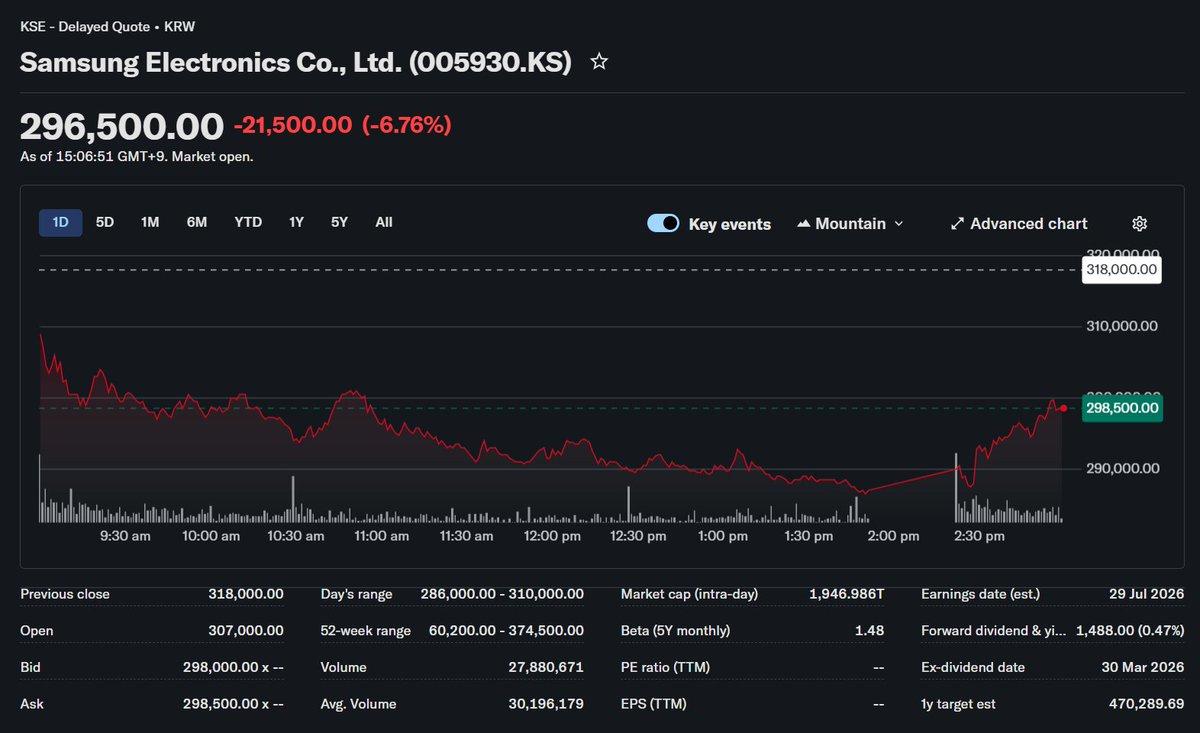
Samsung Electronics shares fell more than 4% despite reporting record third-quarter revenue of approximately 195.3 trillion won and operating profit of 107.4 trillion won. South Korea’s KOSPI dropped about 2.6%, while the MSCI Asia-Pacific index excluding Japan fell roughly 0.7%. Investors were also reacting to Alphabet’s approximately 10% after-hours decline after heavy AI spending and negative free cash flow overshadowed strong revenue growth, while Microsoft gained around 3% as strong cash generation reassured investors. Reuters
Samsung Electronics shares fell more than 4% on Thursday despite the South Korean technology giant reporting record quarterly revenue and operating profit, as investors across Asian markets grew increasingly concerned about the enormous amounts of money being committed to artificial-intelligence infrastructure and whether those investments will generate returns quickly enough to justify their scale. The decline came as technology stocks across the region reacted to developments in the United States, where investors punished Alphabet after its results highlighted the extraordinary cost of expanding data centers, AI computing capacity and cloud infrastructure. The market reaction showed that investors are becoming more selective about the artificial-intelligence boom and are no longer rewarding companies simply for spending heavily on AI without examining the effect on cash flow, profitability and shareholder returns.
Samsung reported third-quarter revenue of approximately 195.3 trillion won and operating profit of about 107.4 trillion won, setting new quarterly records for the company as demand for advanced memory chips used in artificial-intelligence servers continued to surge. The semiconductor division provided the overwhelming majority of the earnings increase, benefiting from higher memory-chip prices and exceptionally strong demand from technology companies expanding their AI computing capacity. Samsung has become one of the major beneficiaries of the global AI infrastructure race because the enormous data centers being constructed around the world require vast quantities of advanced memory, storage and semiconductor components.
Despite the record financial performance, Samsung shares moved sharply lower as investors focused on the amount of additional money the company will have to spend to maintain its position in the increasingly competitive AI semiconductor market. Samsung is investing heavily in high-bandwidth memory, advanced chip manufacturing, packaging technology and new semiconductor facilities as it attempts to meet rapidly growing demand and strengthen its position against competitors including SK Hynix. The scale of those commitments has raised questions about how much of Samsung’s current record earnings will ultimately translate into free cash flow and shareholder returns once future capital expenditure is taken into account.
The decline in Samsung shares contributed heavily to a wider selloff in South Korea because the company is one of the largest components of the country’s stock market. The benchmark KOSPI index fell approximately 2.6%, reversing part of its recent gains as investors reduced exposure to semiconductor and technology stocks. The broader MSCI index of Asia-Pacific shares excluding Japan also declined by around 0.7%, showing that concerns about the sustainability of AI investment were affecting markets beyond South Korea.
Japan’s Nikkei performed more strongly and remained slightly positive during parts of the session, demonstrating that the market weakness was not uniform across the region. Investors were particularly cautious toward companies with heavy exposure to semiconductor production, cloud computing and artificial intelligence because those sectors are at the center of the rapidly expanding global infrastructure cycle. The difference between South Korean and Japanese market performance reflected both differences in index composition and varying levels of exposure to the technology companies most affected by the latest earnings announcements.
The most immediate pressure on Asian technology sentiment came from the United States, where Alphabet shares fell sharply in after-hours trading despite the Google parent company reporting strong revenue growth. Investors focused instead on the company’s rapidly increasing capital expenditure and the impact of AI infrastructure spending on cash generation. Alphabet’s shares dropped by roughly 10% after the results, erasing hundreds of billions of dollars from the company’s market value and pushing Nasdaq futures lower before Asian trading was fully underway.
Alphabet’s results highlighted the growing tension between strong AI-related revenue growth and the enormous cost of building the infrastructure needed to support that growth. The company has been investing heavily in data centers, processors, networking equipment, energy infrastructure and other systems required to train and operate increasingly advanced artificial-intelligence models. Those investments helped strengthen Alphabet’s cloud and AI businesses, but investors became concerned when the company reported approximately $9 billion in negative free cash flow during the quarter.
The market reaction suggested that investors are beginning to demand clearer evidence that artificial-intelligence spending can generate sustainable financial returns rather than simply rewarding companies for expanding as quickly as possible. During the earlier stages of the AI boom, announcements of larger investment programs were often treated positively because they signaled management confidence in future demand. That relationship is now becoming more complicated as the amounts being spent move into hundreds of billions of dollars and investors begin asking how long it will take those investments to produce meaningful profits.
Microsoft’s results provided a sharp contrast to Alphabet’s. Microsoft shares rose approximately 3% after the company demonstrated stronger cash generation while continuing to spend heavily on artificial-intelligence infrastructure. The company reported around $18.6 billion in free cash flow during the quarter, providing reassurance that its existing businesses were generating enough cash to support its AI expansion without placing excessive pressure on its financial position.
The different reactions to Alphabet and Microsoft have become an important signal for global technology markets. Both companies are committing enormous amounts of money to artificial intelligence, but investors appeared more comfortable rewarding Microsoft because it demonstrated that the spending was accompanied by strong cash generation. Alphabet, by comparison, faced a sharp selloff as investors concentrated on the immediate cost of its investment program and the resulting pressure on free cash flow.
Samsung is being judged through a related but slightly different lens because it supplies many of the physical components required for the AI investment boom. The company benefits directly when technology giants build new data centers because those facilities require enormous quantities of memory chips, storage systems and advanced semiconductor products. That demand has helped drive Samsung’s earnings to record levels, but it also exposes the company to the possibility that customers could eventually reduce spending after completing major infrastructure projects.
The semiconductor industry has historically experienced powerful cycles in which periods of strong demand and rising prices encourage manufacturers to invest heavily in new production capacity. Once that additional capacity reaches the market, supply can sometimes grow faster than demand and push prices lower. Investors are therefore attempting to determine whether the current AI-driven memory boom represents a long-term structural shift or another cycle that could eventually create oversupply.
Samsung has maintained that demand remains exceptionally strong and that shortages of some advanced memory products could become even more severe as artificial-intelligence investment continues. High-bandwidth memory has become particularly important because it is used alongside advanced processors in AI servers and allows enormous quantities of data to move rapidly between computing components. Demand for these products has grown rapidly as companies including Microsoft, Alphabet, Amazon and Meta expand the computing power available to their artificial-intelligence businesses.
Samsung is investing aggressively to increase production of advanced memory and strengthen its competitiveness against SK Hynix, which has established a strong position in high-bandwidth memory used in AI systems. SK Hynix has benefited heavily from relationships with major AI chip customers and has reported similarly strong demand conditions. The competition between the two South Korean companies has encouraged further investment in production capacity and research, adding to the amount of capital being committed across the semiconductor industry.
The cost of Samsung’s expansion has become a major issue for shareholders. Semiconductor fabrication plants and advanced packaging facilities require enormous upfront investment, often running into billions of dollars before meaningful production begins. Even when demand is strong, investors must consider whether the returns generated by those factories will be high enough to justify the capital required to build and operate them.
Samsung’s record earnings therefore created an unusual market situation in which the company delivered some of the strongest financial results in its history while its shares fell sharply. The decline demonstrated that record profits alone were not enough to satisfy investors when expectations had already risen dramatically and the company was preparing for another expensive investment cycle. Samsung shares had also rallied significantly before the earnings announcement, creating conditions for investors to take profits once the results were released.
Shareholder returns were another factor affecting market sentiment. Samsung announced a substantial quarterly dividend but did not provide as much detail as some investors had expected about additional dividends, share buybacks or other capital-return measures. Investors have increasingly compared Samsung’s approach with SK Hynix, which recently announced a more aggressive shareholder-return program after benefiting from strong AI-related semiconductor demand.
The broader South Korean economy has also become increasingly dependent on the strength of the semiconductor sector. Chip exports have contributed significantly to economic growth, business investment and South Korea’s trade performance as demand for artificial-intelligence infrastructure has accelerated. Samsung and SK Hynix together control a significant portion of the global memory market, meaning changes in the technology investment cycle can have implications far beyond their individual share prices.
That dependence provides South Korea with substantial economic benefits when semiconductor demand is strong, but it also creates vulnerability if the global technology cycle turns downward. A significant slowdown in AI infrastructure spending could reduce chip exports, weaken corporate investment and put pressure on the broader economy. The sharp fall in the KOSPI on Thursday reflected some of those concerns because Samsung’s performance has an outsized influence on both the stock market and national economic sentiment.
The global scale of artificial-intelligence investment is now becoming difficult for markets to ignore. Major technology companies are expected to spend hundreds of billions of dollars on AI-related infrastructure during 2026, including data centers, graphics processors, networking equipment, electricity systems and cooling technology. The scale of this spending represents one of the largest private-sector investment cycles in modern technology history.
The central debate is no longer whether artificial intelligence will become economically important. Most major technology companies and investors already accept that AI is transforming software, cloud computing, advertising, search, manufacturing and many other industries. The more difficult question is whether the revenue generated by those applications will grow rapidly enough to justify the enormous infrastructure spending required to support them.
Alphabet’s after-hours decline showed how quickly market sentiment can change when investors believe capital expenditure is rising faster than cash flow. Microsoft’s positive reaction demonstrated the opposite, showing that investors remain willing to reward aggressive AI spending when companies can prove that their existing businesses generate enough cash to finance the expansion comfortably.
Samsung’s results sit directly between those two sides of the debate. The company is already earning record profits from AI-related demand, proving that the technology boom is producing substantial economic value for semiconductor suppliers. At the same time, Samsung must continue investing heavily to expand production capacity and remain competitive, meaning the company is also participating in the same expensive infrastructure cycle that is beginning to concern investors.
The market reaction does not necessarily mean investors believe the AI boom is ending. Demand for advanced chips remains extremely strong, cloud companies continue reporting rapid growth and semiconductor manufacturers are still struggling to produce enough of certain high-end components. Instead, the selloff suggests that markets are becoming more disciplined about how they evaluate companies connected to artificial intelligence.
Investors are increasingly separating companies that can convert AI demand into strong cash flow from those whose investment requirements may absorb much of the money generated by the boom. That distinction is likely to become even more important as the technology industry moves from the early excitement surrounding generative artificial intelligence toward a period in which companies must prove that their products can generate sustainable commercial returns.
Samsung’s position remains fundamentally strong. It is one of the world’s largest semiconductor manufacturers, its memory business is benefiting from exceptional demand and the company has the financial resources to continue investing in advanced technology. However, the fall in its shares shows that investors are unwilling to assume that record profits today automatically guarantee even stronger returns tomorrow.
The AI semiconductor market is also becoming increasingly competitive. SK Hynix has developed a strong position in high-bandwidth memory, while companies in the United States, Taiwan and other parts of Asia continue investing in new manufacturing technologies. Samsung must therefore spend heavily not only to increase output but also to maintain technological competitiveness in an industry where leadership can shift quickly between product generations.
Another concern is the possibility of customer concentration. A relatively small group of major technology companies accounts for a large share of global AI infrastructure spending. If even a few of those companies decide to reduce capital expenditure, suppliers throughout the semiconductor industry could feel the impact. That creates a direct connection between the spending decisions of American technology companies and the financial performance of Asian chip manufacturers.
Thursday’s market moves illustrated that connection clearly. Alphabet’s results were released in the United States, but the company’s heavy AI spending and weaker cash-flow outlook immediately influenced investor sentiment toward Samsung and other Asian technology companies. The reaction demonstrated how closely global financial markets now connect cloud computing, artificial intelligence and semiconductor manufacturing.
The same link can work in the opposite direction. Strong demand from companies such as Microsoft, Alphabet and Amazon can support semiconductor prices and boost earnings for Samsung and SK Hynix. That relationship has helped produce the record profits currently being reported across the memory industry.
Energy costs have also become part of the AI investment debate because large data centers require enormous amounts of electricity. Technology companies are increasingly signing long-term power contracts, investing in renewable energy and exploring nuclear generation to secure enough electricity for future computing demand. Rising energy requirements add another layer of cost to AI infrastructure and could influence how quickly companies expand.
Higher global interest rates can further complicate those investments by increasing the cost of financing large infrastructure projects. Even highly profitable companies must consider the financial impact of committing tens of billions of dollars to facilities that may take years to generate their expected returns. Investors are therefore paying closer attention to both operating profits and financing conditions as the AI investment cycle continues.
For Samsung, the immediate outlook remains tied heavily to memory-chip pricing and demand. If shortages persist and customers continue competing for advanced memory supply, the company could continue generating exceptional earnings. If new production capacity eventually catches up with demand, however, pricing pressure could return and reduce profitability.
The company’s ability to strengthen its position in high-bandwidth memory will also be closely watched. Samsung has historically dominated many areas of the memory market, but investors want evidence that it can capture a larger share of the most profitable AI-related products. Success in that area could help justify the heavy investment currently weighing on sentiment.
The broader KOSPI market will also remain sensitive to global technology earnings because of South Korea’s concentration in semiconductor exports. Additional results from major American technology companies could either reinforce or ease concerns about AI spending depending on whether those companies demonstrate stronger cash generation and clearer returns from their infrastructure investments.
For now, the market’s message is increasingly clear. Artificial intelligence remains one of the strongest sources of corporate growth in the global economy, but investors are becoming less willing to ignore its extraordinary cost. Companies benefiting from the boom will increasingly be judged on how efficiently they convert that growth into cash and shareholder returns.
Samsung’s third-quarter performance demonstrated the scale of the opportunity. Revenue reached approximately 195.3 trillion won, operating profit climbed to about 107.4 trillion won and demand for advanced memory remained exceptionally strong. Yet the more than 4% decline in Samsung shares showed that even record earnings can disappoint investors when spending requirements are rising just as quickly as profits.
The sharp fall in the KOSPI, weakness in the broader Asia-Pacific market and pressure on Nasdaq futures all reflected the same concern. Investors are beginning to question whether the global technology industry may be spending too aggressively in the race to dominate artificial intelligence and whether future profits will be large enough to justify the unprecedented investment commitments already being made.
Alphabet’s after-hours selloff intensified those concerns because it showed that strong revenue growth alone is no longer enough to protect technology companies from investor scrutiny. Microsoft’s stronger performance demonstrated that companies capable of combining rapid AI expansion with strong free cash flow may continue to receive a more favorable market response.
The difference between those companies is likely to shape the next phase of the artificial-intelligence investment boom. Markets will continue rewarding growth, but they are increasingly demanding evidence that growth can eventually produce sustainable cash returns rather than endless spending.
Samsung now stands at the center of that global reassessment. The company is enjoying record profits because of the AI boom while simultaneously being forced to spend heavily to remain competitive within it. The tension between those two realities explains why one of the strongest earnings reports in Samsung’s history was accompanied by a sharp decline in its share price.
The broader question facing investors is whether the current artificial-intelligence investment cycle is creating the foundation for decades of profitable technological growth or whether some companies are building capacity faster than future demand will justify. That debate is unlikely to be resolved quickly, but Thursday’s market reaction shows that investors are no longer prepared to assume that bigger AI spending automatically means higher valuations.
Samsung’s record earnings therefore tell only half of the story. The other half is the growing anxiety surrounding the cost of artificial intelligence, the pressure on corporate cash flow and the possibility that companies may eventually have to prove that hundreds of billions of dollars spent on data centers and semiconductor capacity can generate returns equal to the expectations already built into global stock markets.
For now, Samsung remains one of the biggest financial beneficiaries of the artificial-intelligence boom, but its falling share price provides a warning that investor expectations have changed. Record profits are still important, but markets increasingly want evidence that those profits can survive the enormous spending race required to keep the AI revolution moving forward.