RUSSIA AGREES TO BAN RECRUITMENT OF GHANAIANS FOR UKRAINE WAR AFTER MAHAMA RAISES CONCERNS
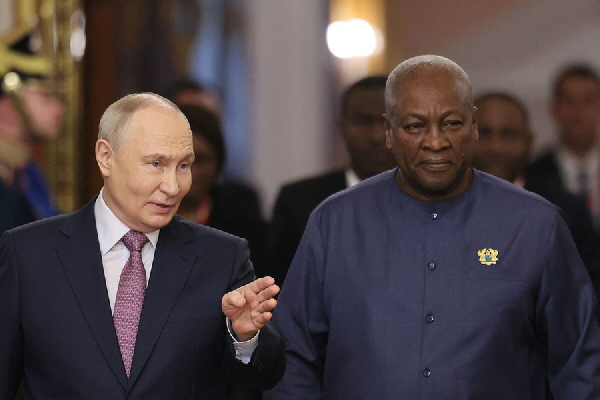
Russian President Vladimir Putin has agreed that Ghanaian nationals will no longer be allowed to participate in the Ukraine war, either through irregular recruitment or as volunteers, according to Ghana’s Foreign Affairs Minister Samuel Okudzeto Ablakwa. The commitment followed talks between President John Mahama and Putin at the Russia-Africa Summit. Ghana has previously reported that roughly 272 of its citizens had been recruited and that 62 had died. The restriction is part of broader bilateral understandings that also cover nuclear energy, defence cooperation, agriculture and scholarships.
Russian President Vladimir Putin has agreed that Ghanaian nationals will no longer be allowed to participate in the war in Ukraine, whether through irregular recruitment channels or as volunteers, according to Ghana’s Foreign Affairs Minister Samuel Okudzeto Ablakwa. The commitment was secured during direct talks between President John Dramani Mahama and Putin on the sidelines of the Russia-Africa Summit in Moscow in late October 2026. Ablakwa announced the outcome in a public statement on October 31, describing it as one of several concrete results of the bilateral engagement.
Ablakwa wrote that, following concerns raised by President Mahama, Putin declared that Ghanaians are no longer allowed to participate in the war with Ukraine and that the policy applies in all circumstances, whether through irregular recruitments or the expression of voluntary interest. The statement places the restriction on both coercive or deceptive practices and on any voluntary enlistment by Ghanaian citizens. Ghana had previously raised the issue at lower levels. In August 2026 Ablakwa received an assurance from Russian Foreign Minister Sergey Lavrov that Moscow would end what Accra described as illegal recruitment from Ghana. At that time Ablakwa stated that 62 Ghanaians had died in the conflict and that 15 others were missing. Earlier figures cited by Ghanaian authorities, drawn in part from information provided by Ukrainian officials, indicated that roughly 272 Ghanaians had been recruited since the full-scale phase of the war began, with annual numbers rising sharply in 2025.
The recruitment of African nationals by Russian forces has become a documented concern across the continent. Multiple African governments have reported that their citizens were lured by offers of employment, training or education and then presented with military contracts once they arrived in Russia. Kenya and South Africa have secured the return of some nationals they say were deceived into signing such contracts. Botswana, Zimbabwe, Cameroon and others have sought the repatriation of citizens who were recruited or captured. Ukrainian authorities have publicly stated that tens of thousands of foreigners from more than 150 countries have signed contracts with the Russian military, including several thousand Africans. Independent tracking and rights organisations have described patterns of deception, coercion and poor conditions for foreign recruits. Russian officials, including the embassy in Accra, have previously rejected claims of systematic unlawful recruitment of African nationals and have said that any specific cases of illegal conscription would be examined through proper channels.
Ghana’s figures place it among the African countries with higher reported numbers of citizens involved. Ablakwa has previously said that the conflict is not Ghana’s war and that young people should not be used as human shields. The government has investigated alleged recruitment networks operating through fraudulent overseas employment schemes. The new commitment, if implemented, would close both the irregular pathways that have been the main source of concern and any residual voluntary channel. Because the announcement originates from the Ghanaian side and describes a declaration by Putin, its practical effect will depend on subsequent administrative measures in Russia, on border and recruitment controls, and on whether Ghanaian citizens already under contract are affected. No independent public confirmation of the specific ban from Russian authorities has been cited in the accounts of the meeting.
The recruitment restriction formed part of a broader set of understandings reached between the two presidents. Ablakwa listed several other outcomes from the same talks, including an agreement to work toward a 2,000-megawatt nuclear power plant intended to support Ghana’s energy security and industrialisation, a new defence cooperation arrangement covering the acquisition of military assets for the Ghana Armed Forces, enhanced agricultural cooperation focused on grain production and fertiliser supply, an increase in scholarships for Ghanaian students, and the revival of a joint cooperation commission. These items reflect longstanding Ghana-Russia ties that date to the late 1950s and include earlier Soviet-era technical assistance. The nuclear discussion revives a project first explored under President Kwame Nkrumah. The summit itself, the third Russia-Africa gathering, drew delegations from nearly 50 African countries and was used by Moscow to expand political and economic links at a time of sustained Western sanctions linked to the Ukraine conflict.
For Ghana the recruitment ban addresses a concrete human-security problem that has produced documented deaths and missing persons among its citizens. Families of the dead and missing have had limited recourse, and the government has had to balance diplomatic engagement with public concern over the loss of young lives in a distant war. The commitment does not reverse losses already suffered, nor does it automatically secure the return of any Ghanaians still in Russian custody or under contract. It does, however, create a clearer diplomatic baseline against which future cases can be measured. Implementation will require continued monitoring by Ghanaian missions, cooperation with Russian authorities on any residual cases, and domestic measures to disrupt recruitment networks that have operated through false job offers.
The wider African pattern suggests that personnel shortages in the Russian military have driven expanded outreach to foreign recruits, including from countries whose governments have formally objected. Several African states have treated the issue as both a consular matter and a question of national dignity. Ghana’s ability to obtain a specific assurance covering both irregular and voluntary participation is presented by Accra as a diplomatic result of presidential-level engagement. Whether similar assurances are extended to other African governments, and whether the ban is enforced in practice, will determine how far the Moscow commitment alters the flow of Ghanaian nationals into the conflict.
What is confirmed is that Ghana’s Foreign Affairs Minister has publicly stated that Putin agreed, after Mahama raised the matter, that Ghanaians will no longer be permitted to participate in the Ukraine war through irregular recruitment or as volunteers. What is also confirmed are the earlier casualty and recruitment figures released by Ghanaian officials and the existence of prior lower-level assurances from the Russian foreign minister. What remains unverified by independent or Russian public statements is the precise scope and enforceability of the new restriction, the status of any Ghanaians already serving under contract, and the detailed mechanisms by which the ban will be applied. The announcement forms one element of a larger package of bilateral understandings reached at the Russia-Africa Summit. Its significance for Ghana lies in the attempt to halt further losses of citizens in a war in which the country is not a party.