OYEBANJI MAKES EKITI HISTORY AS HE BEGINS SECOND CONSECUTIVE TERM
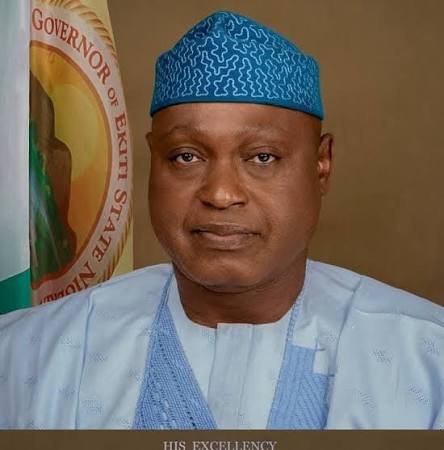
Biodun Oyebanji and Deputy Governor Monisade Afuye have been sworn in for a second consecutive four-year term in Ekiti State following their victory in the June 20 governorship election. Oyebanji secured 319,224 votes and became the first democratically elected incumbent governor since Ekiti’s creation in 1996 to win an immediate second term. Vice President Kashim Shettima represented President Bola Tinubu at the October 16 inauguration in Ado-Ekiti. Premium Times Nigeria
Ekiti State Governor Biodun Oyebanji has been sworn in for a second consecutive four-year term, becoming the first democratically elected incumbent governor since the creation of Ekiti State in 1996 to win re-election and immediately succeed himself in office, a milestone that breaks with nearly three decades of political turnover in the southwestern state.
Oyebanji and his deputy, Monisade Afuye, took the oath of allegiance and oath of office on Friday, October 16, at the Ekiti Parapo Pavilion in Ado-Ekiti. The oaths were administered by the Chief Judge of Ekiti State, Justice Adekanye Ogunmoye, formally opening another four-year term for the All Progressives Congress administration that first came into office in October 2022.
Vice President Kashim Shettima attended the ceremony as the representative of President Bola Tinubu, joining Senate President Godswill Akpabio, Deputy Senate President Barau Jibrin, governors, federal lawmakers, APC leaders, traditional rulers and other political figures who traveled to Ado-Ekiti for the inauguration.
Shettima arrived through the Ekiti Agro-Allied International Cargo Airport and was received by Oyebanji and senior political leaders before proceeding to the inauguration venue. His attendance underscored the national significance attached by the ruling APC to an election victory that delivered a rare second consecutive mandate in a state known historically for frequent changes in political control.
Oyebanji’s second term follows his victory in the June 20, 2026 governorship election. According to results announced by the Independent National Electoral Commission, the APC candidate secured 319,224 votes and won across all 16 local government areas of Ekiti State.
His closest challenger, Oluwole Oluyede of the Peoples Democratic Party, received 40,543 votes, while the candidate who finished third secured 12,872 votes. INEC declared Oyebanji the winner on June 21 after the completion of collation.
The size of the victory gave Oyebanji a clear mandate, but the political significance went beyond the margin. Since Ekiti was created from the old Ondo State in 1996, no sitting democratically elected governor had previously completed a term and then won an immediate second consecutive mandate at the ballot box.
That history had been shaped by fierce political competition, court cases, party changes, impeachment crises and alternating control between rival political camps. Former governor Kayode Fayemi served two terms as governor, but they were separated by the administration of Ayodele Fayose, making Oyebanji the first incumbent to move directly from a completed first term into a second through re-election.
The inauguration therefore represents a measure of political continuity that has been unusual in Ekiti since the return to democratic rule in 1999. For the APC, it consolidates control of the state and gives Oyebanji another four years to implement policies begun during his first administration.
For Oyebanji, the ceremony also begins a more demanding phase of his governorship. The first term provided the administration with an opportunity to establish policy direction and execute projects, but a second consecutive term removes the argument that more time is required simply to settle into office. Residents will now be able to judge the administration against promises already made and projects already underway.
In his inauguration message, the governor said the second term would focus on expanding jobs, improving healthcare, increasing electricity access, supporting agriculture, strengthening infrastructure and widening economic opportunities across the state.
The government has described its second-term agenda as a continuation of existing programs rather than a complete policy reset. The inauguration theme, “The Good Work Continues,” reflects that approach, with officials arguing that the administration intends to consolidate projects already started while accelerating development in sectors identified through consultations with communities.
Ahead of the inauguration, the state government said healthcare, electricity, roads, water supply, agriculture, human capital development and economic opportunities would receive sustained attention during the new term.
One of the administration’s most ambitious proposals is an expansion of rural road development, with officials saying the government intends to target up to 1,500 kilometers of roads through state interventions and partnerships with development organizations.
Road infrastructure has been one of the areas the government has emphasized when presenting its first-term record. The administration says more than 500 kilometers of inter-state, inter-city and rural roads were completed or improved during the first four years.
Those figures are government claims and will continue to be measured against conditions on the ground, but road construction is expected to remain a central part of the second-term program because of its relationship with agriculture, commerce and access to rural communities.
The administration has also placed significant emphasis on the Ekiti Agro-Allied International Cargo Airport, which commenced commercial operations in 2025. The government argues that the airport can support tourism, investment, trade and agricultural exports while improving the state’s connection to other commercial centers.
Agriculture is another major area of focus. Ekiti has a predominantly agrarian economy, and the government has promoted programs intended to draw younger people into commercial farming, increase production and connect agriculture more directly with processing and markets.
Officials say thousands of young people have participated in the Bring Back the Youth into Agriculture initiative and that credit and operational support has been provided to agricultural businesses and cooperatives. The next challenge will be demonstrating whether those interventions translate into sustainable incomes, higher food production and stronger agro-industrial activity.
Healthcare is also expected to feature prominently in the second term. The administration says more than 100 primary healthcare centers have been renovated and equipped, while general hospitals have also received upgrades.
The practical test will be whether those facilities consistently have qualified personnel, medicines, equipment and reliable services. Physical renovation can improve access, but public confidence in the health system depends equally on staffing, affordability and quality of care.
In education, the administration has highlighted spending on public examinations, school infrastructure and technology. Officials say the government paid WAEC examination fees for thousands of students and distributed free JAMB forms to eligible young people during the first term.
Such interventions are expected to continue, although education policy in the second term is likely to face broader questions about teacher availability, classroom conditions, skills training and the connection between schooling and employment.
Job creation may become one of the most politically important measures of the new administration. Like many Nigerian states, Ekiti faces pressure from youth unemployment, underemployment and outward migration by young people seeking opportunities elsewhere.
Oyebanji has pledged to expand skills development, agriculture, small-business support and private-sector investment as part of the response. The success of those plans will depend heavily on whether the state can attract businesses capable of creating sustainable employment rather than relying primarily on government programs and public-sector hiring.
The government has also emphasized support for small and medium-sized enterprises, including loans, grants and assistance with business registration. Officials have said thousands of businesses benefited from financial or administrative support during the first term.
The challenge in the new term will be measuring how many of those businesses survive, expand and create jobs, because disbursing grants or registering enterprises does not automatically guarantee long-term economic growth.
Oyebanji entered the new term after carrying out a significant political and administrative reset. In the days before the inauguration, he dissolved the State Executive Council and ended the appointments of several political officeholders, including directors-general and technical advisers.
The Secretary to the State Government, Professor Habibat Adubiaro, Chief of Staff Oyeniyi Adebayo and Chief Press Secretary Yinka Oyebode were among a small group retained because of the nature of their responsibilities.
The cabinet dissolution means the composition of the second-term government will be closely watched. New appointments will provide an early indication of whether Oyebanji intends to maintain most of his first-term team, introduce new technocrats or rebalance political representation across the state.
Those appointments could also affect the pace of policy implementation. A major reshuffle can bring new ideas and accountability, but it can also slow projects if incoming officials require time to understand existing programs.
The governor has repeatedly emphasized consultation and continuity, suggesting that he intends to avoid a disruptive transition. Because he is succeeding himself rather than taking over from another administration, the state does not face the same handover challenges normally associated with a change of government.
That continuity could make it easier to complete ongoing infrastructure projects and maintain existing social programs. It also means that responsibility for unfinished projects cannot easily be attributed to a previous administration.
Oyebanji’s relationship with President Tinubu and the federal APC government is also likely to remain important during the next four years. After his election victory in June, the governor publicly credited increased federal allocations and other national reforms with giving states additional resources.
Supporters of the federal government argue that reforms introduced by the Tinubu administration have expanded revenue available to states, while critics continue to point to the cost-of-living pressures associated with fuel subsidy removal, inflation and other economic changes.
For Ekiti, the key question will be how increased revenues are converted into measurable local improvements. Higher statutory allocations can provide more money for roads, salaries, healthcare and other services, but public scrutiny will increasingly focus on outcomes rather than revenue alone.
Shettima’s presence at the inauguration reinforced the political alignment between Ado-Ekiti and Abuja. He attended as Tinubu’s representative, while several senior APC figures and governors also participated in the ceremony.
Among those reported present were governors from Kwara, Imo, Sokoto, Kebbi, Ondo and Jigawa states, as well as APC National Chairman Nentawe Yilwatda. Former and serving federal officials were also among the dignitaries at the event.
The ceremony was the centerpiece of a broader inauguration program that began earlier in October and is scheduled to conclude with thanksgiving activities. Events included religious services, public programs and policy-focused engagements organized to mark the transition into the second term.
The government has used those events to present a detailed account of what it considers its first-term achievements and its priorities for the next four years.
That presentation has naturally emphasized the administration’s preferred narrative, while opposition parties and civil society groups are expected to continue scrutinizing issues such as infrastructure delivery, public finances, employment, education and access to healthcare.
Oyebanji’s re-election margin was large enough to give the APC political confidence, but a decisive election victory does not remove the need for opposition oversight. The PDP, other parties, the media and civic organizations will continue to play a role in assessing whether government claims are supported by results.
The governor himself has previously urged political opponents to put the election behind them and focus on the state’s development. After receiving his certificate of return, he said campaigning had ended and called for cooperation across political lines.
That message is likely to remain part of his second-term political strategy. A governor with an unusually large mandate may have more room to pursue policies without an immediate electoral challenge, but such dominance can also increase the importance of independent institutions and public accountability.
Ekiti’s political history makes the new term particularly notable. Since the state was created, governorship politics has frequently been competitive and unpredictable, with leadership changing between parties and personalities.
The uninterrupted re-election of an incumbent therefore represents an unusual period of continuity. Whether that continuity produces stronger institutions and faster development will depend on how the administration uses the next four years.
Oyebanji’s first term began on October 16, 2022, after he succeeded Kayode Fayemi. Before becoming governor, he had served in several state government roles, including as Secretary to the State Government, giving him significant experience within Ekiti’s administrative system before assuming the top office.
That background helped him enter government with a detailed understanding of the state bureaucracy, and his supporters have frequently highlighted his relatively conciliatory political style.
The governor now faces a different political environment from the one he entered four years ago. With re-election secured, expectations are likely to rise because residents can compare promises directly with a full four-year governing record.
Infrastructure projects will be judged on completion rather than announcements, agricultural programs on actual farmer incomes and food output, healthcare investments on service delivery, and employment programs on whether young people find lasting opportunities.
Public finances will also remain under scrutiny. State governments across Nigeria are receiving higher nominal allocations, but inflation and rising project costs mean larger revenues do not necessarily translate into equivalent increases in purchasing power.
Ekiti will therefore have to balance investment in infrastructure with recurrent obligations such as salaries, pensions and the operation of public services.
The administration has emphasized fiscal transparency as one of its strengths and has cited favorable rankings from organizations monitoring state finances. Maintaining that record will be increasingly important as larger sums are committed to second-term projects.
Rural development may provide one of the clearest tests of the government’s stated commitment to inclusive growth. A significant share of the state’s population lives outside Ado-Ekiti and other major urban centers, and residents in those communities frequently measure government performance through roads, electricity, water, schools and access to markets.
The proposed rural road expansion could therefore have effects beyond transportation. Better roads can reduce the cost of moving agricultural produce, improve access to health facilities and schools and encourage private investment in communities that were previously difficult to reach.
Electricity will be another critical area. Businesses and households continue to face reliability challenges, and government officials have listed power supply among the priority issues raised during stakeholder consultations.
Improvements in electricity access could support manufacturing, agro-processing and small businesses, particularly if the state can combine infrastructure investment with more reliable distribution.
Water supply remains equally important because communities across Nigeria continue to face problems accessing safe and dependable public water systems. The administration has said water projects will form part of the second-term agenda, but residents will ultimately judge performance by consistent availability rather than project announcements.
The political milestone surrounding Oyebanji’s inauguration may therefore attract attention today, but the importance of the second term will eventually be determined by ordinary measures of governance.
The governor now has an uninterrupted eight-year window stretching from 2022 to 2030, assuming he completes the second term, giving his administration an unusual opportunity in Ekiti to plan and execute programs over a longer period.
That continuity can be an advantage because large infrastructure and economic projects often require several years to mature. It also creates a clear line of responsibility because the same administration will have controlled both the planning and execution phases.
The inauguration gives Oyebanji the political stability to pursue long-term projects, but it also removes many of the excuses governments sometimes use for delays caused by transitions between administrations.
His administration will therefore enter the next four years with both opportunity and heightened accountability.
The history made on October 16 is primarily electoral. Oyebanji has achieved what no democratically elected incumbent governor of Ekiti had previously done since the state’s creation, securing an immediate second term and remaining in office without interruption.
The larger judgment will come later and will depend on whether political continuity produces measurable improvements in the lives of residents.
As the ceremony ends and the new term begins, attention will shift quickly from celebration to cabinet formation, budgets, project implementation and the priorities laid out for healthcare, electricity, roads, agriculture, water, jobs and human development.
Oyebanji has promised that his second administration will work harder and deliver more than the first. With another four-year mandate now formally underway, the governor and his team will be judged less by the historic nature of the inauguration than by the results they produce before the next transition in 2030.