INEC SOUNDS ALARM OVER DEEPFAKES AND AI FAKE NEWS AS NIGERIA HEADS INTO 2027 ELECTION
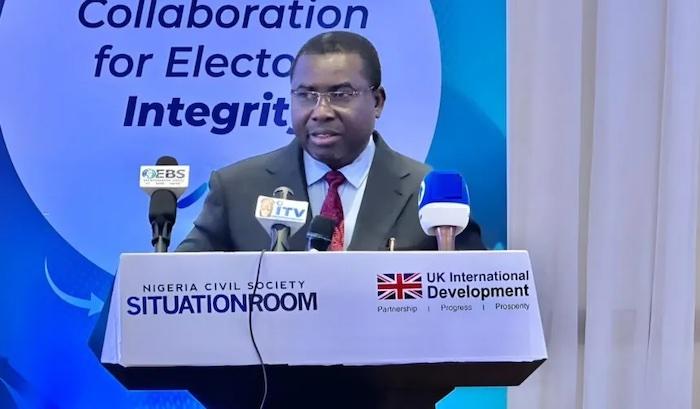
INEC Chairman Joash Amupitan has warned that deepfakes, fabricated audio, synthetic videos and coordinated AI driven disinformation could threaten confidence in Nigeria’s 2027 general elections. INEC has established a specialized AI unit to monitor digital threats and strengthen election administration, but says critical decisions involving accreditation, candidate qualification, collation and election results will remain under human and legal oversight. The Commission is also urging security agencies to remain professional and neutral as preparations intensify.
The Independent National Electoral Commission has warned that artificial intelligence generated fake news, deepfake videos, cloned voices and coordinated disinformation campaigns could pose a serious threat to the credibility of Nigeria’s 2027 general elections, with Chairman Professor Joash Amupitan insisting that technology will be used to strengthen the electoral process but will not be allowed to determine who wins or loses.
Amupitan delivered the warning in Abuja during the Artificial Intelligence and Democracy Forum 2026, convened as political campaigning intensifies ahead of the January 2027 presidential election. He said the central authority in the election must remain the Nigerian voter, stressing that algorithms may help analyze patterns, improve logistics and identify suspicious activity, but they cannot replace human judgment, statutory procedures or the constitutional power of citizens to choose their leaders.
The INEC chairman said the danger surrounding artificial intelligence goes far beyond the possibility of someone attempting to interfere directly with election infrastructure. He warned that increasingly sophisticated technology can now be used to create convincing but entirely fabricated videos, audio recordings, photographs and statements capable of misleading millions of voters within minutes. Such material could falsely portray candidates making inflammatory comments, announce fake election postponements, fabricate endorsements, spread false results or impersonate electoral officials and security agencies.
Amupitan argued that the most serious threat may therefore be psychological rather than mechanical. If voters become unable to distinguish authentic information from sophisticated digital fabrications, public trust in the electoral process could be damaged even where voting and counting procedures themselves remain intact. That challenge is particularly important in Nigeria, where political information spreads rapidly across WhatsApp, Facebook, TikTok, X, Instagram, YouTube and other digital platforms, often reaching large audiences before journalists, government institutions or technology companies can verify or challenge false claims.
The warning comes as generative artificial intelligence tools become cheaper, faster and easier to use. A realistic fake video or cloned voice that once required expensive equipment and specialized technical knowledge can now be produced with consumer level software. During an election campaign, such technology could allow political actors, anonymous groups, fraudsters or foreign influence networks to generate false material at a scale and speed that traditional fact checking systems may struggle to match.
INEC has responded by creating a dedicated artificial intelligence unit within its Information and Communications Technology structure. The Commission says the unit will monitor emerging digital threats, help identify manipulated media, strengthen cybersecurity and develop systems capable of detecting unusual patterns in electoral information. The Commission is also developing an AI governance framework designed to establish limits on how automated systems can be used within election administration.
Amupitan made clear that those tools will operate under human supervision. INEC says no critical electoral decision involving voter accreditation, candidate qualification, result collation or the determination of winners will be handed entirely to an autonomous system. The Commission wants artificial intelligence to function as an administrative and analytical tool rather than as an authority capable of overriding electoral officers, established law or judicial review.
That distinction has become increasingly important because INEC itself plans to expand its use of technology. Artificial intelligence can potentially assist with route planning for sensitive materials, logistics forecasting, cybersecurity monitoring, biometric database management, multilingual voter education and the detection of irregular patterns. It can also help election administrators analyze large volumes of data more quickly than human officials could manage manually.
The Commission believes those advantages can improve efficiency across an election involving more than 170,000 polling units and tens of millions of registered voters. But Amupitan acknowledged that the same technology available to election administrators is also available to people who may want to disrupt public confidence in the process.
Nigeria has already experienced the political consequences of online misinformation during previous elections. False result sheets, misleading videos, edited photographs and fabricated statements have circulated during earlier election cycles, sometimes gaining enormous attention before being corrected. The difference heading into 2027 is the increasing realism of synthetic media and the ability of generative AI systems to produce content designed to imitate the voice, appearance and communication style of real political figures.
That creates a particularly difficult problem when false material appears shortly before voting begins. A fabricated audio recording released hours before an election could spread across private messaging platforms before a candidate or institution has enough time to deny it. A deepfake video purporting to show an INEC official changing election procedures could create confusion among voters. False security warnings could discourage turnout in selected communities, while fake victory announcements could increase tension before official results are released.
INEC has therefore emphasized cooperation with technology companies, civil society organizations, news organizations and fact checking groups. The Commission says it wants false election information identified and challenged rapidly, particularly where fabricated material relates to polling procedures, candidate eligibility, result announcements or the safety of voters.
Technology companies have a particularly important role because much of Nigeria’s election related information now travels through digital platforms. Their content recommendation systems can amplify material rapidly, sometimes before its authenticity has been established. Amupitan has called for greater transparency around political advertising and has warned against algorithmic targeting that exploits sensitive characteristics such as ethnicity, religion or place of origin.
Those concerns are significant in a country where political competition often overlaps with ethnic, regional and religious identity. Artificial intelligence could be used to generate different messages for different communities, allowing campaigns or anonymous operators to circulate inflammatory content to narrowly targeted audiences without the wider public immediately seeing what is being distributed.
The Commission’s concern therefore extends beyond obvious fake videos. Automated networks can also flood social media with coordinated messages, create the illusion of widespread public support or outrage and manipulate trending topics. Large numbers of accounts can repeatedly circulate the same misleading narrative until it appears more credible simply because voters encounter it frequently.
Amupitan said technology must remain subordinate to democratic institutions. His position reflects a broader concern among election authorities worldwide that artificial intelligence can improve administration while simultaneously making political manipulation more sophisticated. The question is no longer simply whether technology should be used in elections, but how to prevent tools designed to improve efficiency from becoming instruments for deception.
Nigeria’s experience with election technology also makes public trust especially important. The 2023 presidential election generated controversy over delays in the electronic transmission and public display of some results through INEC’s results viewing system. Although courts subsequently dealt with legal challenges to the election, disputes surrounding technology became part of a wider debate about transparency and confidence in the Commission.
Heading into 2027, INEC is attempting to avoid a situation in which genuine technical problems become mixed with deliberately fabricated information. When voters already have doubts about a process, convincing fake material can exploit those concerns and become harder to dismiss. The Commission is therefore seeking to build stronger monitoring and communication systems before election day rather than responding only after misinformation begins circulating.
The scale of the election adds to that challenge. INEC’s current calendar places the presidential election on January 16, 2027, followed by governorship and state legislative elections on February 6. Election administration will require the movement of staff, ballots, accreditation technology and security personnel across Nigeria’s 36 states and the Federal Capital Territory.
The Commission has also been cleaning and updating the voter register while preparing its logistics infrastructure and coordinating security arrangements. Its planning has increasingly focused on the intersection between physical security and digital threats, because misinformation can contribute to real world violence if false claims about attacks, ballot manipulation or election results spread rapidly.
Earlier in the year, Amupitan warned that Nigeria’s 2027 electoral environment would combine social media volatility, AI driven disinformation, foreign information manipulation and longstanding logistical challenges. He argued that these digital threats become particularly dangerous when combined with insurgency, communal conflict, political violence and public distrust.
Security agencies will therefore remain central to INEC’s preparations. The Commission has repeatedly called on the police and other agencies involved in election security to act professionally, remain neutral and protect voters, officials, materials and collation centers without interfering with lawful political participation. INEC has stressed that credible elections require citizens to feel safe enough to vote and confident that security personnel are protecting the process rather than favoring political interests.
That expectation is especially important because security forces are often deployed in large numbers during Nigerian elections. Their conduct can influence whether opposition parties, observers and ordinary voters believe the environment is genuinely competitive. Allegations of intimidation, selective enforcement or excessive force can damage confidence even where voting takes place normally in many areas.
INEC has been using the Inter Agency Consultative Committee on Election Security to coordinate planning among the police, intelligence agencies and other security institutions. The Commission has urged agencies to strengthen intelligence gathering, deployment planning and communication before voting begins, particularly in communities where there is a known history of electoral violence or broader insecurity.
The AI threat complicates those responsibilities because security agencies could themselves become targets of impersonation. Fabricated statements attributed to police commanders or fake videos supposedly showing violence at polling centers could spread online and trigger panic. False information claiming that voting has been suspended in a particular state or that security forces have withdrawn from an area could also affect turnout.
INEC’s response therefore depends partly on rapid official communication. Election authorities will need to challenge fake claims quickly enough that corrections reach voters before false information becomes established. Journalists and broadcasters will also face pressure to verify viral content rather than reproducing it simply because it is politically significant or widely shared.
Media organizations are likely to encounter sophisticated manipulation throughout the campaign. A realistic clip showing a candidate apparently admitting electoral fraud or attacking an ethnic group could become major news if published without verification. The increasing quality of synthetic audio makes telephone recordings particularly difficult to authenticate, while AI generated photographs can now imitate the visual characteristics of genuine news images.
The Commission has urged journalists to treat digital verification as part of routine election reporting. That means establishing the original source of recordings, checking timestamps and locations, examining whether credible witnesses or institutions can confirm an event and resisting pressure to publish explosive material before its authenticity is known.
Political parties also face responsibility. INEC has warned that campaigns should not use artificial intelligence to manufacture false statements attributed to opponents or circulate deliberately misleading information about voting procedures. While political campaigning naturally involves persuasion and criticism, synthetic impersonation can cross into deliberate deception capable of undermining informed democratic choice.
Regulation remains complicated because Nigeria must also protect legitimate political speech. Artificial intelligence can be used harmlessly for campaign graphics, translations, voter education, research and administrative work. The challenge is separating those legitimate uses from fraudulent impersonation, malicious disinformation or automated operations designed to manipulate public debate.
That is one reason Amupitan has emphasized governance rather than outright prohibition. INEC is not proposing to remove AI from the electoral environment, something that would be practically impossible. Instead, the Commission is attempting to establish rules that preserve human accountability and allow technology to improve administration without becoming the authority that decides electoral outcomes.
The Commission’s ability to enforce those principles will be tested throughout the campaign. Many of the most influential digital platforms are operated by multinational companies, while political content can be created outside Nigeria and distributed anonymously. Private messaging services also make monitoring difficult because misleading material can circulate within encrypted groups without appearing publicly until it has already reached large audiences.
Foreign information manipulation is another concern. Election authorities around the world have increasingly warned that overseas actors can use social media, automated accounts and synthetic content to deepen existing political divisions. INEC has identified such interference as part of the wider threat environment, although it has not publicly accused a specific foreign government of attempting to manipulate Nigeria’s 2027 election.
Public awareness will therefore form another layer of defense. Voters are being encouraged to rely on official INEC channels for information about polling procedures, election dates and results rather than treating viral screenshots, anonymous voice notes or edited videos as authoritative. The Commission’s challenge will be ensuring that official information reaches people quickly and in formats that are easy to understand.
Trust remains at the center of the issue. Artificial intelligence cannot by itself overturn an election simply because a false video exists, but widespread uncertainty about what is real can weaken confidence in genuine information. If every authentic video is dismissed as potentially fake and every fabricated clip is defended as potentially genuine, the information environment becomes difficult for voters to navigate.
That possibility explains why Amupitan has framed the issue as a threat to informed consent rather than merely a technical cybersecurity problem. Democracy depends on voters being able to make choices based on information they believe is authentic. When synthetic media makes authenticity increasingly difficult to establish, election institutions, journalists, political parties and technology companies all face greater responsibility.
INEC enters this period under considerable pressure to demonstrate both technological competence and institutional neutrality. The Commission will have to manage logistics across the country, oversee accreditation and result management, respond to security threats and simultaneously police an information environment capable of producing convincing falsehoods at extraordinary speed.
The success of its AI safeguards will therefore not be measured simply by whether software detects a deepfake. It will depend on whether INEC can communicate quickly, whether technology companies cooperate, whether political actors refrain from deliberate manipulation and whether voters retain enough confidence in official institutions to reject fabricated information when it appears.
The warning from the Commission is ultimately that Nigeria’s 2027 election will be fought not only at campaign rallies and polling units but also across phones, social networks and private messaging platforms. AI may help INEC plan routes, detect anomalies and strengthen cybersecurity, but the Commission says the legal and democratic authority to choose Nigeria’s leaders remains with voters.
As the election approaches, the unresolved question is whether Nigeria’s institutional safeguards can move as quickly as the technology capable of challenging them. INEC has built an AI unit, developed governance rules and intensified cooperation with stakeholders, but those systems will face their real test when politically damaging synthetic material begins circulating at campaign speed. The credibility of the election will depend not only on accurate counting but also on whether Nigerians can trust the information surrounding the vote.
For Amupitan, the Commission’s position is clear. Artificial intelligence will be used as an administrative tool, not as a substitute for voters, election officials or the law. The larger challenge is ensuring that the technology does not distort the information environment so severely that citizens struggle to make informed decisions before they ever reach the polling unit.