
MAHAMA SAYS BECHEM WILL BECOME GHANAS CHICKEN CAPITAL AS POULTRY PLANT REACHES 50 PERCENT COMPLETION
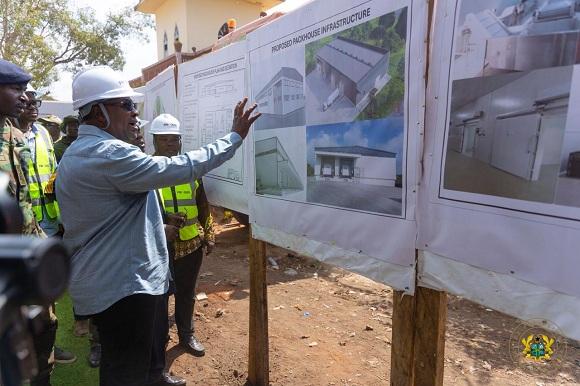
President John Mahama has inspected the poultry, meat and feed processing plant under construction at Bechem and says the town will become Ghana’s chicken production and distribution hub. The facility is about 50 percent complete and is expected to be finished around the middle of 2027. Government says the plant will provide a ready market for local poultry farmers while supporting processing, jobs and nationwide distribution.
President John Dramani Mahama has inspected ongoing construction of the Poultry, Meat and Feed Processing Plant at Bechem in the Ahafo Region and says the project will transform the town into Ghana’s major chicken production and distribution hub once completed. The inspection formed part of his Resetting Ghana tour of the Ahafo Region and brought renewed attention to the government’s broader strategy to expand domestic poultry production, create reliable markets for farmers and reduce the country’s dependence on imported chicken.
Mahama said he was encouraged by the progress of work at the facility and expects the plant to begin operating after completion next year. Consultants and contractors working on the project told the President that construction is currently about 50 percent complete and is expected to be finished by the middle of 2027. The facility is being developed as part of the government’s Nkoko Nkitinkiti poultry programmed, which is intended to link farmers directly to processing capacity and create a more integrated domestic poultry industry.
The President said the factory will give farmers a guaranteed market for birds raised under the programmed, allowing producers to rear chickens for about eight weeks and then sell them directly into the processing system rather than struggling to find buyers independently. He said the objective is to build a reliable supply chain in which farmers, processors, traders and distributors all benefit from increased local production.
Mahama said Bechem would eventually become a major centre where traders from different parts of Ghana could purchase processed chicken in large quantities and transport it to markets across the country. He specifically referenced opportunities for traders to move poultry products from Bechem to towns including Tamale and Bolgatanga, positioning the facility not only as a processing factory but as a national distribution point.
The project was first formally launched in November 2025 when Mahama cut the sod for construction of the Poultry, Meat and Feed Processing Plant. At the time, government said the facility would support agro processing, employment and value addition while creating a ready market for poultry farmers in surrounding regions. The original project timetable targeted completion within about 12 months, but the latest inspection indicates the operational date is now expected around the middle of 2027.
The plant forms part of a wider effort to revive Ghana’s poultry sector after years of heavy reliance on imported frozen chicken. Government data previously cited by Mahama showed that Ghana spent more than 350 million dollars importing poultry products in 2023, a level the administration has described as unsustainable because it places pressure on foreign exchange while limiting opportunities for domestic farmers.
The Nkoko Nkitinkiti programme was designed partly to address that problem by increasing the number of birds raised locally while ensuring that processing and marketing infrastructure expands at the same time. Agriculture Minister Eric Opoku told the President during the Bechem inspection that Ghana’s domestic poultry production had increased from about 4.6 percent to 22 percent as of May 2026 under the programme. Mahama said the reported increase gives government confidence that local production can continue growing before the new factory begins operating.
That increase remains a government reported figure and will ultimately be judged against broader national poultry consumption and import data. However, the administration says the progress demonstrates that farmers are responding to production support and that a stronger domestic supply base is beginning to emerge. The government has also said the programme has contributed to a sustained surplus of eggs in parts of the local market, creating pressure to develop new commercial outlets for producers.
The Bechem plant is intended to solve one of the most persistent problems confronting local poultry farmers, namely the lack of a predictable market after birds are ready for sale. Ghanaian producers have frequently complained that imported frozen chicken competes aggressively on price and supply consistency, making it difficult for local farmers to recover feed, energy and labour costs. A dedicated processing facility linked directly to government supported production could provide farmers with a clearer route to market if the factory operates consistently and purchases birds at commercially viable prices.
Mahama encouraged young people in Bechem and surrounding communities to participate actively in poultry farming rather than waiting only for direct employment at the factory. He said the opportunities surrounding the project would include bird production, transportation, processing, distribution and other agribusiness activities connected to the poultry value chain.
That broader value chain approach is central to the government’s agricultural strategy. The administration says increasing poultry production alone will not be enough if farmers cannot obtain feed, processing capacity, cold storage, transport and dependable buyers. The Bechem project therefore combines meat processing with feed production and other supporting infrastructure intended to make poultry production commercially sustainable beyond household level.
The factory is also expected to support farmers outside Ahafo. Government planning around the project has previously identified producers in neighboring poultry producing areas, including parts of Bono, Bono East and Ashanti, as potential suppliers. That would give the facility a catchment area larger than Bechem itself while creating demand for maize, soybean and other crops used in poultry feed.
Feed remains one of the largest costs in poultry farming and often determines whether local producers can compete with imported meat. By incorporating feed production into the Bechem project, government is attempting to reduce supply bottlenecks and create a more coordinated system in which farmers can obtain inputs and sell finished birds within the same broader programmed.
The project also fits within the administration’s Feed Ghana programmed, which seeks to expand domestic food production and reduce dependence on imports. Poultry has been identified as a priority sector because Ghana continues to import large quantities of frozen chicken despite having local demand, agricultural land and established farming experience. The government has set an earlier target of reaching 75 percent poultry self sufficiency by 2028, although meeting that goal will require sustained growth well beyond the current reported production share.
Under the broader poultry initiative, government has previously announced plans to support tens of thousands of households, commercial anchor farmers and smaller producers. One component involves selected commercial poultry businesses producing millions of birds, while another provides support to smaller farmers across the regions. The household component distributes birds, feed and technical assistance to families with the objective of expanding backyard production and creating additional income opportunities.
Mahama acknowledged during the Bechem visit that not every bird distributed under the programme had been retained for production, noting that some beneficiaries had consumed their chickens. He nevertheless argued that the initiative continues to increase the availability of locally raised poultry and said the important next step is ensuring that producers have a commercial system into which they can sell.
The Bechem factory is intended to provide that system. Once operational, farmers who successfully raise birds to market size should be able to sell them into the plant, where the chickens can be processed, packaged, stored and distributed to consumers across Ghana. Government believes this model can gradually strengthen consumer confidence in locally produced chicken while reducing the market advantage enjoyed by imported frozen products.
The inspection also had a broader political and development dimension because it formed part of Mahama’s two day Resetting Ghana tour of the Ahafo Region. The President’s itinerary includes inspections of major infrastructure and agricultural projects, including the Tepa Goaso Road and the Ntontroso Bridge connecting Acherensua, one of the region’s important food producing areas. The tour is intended to assess progress on government projects while allowing residents and traditional leaders to raise development concerns directly with the President.
The Ahafo visit also includes a public engagement in Goaso where the government is expected to brief residents on regional projects and receive feedback on national programmed. Agriculture has featured prominently in the tour because Ahafo remains a major farming region and because the administration is trying to link road construction, processing facilities and agricultural production more closely.
That connection is especially important for poultry and other perishable products. Expanding production without improving transport infrastructure can leave farmers facing high logistics costs and post harvest losses. Better roads between farming communities and processing centres can reduce travel time, improve access to markets and make it easier for traders to transport processed goods from Bechem to other parts of Ghana.
The President’s declaration that Bechem will become Ghana’s chicken capital is therefore both a political promise and an economic objective. For the claim to become reality, the factory will need to be completed on schedule, operate at meaningful capacity and purchase enough birds to sustain a large network of farmers. Feed supply, veterinary services, financing, electricity, cold storage and distribution will all have to function effectively if Bechem is to develop into the national poultry hub the government is promising.
There is also the question of price competitiveness. Local poultry can struggle against imported chicken because imported products are often produced at very large scale and enter Ghana through established distribution networks. Government support can help close that gap, but the long term competitiveness of the domestic industry will depend on productivity, feed costs, processing efficiency and whether consumers are willing to pay for locally produced chicken.
The administration believes that the current production increase provides a foundation for that transition. Agriculture Minister Eric Opoku said local poultry production has moved from 4.6 percent to 22 percent within roughly a year of programmed implementation, while Mahama said supply should increase further before the Bechem plant is commissioned. If production continues rising, the factory could enter operation with a much larger base of farmers than would have been available when construction began.
The government also expects the plant to create direct employment. Processing facilities require workers in slaughtering, packaging, cold storage, quality control, maintenance, feed production, administration and logistics. Indirect jobs could emerge in farming, transport, retailing and feed crop production, providing opportunities beyond the factory site itself.
Traditional leaders and local authorities in Bechem have previously welcomed the project while also asking government to address other development needs, including healthcare, technical education and higher education infrastructure. Their support reflects expectations that the factory will stimulate wider economic activity in the municipality rather than function as an isolated industrial facility.
The project now faces a straightforward test of delivery. Government broke ground in 2025, construction is reported to be about halfway complete in October 2026 and contractors now expect completion around the middle of 2027. Any significant delay could weaken confidence among farmers being encouraged to expand production in anticipation of the factory opening.
If the timetable is met, the government will then face the more difficult challenge of ensuring the facility operates sustainably after commissioning. Ghana has previously completed industrial and agricultural projects that later struggled with maintenance, financing, raw material supply or management. The Bechem project will therefore be judged not only by whether the buildings are completed but by whether the processing lines remain active and farmers are paid reliably.
Mahama’s emphasis on a guaranteed market suggests the administration is aware of that challenge. Farmers will be more willing to invest in poultry production if they believe there is a dependable buyer when their birds mature. Without that certainty, producers may hesitate to take on the cost of feed, chicks, medicine and labour.
The President’s message in Bechem is consequently focused on building both sides of the market at once. Government is trying to increase the number of birds available while constructing the processing infrastructure needed to absorb them. Traders and distributors are then expected to move processed chicken into markets nationwide, creating a chain from farmer to factory to consumer.
Whether that system can significantly reduce Ghana’s poultry imports will depend on scale. Moving domestic production from a small share of national consumption toward self sufficiency will require millions of additional birds, strong private investment and a sustained policy environment over several years. The Bechem plant alone cannot achieve that transformation, but it could become an important regional anchor if it performs as intended.
For now, Mahama says the progress visible at the construction site gives him confidence that Bechem can emerge as the centre of Ghana’s local chicken trade. With the factory reported at about 50 percent completion and poultry output rising under the government’s programmed, the administration is presenting the project as evidence that agricultural production and industrial processing can be developed together.
The next major milestone will be completion and commissioning in 2027. If the plant opens on schedule and farmers are able to supply it consistently, Bechem could become a major distribution point for locally processed chicken and an important test of Ghana’s attempt to replace imported poultry with domestic production. If those pieces fail to come together, the promise of making the town Ghana’s chicken capital will remain largely symbolic. For the moment, construction is advancing and the government is asking farmers and young entrepreneurs to prepare for the market it says the new factory will create.