I’M BACKING TINUBU, APC IGBOS SUPPORTING IGBO CANDIDATES NOT MY BUSINESS ORJI KALU
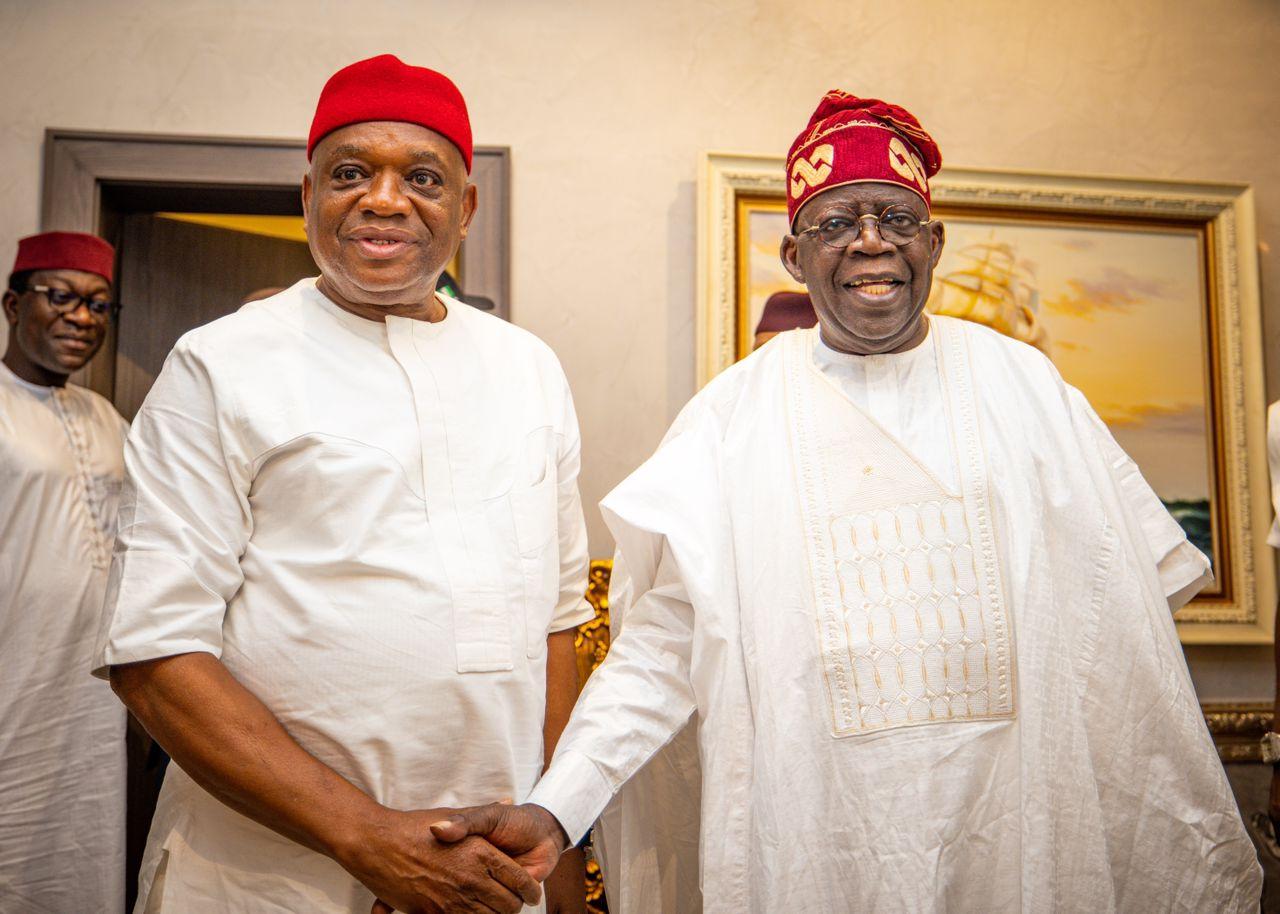
Senator Orji Uzor Kalu has reaffirmed his support for President Bola Tinubu and the APC ahead of Nigeria’s 2027 presidential election, insisting that party loyalty should come before ethnic considerations. Kalu said Igbo politicians and voters are free to support other Igbo candidates, but maintained that he has no obligation to abandon his party’s presidential candidate because of shared ethnicity.
Senator Orji Uzor Kalu has declared that his loyalty to President Bola Ahmed Tinubu and the ruling All Progressives Congress will take precedence over ethnic considerations in Nigeria’s 2027 presidential election, rejecting the expectation that his Igbo identity should compel him to support a presidential candidate from the Southeast running on another political platform. Kalu, the senator representing Abia North and a former governor of Abia State, said he remains firmly committed to Tinubu’s re-election and considers loyalty to his political party the most important factor in determining where he stands politically as Nigeria approaches the January 16, 2027 presidential election.
Speaking during an appearance on ARISE News’ Prime Time program on Monday, November 9, Kalu said Igbo politicians and voters are free to support candidates from their ethnic group if they choose, but insisted that those choices have nothing to do with his own political allegiance. He said his responsibility is to support the party to which he belongs and the presidential candidate that party has presented. “I support Tinubu. I’m in APC. If any Igbo wants to support any other Igbo who is running, that is his business. It’s not my business,” Kalu said, adding that “party loyalty is number one.”
Kalu’s remarks place him squarely within the APC’s effort to deepen Tinubu’s support in the Southeast, a region where the ruling party has historically struggled in presidential elections and where questions of political representation, regional inclusion and the possibility of an Igbo presidency continue to carry considerable political weight. Kalu argued that ethnic identity should not dictate how elected politicians make national political choices, maintaining that being proud of one’s background is not the same as abandoning party affiliation whenever another candidate from the same ethnic group enters an election.
The former Abia governor said his political career has taken him through the Peoples Democratic Party, the Progressive Peoples Alliance and now the APC, which he described as his current political home. He questioned why anyone would expect him to campaign for politicians contesting under a rival platform, including the All Progressives Grand Alliance, simply because those candidates are Igbo. Kalu’s argument is that political parties exist precisely to organize candidates, supporters and policy choices, and that a politician who remains a member of one party cannot reasonably be expected to work for a rival party’s candidate on ethnic grounds.
He also portrayed his position as a broader rejection of ethnic politics, saying he considers himself Nigerian first in matters of national political competition. That framing is likely to resonate with supporters who argue that Nigeria’s political future should be determined by party platforms, competence and national coalition-building rather than regional or ethnic expectations. It is equally likely to attract criticism from voters who believe the Southeast’s long-running demand for greater political inclusion, particularly at the presidential level, should command the loyalty of prominent politicians from the region regardless of their party affiliation.
Kalu’s comments are particularly significant because they come at a time when the Southeast is becoming an increasingly important battleground in the 2027 race. President Tinubu is seeking a second term, and APC leaders have been working to improve the party’s standing in a region where it performed poorly in the 2023 presidential election. Peter Obi, who ran on the Labour Party platform in 2023, dominated the Southeast and won overwhelming support across much of the region, while also building a substantial following among younger and urban voters elsewhere in Nigeria. That performance reinforced the political significance of the Igbo presidency debate and made the Southeast one of the most closely watched regions in the next national election.
Kalu, however, has consistently taken the position that the region should increase its influence by building stronger ties with the party controlling the federal government rather than treating support for an Igbo presidential candidate as an automatic obligation. His latest remarks reinforce that view by separating ethnic identity from party responsibility and by presenting support for Tinubu as a matter of institutional loyalty rather than ethnic preference. In that sense, his position reflects a broader division among Southeast political leaders over whether the region’s interests are better served through opposition politics or through negotiation and participation within the ruling coalition.
During the same interview, Kalu went beyond questions of ethnic politics and strongly defended Tinubu’s chances in the presidential election, predicting that the president would secure a landslide victory. He argued that the APC’s strength extends beyond Tinubu as an individual and rests on a large national structure, widespread grassroots organization and the ability to mobilize voters in areas that may not be fully reflected in online political conversations. Kalu said social media sentiment should not be mistaken for the complete picture of political support across the country and maintained that the APC remains a formidable electoral machine.
The senator also defended Tinubu’s economic reforms, saying the administration has made difficult decisions that he believes are beginning to stabilize the economy. That defense comes against a challenging backdrop for the president, whose government has faced sustained criticism over the cost of living, inflation and the impact of reforms introduced after he took office in May 2023. The removal of the petrol subsidy and changes to Nigeria’s foreign-exchange system contributed to sharp increases in transportation, food and household expenses, placing significant pressure on families and businesses across the country.
Kalu acknowledged the hardship facing Nigerians but argued that major economic restructuring inevitably creates pain before producing longer-term results. His position mirrors the central argument being made by Tinubu and senior members of the APC, who have sought to persuade voters that the administration inherited deep structural problems, took politically difficult steps to address them and now deserves additional time to consolidate the gains. Critics, however, continue to argue that the reforms have imposed excessive hardship on ordinary Nigerians and that economic improvements have not been felt quickly or broadly enough by households struggling with rising prices.
The political challenge for Tinubu is therefore not simply to secure the support of party leaders such as Kalu but to translate those endorsements into votes in regions where the APC has historically struggled. The Southeast is especially important because of its strong opposition voting patterns in 2023 and because of the symbolic importance of the presidency to many voters in the region. The APC’s ability to improve its performance there could significantly strengthen Tinubu’s national coalition, particularly if opposition votes are divided among several candidates.
Kalu’s endorsement is also notable because he is one of the most prominent APC politicians from the Southeast and has repeatedly used his public profile to campaign for Tinubu’s re-election. In previous political engagements, he has dismissed claims that endorsements of Tinubu are driven by fear of opposition forces, arguing instead that supporters are responding to what he sees as the administration’s performance and political strength. He has also appeared publicly in clothing carrying pro-Tinubu 2027 messages, underscoring that his support for the president is neither new nor ambiguous.
The senator’s intervention also speaks to a long-running tension in Nigerian politics between ethnic solidarity and party discipline. Nigeria’s major political parties have traditionally depended on complex coalitions built across ethnic, regional and religious lines, and presidential candidates must construct broad national alliances to compete effectively. At the same time, regional expectations have often played a decisive role in shaping political negotiations, particularly when parties decide which part of the country should produce a presidential or vice-presidential candidate.
For the Southeast, that debate has remained especially sensitive since Nigeria returned to civilian rule in 1999. Many political leaders and civic groups from the region have argued that the presidency should rotate to the Southeast in the interest of national balance and inclusion. Their case is based partly on the argument that other major regions have produced presidents during the Fourth Republic while the Southeast has not. Supporters of that position say an Igbo presidency would address a long-standing political grievance and strengthen the sense of belonging among people in the region.
Others, including Kalu in the context of the current contest, argue that ethnic entitlement should not override party membership or broader national political considerations. That approach places emphasis on the idea that politicians should work within their chosen parties and build coalitions capable of winning power, rather than expecting candidates to receive support primarily because of shared ethnic identity. Kalu’s comments therefore do more than endorse Tinubu; they directly challenge one of the most emotionally charged arguments surrounding the Southeast’s role in national politics.
The senator’s position is likely to intensify debate among Igbo voters, particularly those who believe prominent political figures from the region should use their influence to push more aggressively for a Southeast presidency. To such voters, Kalu’s emphasis on party loyalty may appear to place partisan interest above a broader regional aspiration. His supporters are likely to counter that political power is secured through organization, negotiation and coalition-building and that the Southeast cannot afford to isolate itself from the country’s largest governing party.
Kalu’s remarks also come at a point when political alignments across the Southeast are becoming more complicated. Some influential leaders have moved closer to Tinubu and the APC, while others continue to support opposition platforms. That fragmentation could become a major factor in the 2027 election because the region’s vote may no longer consolidate behind a single opposition candidate to the same degree as it did in 2023. For the APC, even a significant reduction in the opposition’s previous margins could represent an important strategic gain.
At the same time, Kalu’s confidence in a Tinubu landslide will be tested against broader national concerns over the economy, insecurity, governance and public trust in political institutions. While the APC has the advantages of incumbency and an extensive party structure, the election will ultimately be decided by whether voters believe their circumstances have improved sufficiently under the current administration and whether opposition candidates can present a credible alternative capable of mobilizing support across multiple regions.
The Independent National Electoral Commission has scheduled the presidential and National Assembly elections for January 16, 2027, making the remaining campaign period critical for parties seeking to consolidate alliances and persuade undecided voters. As the election draws closer, endorsements by influential politicians such as Kalu will become increasingly important, but their real value will depend on whether they can deliver votes beyond their personal networks and political structures.
For Kalu, however, the choice has already been made. His latest remarks leave no uncertainty about where he stands: he intends to remain with the APC and campaign for Tinubu regardless of whether another Igbo politician enters the presidential race under a different party. That position places him firmly on one side of a broader argument over whether ethnicity, regional aspiration or party allegiance should carry the greatest weight in Nigeria’s national politics.
As Nigerians move closer to the 2027 election, the significance of Kalu’s comments will extend beyond his personal support for the president. They expose the competing political strategies now emerging in the Southeast, where some leaders are betting that closer alignment with Tinubu can deliver greater influence while others continue to argue that the region should pursue its presidential ambitions through alternative political platforms. Whether voters embrace Kalu’s argument that party loyalty should come before ethnic solidarity will become clearer when ballots are cast, but his intervention has already sharpened one of the most consequential political debates of the election season.