EDO STUDENTS LEARN IN FLOODED, ROOF-DAMAGED CLASSROOMS DESPITE BILLIONS IN STATE REVENUE AND SCHOOL RENOVATION BUDGETS
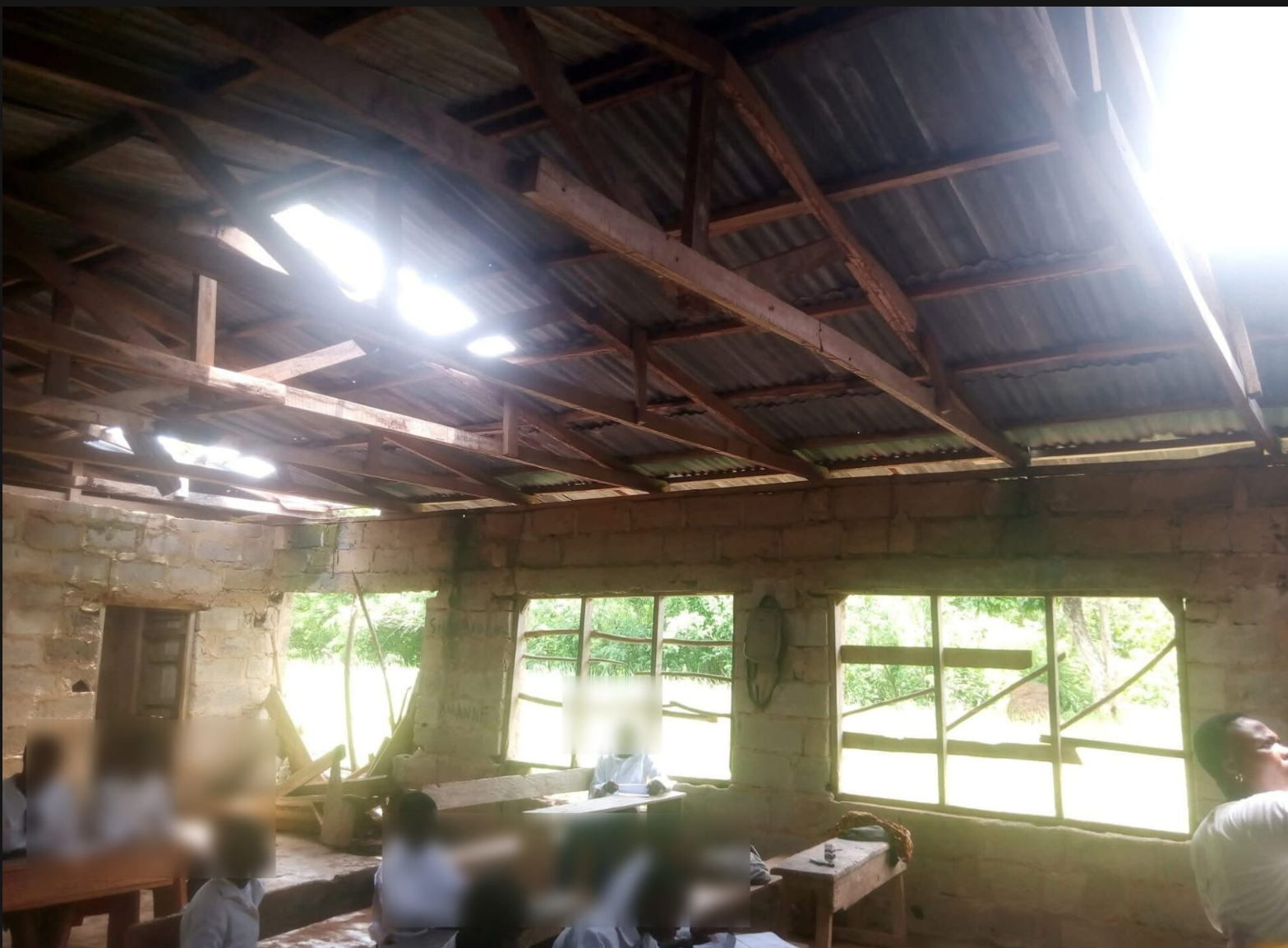
Students at Okpokhumi Grammar School in Owan East, Edo State, are reported to be learning in deteriorated classrooms with damaged roofs, exposed wooden supports and spaces that become flooded during rainfall. Civic group MonITNG says the school serves several surrounding communities and has repeatedly demanded urgent rehabilitation. The widely circulated claim that Edo receives exactly ₦17.28 billion every month in federal allocations could not be independently verified; more reliable recent figures cited by the group show about ₦145.25 billion in gross FAAC receipts between January and July 2026. Edo’s official 2026 budget separately provides more than ₦10 billion across major school construction and renovation lines.
Students at Okpokhumi Grammar School in Owan East Local Government Area of Edo State are continuing to receive lessons in severely deteriorated classrooms with sections of roofing missing, exposed wooden trusses, damaged walls and floors that reportedly become flooded during heavy rainfall, renewing questions over how quickly the state government is translating rising public revenue and billions of naira in education appropriations into safe learning conditions for children in rural communities. The school, which serves students from Okpokhumi Emai and surrounding communities including Ojavun Emai New, Ojavun Emai Old and other nearby settlements, has been the subject of repeated public complaints throughout 2026, with civic-monitoring organization MonITNG publishing photographs and videos showing students attending classes in buildings that appear to require substantial rehabilitation.
The condition of the school first attracted renewed national attention in May when MonITNG published images showing classrooms with badly damaged roofs, missing ceilings, cracked floors and deteriorating walls. The organization said about 1,768 students depended on the institution and described it as the only government secondary school serving several communities in that part of Owan East. It said rainfall could leave classrooms flooded and disrupt lessons, forcing students to contend with wet floors, damaged books and unsafe structures while preparing for major examinations and attempting to complete their secondary education.
The concerns resurfaced in October when new reporting again highlighted Okpokhumi Grammar School’s condition and questioned why rehabilitation had not yet reached the facility despite substantial public revenue flowing to Edo State. MonITNG said students from Evbiamen, Okpokhumi Emai, Ojavun Emai New and Ojavun Emai Old continued to attend classes in structures with damaged roofing and exposed wooden supports. The group called on Governor Monday Okpebholo, the Edo State Ministry of Education and elected representatives from Owan East to intervene urgently and provide a clear rehabilitation timetable.
The financial comparison attached to the campaign requires careful explanation. Some social-media versions of the story have described Edo as receiving ₦17.28 billion every month from the Federation Account Allocation Committee, but that specific monthly figure could not be independently verified from current official revenue records reviewed for this report. A more reliable figure cited by MonITNG and repeated in multiple recent reports states that Edo received approximately ₦116.89 billion in gross FAAC allocations between January and June 2026 and another ₦28.36 billion in July, bringing the cited seven-month total to roughly ₦145.25 billion.
Those FAAC receipts are not education funds alone. Federation allocations support the full range of state responsibilities, including salaries, health services, roads, security, debt obligations, pensions, administration and infrastructure. It would therefore be misleading to suggest that the entire ₦145.25 billion could have been spent on Okpokhumi Grammar School or public education. The relevance of the figure is instead that it demonstrates the broader revenue environment in which rural schools continue to report severe infrastructure deficits and raises legitimate questions about prioritization, implementation and whether approved education projects are reaching the schools with the greatest need.
Edo’s own 2026 budget strengthens that accountability question because it includes substantial allocations specifically designated for educational infrastructure. The state’s published Citizens Budget provides ₦4 billion for the construction and renovation of primary and junior secondary schools across Edo, ₦3.4 billion for the renovation of 17 senior secondary schools at ₦200 million per school and ₦2.781 billion for the renovation of 131 secondary schools across the state. Those line items alone amount to more than ₦10 billion in planned school-related construction and rehabilitation, although the budget documents do not establish from the information publicly available whether Okpokhumi Grammar School is included among the schools scheduled for work.
That distinction is central to evaluating the government fairly. An approved budget is an authorization and spending plan, not evidence that every listed project has already been completed or even begun. Implementation can be affected by procurement schedules, contractor mobilization, cash releases, engineering assessments and other administrative processes. At the same time, the continued deterioration of a school that has been publicly flagged repeatedly creates pressure on the government to explain whether it has been assessed, whether funds have been assigned to it and when students can expect repairs.
Okpokhumi Grammar School’s problems are not newly discovered. Research and earlier public-interest reporting indicate that educational facilities in parts of Owan East and Owan West have struggled with deterioration for years. A 2024 academic paper discussing abandoned and deteriorating public infrastructure in Edo specifically referred to Okpokhumi Emai Grammar School, describing missing doors and windows and substantial portions of roofing that had already deteriorated. The paper suggested the school had faced long-term neglect predating the current administration, meaning responsibility for the infrastructure crisis spans more than one political tenure.
That history matters because Governor Okpebholo’s administration inherited a public-school system containing both functioning modernized facilities and older schools requiring major reconstruction. The government itself has acknowledged that many schools were in poor condition when it took office. Earlier in 2026, Okpebholo said his administration had encountered schools with badly degraded classrooms, furniture and laboratories and argued that ongoing reconstruction work was intended to transform them into safer and more effective learning environments.
The government has pointed to rehabilitation projects elsewhere in Edo as evidence that it is addressing the inherited infrastructure deficit. In some schools, officials have highlighted reconstructed classroom blocks, laboratories and furniture as part of the administration’s education program. The state’s 2026 budget further demonstrates an intention to expand that work across a much larger number of schools, including the planned renovation of 131 secondary institutions statewide.
The unresolved issue is whether Okpokhumi Grammar School has been included in that intervention and, if so, how quickly construction can begin. VNTV could not find a specific public statement from the Edo State Government or Ministry of Education responding directly to the latest October complaints about Okpokhumi or providing a start date for repairs at the school. That absence does not establish that no internal assessment or procurement process exists, but it leaves affected families without a publicly documented timetable against which to measure progress.
MonITNG has argued that students should not continue learning in buildings with compromised roofs and flooded floors while the state government is budgeting billions for educational infrastructure. Its campaign has also drawn attention to elected representatives from the area, including lawmakers it says should use their positions to press for rehabilitation. The organization has demanded not simply cosmetic work but a comprehensive intervention involving structural repairs, functional furniture, improved sanitation and a learning environment capable of protecting students from rain and other hazards.
The physical condition of the school raises questions beyond comfort. Missing roofing and exposed structural elements can create safety risks during heavy rain and high winds, while repeated water intrusion can accelerate deterioration of concrete, ceilings, electrical systems and classroom furniture. Flooded floors can also disrupt academic schedules and damage textbooks, notebooks and examination materials, particularly in communities where families may struggle to replace lost supplies.
For teachers, a deteriorated building can make maintaining consistent instruction difficult. Lessons may have to stop when rain becomes heavy, students can be moved between already crowded rooms and teachers may have to work around damaged furniture or unsafe areas. Over time, these conditions can influence attendance, concentration and parents’ willingness to keep children enrolled, especially if alternatives exist elsewhere.
The challenges are particularly significant in rural areas because public schools often serve several communities simultaneously. If Okpokhumi Grammar School is indeed the only government secondary institution readily serving the surrounding settlements identified by MonITNG, closure or severe disruption could force students to travel substantially farther to continue their education. Transportation costs, distance and safety concerns can then become additional barriers, especially for families already under economic pressure.
Edo’s education system has received considerable policy attention over the past decade, including major reforms under the previous administration through the Edo Basic Education Sector Transformation program, commonly known as EdoBEST. That initiative focused heavily on teacher training, digital tools and learning outcomes and attracted international attention for attempts to improve classroom instruction. However, improvements in teaching systems do not remove the need for physical infrastructure, particularly where roofs, floors, sanitation facilities and classroom furniture have deteriorated.
The Okpokhumi case illustrates that tension. A state can invest in curriculum, teachers and digital-learning reforms while still facing severe infrastructure gaps in older or rural schools. Effective education policy therefore requires both instructional reform and sustained capital spending capable of ensuring that children have safe physical spaces in which those reforms can work.
The issue is also complicated by Nigeria’s multi-tiered education funding system. State governments, state universal basic education boards, federal intervention agencies and local institutions can all play different roles depending on the level of education and project involved. This can create delays when counterpart funding, procurement or project responsibilities are not aligned, and it can also make public accountability difficult because residents may not know which institution is responsible for a particular repair.
Universal Basic Education Commission funding is one example. In August, reporting based on information released following a Freedom of Information request indicated that Edo was among several states with unaccessed UBEC intervention funds, with approximately ₦3.555 billion listed as outstanding for the state at the time. Such funds ordinarily require states to fulfill conditions, including counterpart funding, before they can be accessed. The existence of unaccessed funds does not automatically mean the money could have been used immediately for Okpokhumi, but it adds another layer to public concern about whether all available education financing is being converted efficiently into infrastructure.
Government officials have repeatedly insisted that education remains a priority under the current administration. Commissioner for Education Paddy Iyamu has publicly discussed reforms involving curriculum, teacher development, school administration and new policies intended to improve education standards. Okpebholo has also visited reconstructed schools and said his administration intends to make public institutions centers of learning and excellence.
Those commitments now face a practical test in schools such as Okpokhumi. Residents are not primarily asking for new policy declarations; they are asking whether the physical conditions visible in photographs will be repaired and whether students will continue having to learn beneath damaged roofs while budgeted projects move through government processes.
The problem is not unique to Okpokhumi or even Edo State. Across Nigeria, reports regularly document rural public schools operating without adequate furniture, roofs, toilets or water. In some cases, pupils sit on floors or study under trees despite state and federal education budgets running into billions of naira. The repetition of those reports has increasingly shifted public discussion from whether governments allocate money to education toward whether projects are properly prioritized, executed, monitored and maintained.
Maintenance is particularly important because school infrastructure can deteriorate quickly once small problems are ignored. A damaged section of roofing can allow rainwater into ceiling structures and walls; untreated water damage can weaken buildings; broken windows and unsecured compounds can expose facilities to vandalism; and missing desks can gradually turn classrooms into spaces unsuitable for structured instruction. By the time full rehabilitation becomes unavoidable, the cost can be substantially higher than preventive maintenance would have required.
The condition of Okpokhumi Grammar School also raises questions about project selection. Edo’s 2026 budget specifically provides for renovations across a large number of schools, but publicly available budget summaries do not list all 131 secondary schools by name. Greater disclosure of the selection criteria and implementation schedule would allow communities to determine whether their schools are included and would make it easier for civil society organizations to track progress.
Such transparency could also protect the government from inaccurate allegations. If Okpokhumi is already included in an approved contract or rehabilitation phase, publishing that information would allow residents to monitor contractor mobilization rather than assume the school has been ignored. If it is not included, officials could explain why and whether an emergency intervention is being considered.
The same principle applies to the FAAC figures being used in public debate. Rising federal allocations do not mean every public problem can be resolved immediately, and state governments must divide revenue among competing responsibilities. However, higher revenues do increase public expectations that essential services such as education, health and basic infrastructure will show visible improvement.
The ₦145.25 billion gross FAAC figure cited for January through July therefore should not be treated as money earmarked for one school, but it does provide important fiscal context. Combined with the more than ₦10 billion contained in specific 2026 school-construction and rehabilitation budget lines, it makes the state of Okpokhumi a legitimate subject for scrutiny.
The government also has a responsibility to distinguish budget approval from actual expenditure. Citizens need to know how much of the planned education capital budget has been released, how many projects have been awarded, how many contractors have mobilized and how many schools have been completed. Without that implementation information, large budget figures can coexist with deteriorated facilities without the public being able to identify precisely where the breakdown occurred.
For Okpokhumi’s students, those accounting questions have immediate physical consequences. Each rainy period that passes without repairs exposes the school to further deterioration and can interfere with learning. Students preparing for examinations are expected to compete with peers from better-equipped schools despite conditions that may make consistent classroom instruction difficult.
The photographs circulated by MonITNG are therefore more than images of aging buildings. They document the gap that can emerge between state-level policy promises and what individual communities experience. Whether that gap reflects inadequate funding, slow implementation, poor project prioritization, accumulated neglect or a combination of those factors is the question state authorities now need to answer.
The political dimension should not obscure the factual one. MonITNG has strongly criticized Governor Okpebholo and other political representatives and has linked the school’s condition to broader questions about government priorities. Those criticisms are advocacy positions, not independent findings of misconduct. There is no evidence in the material reviewed by VNTV that money specifically allocated to Okpokhumi Grammar School was stolen, diverted or deliberately withheld, and such a claim should not be made without procurement records, audit findings or other evidence.
What the available evidence does establish is that the school has suffered serious deterioration for years, that current photographs and reports show students continuing to use damaged facilities, and that the state government has approved significant education-infrastructure spending for 2026. The legitimate accountability question is therefore whether Okpokhumi is part of those programs and, if not, why a school serving several communities has not yet been prioritized.
A specific response from the Edo State Ministry of Education would help resolve that question. Authorities could identify whether engineers have inspected the buildings, whether the school is among the 131 secondary schools scheduled for renovation, whether procurement has begun and what temporary safety measures are being provided while rehabilitation is pending.
Until such details are published, residents and education advocates are likely to continue using the school as an example of the uneven condition of public infrastructure across Edo. The state has shown through its budget that it recognizes school rehabilitation as a major need, but the effectiveness of that spending will ultimately be judged by completed classrooms rather than appropriations alone.
For students at Okpokhumi Grammar School, the issue is considerably simpler than the accounting surrounding it. They need roofs capable of keeping out rain, floors that do not flood, walls that are structurally sound, usable desks, functional sanitation and classrooms where teachers can complete lessons without weather determining whether learning continues.
The next meaningful development will therefore not be another budget announcement but evidence of an actual intervention at the school. A government inspection, contractor mobilization, emergency repair or publication of a rehabilitation timetable would provide the first clear indication that the repeated complaints have translated into action.
For now, the strongest verified conclusion is that students at Okpokhumi Grammar School remain associated with a learning environment repeatedly documented as severely deteriorated, while Edo State has simultaneously received substantial public revenue and approved billions of naira for education infrastructure. The precise ₦17.28 billion monthly FAAC figure circulating with the story should not be presented as established fact, but the broader accountability question remains: with significant revenue and school-renovation funds available, families in Owan East are still waiting to see when one of their most important public schools will receive the safe classrooms its students have been asking for.