DANGOTE SINOTRUK UNVEILS NIGERIA’S FIRST LOCALLY ASSEMBLED ELECTRIC HEAVY-DUTY TRUCK IN LAGOS
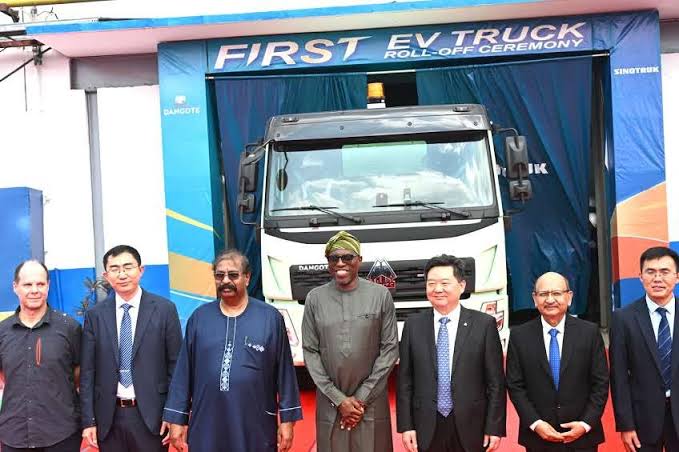
Dangote Sinotruk West Africa Limited has unveiled Nigeria’s first locally assembled electric heavy-duty truck at its Ikeja, Lagos assembly facility, expanding the joint venture into electric commercial vehicles after years of assembling conventional trucks, buses and pickups. The new range includes reported configurations with up to a 600 kWh battery and about 350 kilometers of driving range, while the company says it is developing charging infrastructure, spare-parts capability, technical expertise and after-sales support to encourage adoption. Sinotruk President Liu Wei described the vehicle as the first new-energy heavy-duty truck assembled in Africa, although that broader continental claim has not been independently verified, while the rollout’s long-term success will depend on vehicle pricing, electricity supply, charging infrastructure, financing and the company’s ability to deepen local manufacturing and technical capacity.
LAGOS, NIGERIA — Dangote Sinotruk West Africa Limited has unveiled Nigeria’s first locally assembled electric heavy-duty truck at its assembly facility in Ikeja, Lagos, marking a significant expansion of the Dangote-Sinotruk joint venture from conventional commercial vehicle production into electric mobility and positioning the company for a larger role in Nigeria’s transition toward cleaner transportation. The rollout, held on Sunday, November 15, brought together senior officials from Dangote Group, China’s Sinotruk Group, the Lagos State Government, customers, business partners and other industry stakeholders, with the company presenting the new vehicle as part of a broader strategy to deepen local assembly, strengthen automotive technology transfer and build a commercial vehicle manufacturing base capable of serving Nigeria and the wider West African market.
The unveiling represents a notable shift in the evolution of the Dangote-Sinotruk partnership, which has spent years assembling conventional heavy-duty trucks, tippers, buses, pickups and other commercial vehicles in Nigeria. The joint venture was formally established in 2014 after the partnership began earlier in the decade, and its first locally assembled heavy-duty truck rolled off the production line in 2017. Since then, the company says more than 8,000 vehicles have been assembled locally, while a commercial vehicle welding and e-coating paint line became operational in 2024, allowing the business to move beyond basic assembly toward a more integrated manufacturing model. The introduction of electric commercial vehicles now adds another technological layer to that progression and signals the company’s intention to participate directly in the emerging market for lower-emission freight and logistics vehicles.
At the center of the rollout is an electric heavy-duty truck designed for commercial transport and logistics applications, but reports from the event indicate that Dangote Sinotruk is introducing more than one electric configuration. Daily Trust reported that one 4x2 electric cargo truck on display is equipped with a 100 kWh battery, a 95 kW high-efficiency motor and a stated driving range of about 200 kilometers, while a 400 kW direct-current fast-charging system with dual-gun output was also unveiled alongside it. Separate reporting from The Sun described a larger 6x4 electric tractor head fitted with a 600 kWh battery, a driving range of about 350 kilometers and a high-power motor intended for heavier haulage and logistics work, suggesting that the company is preparing a range of electric commercial vehicles rather than relying on a single model for all transport requirements.
The differences between those models are important because the economics and practicality of electric trucking depend heavily on the type of work a vehicle is expected to perform. A shorter-range cargo truck may be suitable for urban distribution, industrial movements, waste operations or depot-based logistics where vehicles can return regularly for charging, while a larger tractor unit with greater battery capacity may be better suited to regional freight routes where operators require longer distances between charging stops. Nigeria’s freight system depends heavily on road transport, meaning the successful introduction of electric heavy-duty vehicles will require careful matching of battery range, charging speed, payload requirements and route conditions rather than simply replacing diesel trucks one-for-one across every type of operation.
Dangote Industries Group Vice-President Devakumar V.G. Edwin described the electric rollout as another major stage in the development of the joint venture and said the company is attempting to bring more advanced transportation technology into the Nigerian market while supporting lower operating costs and reduced tailpipe emissions. He acknowledged, however, that the economic case for electric commercial vehicles will depend on the cost of electricity, the availability of charging infrastructure and the particular applications in which the trucks are deployed. That acknowledgment is significant because electric trucks can offer lower fuel and maintenance expenses under the right operating conditions, but those advantages can be reduced if charging is unreliable, electricity is expensive or vehicles are used on routes that exceed practical battery range.
The company says it is already preparing for some of those challenges by developing after-sales support, spare-parts capability and technical expertise around electric commercial vehicles. Edwin said successful adoption would require reliable charging facilities and trained personnel capable of maintaining high-voltage systems, batteries, power electronics and electric drivetrains, and he indicated that Dangote Sinotruk intends to support customers not only with vehicles but also with charging infrastructure and technical assistance. That is a critical part of the rollout because commercial fleet operators generally evaluate vehicles on total operating reliability rather than novelty alone, and a truck that cannot be repaired quickly or charged consistently may become economically unattractive regardless of its environmental advantages.
Sinotruk Group President Liu Wei described the event as a historic development for Nigeria, the joint venture and the wider African automotive sector, saying the electric heavy-duty vehicle represented what he called the first new-energy truck assembled on the African continent. That broader continental claim should be treated as a company assertion because independent evidence covering every African vehicle assembly operation has not been presented publicly. What is clear, however, is that the Lagos rollout represents a major new stage for commercial electric vehicle assembly in Nigeria and gives the country a locally assembled heavy-duty EV option at a time when most electric vehicles used across Africa are still imported as finished products or concentrated in smaller passenger and light-commercial categories.
Liu said the company intends to continue increasing local manufacturing capability, expanding its production lines and improving technology transfer to Nigerian engineers and technicians. Sinotruk is expected to provide additional training opportunities, including practical technical exposure at facilities in China, as part of efforts to build local competence in newer automotive technologies. Such training could become increasingly important if Nigeria’s electric commercial-vehicle market grows, because the country will require technicians capable of diagnosing and repairing battery packs, charging systems, electronic control units and high-voltage components that differ substantially from conventional diesel drivetrains.
The Lagos State Government welcomed the rollout as an important industrial and transport development, with state representatives arguing that local electric-vehicle assembly can support lower emissions, create technical jobs and reduce dependence on imported finished vehicles. Lagos already has a substantial relationship with the Dangote Sinotruk facility and has previously purchased trucks assembled by the company for public-service applications, including waste-management operations. Government procurement could become especially important in the early stages of electric commercial-vehicle adoption because municipal fleets, buses, sanitation vehicles and other depot-based operations are often among the easiest categories to electrify, given their predictable routes and centralized parking locations.
The unveiling also fits into Nigeria’s wider search for alternatives to diesel and petrol in the transport sector. The federal government has strongly promoted compressed natural gas in recent years, while interest in electric vehicles has grown more gradually as automakers, logistics firms and state governments explore ways of reducing fuel costs and exposure to volatile petroleum prices. Dangote itself has already expanded the use of CNG-powered trucks across parts of its logistics operations, and Edwin described the move into electric vehicles as the next stage in a broader transition toward alternative-energy transport technologies rather than a complete replacement of every existing fuel type.
That gradual approach reflects the reality of Nigeria’s transport market. Electric trucks offer the advantage of zero tailpipe emissions and potentially lower drivetrain maintenance because electric motors have fewer moving parts than diesel engines, but they also require dependable power generation and high-capacity charging infrastructure. Nigeria’s electricity system remains one of the biggest challenges to mass EV adoption, particularly for heavy-duty vehicles that require substantially more power than passenger cars. Fleet operators may therefore need dedicated charging stations supported by industrial power supplies, embedded generation or renewable-energy systems rather than relying entirely on ordinary public-grid connections.
Battery economics will be another decisive factor. Heavy-duty electric trucks require large and expensive battery packs, and operators will need clarity on battery warranties, replacement costs, degradation, residual value and financing before large fleets are likely to transition. The company has not yet publicly disclosed comprehensive pricing for the vehicles, projected annual production volumes or the commercial terms under which fleet buyers will acquire them, leaving important questions about affordability and scale unanswered. Those details will determine whether the rollout develops quickly into a mainstream logistics option or remains concentrated among large corporate fleets capable of investing in charging infrastructure and specialized technical support.
The 200-kilometer and 350-kilometer ranges reported for different models also highlight the practical limitations and opportunities of electric freight transport in Nigeria. Vehicles operating within Lagos, industrial zones or fixed regional corridors could potentially function effectively within those ranges, particularly if fast charging is available at depots. Long-distance haulage across routes stretching several hundred kilometers between major Nigerian cities would require a broader network of high-capacity chargers and carefully planned stops, making infrastructure development just as important as vehicle assembly itself.
The announcement therefore carries industrial significance beyond the trucks displayed at the Ikeja plant. Local assembly of electric commercial vehicles can create demand for new categories of engineering, software, diagnostics, charging equipment and technical training, while offering Nigeria an opportunity to participate more directly in a global automotive industry that is increasingly shifting toward electrification. The extent of that local value will depend on how much of the vehicle is eventually manufactured or sourced within Nigeria rather than imported as components for final assembly, an issue that will become increasingly important as the company moves from demonstration and early production toward larger-scale manufacturing.
Dangote Sinotruk says its long-term ambition is to become one of West Africa’s leading automotive assembly and manufacturing businesses, using Nigeria’s large market and industrial base as a foundation for regional expansion. That strategy could eventually give the company access to neighboring markets where governments and commercial operators are also exploring cleaner transport technologies, but regional growth will face many of the same challenges seen in Nigeria, including charging infrastructure, vehicle financing, electricity supply and maintenance capacity.
The partnership’s more than 8,000 locally assembled vehicles provide it with an existing manufacturing and service footprint that could help reduce some of those barriers. Unlike a new entrant launching an electric truck without an established customer base, Dangote Sinotruk already supplies commercial vehicles and has existing relationships with logistics companies, industrial operators and public-sector customers. The company can therefore introduce electric vehicles into fleets already familiar with its conventional products, potentially allowing customers to compare operating costs directly across diesel, CNG and electric platforms.
The environmental benefits could also become significant if electric trucks are adopted in large numbers and charged using increasingly cleaner electricity sources. Heavy-duty diesel vehicles contribute disproportionately to transport emissions because of their high fuel consumption and long operating hours, particularly in congested urban environments such as Lagos. Replacing some of those vehicles with electric alternatives could reduce local exhaust pollution, including particulate matter and nitrogen oxides, even though the full carbon benefit would depend on how the electricity used for charging is generated.
That distinction matters because electric vehicles eliminate tailpipe emissions but do not automatically eliminate emissions from the wider energy system. If charging electricity comes predominantly from fossil-fuel generation, part of the environmental impact is shifted from the vehicle to the power source. Nigeria’s long-term energy-transition strategy therefore requires transportation electrification and cleaner electricity generation to develop together if the country is to achieve the maximum climate and air-quality benefits from EV adoption.
The rollout may also increase pressure on policymakers to develop clearer regulations and incentives for electric commercial vehicles. Standards will be required for charging systems, battery safety, vehicle certification, technician training and end-of-life battery management, while financing policies may determine whether businesses can afford the higher upfront cost of electric trucks. Import duties on components and batteries, local-content incentives and electricity tariffs for commercial charging could all influence whether manufacturers consider Nigeria an attractive place to expand EV production.
For customers, the decisive measure will remain total cost of ownership. Electric trucks can be more expensive to purchase initially but potentially cheaper to operate because electricity can cost less than diesel and electric drivetrains generally require less routine maintenance. Those savings become meaningful only when vehicles travel enough kilometers, charging is efficient and battery life remains strong over many years. Dangote Sinotruk’s success will therefore depend on demonstrating real operating data from Nigerian conditions rather than relying only on global assumptions about EV economics.
The Lagos rollout gives the company an opportunity to generate that data locally. Early fleet deployments can show how the trucks perform under Nigeria’s heat, road conditions, traffic congestion, payload demands and power-supply realities. Those results will help determine which applications are best suited to electrification and whether modifications are required before production expands.
The unveiling also illustrates the growing technological importance of Chinese automotive companies in Africa. Sinotruk is one of China’s major heavy-duty vehicle manufacturers and has increasingly used international joint ventures and assembly partnerships to reach developing markets. By combining Chinese vehicle technology with Dangote’s manufacturing and industrial footprint in Nigeria, the partnership reflects a broader model in which African markets seek to move from importing completed vehicles toward domestic assembly and, eventually, higher levels of local production.
That transition will be closely watched because local assembly alone does not necessarily guarantee deep industrial development. The strongest economic benefits would come if Nigeria gradually develops domestic suppliers for vehicle bodies, wiring systems, components, charging equipment and other parts while training engineers to participate in product development rather than only final assembly. Dangote Sinotruk’s promises of technology transfer and technical training will therefore be important measures of whether the electric-vehicle expansion creates lasting local capability.
For now, the unveiling represents an important technological milestone but not yet proof of mass-market transformation. The truck has been assembled locally, charging technology has been demonstrated and the company has publicly committed to supporting customers, but pricing, commercial production volumes, nationwide charging plans and detailed rollout schedules remain limited. Those factors will determine how quickly electric heavy-duty vehicles move from a high-profile industrial launch into ordinary freight, construction and municipal operations across Nigeria.
The broader significance is that Nigeria now has a domestic assembly operation attempting to compete in one of the fastest-changing areas of global transportation. Heavy-duty trucking has traditionally been one of the most difficult sectors to electrify because of battery weight, charging requirements and long-distance operating patterns, but advances in battery technology and high-power charging are making electric freight increasingly viable for selected routes around the world. Dangote Sinotruk is now positioning Nigeria to participate in that transition rather than waiting for the technology to mature entirely elsewhere.
The next stage will be far more important than the unveiling itself. The company will need to prove that the vehicles can operate reliably, that customers can charge them efficiently, that maintenance support is available and that the economics make sense against diesel and CNG alternatives. Government will need to provide a predictable policy environment, while electricity and charging infrastructure will need to improve if adoption is to extend beyond a small number of large corporate buyers.
If those pieces come together, the Ikeja rollout could mark the beginning of a significant shift in Nigeria’s commercial transport industry and strengthen the country’s ambition to become a manufacturing base for West Africa. If charging, financing and technical-support challenges remain unresolved, electric heavy-duty trucks may struggle to move beyond limited fleet applications despite their technological promise.
What is already clear is that Dangote Sinotruk has moved Nigeria’s commercial vehicle industry into a new phase. The locally assembled electric heavy-duty truck places battery-powered freight alongside diesel and CNG within the country’s growing mix of transport technologies, while the company’s broader electric range signals that the joint venture is preparing for a future in which commercial fleets will increasingly be judged not only by carrying capacity and purchase price but also by energy efficiency, emissions and operating cost.
The unveiling in Lagos is therefore more than the presentation of a single vehicle. It represents a test of whether Nigeria can combine local assembly, international technology partnerships, energy reform and industrial policy to build a commercially viable electric-transport ecosystem. The truck itself has now rolled off the line; the larger challenge is whether the infrastructure, economics and local technical capacity can develop quickly enough to keep it moving.