CAS IS SET TO RULE ON THE 2025 AFCON FINAL. SENEGAL HOLDS THE TROPHY, BUT MOROCCO WANTS IT DECIDED BY JUDGES
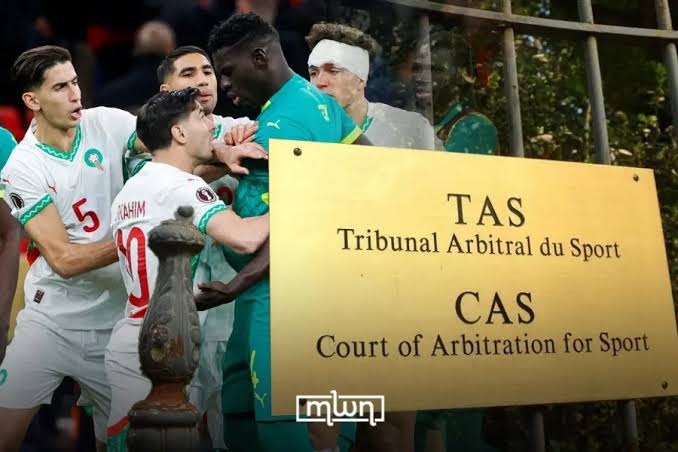
The Court of Arbitration for Sport (CAS) is expected to announce its decision on the disputed 2025 Africa Cup of Nations final between Morocco and Senegal on Tuesday afternoon, November 24, 2026. The ruling has not yet been delivered, and its content is not known. Senegal was crowned champion at the end of the final. The trophy was presented to Senegal captain Kalidou Koulibaly by CAF President Patrice Motsepe and Prince Moulay Rachid of Morocco. Morocco, the tournament host, has challenged the result, taking the case to sport's highest court. CAS is the independent body that settles disputes in world sport. Its panel could uphold Senegal's title, rule in Morocco's favor, order a replay or send the matter back to the Confederation of African Football (CAF). History suggests CAS rarely overturns results decided on the pitch, but it has stepped in before when rules were broken. For fans in Nigeria, Ghana and across Africa, the verdict will shape how the continent's biggest tournament is remembered, and how much trust supporters place in the people who run African football.
The final whistle was supposed to settle it. The trophy lift was supposed to seal it. Ten months later, a panel of lawyers in Switzerland may have the last word.
The Court of Arbitration for Sport is expected to deliver its decision on Tuesday afternoon on the dispute over the 2025 Africa Cup of Nations final between Morocco and Senegal. The announcement has been widely reported and shared across football media and social platforms. Fans have been waiting for months.
It is important to be clear about where things stand. As of Monday, CAS has not delivered its ruling. Nobody outside the case knows what the panel has decided. Claims online that the verdict has "already leaked," or that one side has "already won," should be treated with caution. Until CAS publishes its decision, Senegal remains the champion of record, and Morocco's challenge remains just that: a challenge.
What is not in dispute is how the night ended. Senegal finished the final as winners. Captain Kalidou Koulibaly, the veteran defender who has led the Lions of Teranga through some of their best years, received the trophy from CAF President Patrice Motsepe and Prince Moulay Rachid of Morocco. The image of a Moroccan royal handing the cup to the team that beat Morocco on Moroccan soil was striking. For Senegal, it was a second continental crown. For the host nation, it was heartbreak.
Morocco did not accept that heartbreak quietly. The Royal Moroccan Football Federation pursued a challenge to the outcome, and the matter has now reached CAS.
The tournament itself carried enormous weight for Morocco. The country hosted the 2025 edition, staged from December 2025 into January 2026, with the final played in Rabat. It was a showcase for a nation that has invested heavily in football over the past two decades. Morocco built and upgraded stadiums, expanded transport links and positioned itself as Africa's football powerhouse off the pitch as well as on it. The Atlas Lions reached the semifinals of the 2022 World Cup in Qatar, the first African team to go that far. Morocco is also set to co-host the 2030 World Cup with Spain and Portugal.
Yet for all that progress, Morocco's only Africa Cup of Nations title came in 1976. Winning at home, with that squad, in that new era, was meant to end a wait of nearly half a century. Instead, the dream slipped away in the final, and now the country is asking a court to look again.
Senegal's story is different. For decades, Senegal was one of Africa's great nearly teams. It produced brilliant players and memorable World Cup moments, most famously the win over France in 2002. But the AFCON trophy kept escaping. The Lions lost the 2002 final on penalties to Cameroon and the 2019 final to Algeria. Then, at the tournament held in Cameroon in early 2022, they finally won, beating Egypt on penalties. The 2025 title confirmed Senegal as one of the continent's elite. Losing it in a courtroom would be a bitter blow for a country that waited so long for its first.
What exactly is the dispute about? This is where caution matters most. The full legal arguments from Morocco, Senegal and CAF have not been published in detail. CAS hearings are usually private, and parties often keep their written submissions out of public view. Much of what circulates online is opinion, partial accounts or rumor.
Disputes like this one typically turn on a few kinds of questions. Did a team break the competition rules in a way that should change the result? Were match officials or organizers responsible for a serious failure? Was a decision by CAF's disciplinary or appeal bodies applied correctly? Was a sanction too harsh, too lenient or not applied at all? CAS does not usually ask who played better. It asks whether the rules were followed and whether the bodies that run the game made lawful decisions.
That distinction is the key to understanding Tuesday's ruling.
The Court of Arbitration for Sport was created in 1984 and is based in Lausanne, Switzerland. It is independent of sports federations, including FIFA and CAF. Its job is to settle disputes in sport, from doping bans and player transfers to eligibility cases and contested results. Most major sports bodies, including CAF, write CAS into their rules as the final place of appeal. When a federation or club loses a case at CAF level and wants to go further, CAS is usually where it goes.
Cases are heard by a panel, typically of three arbitrators. Each side often chooses one arbitrator, and a president of the panel is appointed. The panel reviews the evidence, hears the parties and issues a binding award. That award can only be challenged at Switzerland's Federal Supreme Court, and only on narrow legal grounds, such as a serious breach of procedure. In practice, a CAS ruling is almost always the end of the road.
So what can CAS do on Tuesday? There are several realistic outcomes.
The first is to uphold the result. The panel could dismiss Morocco's appeal and confirm that Senegal won the 2025 AFCON. This would leave the trophy where it is and close the case. Based on CAS history, this is often the most common outcome in disputes over results.
The second is to rule in Morocco's favor and change the outcome. If the panel found that a serious rule breach occurred and that the competition rules required a specific penalty, it could set aside the earlier decision. In theory, that could mean the result being changed or the title being awarded differently. This would be extraordinary for a continental final, and it would cause shockwaves across African football.
The third is to order a replay. CAS can, in some cases, annul a decision and require a match to be played again. Replays are rare at this level, especially months after the event, because of the cost, the scheduling problems and the fact that squads change. But it is not impossible.
The fourth is to send the case back to CAF. CAS sometimes finds that a decision was made by the wrong body or under the wrong procedure. Rather than deciding the result itself, it can refer the matter back to CAF's disciplinary bodies to decide again under the correct process.
The fifth is a middle path. CAS could leave the result standing while upholding or changing sanctions, such as fines or suspensions, linked to events around the match. That would allow the panel to recognize wrongdoing without rewriting the history of the final.
Which of these happens will depend on the facts and the rules. But one principle hangs over the whole case. CAS has long followed what lawyers call the "field of play" doctrine. In simple terms, it means the court does not normally second-guess decisions made by referees during a match. A missed foul, a debated penalty or a questionable offside call is part of the game. CAS will usually only step in if there is evidence of bad faith, corruption, arbitrary conduct or a clear breach of the rules that goes beyond ordinary refereeing judgment.
That doctrine makes it hard to overturn a result based on what happened on the pitch alone. It does not make it impossible when the dispute concerns how rules were applied off it.
There are real precedents, and some of them involve the same countries and the same continent.
The closest comparison may be the 2019 CAF Champions League final between Espérance of Tunisia and Wydad Casablanca of Morocco. In the second leg in Radès, Wydad had a goal disallowed, and the video assistant referee system was not available to review it. Wydad's players refused to continue, and the match was abandoned. Espérance was declared champion. Days later, CAF's executive committee ordered the second leg to be replayed. Espérance appealed to CAS, which set aside the replay order and sent the case back to CAF's disciplinary bodies. In the end, the title stayed with Espérance. That saga showed two things. CAS is willing to overturn decisions made by CAF if the wrong process is used. And refusing to play, whatever the grievance, carries heavy consequences under the rules.
Senegal itself has been part of football legal history. In 2016, Senegal lost a World Cup qualifier to South Africa. The match was later found to have been manipulated by the referee, Ghana's Joseph Lamptey, who had awarded a penalty for a handball that clearly did not happen. FIFA banned Lamptey for life, and CAS upheld that ban. FIFA then ordered the match replayed. Senegal won the replay and went on to qualify for the 2018 World Cup. It remains one of the clearest examples of a result being wiped out because of proven wrongdoing by an official, and it is a case that both Senegalese and Ghanaian fans remember well.
Outside Africa, the Byron Castillo case offers a different lesson. Before the 2022 World Cup, Chile and Peru argued that Ecuador had fielded an ineligible player during qualifying. They hoped CAS would remove Ecuador from the tournament. CAS found that false documents had been used regarding the player's details, but it did not throw Ecuador out. Instead, it fined Ecuador and docked it points for the next qualifying campaign. The message was clear. Even when CAS finds a breach, it does not always change the result. It looks for a penalty that fits the rules and the offense.
These cases help explain why most legal observers expect caution from the court. Changing the winner of a continental final is a dramatic step. CAS will only take it if the evidence and the rules leave it little choice.
Whatever the panel decides, the case is already a problem for CAF.
African football has fought for years to improve its image. Disputes over refereeing, scheduling, security and governance have followed CAF competitions for a long time. Patrice Motsepe, the South African billionaire who became CAF president in 2021, has promised reform, professionalism and stronger commercial deals. A continental final that ends in a courtroom does not fit that story. If CAS finds that CAF's own processes failed, it will raise hard questions about how the confederation handles disputes. If CAS confirms CAF's decisions, it will strengthen the confederation's authority, but the long legal fight will still leave a mark.
There is also a political layer. Morocco's federation and government have become deeply influential in African football. The country hosts CAF events, trains referees, offers its stadiums to other national teams and plays a growing role in continental decisions. Critics have sometimes argued that Morocco carries too much weight in CAF's corridors. Supporters say Morocco is simply investing where others have not. A verdict in Morocco's favor will be read by some fans as fair justice and by others as proof of influence. A verdict against Morocco will be read by some as a rejection of pressure. Neither reading is fair to the court unless it is backed by the reasoning in the published award. Fans should read the decision before deciding what it means.
For Senegal, the stakes are emotional as much as legal. Players such as Koulibaly, Sadio Mané and Idrissa Gana Gueye have carried the national team through its golden era. Many of them are in the later stages of their careers. Their place in history is tied to the trophies they won. Having one of those trophies taken away by a court would be a painful way for a generation to be remembered.
For Morocco, the stakes are just as high. A ruling in its favor would give the country a long-awaited second AFCON title, though without the joy of a celebration on the pitch. A ruling against it would end the case and force the nation to move on. Either way, the Atlas Lions will soon turn their focus to the 2027 AFCON in East Africa and the 2030 World Cup at home.
Nigerian fans will watch Tuesday's ruling with more than passing interest.
The Super Eagles know the pain of losing a final. They reached the 2023 AFCON final in Côte d'Ivoire and lost 2-1 to the host nation. They know the frustration of feeling let down by football administration too. In October 2024, the Nigeria squad was stranded for hours at Al Abraq airport in Libya before an AFCON qualifier. The team refused to play, and CAF later awarded Nigeria a 3-0 win and fined the Libyan federation. That episode showed how decisions made in offices can matter as much as goals scored on the pitch.
Nigeria also missed out on the 2026 World Cup, a hard blow for one of Africa's biggest footballing nations. With Morocco and Senegal among Africa's strongest sides heading to that tournament, Nigerian supporters are watching rivals grow while their own team rebuilds. How CAS treats a dispute between two of the continent's top teams will matter to Nigeria the next time the Super Eagles find themselves in a contested match, whether as the aggrieved side or the accused.
Ghanaian fans have their own reasons to follow the case closely. The Black Stars did not qualify for the 2025 AFCON, a shock for a four-time champion. They did, however, qualify for the 2026 World Cup, restoring some pride. Ghana's football history is also linked to one of the most important integrity cases in African football: the Lamptey scandal involving Senegal's 2016 qualifier. That case damaged the reputation of Ghanaian refereeing and pushed CAF and FIFA to take match integrity more seriously. Ghanaian fans know better than most how one rogue decision can reshape a result, and how important it is for governing bodies to act fairly when things go wrong.
For all African fans, there is a bigger question underneath the legal one. Can supporters trust that the results they celebrate will stand? Football is built on the belief that what happens on the pitch is real and final. When results are decided months later in a courtroom, that belief weakens. Fans in Lagos, Accra, Dakar, Casablanca and beyond want a competition where rules are clear, officials are competent and disputes are settled quickly and fairly.
Courts like CAS exist to protect that trust. When a rule is broken, someone must be able to say so and act on it. But every case that reaches CAS is also a sign that something went wrong earlier, in the organization of the match, the handling of incidents or the decisions taken afterward. The best outcome for African football is not one more dramatic ruling. It is fewer cases that need a ruling at all.
What should fans watch for on Tuesday?
First, the decision itself. CAS usually announces its verdict through a media release, followed by the full reasoned award, sometimes later. The release will say whether Morocco's appeal was upheld, partly upheld or dismissed.
Second, the reasoning. The award will explain which rules the panel applied and how it read the evidence. That reasoning will matter for future cases across African football.
Third, the reactions. Expect strong statements from the Moroccan and Senegalese federations, and from CAF. Expect celebrations in one country and anger in the other. Social media will be loud. Not all of it will be accurate.
Fourth, the consequences. If the result changes, CAF will need to explain how the trophy, medals, prize money and records will be handled. If the result stands, Morocco will have to decide whether any further legal step is worth pursuing, though options beyond CAS are very limited.
For now, the facts are simple. Senegal won the 2025 Africa Cup of Nations final and lifted the trophy, with Kalidou Koulibaly receiving it from Patrice Motsepe and Prince Moulay Rachid. Morocco challenged the result. The Court of Arbitration for Sport, the highest independent authority for resolving disputes in sport, is expected to announce its verdict on Tuesday afternoon. The ruling has not yet been delivered, and its outcome is unknown.
On Tuesday, the panel will decide whether Senegal's celebration stands or whether the final gets a new ending. Whatever it decides, African football will be watching, and so will everyone who believes the game should be won on the pitch.