
ANTI-MIGRANT VIOLENCE ERUPTS IN DURBAN AS VEHICLES BURN AND FOREIGN-OWNED SHOPS ARE TARGETED
The World Bank’s latest Nigeria Development Update projects average economic growth of about 4.4% a year through 2028, provided reforms continue and public-service delivery improves. Nigeria’s economy grew about 4.2% in the first half of 2026, up from 3.9% in 2025, while the Bank says state-government revenues increased roughly 93% in real terms between 2023 and 2025. It projects inflation could decline toward 12% by 2028, but warns that stronger revenues must now translate into better jobs, infrastructure, healthcare, education and living standards.
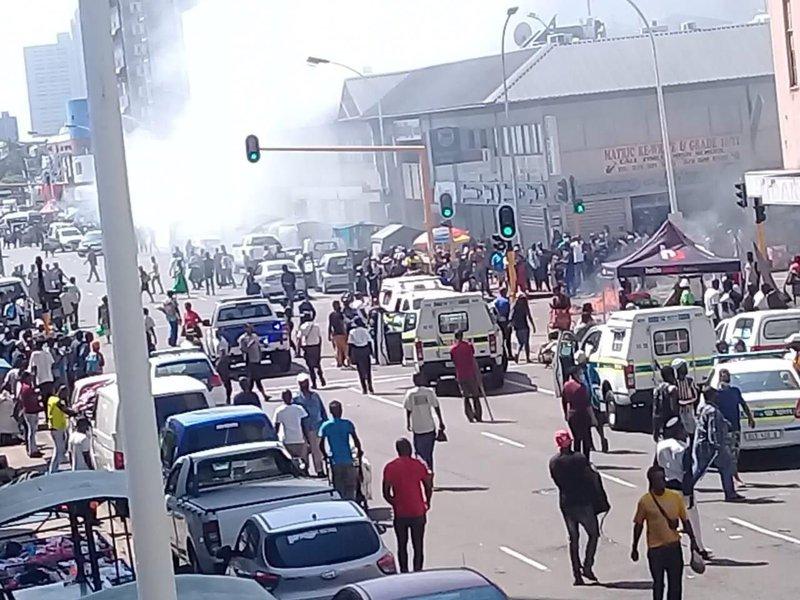
Violent anti-migrant protests erupted across central Durban on Thursday, leaving at least 11 vehicles torched or damaged, shops looted and parts of the city center engulfed in smoke as police struggled to contain groups that had earlier gathered outside the Durban Refugee Reception Centre to oppose the processing of asylum applications.
The unrest spread through Durban’s central business district after protesters moved away from the Department of Home Affairs refugee office on Che Guevara Road and into surrounding commercial streets, including Dr Pixley KaSeme Street. Eyewitness News counted at least 11 vehicles that had been burned or damaged, while other South African reports later put the number of vehicles affected at 10 or more as authorities continued assessing the destruction. Firefighters extinguished several fires, police cordoned off streets and public-order officers used crowd-control measures as demonstrators broke into smaller groups and moved through the CBD.
The violence was directed in significant part at foreign nationals and businesses believed to be foreign-owned, placing Thursday’s events within the wider wave of anti-immigration hostility that has repeatedly affected South Africa. Reuters described the incidents in Durban and Johannesburg’s Soweto township as violent anti-migrant protests, while local reports documented protesters confronting asylum seekers, attacking shops and demanding that foreign nationals leave the country.
However, one of the most serious claims circulating on social media Thursday — that a South African man had been shot dead by foreign nationals in Durban and that the killing triggered the vehicle burnings — had not been confirmed by police in the most detailed official account available by Thursday evening. KwaZulu-Natal police spokesperson Col. Robert Netshiunda instead said police had been told that a demonstrator was assaulted by foreign nationals and suffered a broken leg, after which anger among protesters escalated into attacks on vehicles, people and property. Police said three foreign nationals had been arrested in connection with the alleged assault.
That distinction is important because early reports from a rapidly developing scene offered conflicting accounts of what triggered the violence. Some reports and social-media posts alleged a fatal shooting, while police publicly described an assault and had not confirmed that anyone was killed in that confrontation. VNTV therefore cannot independently state as fact that foreign nationals shot a local man dead in Durban unless authorities subsequently confirm such a killing.
Netshiunda said protesters burned at least 10 vehicles and set a building alight in what police described as an apparent retaliatory attack following the alleged assault. Officers fired rubber bullets and tear gas as some members of the crowd threw stones and debris at police, while authorities attempted to prevent confrontations between foreign nationals and local demonstrators. Police said resources were stretched because several gatherings were taking place in the city at the same time.
The violence followed an increasingly tense confrontation at the Durban Refugee Reception Centre, where hundreds of foreign nationals had attempted to access asylum services after the Department of Home Affairs instructed its refugee offices to comply with a Constitutional Court judgment widening access to the asylum application process.
Anti-immigration activists had gathered around the Che Guevara Road facility and sought to prevent asylum seekers from entering. Police eventually told foreign nationals waiting outside to leave for their own safety as the atmosphere deteriorated. The office was closed, after which protesters moved toward central Durban.
TimesLIVE reported that about 100 protesters, some carrying sticks and sjamboks, had confronted asylum seekers outside the refugee office earlier Thursday. Police used pepper spray as the crowd became unruly, while a fire was started at a scrapyard behind the Home Affairs facility. The group subsequently marched toward the CBD, where additional demonstrators joined and the situation deteriorated further.
On Dr Pixley KaSeme Street, vehicles were overturned or set on fire and thick smoke rose between buildings as police and private security attempted to secure sections of the city center. Smaller groups were reported moving between streets and attacking shops, while some businesses closed their doors and residents sought shelter from the unrest. Local reports also described stones being thrown at the China Mall in the Point area.
Eyewitness News said approximately 100 protesters remained in the area even after firefighters had brought some of the vehicle fires under control. The outlet reported that homeless people later began removing valuable parts from some of the damaged vehicles, illustrating the breakdown of order that followed the initial confrontations.
The events in Durban were not isolated. Anti-immigration protests also turned violent in Soweto on Thursday, where vehicles were set ablaze during clashes involving residents and foreign-owned businesses. Gunfire was reported during the Soweto confrontation, although the source of the shots was not immediately established and authorities had not confirmed that anyone was injured.
South Africa’s acting national police commissioner, Lt. Gen. Puleng Dimpane, was expected to assess police deployments in Gauteng, KwaZulu-Natal and other areas identified as potential hotspots as authorities attempted to prevent the disturbances from spreading.
The immediate political backdrop to the violence is a Constitutional Court judgment that changed how people seeking asylum must be allowed to access South Africa’s refugee system. The government’s Inter-Ministerial Committee on Migration confirmed Thursday that refugee reception offices had been instructed to accept applications from people who indicate an intention to seek asylum, including individuals who entered the country irregularly or who had previously been blocked by procedural requirements.
The ruling does not automatically give applicants refugee status, permanent residence or permission to remain indefinitely in South Africa. Instead, it means they must be given access to the asylum process and have their individual claims assessed under the law.
Government officials issued that clarification after misinformation around the ruling contributed to growing anger. The Inter-Ministerial Committee said there are only five refugee reception centers in South Africa and acknowledged that implementation of the judgment had resulted in unexpectedly large numbers of people arriving at some facilities, creating significant pressure on Home Affairs resources.
Authorities said they are increasing processing capacity, biometric checks, identity verification and cooperation between immigration and security agencies while accelerating asylum decisions and taking action against applicants who abuse the system. Government stressed that irregular migration laws remain in force and that people who do not qualify for protection can still be subject to immigration enforcement.
The distinction between access to an asylum hearing and the granting of asylum has become central to the national debate. Government officials said misinformation suggesting that the Constitutional Court had simply legalized undocumented migration was incorrect and risked further inflaming already volatile tensions.
South Africa has struggled for years with recurring hostility toward migrants from other African countries and elsewhere, particularly during periods of high unemployment, weak economic growth and pressure on public services. Foreign nationals have frequently been blamed for crime, unemployment and pressure on housing or healthcare, although broad claims attributing those problems to migrants are often unsupported by evidence.
The country’s official unemployment rate remains around one-third of the labor force, while unemployment among young people is considerably higher. Severe inequality, housing shortages, crime and frustration with public services have created an environment in which immigration has become an increasingly potent political issue.
Anti-immigration organizations have gained visibility during 2026, organizing demonstrations and demanding tighter enforcement against undocumented migrants. One of the prominent groups involved in Durban has been March and March, whose supporters have repeatedly demonstrated against undocumented immigration.
Foreign nationals have accused the organization and similar movements of creating an atmosphere of intimidation, allegations March and March has rejected. In May, foreign nationals in Durban sought protection from police after saying they were being threatened and driven from communities by anti-immigration activists.
The situation became serious enough earlier this year that hundreds of refugees and asylum seekers sought shelter around police stations and religious facilities in Durban. In September, the Department of Home Affairs relocated 274 people from outside its Che Guevara Road offices to the Lindela Repatriation Centre in Gauteng after consultations with affected communities.
Those transferred included 191 nationals of the Democratic Republic of Congo, 76 Burundians, five Ugandans, one Mozambican and one Ghanaian, according to the Department of Home Affairs.
The September relocation illustrates how long tensions around the Durban center have been building. Government had already publicly condemned violence in the area and stressed that immigration enforcement is the responsibility of state authorities rather than private groups or political activists.
In June, South Africa’s government explicitly warned that violence, intimidation and the targeting of people on the basis of nationality were crimes and said xenophobia, Afrophobia and other forms of intolerance had no place in the country. Authorities also said blocking people from accessing public services was unlawful.
Thursday’s scenes demonstrate how difficult it has been to enforce that principle as political anger around immigration intensifies.
The violence also prompted international concern. The United States Consulate General in Durban issued a security alert advising U.S. personnel and citizens to avoid affected parts of the city center after reports of violence and looting targeting foreign nationals.
The classification of the unrest as xenophobic is likely to remain politically contested. Some anti-immigration organizers insist their campaigns are aimed specifically at undocumented migration rather than foreigners generally and reject accusations of xenophobia. However, when individuals or businesses are attacked because they are perceived to be foreign, the distinction between an immigration protest and xenophobic violence becomes increasingly difficult to maintain.
Thursday’s events involved demonstrators gathering specifically against asylum seekers, foreign nationals being removed from the refugee reception center for their own safety and shops identified as foreign-owned being targeted during subsequent violence. Reuters described the disturbances as anti-migrant protests, while earlier government statements have warned directly against nationality-based attacks.
The South African government now faces the dual challenge of enforcing immigration law while protecting people who have a legal right to seek asylum. The Constitutional Court ruling requires authorities to accept asylum applications for assessment without allowing preliminary procedural barriers to prevent individuals from lodging claims.
That does not mean every person who applies will qualify for refugee protection. Applicants must still undergo screening and adjudication, and unsuccessful claimants can ultimately be removed through lawful immigration procedures.
Government officials have attempted to emphasize that distinction because public misunderstanding has fueled fears that South Africa has opened its borders without restrictions. The Inter-Ministerial Committee said Thursday that refugee offices would strengthen biometric verification and identity screening and that officials would continue investigating fraud and abuse within the asylum system.
The challenge is that legal explanations are unfolding alongside an increasingly emotional political debate. South Africans facing unemployment, crime and poor public services have legitimate grievances with government performance, but attacks on foreign nationals do not resolve those underlying problems and can expose both migrants and South African citizens to further violence.
They can also carry serious economic consequences. Durban is one of South Africa’s most important commercial and tourism centers, and scenes of burning vehicles, looted shops and street battles can damage businesses, disrupt transportation and undermine confidence in the city center.
The attacks may also affect relations between South Africa and neighboring African countries whose citizens live and work there. Previous outbreaks of xenophobic violence have triggered diplomatic protests and retaliatory demonstrations elsewhere on the continent.
Nigeria, Zimbabwe, Mozambique, Malawi, the Democratic Republic of Congo, Burundi and several other African countries have significant migrant communities in South Africa. Whenever nationality-based violence occurs, governments face pressure to protect their citizens and demand accountability from Pretoria.
Authorities will now have to establish responsibility for the Durban violence on an individual basis. Police said three foreign nationals were arrested over the alleged assault that preceded the escalation, but those arrests do not establish guilt and are separate from the investigation into who torched vehicles, attacked businesses and participated in looting.
Police will also need to clarify whether additional arrests have been made among protesters and whether criminal cases will include public violence, arson, malicious damage to property, assault or looting.
Investigators must separately determine exactly what occurred during the incident that protesters said provoked the retaliatory violence. By Thursday evening, police had publicly confirmed an alleged assault and reported leg injury, rather than the widely circulated claim that a South African man had been shot dead by foreign nationals.
That difference is significant in a volatile environment where unverified claims can spread quickly and trigger further attacks. A false or exaggerated account of a killing could deepen hostility toward entire migrant communities even before investigators establish the facts.
Police and government officials therefore face pressure not only to restore physical order but also to communicate verified information quickly enough to prevent rumors from driving additional violence.
The unrest remains a developing security situation. Streets in central Durban were being monitored by police after firefighters extinguished vehicle fires, while authorities were considering reinforcement of public-order deployments. Similar disturbances in Soweto increased concern that anger over the asylum ruling could trigger further confrontations beyond KwaZulu-Natal.
The Constitutional Court decision itself remains in force, and the government has said it will comply while increasing capacity at refugee reception offices. Authorities have simultaneously promised continued enforcement against people who do not qualify to remain in the country.
What remains unresolved is whether the government can implement that legal framework without allowing asylum seekers to become targets of intimidation or violent groups to substitute themselves for immigration authorities.
Thursday’s events have moved South Africa’s immigration dispute beyond protests and political rhetoric into a serious public-order crisis. At least 11 vehicles were reported torched or damaged in Durban, foreign-owned businesses were targeted, asylum seekers were moved away from the Home Affairs facility for safety and police were forced to deploy crowd-control measures across the city center.
The immediate priority for authorities is to prevent further attacks, establish precisely what happened during the confrontation that preceded the unrest and prosecute individuals responsible for violence regardless of nationality. The broader challenge will be considerably harder: enforcing immigration law, implementing the Constitutional Court’s asylum ruling and confronting a resurgence of hostility toward foreign nationals without allowing misinformation, vigilantism and economic frustration to turn South African streets into repeated scenes of nationality-based violence.