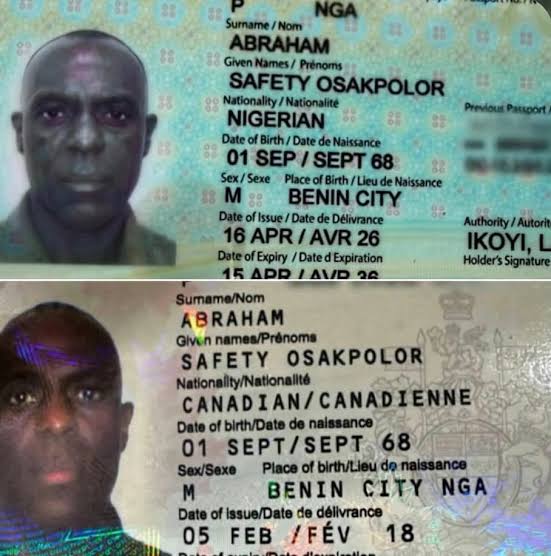
Abraham Safety Osakpolor was born in Benin City on the first day of September 1968. He grew up in a country that would change many times over the following decades. At some point, his life carried him across the Atlantic, and he came to hold a Canadian passport alongside his Nigerian one. On Friday, November 13, 2026, that life ended on the side of one of the busiest roads in Lagos. A moving vehicle struck him as he walked along the expressway leading from Murtala Muhammed International Airport toward Oshodi. He was rushed to a hospital and pronounced dead. Today his body lies in a morgue, and the police officers who handled the case are asking the public for help with a simple and heartbreaking task. They want to find someone who knew him.
The appeal came from the Airport Police Command, whose Public Relations Officer, Adeola Mohammed, released a statement on Wednesday. It was brief and factual, the kind of notice that can easily disappear in a busy news cycle. It gave his full name, his age, his place and date of birth, and the details of the accident. It noted that he held dual Nigerian and Canadian passports. It said his remains had been deposited in the morgue. What it could not say was who he was to the world. It did not name a spouse, a child, a sibling or a friend. Five days after his death, no one had come forward to claim him.
That gap is the center of this story. A man with two passports, documents that usually mark someone as connected and accounted for, died in one of the most watched places in the country, and still no family member has appeared. Many questions remain unanswered. Police have not said whether he had just arrived in Lagos on a flight, whether he was leaving, or whether he had been in the city for some time. They have not said why he was on foot along an expressway built mainly for fast moving traffic. They have not shared details about the vehicle involved or the driver. Those answers may come as investigations continue. For now, the most urgent need is the one the police have put before the public. Somewhere, a family deserves to know.
The road where Osakpolor died is no ordinary street. The airport expressway is the first stretch of Nigeria that millions of travelers see. It carries a constant stream of private cars, taxis, ride hailing vehicles, airport shuttles, commercial buses and trucks between the international and domestic terminals and the rest of the city. Toward Oshodi, it feeds into one of the most crowded transport hubs in West Africa, a place where buses, traders and commuters meet in enormous numbers every day. Lagos State rebuilt and widened the airport road in recent years, adding lanes, lighting and landscaping that made the route faster and more attractive. Wider and smoother roads, however, also encourage higher speeds. For anyone on foot, that can turn a short walk into a deadly gamble.
People walk along and across this expressway for many reasons. Some are workers heading to jobs around the airport, from cleaners and security guards to vendors and drivers waiting for passengers. Some are travelers who cannot afford or do not want to pay inflated fares for a short ride. Some get stranded when a vehicle breaks down or a ride falls through. Others simply misjudge how far a destination is, or assume there will be a safe path that does not exist. Pedestrian bridges and crossings exist at some points, but residents often complain that they are too far apart, poorly lit at night or unsafe because of crime. When the safe option means a long detour, many people take the risk of walking by the road or dashing across the lanes.
Lagos has tried to change that behavior through enforcement. The state has laws against crossing highways where pedestrian bridges are available, and officials have at times arrested and prosecuted people caught doing so. Yet enforcement alone has not solved the problem, because it does not address why people walk where they do. Road safety experts often say that infrastructure shapes behavior. If a road is designed only for cars, people on foot will still use it, and they will do so without protection. Continuous walkways separated from traffic, well spaced crossings, working streetlights, speed control and visible traffic officers can save lives. Without them, the edge of the expressway becomes a narrow strip between moving metal and open drains.
The wider numbers are sobering. Road crashes kill thousands of people in Nigeria every year, according to official figures, and road safety advocates believe the true toll is higher because many deaths are never recorded. Pedestrians account for a large share of those who die, especially in cities. Across Africa, the World Health Organization has long identified pedestrians as among the most vulnerable road users, killed at rates far higher than in wealthier regions. Each of those numbers represents a person like Abraham Osakpolor, someone who left home one morning expecting to return, and whose family may learn of the death days later, or never at all.
His dual nationality adds another layer to his story. Nigeria has one of the largest diasporas in Africa, and Canada has become one of its most important destinations. Over the past two decades, tens of thousands of Nigerians have moved to Canadian cities such as Toronto, Calgary, Edmonton, Winnipeg and Ottawa to study, work and raise families. Many of them come from Edo State, which has a long tradition of migration and strong family ties that stretch across continents. Nigeria allows its citizens to hold another nationality, and many Nigerian Canadians travel home regularly for weddings, funerals, business, land matters and family visits. Murtala Muhammed International Airport is often their first and last stop on those journeys.
Returning home can bring great joy, but it can also expose people to risks they are no longer used to managing. Someone who has lived abroad for years may underestimate the speed of traffic on a Lagos expressway, or overestimate how safe a roadside walk might be. They may travel alone, without telling relatives in Nigeria exactly when they will land or where they will stay. Their closest family may be thousands of kilometers away in another time zone, unaware that anything has happened. If their phone is damaged or lost in an accident, the trail can go cold quickly. That may help explain how a man carrying two national passports could remain unclaimed for days.
There are also institutions that could help close that gap. Canada maintains a High Commission in Abuja and offers consular support when its citizens die or are injured abroad, including helping to notify families. Nigeria has agencies focused on its citizens abroad, including the Nigerians in Diaspora Commission, which works to connect the government with Nigerians living overseas. Community associations of Nigerians in Canada, especially groups rooted in Edo State, often act as informal networks that spread news faster than any official channel. A shared post, a phone call or a message in a community group could be the thread that leads back to Osakpolor's family. The police appeal is, in many ways, a request for that kind of human network to activate.
The question of what happens if no one comes forward is where this story turns darker. Nigerian morgues, especially public facilities in large cities, hold many bodies that are never claimed. Some belong to accident victims who carried no identification. Others belong to people whose families live far away, cannot afford mortuary fees or never learn of the death. Many are victims of violence, mob attacks, building collapses or disasters. Morgues in some hospitals have struggled with overcrowding, poor refrigeration and rising costs. After a period of time set by law and regulation, authorities may arrange mass burials of unclaimed bodies. Lagos State has carried out such burials over the years, laying hundreds of unnamed people to rest at once.
For the families of the missing, those burials can be devastating. Some Nigerians have spent months or years searching for relatives who vanished, visiting police stations and hospitals, posting appeals online and following every rumor. Some later discover that the person they were looking for died soon after disappearing and was buried as an unknown body. The pain of that discovery is often deepened by the sense that the system failed to connect the dots. Records may be incomplete. Photographs may not be taken or stored. Fingerprints and DNA samples are rarely collected for routine cases. Information is not always shared between police commands, hospitals and morgues, let alone across state lines or international borders.
Abraham Osakpolor is in a more fortunate position than many of the unclaimed dead, even in death. His name is known. His date and place of birth are known. His nationality is documented on two passports. The police have made a public appeal. That gives his family a real chance of finding him, if the message reaches them. Yet the fact that a man with so much identifying information still needs a public appeal shows how weak the links can be between a death on a Lagos road and the people who would grieve it. If it can happen to him, it can happen far more easily to people with no papers at all.
Experts and advocates have suggested many ways to strengthen that system. A central national database of unidentified and unclaimed bodies, searchable by families and accessible to police, hospitals and morgues, could save countless people from endless searching. Standard procedures for recording photographs, personal effects and identifying marks would make later identification easier. Closer cooperation with foreign embassies would help when a foreign passport is found. Clear public information on how to report a missing person and how to check morgues would help families act quickly. None of these steps would bring back the dead, but they would give more of them back their names and their families.
The same is true of road safety on the airport expressway. Better pedestrian infrastructure, stricter speed enforcement, more visible traffic management and public awareness campaigns aimed at both drivers and walkers could reduce the number of deaths. Airport authorities, the Lagos State Government and federal road safety agencies all have a stake in a road that serves as Nigeria's front door. A gateway that welcomes millions of visitors each year should not also be a place where people die walking beside it. Every death on that road is a signal that its design and management still leave the most vulnerable people exposed.
In the end, though, this story is about one man. Abraham Safety Osakpolor lived 58 years. He was born in Benin City and carried that city's name on his birth record. He made a life that reached Canada. Somewhere along the way, he may have raised children, worked hard jobs, supported relatives back home or planned a return for good. People may remember his laugh, his habits, the way he spoke about home. Some of them may be wondering right now why he has not called. The police statement cannot tell them. Only someone who recognizes his name can.
For now, his body waits in a Lagos morgue while the appeal travels through newspapers, radio, social media and community groups. Each share increases the chance that the message reaches the right person. Anyone who knew Abraham Safety Osakpolor, or knows his relatives in Nigeria or Canada, is being urged to contact the Airport Police Command. It is a small act that could give one family the chance to grieve, to bring him home and to bury him with his name. In a country where too many people die nameless and unclaimed, that chance matters more than any headline.