
TRUMP AND XI SET FOR HIGH STAKES WHITE HOUSE TALKS AS US CHINA TRADE TRUCE EXTENDED
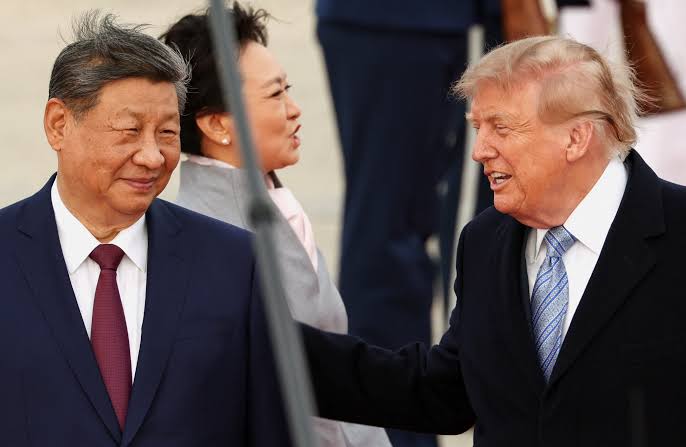
U.S. President Donald Trump and Chinese President Xi Jinping are set to hold high stakes talks at the White House on Thursday, with trade, technology, rare earths, Taiwan and other major issues on the agenda. The meeting comes after Washington and Beijing agreed to extend their trade truce by two months.
U.S. President Donald Trump and Chinese President Xi Jinping are set to meet at the White House on Thursday for high stakes talks aimed at stabilizing relations between the world's two largest economies, with trade expected to dominate an agenda that also includes technology, rare earths and Taiwan.
The summit comes a day after Xi arrived in Washington for a three day state visit and was personally welcomed by Trump at Joint Base Andrews in Maryland.
The airport reception was an unusual diplomatic gesture. According to C SPAN records cited by Reuters, it was the first time in 11 years that a U.S. president had personally welcomed a foreign leader at Joint Base Andrews.
Xi's visit to Washington is his first in more than a decade and marks his second meeting with Trump this year following their talks in Beijing in May.
Hours before the White House summit, Washington announced that the United States and China had agreed to extend their existing trade truce by another two months.
U.S. Treasury Secretary Scott Bessent said the agreement would extend the arrangement until January 10, 2027, giving both sides additional time to negotiate unresolved economic disputes.
The development reduces the immediate risk of another escalation in tariffs, but expectations for a comprehensive trade agreement remain limited.
Reuters reports that both governments appear focused on maintaining stability and securing incremental agreements rather than attempting to resolve the broader economic rivalry in a single meeting.
Trade remains at the center of the discussions.
Washington wants China to follow through on commitments involving purchases of American agricultural products and Boeing aircraft while seeking greater access for U.S. businesses.
The United States is also pressing Beijing over restrictions on rare earths and critical minerals, which are essential to industries ranging from automobiles and electronics to aerospace and defense.
China dominates significant parts of the global supply chain for rare earth mining, processing and magnets, giving Beijing considerable influence over materials considered strategically important by Washington.
Beijing, meanwhile, has pushed the United States to ease restrictions affecting Chinese access to advanced American technology.
Artificial intelligence is another major issue surrounding the summit.
Officials from the two countries have discussed establishing a new dialogue dealing with AI related risks and incidents that could have national security implications.
However, intense competition between Washington and Beijing over advanced semiconductors, computing power and artificial intelligence is expected to limit the scope of deeper cooperation.
Taiwan remains one of the most sensitive issues in the relationship.
Beijing considers the self governed island part of China and has repeatedly opposed U.S. arms sales and other forms of support for Taipei.
Washington maintains unofficial relations with Taiwan and is required under U.S. law to provide the island with the means to defend itself.
Xi is expected to raise the issue during his talks with Trump, while any change in Washington's longstanding position would face intense scrutiny in the United States and across Asia.
China's relationship with Iran is also expected to feature in discussions.
Beijing remains the largest buyer of Iranian oil, while the Trump administration has been seeking to increase economic pressure on Tehran.
Despite those disagreements, both governments have signaled an interest in preventing their wider rivalry from escalating into another major confrontation.
China enters the summit with strong export performance and significant leverage in critical mineral supply chains, while Trump is seeking progress on trade and greater Chinese purchases of American goods.
The ceremonial elements of Xi's visit will continue alongside the negotiations, including an official White House welcome and state dinner.
But the central question surrounding Thursday's summit is whether the two leaders can turn the temporary trade truce into a more durable framework for managing economic and geopolitical competition.
For now, the extension of the trade truce provides both sides with additional negotiating time.
The outcome of the Trump Xi talks will be closely watched beyond Washington and Beijing because decisions involving tariffs, technology and critical minerals between the world's two largest economies can have consequences for global trade, financial markets and supply chains.