SHETTIMA DECLARES HARDEST PART OF NIGERIA’S ECONOMIC RESET OVER AND PROMISES PURE HARVEST IN SECOND TERM
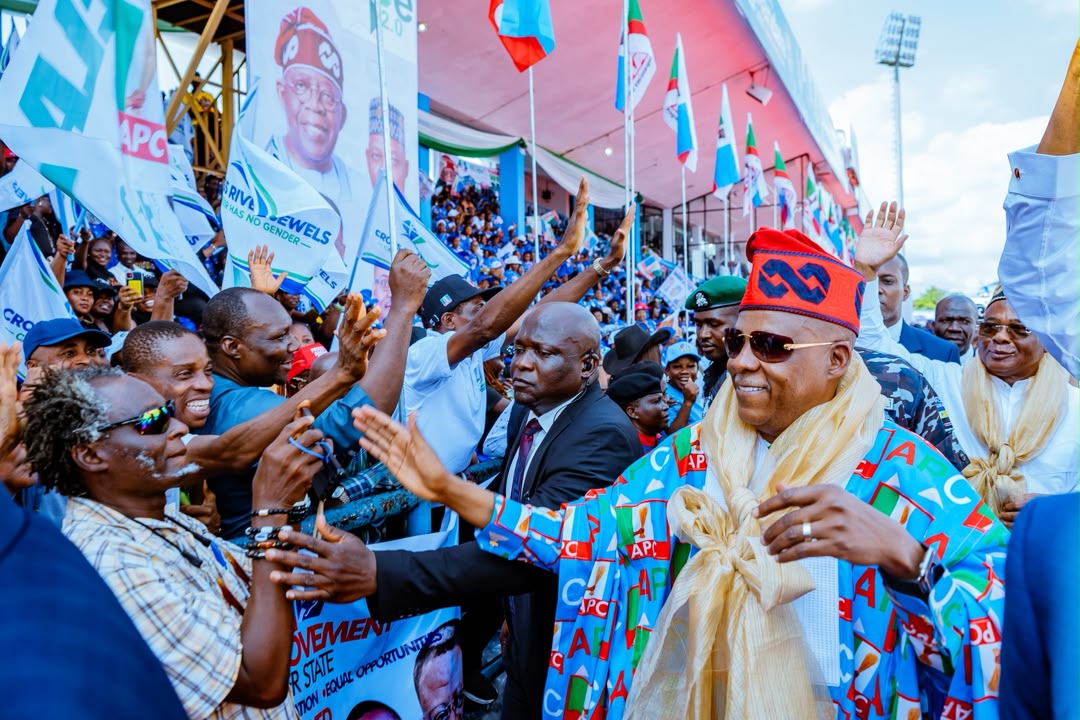
Vice President Kashim Shettima told an APC rally in Calabar that the toughest phase of President Bola Tinubu’s economic reforms is over and that a second term would be a period of pure harvest for Nigerians. He argued that the administration had already completed the most difficult work of resetting the economy and that no rival party could change its direction. The remarks were made while seeking renewed mandates for the national ticket and for Cross River State officials ahead of the 2027 elections.
Vice President Kashim Shettima has declared that the toughest phase of the economic reforms introduced by the administration of President Bola Tinubu is complete and that a second term would mark a period of pure harvest for Nigerians. He made the statement on Monday during an All Progressives Congress presidential campaign rally in Calabar, Cross River State, where he urged voters to renew the mandate of the president and himself ahead of the 2027 elections.
Shettima told the gathering that the administration had already completed the most difficult job of economic reset. “We are confident of this promise to deliver for this nation because we have already done the most difficult job of economic reset. None of the other options available has the capacity to move the needle of the economy. We have rescued the economy, and the road ahead is one of harvest. This second term is one of harvest, for you and all Nigerians,” he said. He described the reforms as painful but necessary and argued that they had laid the foundation for future prosperity and tangible returns to citizens. He further maintained that no rival political party possessed the capacity to alter the nation’s economic trajectory.
The vice president linked the campaign message to specific projects he said would benefit Cross River State. He cited the Lagos-Calabar Coastal Highway as an example of the administration’s effort to open the state to wider economic activity after assuming office in 2023, and he noted that the Bakassi Deep Sea Port had received federal approval and support. He presented both initiatives as measures that would improve connectivity, attract investment, generate employment and support trade. In the same address he asked Cross River voters to return Governor Bassey Edet Otu and Deputy Governor Peter Odey for another term alongside the national ticket.
The claim that the hardest part of the reset is finished sits against the background of the policies the Tinubu administration adopted shortly after taking office in May 2023. Those measures included the removal of the long-standing fuel subsidy and the unification of the foreign-exchange windows. Both steps produced sharp increases in fuel prices, transport costs and the prices of imported goods, and they contributed to elevated inflation through 2024 and much of 2025. Administration officials have repeatedly described the measures as unavoidable corrections that prevented a deeper fiscal and external crisis. Shettima and other senior figures have pointed to subsequent improvements in certain macroeconomic indicators, including periods of positive real GDP growth, a recovery in external reserves toward the mid-to-high fifty-billion-dollar range, and a gradual decline in headline inflation from earlier peaks. Food inflation has remained higher than headline rates, and many households continue to report pressure on real incomes.
Opposition parties and independent analysts have contested the characterisation of the reset as complete. Critics argue that the gains in reserves and growth have not yet translated into broadly shared improvements in living standards, that poverty and food-price pressures remain elevated, and that the full costs of the adjustment are still being borne by ordinary citizens. They also question whether the projected “harvest” phase can materialise without further policy adjustments, stronger non-oil revenue, and sustained gains in power, agriculture and manufacturing. The vice president’s assertion that no alternative political option can move the economic needle is a campaign argument rather than a settled assessment of policy options. It will be tested by the platforms the main opposition parties eventually present and by the performance of the economy between now and the 2027 vote.
The Calabar rally formed part of the early stages of the APC’s presidential campaign effort. President Tinubu had previously flagged off the national campaign in Kaduna. Shettima’s appearance in Cross River combined a defence of the national reform programme with state-level promises on infrastructure. The dual message is consistent with the administration’s broader narrative that the difficult phase of stabilisation has been completed and that the remaining years, if the mandate is renewed, will be devoted to translating macroeconomic gains into visible benefits for citizens. Whether that translation occurs at the speed and scale implied by the “pure harvest” phrasing will depend on the trajectory of inflation, employment, real wages and the implementation of the major projects cited at the rally.
What is confirmed is that Vice President Kashim Shettima, speaking at an APC campaign event in Calabar on 2 November 2026, stated that the hardest part of the administration’s economic reset is over and that the next term would be one of harvest. The statement was made in the context of a call for the re-election of President Tinubu and himself, as well as the Cross River governor and deputy governor. What remains a matter of political and economic judgement is whether the most difficult phase has in fact ended for households, how quickly any gains will reach ordinary citizens, and whether the opposition can offer a credible alternative trajectory. The remarks form one element of the governing party’s early 2027 campaign positioning.