RUSSIA SAYS 613 UKRAINIAN DRONES TARGETED MOSCOW AS KHARKIV COMES UNDER RUSSIAN ATTACK
Russia says 613 Ukrainian drones headed toward the Moscow region overnight, with most neutralized by air defenses and 231 intercepted on the immediate approaches to Moscow, according to Mayor Sergei Sobyanin. The claims have not been independently verified. Temporary restrictions were imposed at Vnukovo, Domodedovo and Zhukovsky airports before being lifted. Separately, Russian forces struck Kharkiv, where Mayor Ihor Terekhov said an educational institution was damaged and a separate attack caused a fire in another district. Reuters
Russian authorities say 613 Ukrainian drones flew toward the Moscow region overnight in one of the largest reported aerial attacks directed at the Russian capital during the war, forcing temporary restrictions at major airports as air-defense units attempted to intercept the incoming aircraft, while Russian forces simultaneously carried out fresh strikes on Kharkiv, damaging an educational institution in Ukraine’s second-largest city.
Moscow Mayor Sergei Sobyanin said the drones approached the wider Moscow region between approximately 8:30 p.m. on October 28 and 7 a.m. on October 29. According to his account, most were intercepted by Russian Defense Ministry air-defense units at longer distances from the capital, while 231 were neutralized on the immediate approaches to Moscow. The figures represent claims by Russian authorities and could not be independently verified from the battlefield or through publicly available evidence.
The distinction between the two numbers is important. Sobyanin did not say that all 613 drones reached Moscow itself or that 613 were destroyed directly over the capital. His account was that 613 unmanned aircraft were moving in the direction of the wider Moscow region, with the majority intercepted at distant approaches and 231 destroyed closer to the city. Russian officials have not yet released a complete breakdown showing exactly where every drone was intercepted, how many reached the Moscow region or whether any successfully struck their intended targets.
The reported scale of the attack would make it one of the most significant Ukrainian long-range drone operations toward Moscow since Russia launched its full-scale invasion of Ukraine in February 2022. Ukraine has steadily expanded the range and number of domestically produced attack drones used against Russian military, industrial, energy and logistics facilities, increasingly bringing areas hundreds of kilometers from the Ukrainian border within reach.
Russian authorities imposed temporary restrictions on flights at Vnukovo, Domodedovo and Zhukovsky airports as the drone activity continued. The restrictions affected arrivals and departures while air-defense operations were underway, reflecting the disruption that large drone raids can cause even when most of the aircraft are reportedly intercepted before reaching their targets. The restrictions were lifted at around 6:45 a.m. Moscow time after authorities concluded that the immediate threat had diminished.
Some flights were reportedly delayed, diverted or required special clearance as the airports operated under restrictions. Russian aviation authorities frequently impose temporary closures during drone attacks because falling debris from interceptions can pose a threat to civilian aircraft even when drones themselves are destroyed before reaching airport areas.
Sobyanin said emergency services had been sent to locations where drone debris was reported to have fallen. Russian authorities had not initially reported major casualties or significant destruction in Moscow itself from the overnight operation, although detailed damage assessments remained limited during the early hours of Thursday.
Ukraine had not immediately provided a detailed official account confirming that it launched all of the drones described by Moscow authorities. Kyiv generally comments selectively on long-range operations inside Russia and often avoids providing operational details while attacks are still underway.
Ukraine has increasingly argued that strikes on Russian territory are intended to reduce Moscow’s ability to sustain the war by targeting military production, fuel facilities, air bases, logistics networks and other infrastructure linked to Russian operations. Russian officials characterize Ukrainian strikes inside Russia as terrorist attacks, particularly when drones approach civilian areas or major cities.
The latest attack represents another escalation in the increasingly intense drone war between the two countries. Russia routinely launches large waves of drones and missiles against Ukrainian cities and energy infrastructure, while Ukraine has developed increasingly sophisticated long-range drone systems capable of reaching Moscow, oil refineries and military facilities deep inside Russian territory.
Only days before the latest Moscow raid, Russian authorities reported another exceptionally large Ukrainian drone attack involving hundreds of aircraft across multiple regions. That operation came amid a broader increase in long-range strikes by both sides as diplomatic efforts to bring the war toward negotiations have continued without producing a comprehensive ceasefire.
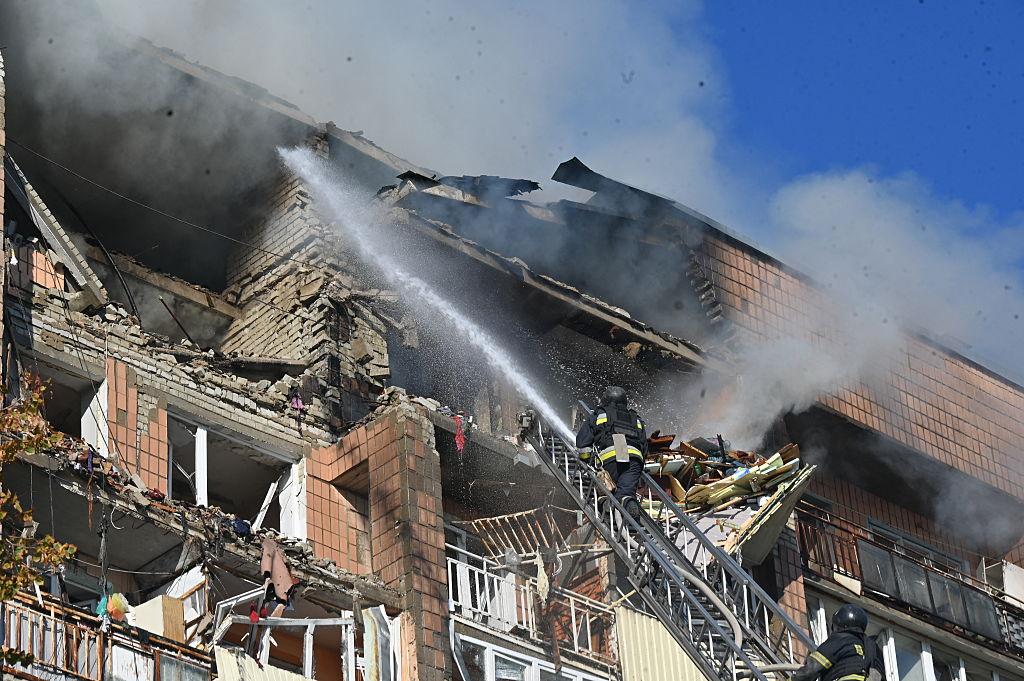
While Moscow was dealing with the reported Ukrainian drone assault, Kharkiv came under fresh Russian attack. Mayor Ihor Terekhov said a Russian strike hit an educational institution in the city’s Saltivskyi district during the night. He said officials were assessing the consequences of the attack and had not immediately provided a confirmed casualty figure.
Terekhov also reported a separate strike in Kharkiv’s Kholodnohirskyi district, where a fire broke out after the attack. Emergency services were dispatched to affected areas while authorities worked to determine the scale of the damage and whether residents had been injured.
Kharkiv has been one of the Ukrainian cities most frequently targeted by Russian missile, drone and glide-bomb attacks because of its proximity to the Russian border. Located in northeastern Ukraine, the city is only a relatively short distance from Russian territory and has endured repeated attacks on residential neighborhoods, industrial facilities, energy infrastructure and public buildings throughout the war.
The latest strike on an educational facility follows another attack on Kharkiv only a day earlier. On October 28, a Russian drone struck the city’s Osnovianskyi district, causing a major fire and injuring civilians, including a young child, according to local authorities. The successive attacks illustrate the persistent danger facing residents as both sides expand their use of unmanned aircraft.
Ukrainian authorities have accused Russia of deliberately targeting civilian infrastructure, while Moscow maintains that its strikes are directed at military facilities, defense production sites and infrastructure supporting Ukraine’s armed forces. Independent investigators and international organizations have documented numerous cases in which Russian attacks have struck civilian locations during the war.
The overnight exchanges demonstrate the geographic expansion of aerial warfare. Moscow, more than 400 kilometers from Ukraine at its nearest point, has increasingly faced drone threats that would once have been considered difficult for Kyiv to sustain. At the same time, Ukrainian cities such as Kharkiv remain exposed to almost constant Russian attacks because of Moscow’s much larger stockpile of missiles, drones and aircraft.
Ukraine’s long-range drone campaign has developed rapidly. Kyiv has invested heavily in domestic drone production after restrictions on some Western-supplied weapons limited how those systems could initially be used inside Russian territory. Ukrainian companies and military units have developed multiple types of one-way attack drones capable of carrying explosives over hundreds or even more than 1,000 kilometers.
These systems are generally cheaper than cruise or ballistic missiles, allowing Ukraine to launch them in large numbers with the intention of overwhelming Russian air defenses or forcing Moscow to expend expensive interceptor missiles. Large-scale raids can also compel Russian authorities to shut airports, reposition air-defense units and divert resources away from front-line areas.
Russia has responded by expanding air-defense deployments around Moscow and other strategic regions. The capital is protected by multiple layers of radar, missile systems, electronic warfare equipment and mobile air-defense units, but the increasing scale of Ukrainian attacks has demonstrated that defending such a large territory remains difficult.
Russian officials frequently report destroying the majority of incoming drones. Independent verification of those claims is often impossible because Moscow releases limited information about successful strikes, damage or the exact locations where drones are intercepted.
The reported 613-drone figure is therefore significant but should be treated as an official Russian claim rather than a fully independently established number. Sobyanin’s separate statement that 231 drones were intercepted near Moscow provides a clearer indication of the scale of air-defense activity immediately around the capital, but it does not establish what happened to every aircraft included in the larger total.
The operational purpose of the Ukrainian raid was also not immediately clear. There was no early confirmation of strikes on a specific military base, industrial facility or energy installation near Moscow. Ukraine has previously targeted Russian defense plants, refineries, fuel depots and aviation infrastructure as part of a strategy intended to weaken Russia’s ability to sustain military operations.
Moscow is also an important political and psychological target. Successful Ukrainian drones reaching the capital demonstrate that the war can affect areas far removed from the front line and force the Russian government to devote extensive resources to protecting major population centers.
For residents, even intercepted attacks can create significant disruption. Airport closures, air-defense explosions and falling debris can interrupt travel and create safety risks, while emergency alerts can continue for hours during large raids.
The latest airport restrictions affected three important facilities serving the Russian capital. Vnukovo, Domodedovo and Zhukovsky all imposed temporary controls before returning to more normal operations after the overnight threat passed.
Russian civil aviation authorities have repeatedly used temporary flight restrictions during Ukrainian drone attacks. Although the measures can prevent accidents, they also create delays across Russia’s aviation network because aircraft may need to circle, divert or remain grounded until airports reopen.
The drone exchange comes at a time when diplomatic efforts surrounding the war remain uncertain. Russia and Ukraine continue to publicly state positions that are far apart on territory, security guarantees and the conditions required for a ceasefire. Despite repeated international efforts to restart negotiations, both militaries continue to conduct large-scale offensive operations and deep strikes.
The growing use of drones has become one of the defining features of the conflict. Small tactical drones dominate many sections of the front line, while long-range systems increasingly allow both countries to strike hundreds of kilometers beyond the battlefield.
Russia has relied heavily on Iranian-designed Shahed-type drones and domestically produced variants to attack Ukrainian cities and infrastructure. Ukraine has responded by developing its own long-range systems and using them against targets inside Russia.
The economic cost of this aerial competition is also significant. Air-defense missiles can cost substantially more than the drones they are designed to destroy, meaning large waves can be intended not only to damage targets but also to exhaust defensive ammunition and force opponents to spend heavily on protection.
Both countries have therefore adapted by increasing the use of electronic warfare, mobile gun units and cheaper interception methods alongside traditional missile-based air defenses.
Moscow’s defenses have become particularly dense because of the political importance of protecting the capital. The Kremlin, government institutions, military headquarters and key economic centers are located within the city, making Moscow one of Russia’s highest-priority air-defense zones.
Ukraine’s ability to send what Russian authorities describe as hundreds of drones toward that region shows how dramatically the technological dimension of the war has changed since 2022.
At the same time, the attacks on Kharkiv reinforce the continuing imbalance in immediate civilian exposure. Kharkiv remains close enough to Russia that warning times for some missiles and guided bombs can be extremely short, leaving residents limited time to reach shelters.
Repeated attacks have damaged homes, schools, businesses and energy infrastructure, while city authorities have had to maintain emergency services under near-continuous wartime conditions.
Thursday’s strike on an educational institution is the latest example. Terekhov said authorities were determining the extent of damage and whether anyone had been hurt. The lack of an immediate casualty figure should not be interpreted as confirmation that no injuries occurred, because emergency teams were still assessing the site when the first reports emerged.
The developing nature of both incidents means casualty and damage figures could change. Russian officials may provide additional information about drone debris or successful strikes around Moscow, while Ukrainian authorities may update the consequences of the Kharkiv attacks as rescue workers complete their assessments.
For now, the confirmed public picture is based primarily on statements from local officials on both sides. Moscow says 613 drones were traveling toward its wider region and that most were neutralized, including 231 intercepted near the capital. Ukrainian officials say Russian attacks struck Kharkiv, damaging an educational facility and triggering a fire in another district.
The simultaneous attacks underline how far the war has evolved beyond a conventional front-line conflict. Long-range drones now allow both Russia and Ukraine to threaten cities and infrastructure deep inside each other’s territory while conventional combat continues across eastern and southern Ukraine.
The strategic effects extend beyond immediate physical damage. Each large attack forces the opposing side to activate expensive air defenses, disrupt transportation, mobilize emergency services and respond to the psychological effect of bringing warfare closer to major civilian centers.
Whether the reported Moscow raid caused significant damage will become clearer as Russian authorities release further information. Ukraine may also eventually provide additional detail regarding the objectives of the operation, although Kyiv has frequently maintained operational silence around its deepest strikes inside Russia.
In Kharkiv, authorities will continue assessing the educational facility and other affected areas while monitoring the possibility of further attacks. The city has repeatedly been targeted in successive waves, meaning emergency services and residents remain on heightened alert.
The overnight events therefore represent another major escalation in the long-range drone war, with Russia reporting an exceptionally large attack aimed toward its capital while simultaneously continuing strikes against one of Ukraine’s most heavily targeted cities. The final scale of damage remains uncertain, but the operation demonstrates that neither side has reduced its capacity or willingness to launch deep aerial attacks as the conflict continues.