
PETER OBI ASKS NIGERIANS FOR 2027 MANDATE, PROMISES TO MOVE COUNTRY FROM CONSUMPTION TO PRODUCTION
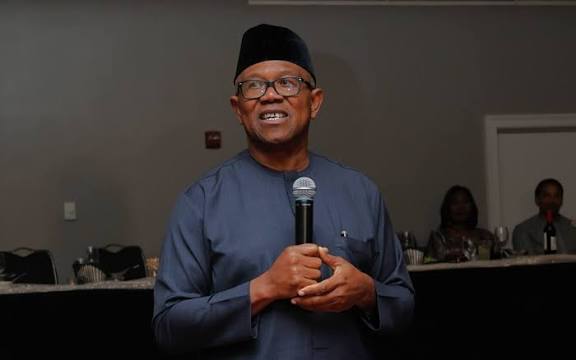
Peter Obi is asking Nigerians to give him the opportunity to lead the country in 2027, arguing that Nigeria needs a government focused on production, fiscal discipline, investment, security, education and measurable improvements in citizens’ lives. The former Anambra State governor has made moving Nigeria from what he describes as a consumption driven economy to a production led economy one of the central themes of his presidential campaign. Obi points to his record in Anambra, including investments in education, support for mission schools, improvements in school performance and a reputation for relatively disciplined public spending. He is campaigning against President Bola Tinubu’s administration at a time when many Nigerians continue to face pressure from high fuel prices, living costs, insecurity and unemployment. No criminal conviction against Obi was identified in the public records and sources reviewed for this report. However, claims that he is the only Nigerian politician, past or present, without a criminal record cannot responsibly be established as fact.
Peter Obi is asking Nigerians to entrust him with the presidency in 2027, presenting himself as a candidate focused on rebuilding the economy around production, investment and more disciplined management of public resources.
The former Anambra State governor has formally entered the 2027 presidential contest under the Nigeria Democratic Congress and has repeatedly argued that Nigeria must stop depending excessively on imports, borrowing and consumption.
His central economic message is straightforward.
Nigeria, he says, must produce more of what it consumes, process more of what it produces and build industries capable of competing internationally.
OBI PUTS PRODUCTION AT CENTER OF CAMPAIGN
Obi has made the phrase “from consumption to production” one of the defining themes of his political message.
He says agriculture should form part of the foundation.
His argument is that Nigeria has large areas of productive land, a young population and a huge domestic market but has failed to convert those advantages into enough jobs, exports and industrial output.
He has also identified manufacturing, technology, energy, construction, creative industries and small businesses as sectors capable of creating employment.
Obi says government borrowing should be directed toward investment rather than routine consumption.
His campaign argues that public spending should produce measurable economic value.
OBI SAYS NIGERIA CANNOT IMPORT ITS WAY TO PROSPERITY
The former governor has repeatedly argued that Nigeria’s heavy dependence on imported goods weakens the economy.
His proposed alternative is to expand local agriculture, manufacturing and value added production.
That approach, he says, would create jobs, reduce pressure on foreign exchange and help strengthen the naira over time.
Obi has also said he would retain aspects of the current floating exchange rate system introduced under President Bola Tinubu but would attempt to support the currency through increased productivity.
HIS ANAMBRA RECORD REMAINS CENTRAL TO HIS CASE
Obi served as governor of Anambra State between 2006 and 2014.
His supporters frequently point to his performance in education and fiscal management as evidence for his national campaign.
One of the most significant decisions of his administration was the return of many previously government controlled schools to missionary organizations while the state continued providing financial and material support.
That policy involved Catholic and Anglican missions and was accompanied by investments in school infrastructure, teacher support and educational equipment.
ANAMBRA RECORDED STRONG EDUCATION RESULTS
During Obi’s tenure, Anambra recorded strong results in national examinations.
The state rose significantly in national education rankings and performed strongly in examinations conducted by bodies including the National Examinations Council.
Supporters of Obi cite those results as evidence that the partnership with mission schools and increased education investment produced measurable outcomes.
The record has remained one of the most widely discussed aspects of his governorship.
SCHOOL INFRASTRUCTURE ALSO RECEIVED INVESTMENT
Obi’s administration funded classroom construction and rehabilitation across communities in Anambra.
His government also provided educational materials, computers and other support to schools.
Part of the strategy was to spread educational investment across communities rather than concentrate projects exclusively in major cities.
Critics have disputed some of the numbers promoted by Obi’s supporters, but independent fact checking has found evidence supporting significant education interventions during his tenure.
HEALTHCARE WAS ANOTHER AREA OF INVESTMENT
Obi’s administration also invested in healthcare facilities and worked with church managed hospitals and other institutions.
His government participated in programs linked to the Millennium Development Goals and supported health centers, maternal care and hospital infrastructure.
The broader approach was similar to the education model, with government working alongside faith based institutions and other established providers.
FISCAL DISCIPLINE REMAINS ONE OF OBI'S STRONGEST POLITICAL ARGUMENTS
Obi has long presented himself as a politician focused on reducing waste and controlling government spending.
He has said that he left substantial cash and investments for Anambra when he left office.
The widely repeated figure of roughly ₦75 billion has been the subject of political debate.
Fact checks have found substantial evidence that Obi left significant financial assets and savings, though disagreements remain over the exact value, composition and liabilities attached to the state at the time.
The current Anambra State Government has also challenged aspects of Obi’s account of the state’s finances.
For a fair assessment, both points matter.
OBI'S RECORD HAS ALSO FACED CRITICISM
A serious assessment of Obi’s governorship cannot include only favorable claims.
Critics have questioned aspects of infrastructure delivery, local government administration and the emphasis placed on savings.
The current Anambra administration has also disputed parts of Obi’s account of debts and assets left behind.
Those disagreements remain part of the political debate surrounding his record.
That does not erase documented achievements in education and fiscal management, but it means his entire eight year tenure should be examined through verifiable evidence rather than campaign claims alone.
CRIMINAL RECORD CLAIM REQUIRES CAUTION
Obi’s supporters sometimes describe him as uniquely free of criminal allegations or convictions among Nigeria’s political elite.
No criminal conviction against Peter Obi was identified in the public sources reviewed by VNTV for this report.
However, it would be inaccurate to state that he is the only Nigerian politician in history with no criminal record.
Nigeria has thousands of past and present political officeholders, and such an absolute claim cannot reasonably be verified.
Political credibility should therefore be judged using documented records rather than sweeping comparisons.
TINUBU GOVERNMENT FACES ECONOMIC PRESSURE
Obi is campaigning against the administration of President Bola Ahmed Tinubu.
Tinubu entered office in 2023 and immediately removed the petrol subsidy while his government also moved toward a more market determined exchange rate.
The administration argues that these policies were necessary to correct longstanding economic distortions.
The reforms have attracted praise from some investors and international economic institutions.
But ordinary Nigerians have also experienced significant economic pressure.
PETROL PRICES HAVE BECOME A MAJOR ISSUE
Fuel prices have risen sharply.
By September 2026, petrol was selling at around ₦1,400 per litre in Lagos and Abuja and even higher in some northern areas.
Diesel prices have also risen significantly.
These costs affect transportation, food distribution, business operations and household budgets.
That economic reality is expected to be one of the central issues in the 2027 campaign.
TINUBU ADMINISTRATION SAYS REFORMS ARE WORKING
The government rejects the argument that its economic policies amount simply to failure.
Tinubu and his officials have pointed to economic growth, increased investment, fiscal restructuring and improvements in some macroeconomic indicators.
The administration argues that painful reforms were necessary because previous economic arrangements were unsustainable.
It has also said that abandoning those reforms would reverse progress.
That remains the government’s position.
OBI ARGUES GROWTH MUST REACH ORDINARY PEOPLE
Obi’s counterargument is that economic statistics have limited meaning if households cannot afford food, transportation, housing, education and healthcare.
He says government should be judged by measurable improvements in citizens’ daily lives.
In his October 1 message, Obi said Nigerians should begin seeing the impact of effective leadership within the first year of his administration if elected.
He has promised to prioritize security, education, healthcare and productive enterprise.
SECURITY IS CENTRAL TO HIS ECONOMIC PLAN
Obi argues that Nigeria cannot become a productive economy without improving security.
Farmers cannot expand food production if they are unable to safely reach farmland.
Factories cannot operate efficiently if transportation routes are insecure.
Businesses are also less likely to invest where kidnapping, banditry and terrorism remain serious risks.
His campaign therefore connects economic reform directly with improvements in policing, intelligence and border management.
YOUTH EMPLOYMENT IS ANOTHER MAJOR FOCUS
Nigeria has one of the world’s largest youth populations.
Obi says that population should be treated as an economic asset rather than a burden.
His plan emphasizes agriculture, small businesses, technology and manufacturing as areas where young Nigerians could find employment or build enterprises.
He has argued that government should make financing and infrastructure more accessible to productive businesses.
EDUCATION WOULD REMAIN CENTRAL
Obi’s Anambra experience has also shaped his national education proposals.
He has repeatedly described education as one of the most important forms of investment a government can make.
His campaign argues that Nigeria should improve basic education, technical skills and university funding while ensuring that education is connected to the needs of the economy.
The objective, according to Obi, is to create a workforce that can participate in a modern productive economy.
OBI IS ALSO ASKING NIGERIANS TO PROTECT THEIR VOTES
The candidate has urged Nigerians to register, participate in the 2027 election and monitor the process from polling units through final collation.
He says electoral credibility will be essential to public trust.
Obi has also pledged that electoral manipulation would face prosecution under his administration.
Those commitments remain campaign promises that would need to be implemented if he wins office.
HIS 2023 EXPERIENCE STILL SHAPES THE CAMPAIGN
Obi finished third in Nigeria’s 2023 presidential election behind Bola Tinubu and Atiku Abubakar.
He challenged the result through the courts but did not overturn Tinubu’s victory.
The 2027 campaign gives Obi another opportunity to present his economic and governance record directly to voters.
He has said candidates should face Nigerians, defend their records and explain their plans rather than campaign through representatives.
2027 SHOULD BE ABOUT RECORDS AND POLICIES
The strongest democratic argument for or against any presidential candidate should rest on evidence.
For Peter Obi, that means examining his record in Anambra, his private sector background, his economic proposals and the credibility of his promises.
For President Bola Tinubu, it means examining the measurable results of his current administration.
Other presidential candidates should face the same scrutiny.
The choice ultimately belongs to Nigerian voters.
WHAT IS DOCUMENTED ABOUT OBI
Obi governed Anambra State for approximately eight years.
His administration invested substantially in education and partnerships with mission schools.
Anambra recorded significant improvements in national educational performance during his tenure.
His government became associated with fiscal discipline and the preservation of significant state financial assets.
He is campaigning in 2027 on a platform centered on production, investment, security, education and more disciplined public spending.
WHAT SHOULD NOT BE PRESENTED AS FACT
It cannot responsibly be stated that Peter Obi is the only honest politician Nigeria has ever produced.
It also cannot be established that he is the only Nigerian politician without a criminal record.
Likewise, no news organization can establish in advance that he is the only person capable of moving Nigeria from consumption to production.
What can be established is that the production agenda is a central and documented part of his campaign.
THE QUESTION BEFORE NIGERIAN VOTERS
Nigeria enters the 2027 election facing difficult questions about the economy, security, jobs, public debt, education and trust in government.
Obi is asking voters to compare his record with those of his opponents.
President Tinubu will also be asking Nigerians to judge whether the reforms introduced under his administration deserve more time.
The election will therefore offer voters competing assessments of Nigeria’s problems and competing plans for addressing them.
Peter Obi’s argument is that his record in Anambra and his emphasis on production provide evidence of how he would govern nationally.
Whether Nigerians accept that argument will be decided at the ballot box.