

NATO JET SHOOTS DOWN EXPLOSIVE CARRYING DRONE OVER LITHUANIA AS ITALY POINTS TO POSSIBLE RUSSIAN ORIGIN
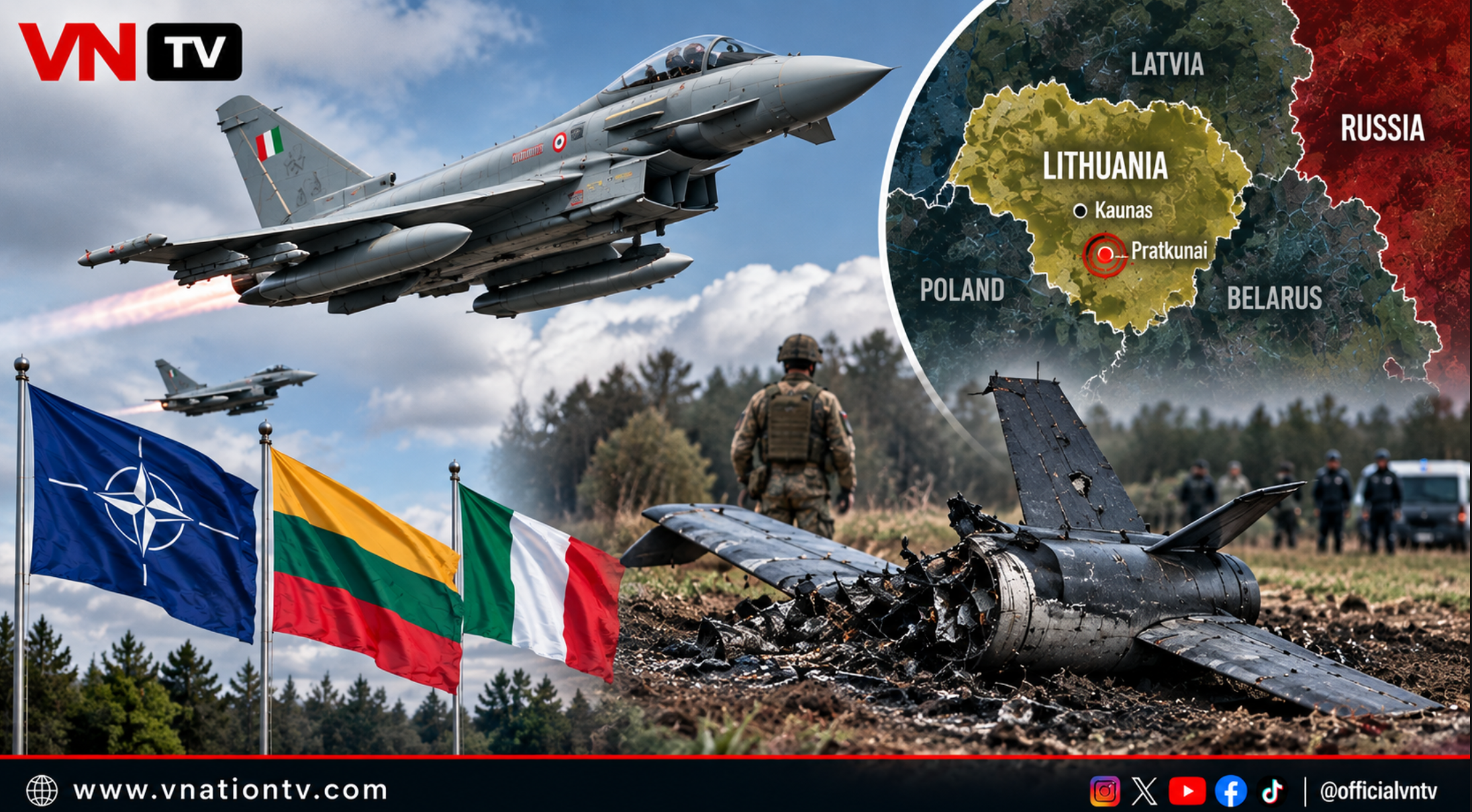
An Italian fighter operating under NATO's Baltic air defense mission has shot down a drone that entered Lithuanian airspace from Belarus. An explosive was later discovered and neutralized at the crash site. Italy's defense minister says the threat most probably originated from Russia, although Lithuanian authorities say the investigation has not yet established the drone's origin.
VILNIUS, LITHUANIA — An Italian fighter jet operating under a NATO air defence mission has shot down a drone over Lithuania after the aircraft entered the NATO member's airspace from Belarus, marking a significant new security incident along the alliance's eastern flank.
The drone entered Lithuanian airspace shortly after midnight on September 15 and was intercepted near the village of Pratkūnai, not far from Kaunas, according to Lithuanian authorities.
Italian Defence Minister Guido Crosetto said the threat most probably came from Russia after meeting Italian crews stationed at Šiauliai Air Base as part of NATO's Baltic Air Defence mission.
Lithuanian authorities have not yet officially established the drone's origin and are examining debris recovered from the site.
A Ukrainian military source who reviewed images of the wreckage told Reuters that the debris appeared similar to Russia's Geran 2, a long range attack drone widely used by Russian forces.
Russia had not immediately commented on the incident.
EXPLOSIVE FOUND AND NEUTRALISED
Lithuanian Defence Minister Robertas Kaunas confirmed that an explosive device was discovered at the site where the drone came down.
Bomb disposal specialists subsequently neutralised the explosive while Lithuanian military and security personnel continued examining the wreckage.
No casualties or significant property damage have been reported.
Air alerts had been issued for Vilnius, Kaunas and surrounding areas after authorities detected the incoming aircraft.
Italian Eurofighter aircraft stationed in Lithuania under NATO's Baltic mission were scrambled and intercepted the drone before it could continue further into Lithuanian territory.
Lithuanian President Gitanas Nausėda said the successful interception demonstrated that the country's air defence system and NATO's presence were functioning as intended.
INCIDENT COMES AMID HEIGHTENED NATO SECURITY CONCERNS
The interception comes as NATO's eastern members remain on heightened alert following a series of drone related incidents and Russian strikes increasingly close to alliance territory.
Days earlier, Russian drones struck Ukrainian infrastructure near the Polish border.
One drone hit a passenger train near the Ukrainian Polish frontier after a diplomatic train carrying former British Prime Minister Boris Johnson, former Swedish Prime Minister Carl Bildt and other European officials had travelled through the area.
Another Russian drone struck a truck near the Yahodyn Dorohusk border crossing approximately 800 metres from Polish territory.
Those attacks prompted Poland to strengthen security at its frontier with Ukraine.
Polish military engineers are constructing protective barriers as well as observation and guard positions near the Dorohusk, Medyka and Korczowa border crossings.
Polish Defence Minister Władysław Kosiniak Kamysz said the recent Russian actions demonstrate that the security threat extends beyond Ukraine and affects Europe more broadly.
NATO EASTERN FLANK UNDER PRESSURE
The Lithuanian incident is particularly significant because NATO aircraft did not merely monitor the unidentified aircraft. They intercepted and destroyed it after it entered allied airspace.
However, Lithuanian authorities have cautioned against reaching conclusions about who operated the drone before the investigation is completed.
If investigators formally establish that it was a Russian military drone, the incident would add to growing concerns about Russian military activity and unmanned aircraft appearing close to or inside NATO airspace.
For now, NATO has not announced an Article 5 response to the incident.
Lithuanian investigators are continuing to examine the wreckage to establish the drone's type, origin and circumstances surrounding its entry into the country's airspace.