GHANA POLICE MEN CROWN GREATER ACCRA VOLLEYBALL LEAGUE CAMPAIGN WITH TITLE AFTER 3-1 WIN OVER KALIBI
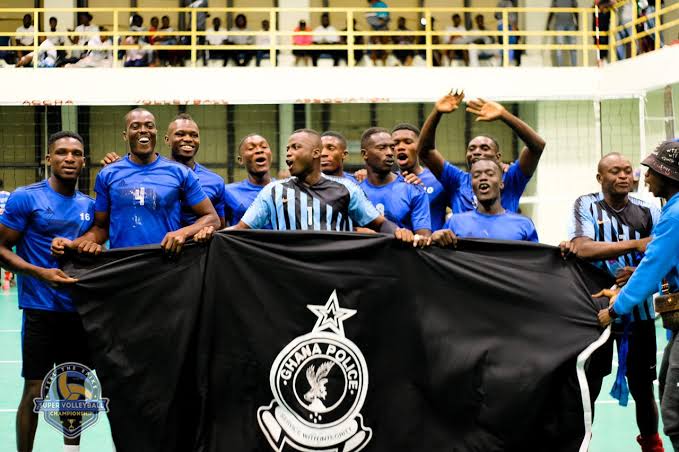
Ghana Police Men have won the 2025/2026 Greater Accra Volleyball League title after defeating Kalibi Volleyball Club 3–1 at the El-Wak Sports Stadium on Sunday, November 8. Police Ladies also defeated Kalibi 3–2 on the final matchday, completing a successful end to the season for the Ghana Police volleyball teams. Police Director of Sports ASP Bernice Timbilla congratulated both teams and urged them to begin preparations for the upcoming Super Volleyball Championship.
Ghana Police Men have been crowned champions of the 2025/2026 Greater Accra Volleyball League after defeating Kalibi Volleyball Club 3–1 in their final fixture of the season at the El-Wak Sports Stadium, bringing a demanding campaign to a successful conclusion and underlining the team’s position among the strongest volleyball sides in the country. Police entered the final matchday knowing that a strong performance was required to complete their title push, and they responded with the composure and discipline that had characterized their run through the latter stages of the season, overcoming a competitive Kalibi side to secure the championship in front of supporters at one of Accra’s traditional volleyball venues.
The title-clinching victory brought an impressive end to a season in which Police had to work their way through a highly competitive men’s division rather than simply dominate from start to finish. Earlier in the campaign, Ghana Army had occupied the top position in the standings and appeared well placed to control the championship race, but Police maintained pressure over the course of the season, continued collecting crucial victories and ultimately positioned themselves to take the title in the final stretch. Their success against Kalibi therefore represented more than a single match victory; it completed a sustained recovery and title challenge built over months of league competition.
Kalibi entered the final fixture with a reputation as one of the most competitive civilian clubs in Ghanaian volleyball and had already shown during the season that they were capable of troubling the established security-service teams. Police, however, approached the deciding match with greater consistency and were able to control enough of the key moments to take three of the four sets and close out the encounter 3–1. The result confirmed Police as champions and gave the club a significant domestic honor at the end of a season that had demanded resilience, tactical discipline and physical consistency across a long league schedule.
The victory also completed a successful day for the Ghana Police volleyball program after the Police Ladies defeated Kalibi 3–2 in the women’s fixture earlier at El-Wak. The women’s contest was considerably tighter, stretching across five sets before Police eventually prevailed, while the men followed by producing the decisive result needed to turn the day into a celebration for the entire Police sports unit. Although the women did not claim the league title, their victory ensured that both Police teams ended the campaign on a positive note and reinforced the depth of the institution’s volleyball program.
Following the matches, Ghana Police Director of Sports ASP Bernice Timbilla congratulated the men’s team on winning the league championship and praised the women for their determination in overcoming Kalibi. She urged both teams to maintain the discipline and commitment that had carried them through the league season and challenged the players to turn their attention quickly toward preparations for the next major competition rather than allowing the title celebrations to disrupt their momentum.
That message reflects the competitive expectations surrounding Ghana Police volleyball. The men’s team has established itself as a regular contender in both domestic and regional competitions, and the 2025/2026 league title adds another major achievement to a program that has consistently featured among the strongest institutional teams in Ghana. Police have competed successfully against Ghana Army, Ghana Air Force, Ghana Prisons, Ghana Immigration and leading civilian clubs, while also representing Ghana in competitions involving teams from across West Africa.
Earlier in 2026, Police Men took part in the African Volleyball Confederation Zone III competition in Accra, beginning that campaign with a commanding straight-sets victory over Dynamic Volleyball Team at the Borteyman Sports Complex. That tournament brought together clubs from the sub-region and provided Police with exposure to a different level of competition, testing the squad against opponents with varying playing styles and tactical approaches. The experience gained in that competition appears to have complemented the demands of the domestic campaign, where consistency over a much longer season ultimately became decisive.
Kalibi, the opponent Police had to overcome to secure the title, also carries significant pedigree. The club hosted the CAVB Zone III competition earlier in the year and has developed into one of Ghana’s most visible civilian volleyball organizations, regularly challenging the security-service clubs that have historically dominated domestic volleyball. The strength of Kalibi and other civilian teams has helped raise the standard of the Greater Accra league and ensured that leading institutional sides can no longer expect straightforward victories simply because of their history or resources.
That competitive balance has become increasingly important for Ghanaian volleyball. The Greater Accra Volleyball League remains one of the most active and structured volleyball competitions in the country, featuring teams drawn from security services, civilian clubs, universities and community organizations. The league traditionally runs through much of the year, creating regular competitive opportunities for players and providing a pathway toward national-team selection, regional competitions and the annual Super Volleyball Championship.
The security services continue to play a major role in sustaining the sport. Ghana Police, Ghana Army, Ghana Air Force, Ghana Prisons, Ghana Immigration and other state institutions maintain volleyball teams that train regularly and compete across the season, providing athletes with stable structures in a sporting environment where many civilian clubs face financial and logistical challenges. Their involvement has helped preserve a strong level of competition, while civilian clubs such as Kalibi and El-Wak Wings have increasingly demonstrated that they can compete successfully against those institutional teams.
For Police Men, the title also reflects the importance of sustained preparation rather than reliance on isolated performances. A league championship is accumulated across multiple fixtures, with teams required to perform at home and away venues, manage injuries, adapt to different opponents and maintain concentration throughout a season that can stretch from the early months of the year into November. Police’s ability to remain within reach of the leaders and eventually move into title-winning position suggests a squad that improved as the campaign progressed rather than one that peaked too early.
The team’s success will also be viewed as an important achievement for the Ghana Police Sports Unit, which oversees competitive participation across several disciplines. Sports within the Ghana Police Service have traditionally been used not only for competition but also for physical conditioning, institutional identity and public engagement. Volleyball has become one of the disciplines in which Police have consistently produced competitive teams, and winning the Greater Accra League strengthens that reputation.
The support structure surrounding the players was acknowledged after the final match. Ghana Police Sports officials expressed appreciation to individuals and organizations that supported the team during the campaign, including retired senior officers, current sports personnel, volleyball administrators, police recruits and supporters who attended matches during the season. Such support is particularly important in sports outside football, where gate revenue, sponsorship and commercial coverage remain limited despite strong participation and growing spectator interest.
Ghanaian volleyball has spent years attempting to build a larger commercial profile, and the Greater Accra League remains central to that effort. Unlike football, where clubs benefit from extensive media coverage and significant sponsorship attention, volleyball still relies heavily on institutional support, volunteers and dedicated administrators. The competitive quality of fixtures such as Police against Kalibi demonstrates the level that the sport can reach when teams receive consistent preparation and access to suitable facilities.
El-Wak Sports Stadium has been one of the key venues supporting that development. Volleyball matches have regularly been staged there over the years, giving teams and supporters a recognized location for major fixtures. The atmosphere created by league matches at El-Wak has also helped civilian clubs establish stronger identities and has brought security-service teams into direct competition with community-based organizations in front of spectators.
Police’s championship adds another chapter to a league that has produced different winners across recent seasons. Ghana Army, Ghana Air Force, El-Wak Wings and Police have all featured prominently in title races, while clubs such as Kalibi have continued challenging the established hierarchy. That turnover is important because a competitive league is more valuable to player development than one dominated permanently by a single institution.
The title may also have implications for selection ahead of future national and regional competitions. Players who perform consistently in the Greater Accra league often become candidates for national-team consideration because the competition brings together many of Ghana’s leading domestic volleyball athletes. Winning a league title therefore gives individual Police players an opportunity to strengthen their case for selection when coaches assess available talent.
For the technical staff, however, the immediate challenge will be to maintain standards after the championship. Teams often face a natural drop in intensity after completing a long league campaign, particularly when players have spent months balancing competitive responsibilities with professional obligations. The Police coaching team will need to manage recovery while ensuring the squad remains physically and tactically prepared for the next competition.
Attention now turns toward the Super Volleyball Championship, commonly known as the SVC, which has become one of Ghana’s major end-of-year volleyball events. The competition brings together leading domestic clubs and, in recent editions, teams from elsewhere in West Africa, creating a shorter but more intense tournament environment than the league. Police have strong history in the competition and will enter the next edition with increased confidence after finishing the league season as champions.
The transition from league competition to tournament volleyball requires a different approach. In a league, teams can recover from individual defeats because the championship is decided over a long series of fixtures. In a tournament, one poor performance can end a title challenge immediately, making concentration and squad depth even more important. Police’s ability to maintain the level shown against Kalibi will therefore determine whether their domestic league success can translate into another major trophy.
ASP Timbilla’s call for immediate preparation reflects that reality. While celebrating the men’s championship, she emphasized the need for both Police teams to remain focused and continue working toward the SVC rather than treating the end of the league as the end of their competitive responsibilities. The message was particularly relevant for the women, whose five-set victory over Kalibi demonstrated their ability to compete with one of the strongest female clubs even though they did not finish the league as champions.
The Police Ladies’ performance may provide an important psychological boost heading into the next competition. Kalibi has been one of the leading forces in women’s volleyball and has enjoyed significant success in recent seasons, making a 3–2 victory over them a meaningful result even without a league trophy attached. For Police, the challenge will be to convert that performance into greater consistency over the next tournament cycle.
The men, meanwhile, can approach the upcoming competition knowing they have completed the league season by defeating a difficult opponent under pressure. Winning when a championship is within reach requires emotional control as much as technical ability, because players must manage the significance of the occasion while still executing basic skills such as serving, reception, setting, blocking and transition play. Police’s 3–1 success suggests they handled that pressure effectively.
The final result also demonstrates the value of competitive civilian opposition. Kalibi’s presence forced Police to earn the championship rather than simply collect it against an overmatched opponent. Strong civilian clubs are essential to the future of Ghanaian volleyball because they expand participation beyond state institutions and create development opportunities for athletes who are not members of the security services.
Greater investment in those clubs could significantly strengthen the league. Civilian teams often struggle with costs associated with transport, equipment, accommodation, medical care and player welfare, while security-service teams can rely on established institutional structures. Administrators have repeatedly appealed for corporate sponsorship to reduce that imbalance and create a more sustainable competition.
A stronger league would also improve Ghana’s regional competitiveness. Clubs representing the country in West African and African tournaments need regular high-intensity matches at home if they are to compete successfully abroad. Domestic fixtures involving Police, Army, Air Force, Kalibi and other leading teams provide that preparation and expose players to the physical and tactical demands they will encounter internationally.
The March CAVB Zone III tournament offered an example of that progression. Police Men opened strongly with a 3–0 win over Dynamic Volleyball Team, while other Ghanaian clubs also tested themselves against regional opposition. Such events allow domestic coaches to identify weaknesses that may not be obvious in local competition and give players experience against opponents unfamiliar with their normal systems.
Winning the Greater Accra title therefore represents both an achievement and a platform for Police. The championship confirms that they were the most successful men’s team over the domestic league campaign, but the next measure of their development will come when they face the strongest available opposition in tournament competition.
For the Ghana Police Service, the victory also provides another sporting success that can be used to encourage participation among younger officers and recruits. Security-service teams historically play an important role in Ghanaian athletics because they provide structured training environments and employment pathways for talented sportsmen and women. Maintaining competitive volleyball programs contributes to that broader sporting system.
The league’s conclusion also offers administrators an opportunity to assess the season as a whole. Officiating standards, venue quality, scheduling, player welfare and sponsorship remain areas that will determine how quickly the competition can grow. The sport has attracted dedicated audiences at venues such as El-Wak, Kawukudi, Burma Camp and the Police Depot, but converting that interest into stronger commercial support remains a major challenge.
Improved media coverage could help. Volleyball offers fast-paced matches, clear scoring and strong institutional rivalries, making it well suited to television and digital streaming. Greater visibility would also give sponsors more reason to invest and could encourage young athletes to view volleyball as a serious competitive pathway rather than a secondary sport.
Police’s victory provides exactly the kind of sporting narrative that can strengthen that visibility: a team pursuing the title over a long season, overcoming rivals and securing the championship in the final fixture. The fact that the deciding match came against Kalibi, one of the league’s stronger civilian clubs, added competitive weight to the occasion and ensured the season ended with a meaningful contest.
For Kalibi, defeat does not diminish the progress the club has made. Competing at the level required to influence a championship race demonstrates that civilian volleyball continues to develop, while the club’s involvement in regional competition has also increased its profile. The challenge will be to build on those foundations and convert competitive performances into future domestic titles.
Police, however, leave El-Wak with the trophy and the distinction of being the 2025/2026 Greater Accra Volleyball League men’s champions. Their 3–1 victory provided the final confirmation of a campaign built on consistency, discipline and the ability to remain competitive through the decisive stages of the season.
The result also completed a positive final day for the wider Police volleyball program, with both the men and women defeating Kalibi. The men took the larger prize by securing the league championship, while the women’s five-set victory gave the team another encouraging performance heading into the next phase of competition.
The celebrations will eventually give way to preparation, with the Super Volleyball Championship now the next major target. Police will enter that tournament carrying the confidence of league champions but also the expectations that come with that status, and their opponents will view them as one of the teams to beat.
For the Greater Accra Volleyball League, the conclusion of another competitive season reinforces the importance of the competition to Ghanaian volleyball. It continues to provide regular matches, develop athletes and create rivalries capable of attracting spectators, while serving as the domestic foundation from which teams progress to regional and international events.
Police Men’s title-winning performance at El-Wak was therefore more than the final result of one fixture. It was the culmination of months of league competition, a reward for sustained form and another indication of how competitive the men’s division has become. As the domestic season closes and attention turns toward the next major tournament, Ghana Police can do so as champions, with their 3–1 victory over Kalibi standing as the result that officially completed their Greater Accra Volleyball League title campaign.