GHANA AIR FORCE TAKES DELIVERY OF $60.68 MILLION DASSAULT FALCON 6X PRESIDENTIAL JET AS NDC FACES ACCUSATIONS OF HYPOCRISY OVER ITS PAST OPPOSITION TO KUFUOR-ERA AIRCRAFT
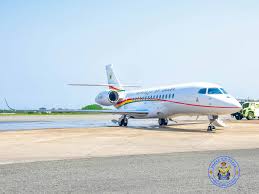
The Ghana Air Force has taken delivery of a new Dassault Falcon 6X long-range executive jet. The aircraft cost $60.68 million and arrived in Accra from France on Monday, November 16, 2026. Parliament approved the purchase on December 4, 2025. The plane will serve as a presidential and VIP transport aircraft. Its arrival has reopened one of the most emotional debates in Ghanaian politics: whether the country should spend large sums on aircraft for its leaders. The governing National Democratic Congress (NDC) argues that the jet is a matter of presidential security, operational reliability and long-term savings. It points to Ghana's aging presidential fleet and the high cost of chartering private planes. The opposition New Patriotic Party (NPP) has seized on the NDC's history. When the NPP government of President John Agyekum Kufuor moved to acquire two aircraft at a combined cost of $105.15 million, the NDC, then in the Minority in Parliament, strongly opposed the deal. Critics now accuse the party of doing in power what it condemned in opposition. The purchase also lands at a sensitive economic moment. Ghana is still rebuilding after its 2022 debt crisis, a sovereign default, a painful domestic debt exchange and an IMF-backed recovery program. Many citizens continue to feel the strain of high living costs. Built by Dassault Aviation, the French maker of the Rafale fighter and the Falcon business jet family, the Falcon 6X offers intercontinental range, a wide cabin and modern safety systems. Few dispute that it is a capable aircraft. The real argument is about priorities, consistency and trust. It is about whether Ghana's political class can agree on rules for state assets that do not change every time power changes hands.
A gleaming new aircraft touched down in Accra on Monday, November 16, 2026, and within hours it had become the most talked-about machine in Ghana. The Ghana Air Force took delivery of a brand-new Dassault Falcon 6X, a long-range executive jet flown in from France and bought for $60.68 million. Officially, it is a state asset that will carry the president and senior officials on national business. Politically, it is something far more combustible. The arrival of the jet has revived a bitter argument between the governing National Democratic Congress and the opposition New Patriotic Party. That argument touches on cost, consistency, presidential safety and what Ghanaians can fairly expect from the people they elect. It has also forced the country to look again at a question it has never quite settled. Is a presidential jet a necessity of statehood, or a luxury that a struggling economy cannot afford?
The road to Monday's delivery began in Parliament. On December 4, 2025, lawmakers approved the purchase of the new aircraft, clearing the way for the government to finalize the deal with the manufacturer. With the NDC holding a commanding majority after its sweeping victory in the December 2024 elections, the approval was never in serious doubt. Government officials explained at the time that the acquisition was needed to give the presidency a safe, reliable and modern aircraft suited to Ghana's diplomatic and security needs. Nearly a year later, the finished plane rolled to a stop on the tarmac in Accra. Air Force personnel received it, and supporters of the government celebrated it as a long-overdue upgrade. Critics described it as an expensive contradiction.
That contradiction is at the heart of the controversy. Ghana's political memory is long, and the NDC's record on presidential aircraft is well documented. During the Kufuor administration, the NPP government pursued the acquisition of two aircraft for presidential and state use, at a combined cost of $105.15 million. The NDC, then sitting in the Minority in Parliament, strongly opposed the arrangement. Its lawmakers argued that the spending was excessive and poorly timed. They questioned whether a developing country with urgent needs in health, education, roads and water should be pouring tens of millions of dollars into planes for its leaders. They framed the issue as a matter of priorities and of respect for ordinary Ghanaians. Those arguments resonated with many voters at the time, and they helped shape the NDC's public image as a party skeptical of elite privilege.
Nearly two decades later, the roles have reversed. The NDC is now in government, and it is the party acquiring a presidential jet. The NPP, now in opposition, has been quick to point this out. Opposition figures and their supporters argue that the NDC's earlier objections have been exposed as political theater. They say the party condemned aircraft purchases when it suited its campaign message and then embraced them once it controlled the budget. They also note that NDC figures were fierce critics of former President Nana Akufo-Addo's use of chartered luxury jets for foreign trips. Those critics questioned the hourly cost of the charters and accused the presidency of extravagance. To the NPP, the Falcon 6X purchase is proof that the NDC's outrage was never really about principle.
The government sees things very differently. Officials and party supporters argue that circumstances have changed and that the decision rests on practical grounds, not political convenience. Their case begins with the aircraft Ghana already had. For years, presidents have relied on an aging Falcon 900EX and a small fleet of older Air Force planes. As those aircraft age, maintenance costs rise, downtime increases, and questions about reliability grow louder. When the official jet is unavailable or unsuitable for a particular trip, the presidency has often turned to chartered aircraft. Charters can be extremely expensive, especially for long-haul journeys, and the money spent leaves the state with nothing to show for it afterward. Supporters of the purchase argue that owning a modern aircraft will, over time, cost less than repeatedly renting one. They also say it gives the state full control over maintenance standards, crew training and security arrangements.
Security sits at the center of the government's argument. A head of state is not an ordinary traveler. The president carries the weight of national decision-making, and any threat to their safety is a threat to the stability of the country. Governments around the world provide their leaders with dedicated aircraft for this reason. Such planes can be secured, inspected and crewed by trusted military personnel. They are fitted with communications equipment that allows the leader to govern from the air, and they can fly on short notice without depending on commercial schedules or private operators. Supporters of the Falcon 6X argue that asking a president to share commercial flights or to rely on chartered planes of uncertain history exposes the country to unnecessary risk. Some commentators have put it bluntly, arguing that the president's security must come before politics. They say the debate should not be reduced to party point-scoring over a tool of state.
Ghana's recent history gives that argument emotional force. In August 2025, a Ghana Air Force helicopter crashed in the Ashanti Region, killing everyone on board. Among the dead were Defence Minister Edward Omane Boamah and Environment Minister Ibrahim Murtala Muhammed. The tragedy shook the nation and raised hard questions about the condition of the country's military aviation fleet and the safety of officials who rely on it. For many Ghanaians, it was a painful reminder that the state of government aircraft is not an abstract budget issue. It can be a matter of life and death. Government supporters argue that investing in modern, well-maintained aircraft is part of the lesson the country should take from that loss.
The aircraft itself is undeniably impressive. The Falcon 6X is one of the newest models from Dassault Aviation, the French aerospace company best known around the world for its Rafale fighter jet and its earlier Mirage combat aircraft. Dassault has built its Falcon line of business jets for decades, and they are widely used by corporations, wealthy individuals and governments seeking long range and reliability. The 6X entered service in 2023 and was designed to compete at the top of the large-cabin business jet market. It can fly roughly 5,500 nautical miles, about 10,200 kilometers, without refueling. That range puts most of Europe, the Middle East and the east coast of the United States within nonstop reach of Accra. It cruises at high speed, with a top speed close to Mach 0.90. It is powered by two Pratt & Whitney Canada PW812D engines.
What sets the 6X apart from many rivals is its cabin. Dassault markets it as having one of the tallest and widest cabins of any purpose-built business jet. The cabin is nearly two meters high and more than two and a half meters wide, with a length of over 12 meters. It can seat up to 16 passengers, depending on how it is configured. In government service, that space typically allows for a private working area for the head of state, a meeting space for advisers, seating for security staff and delegation members, and rest areas for long journeys. The aircraft also features advanced flight controls and avionics drawn from Dassault's military experience, along with modern safety and navigation systems. Few critics dispute that, as a machine, it is a capable and well-regarded aircraft. Their objection is not to the jet. It is to the price, the timing and the politics.
The timing matters a great deal. Ghana is still climbing out of one of the worst economic crises in its modern history. In 2022, inflation soared, the cedi lost much of its value, and the country's debt became unsustainable. The government suspended payments on most of its external debt, effectively defaulting, and launched a domestic debt exchange that hit bondholders, pension funds and ordinary savers hard. Ghana turned to the International Monetary Fund for a $3 billion support program, which came with demanding targets on spending, revenue and fiscal discipline. Since then, the economy has shown signs of recovery. Inflation has eased and the cedi has steadied at various points. Yet many households still feel the squeeze of high prices, unemployment and stretched public services. Teachers, nurses and other public workers have pressed for better pay. Hospitals, schools and roads in many parts of the country remain in urgent need of investment.
Against that backdrop, critics say, a $60.68 million aircraft sends the wrong message. They argue that the same sum could build or equip hospitals, fund school infrastructure, support farmers or ease arrears owed to contractors. They point out that the government has asked citizens to accept tough measures in the name of recovery and accountability. And they question how leaders can preach belt-tightening while buying a new jet for themselves. The NDC built much of its 2024 campaign on a promise to "reset" Ghana, cut waste and run a leaner government. For some voters, the Falcon 6X sits awkwardly beside that promise. Opposition voices have made sure the comparison stays in the headlines.
Defenders of the purchase reply that the comparison is misleading. They argue that a functioning state needs both social investment and basic tools of governance. They also contend that refusing to replace aging aircraft does not save money in the long run. Instead, they say, it pushes the costs into expensive repairs and charter bills that rarely receive the same public scrutiny. They point out that the purchase went through Parliament, was debated openly and was approved through the proper process. In their view, this is how state procurement should work. The real failure, they argue, would be continuing to patch up old planes while quietly spending large sums on charters.
Both sides have a point, and that is precisely why the debate is so heated. The NPP is right that the NDC's past positions make its current choice look inconsistent. A party that loudly condemned aircraft spending cannot be surprised when its own words are thrown back at it. Yet the NDC is also right that the NPP, in government, faced the same pressures. Under Akufo-Addo, the NPP defended its use of chartered jets by pointing to the limitations of the existing presidential aircraft. In other words, each party has argued for and against presidential aircraft depending on which side of the aisle it sat. That pattern is not unique to Ghana, but it is especially visible here because the country's two major parties have alternated in power so regularly since the return to constitutional rule in 1993.
That cycle reveals a deeper problem in Ghana's governance debate. Decisions about major state assets, from presidential aircraft to official residences and vehicle fleets, are too often judged through a purely partisan lens. When one party buys, the other objects. When power changes, the positions swap. The result is a political culture in which voters struggle to know which arguments are sincere and which are tactical. Governance analysts and civil society groups have long called for clearer, bipartisan rules on such purchases. They have urged independent assessments of need, published lifetime cost comparisons between ownership and chartering, transparent tender processes and regular public reporting on how state aircraft are used. A framework like that could take some of the heat out of future debates. It would also give citizens confidence that such decisions are driven by evidence rather than by whichever party happens to be in charge.
Transparency will be the test the government cannot avoid. Ghanaians will want to know how the $60.68 million price was negotiated and how it compares with what other governments have paid for similar aircraft. They will ask what the plane will cost to operate and maintain each year, and what will happen to the older aircraft in the fleet. They will also want to know who will be allowed to use the jet, for what purposes and under what rules. Clear answers would strengthen the government's claim that the purchase is a sound investment. Vague answers would feed suspicion that the jet is simply a symbol of power for whoever holds office.
The opposition, too, faces a test. Criticism of government spending is a vital part of democratic accountability, and the NPP has every right to challenge the purchase. But if its objections are to carry weight beyond the news cycle, they will need to go further than accusations of hypocrisy. Voters may reasonably ask what the NPP would do differently. Would it ground the jet if it returned to power, sell it, or quietly use it? Would it support binding rules on presidential aircraft that apply to every government? A credible opposition offers alternatives, not just objections.
For ordinary Ghanaians, the debate is about more than a single aircraft. It is about whether their leaders share the sacrifices they ask the public to make. It is about whether promises made in opposition mean anything once a party takes office. And it is about whether the institutions of the state are built to last beyond one administration or one election. The Falcon 6X will likely serve Ghana for many years, carrying presidents from both parties long after this argument has faded. Its true legacy may depend less on how it flies and more on whether the controversy it sparked pushes the country toward a more honest, consistent and transparent way of making decisions about public money.
For now, the jet sits in Accra, a sleek symbol of both national ambition and political contradiction. The government sees a safer, more reliable future for presidential travel. The opposition sees a broken promise with wings. Somewhere between those views lies the question Ghanaians will keep asking long after the novelty of the new plane wears off: who decides what the state truly needs, and who holds them to account when their positions change?