
ERITREA ASKS UN SECURITY COUNCIL TO ACT AGAINST ETHIOPIA AS TIGRAY CRISIS ESCALATES
Eritrea has asked the UN Security Council to take deterrent action against Ethiopia under Chapter VII after Addis Ababa accused Eritrean forces of advancing up to 60 kilometers into Tigray. Eritrea denies launching an invasion and says Ethiopia's accusation amounts to a declaration of war. Ethiopian forces and their allies have meanwhile regained Adigrat as drone strikes and troop movements raise fears that the Tigray conflict could expand into a direct Ethiopia Eritrea war.
Eritrea has asked the United Nations Security Council to take deterrent action against Ethiopia as rapidly worsening tensions over the war in northern Ethiopia push the two neighboring states closer to direct confrontation. Eritrean Foreign Minister Osman Saleh made the request in a letter sent to the Council on Saturday, arguing that Ethiopia's accusation that Eritrean forces had launched an all out invasion of Tigray amounted to a declaration of war against Eritrea and required an international response before the confrontation develops into a much wider regional conflict.
Saleh called on the Security Council to condemn Ethiopia's position and consider action under Chapter VII of the United Nations Charter, the section that gives the Council authority to respond to threats to international peace and security through measures that can range from sanctions and diplomatic restrictions to, in exceptional circumstances, authorization of force. Eritrea says Ethiopia is attempting to create a justification for military action against it and denies Addis Ababa's allegation that Eritrean troops deliberately launched a full scale invasion of Ethiopian territory.
The Eritrean letter follows an equally serious communication from Ethiopia to the Security Council. Ethiopian Foreign Minister Gedion Timothewos told the Council that Eritrean infantry and mechanized units had crossed into northern Ethiopia and advanced as far as 60 kilometers into Tigray. Ethiopia described the alleged movement as a blatant act of aggression and invoked its inherent right to self defense under Article 51 of the UN Charter. Addis Ababa has said it will defend its territorial integrity if Eritrean forces remain inside the country.
The 60 kilometer figure is an Ethiopian government claim and has not been independently established across the entire front. However, multiple independent reports and witnesses have documented the presence of Eritrean troops inside northern Ethiopia in recent days, while Eritrea continues to reject Ethiopia's characterization of those movements as an invasion. The disagreement over what exactly Eritrean forces are doing inside Tigray has now become one of the most dangerous elements of a conflict that was initially centered on renewed fighting between Ethiopian federal forces and the Tigray People's Liberation Front.
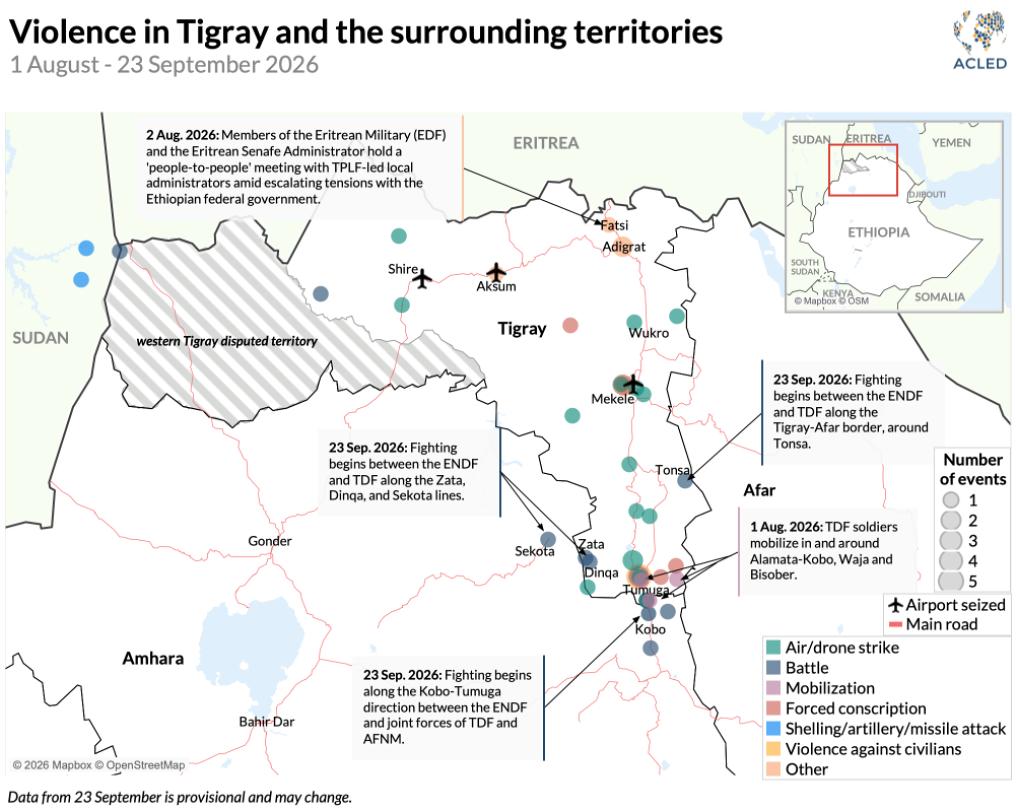
Ethiopian forces and allied fighters moved into the strategically important city of Adigrat near the Eritrean border after days of clashes, drone attacks and reported explosions. Adigrat is particularly significant because of its proximity to Eritrea and because control of the city affects military movement along one of the main corridors between northern Tigray and the international border. Reports from the area indicate that federal aligned forces regained control after rebels and forces associated with Eritrea had operated around the city.
The Ethiopian military has also carried out drone strikes in areas where Eritrean troops were reportedly present. The Armed Conflict Location and Event Data project reported Ethiopian drone activity targeting Eritrean forces near Adigrat, while residents and other witnesses described explosions in the surrounding area. The strikes increase the risk that what began as an internal Ethiopian conflict could become a direct interstate war between Ethiopia and Eritrea.
The United Nations has publicly expressed concern about that possibility. UN Secretary General António Guterres said he was gravely concerned by renewed fighting in Tigray, Afar and Amhara and specifically noted reports of Eritrean forces inside Ethiopia. He urged all parties to stop hostilities, respect territorial integrity and return to dialogue under the framework of the Pretoria Agreement that ended the devastating 2020 to 2022 Tigray war. The Secretary General also called on neighboring governments to avoid actions that could further fuel the conflict.
The present crisis represents a dramatic reversal in relations between Ethiopia and Eritrea. Ethiopian Prime Minister Abiy Ahmed and Eritrean President Isaias Afwerki restored relations in 2018 after two decades of hostility following the 1998 to 2000 border war. Abiy's diplomatic opening toward Eritrea was a major factor in his receipt of the Nobel Peace Prize in 2019, and the two governments subsequently became military partners during the war against the TPLF beginning in 2020.
That wartime partnership did not survive the political changes that followed the 2022 Pretoria peace agreement. Relations between Addis Ababa and Asmara deteriorated sharply as Eritrea became increasingly suspicious of Ethiopia's intentions toward the Red Sea and Ethiopia accused Eritrea of attempting to destabilize its northern regions. The former allies are now exchanging accusations that would normally be associated with governments preparing for a possible interstate conflict.
One of the biggest underlying disputes concerns Ethiopia's access to the sea. Ethiopia has been landlocked since Eritrea gained independence in 1993 and has repeatedly argued that secure access to a Red Sea port is strategically and economically essential for a country of its size. Abiy has said Ethiopia must find a peaceful and lawful solution to its maritime access problem, but comments from Ethiopian officials since 2023 have alarmed Eritrea, which fears that Addis Ababa may eventually attempt to secure sovereign access to the coast through Eritrean territory.
Eritrea has repeatedly pointed to those statements when accusing Ethiopia of harboring aggressive intentions. Eritrean Information Minister Yemane Gebremeskel has cited Ethiopian discussions about sea access as evidence that the current dispute should not be viewed only through the lens of events in Tigray. Asmara believes Ethiopia is building a broader political case that could eventually be used to justify pressure against Eritrean sovereignty, particularly around the strategic port of Assab.
Ethiopia rejects that interpretation and says it continues to seek maritime access through peaceful negotiations. Addis Ababa instead accuses Eritrea of backing armed movements operating against the Ethiopian government, including factions involved in renewed fighting across Tigray and neighboring regions. Eritrea denies financing or directing those groups.
The renewed Tigray conflict has already destabilized large areas of northern Ethiopia. Federal forces have battled the TPLF and its allies after the rebel movement joined a broader opposition alliance challenging Abiy's government. Fighting has included airstrikes and artillery attacks around Mekelle, Adwa, Sheraro and other areas, with civilians again caught between competing armed forces only a few years after the region experienced one of Africa's deadliest recent wars.
The earlier Tigray war from 2020 to 2022 killed hundreds of thousands of people through combat, famine, disease and the collapse of essential services. Eritrean troops fought alongside Ethiopian federal forces during that conflict and were accused by human rights organizations and survivors of serious abuses. Eritrea rejected many of those allegations. The possibility of another large scale Ethiopian and Eritrean confrontation therefore raises particularly severe humanitarian concerns because many communities in the region have still not recovered from the previous war.
The latest diplomatic confrontation at the United Nations also shows that both governments are attempting to establish international legitimacy for their positions before any further military escalation. Ethiopia has invoked the right of self defense, while Eritrea is asking the Security Council to treat Ethiopia's rhetoric and actions as a threat to international peace. Each government is effectively arguing that the other side is the aggressor.
That competition over the diplomatic narrative matters because international law treats self defense differently from offensive military action. Ethiopia would need to demonstrate that it is responding to an armed attack or imminent threat if it seeks to justify military action under Article 51. Eritrea, meanwhile, wants the Security Council to conclude that Ethiopia itself is preparing aggression and that preventive international measures are necessary.
Chapter VII does not mean the United Nations will automatically impose sanctions or authorize military intervention. The Security Council would first have to agree that the situation constitutes a threat to peace, breach of peace or act of aggression, and any significant action could be shaped by the positions of the five permanent members. Eritrea's request is therefore politically significant but does not itself trigger enforcement measures.
The Council has not announced the type of action, if any, it will take in response to the competing letters. Diplomatic efforts are likely to focus first on preventing further cross border fighting, verifying troop movements and encouraging renewed communication between Addis Ababa and Asmara.
The African Union could also face growing pressure to intervene diplomatically. The organization helped support the Pretoria Agreement that ended the previous Tigray war and has repeatedly urged regional governments to resolve disputes through negotiation. A direct Ethiopia Eritrea conflict would present an even larger challenge because both governments are central actors in the Horn of Africa and have relationships with competing regional powers.
The consequences could extend far beyond Ethiopia and Eritrea. Sudan is already experiencing prolonged instability, Somalia remains vulnerable to insurgent violence and Red Sea security has become increasingly important because of conflicts affecting major international shipping routes. A new interstate war involving Ethiopia and Eritrea could draw in neighboring countries or encourage armed movements to exploit the instability.
There are also concerns about the involvement of Egypt and other governments with strategic interests in Ethiopia. Addis Ababa has accused Eritrea, Sudan and Egypt of supporting groups hostile to the Ethiopian government, accusations those countries have rejected. Ethiopia and Egypt continue to have major disagreements over Nile water and the Grand Ethiopian Renaissance Dam, adding another layer to regional tensions.
Inside Tigray, civilians once again face the most immediate consequences. Banks, health services, transport routes and other basic infrastructure have been disrupted in areas affected by renewed fighting. Humanitarian organizations have warned that hunger and shortages of medicine remain serious problems, particularly in communities that had only begun recovering from the previous conflict.
Some normal services are returning in areas brought under federal control, and Ethiopian Airlines has prepared to resume flights to Mekelle, but the security picture remains unstable. Control of towns can change quickly, and continued fighting near the Eritrean border could reverse attempts to restore transportation and commercial activity.
Adigrat will remain one of the most important locations to watch. Ethiopian and allied forces entering the city represents a significant military development because of its proximity to Eritrea. Any further movement north from Adigrat toward the border could bring Ethiopian and Eritrean forces into even closer contact and increase the likelihood of direct fighting.
The language now being used by both governments is itself a warning sign. Ethiopia has described Eritrea's alleged actions as an invasion requiring self defense. Eritrea says that accusation amounts to a declaration of war. When neighboring governments begin formally using those terms in correspondence with the United Nations, the political space for compromise can narrow quickly unless outside mediators intervene.
Despite that rhetoric, neither government has formally declared war. Eritrea has denied invading Ethiopia, while Ethiopia continues to frame its military actions as defensive. That distinction remains important because reports of troop movements, airstrikes and cross border deployments do not by themselves mean a formally declared interstate war has begun.
The immediate priority for international mediators will be preventing the confrontation from reaching that point. Verification of troop positions, especially around Adigrat and the northern Tigray border, could help establish whether Eritrean forces are withdrawing, holding territory or moving deeper into Ethiopia. At the same time, Ethiopia would face pressure to avoid expanding drone or ground operations into Eritrean territory.
The UN Secretary General's statement provides the clearest international position so far. The United Nations is calling for an immediate halt to hostilities, respect for territorial integrity and renewed negotiations under the Pretoria framework while expressing concern about reports of Eritrean military presence inside Ethiopia.
For Eritrea, however, those calls are not enough. Asmara wants the Security Council to go further by condemning Ethiopia and adopting measures designed to deter what it believes is an impending attack. Ethiopia is making essentially the opposite case, telling the same Council that Eritrea is already committing aggression and that Ethiopian forces are acting in legitimate self defense.
The competing appeals leave the Security Council confronting two sharply contradictory narratives while events on the ground continue moving rapidly. Independent reporting supports concerns about Eritrean military presence inside Ethiopia, but many details about the scale, command structure and purpose of those deployments remain unclear.
What is no longer unclear is the seriousness of the confrontation. Ethiopia and Eritrea have moved from diplomatic tension and accusations over Red Sea access to military deployments, drone strikes, competing self defense claims and formal appeals to the United Nations Security Council.
Whether the crisis develops into another full scale war will depend heavily on what happens around northern Tigray in the coming days. A withdrawal of forces and renewed diplomatic contact could still reduce tensions, but additional cross border movements or attacks could produce a conflict far more difficult to contain. For a region that has already endured years of war and humanitarian catastrophe, the current Ethiopia Eritrea standoff represents one of the most dangerous escalations since the Pretoria peace agreement ended the previous Tigray conflict.