EFCC CHAIRMAN WARNS ENGINEERS AGAINST CORRUPTION, SAYS UNETHICAL PRACTICES CAN COST LIVES
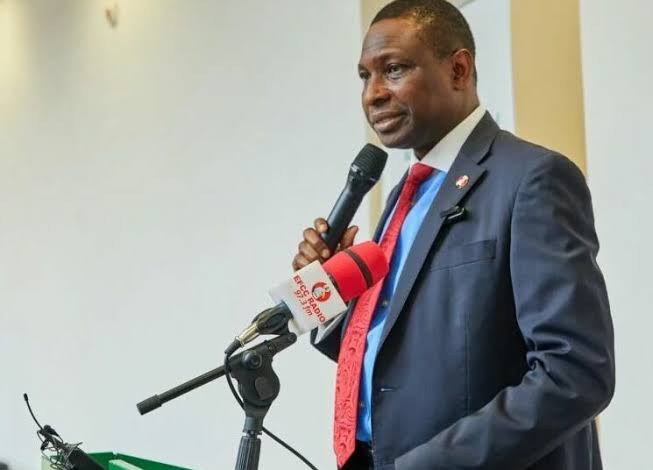
EFCC Chairman Ola Olukoyede has urged 45 newly inducted engineering graduates of Bamidele Olumilua University of Education, Science and Technology in Ikere-Ekiti to reject corruption and make integrity central to their professional careers. Speaking on November 12, Olukoyede warned that falsifying records, manipulating contracts, diverting funds or approving poorly executed engineering projects could put lives at risk and undermine Nigeria’s development. He also urged students to reject cybercrime, identity theft and internet fraud and said the EFCC had secured 10,872 convictions and recovered more than N1.288 trillion in monetary assets over the preceding three years.
IKERE-EKITI, NIGERIA — The Chairman of Nigeria’s Economic and Financial Crimes Commission, Ola Olukoyede, has warned a new generation of engineers that corruption in their profession can do far more than waste public money, arguing that compromised designs, falsified records, manipulated contracts and certification of poorly executed projects can directly endanger human lives and deepen Nigeria’s development crisis. Addressing 45 newly inducted engineering graduates of Bamidele Olumilua University of Education, Science and Technology in Ikere-Ekiti, Ekiti State, Olukoyede urged the graduates to regard integrity as an essential part of professional competence and not simply as an abstract moral principle, telling them that Nigeria’s ability to turn its considerable natural and human resources into lasting prosperity depends partly on whether professionals resist corruption when they enter positions of responsibility.
Olukoyede delivered the message during the university’s engineering induction ceremony on Thursday, November 12, in a lecture titled “Integrity, Accountability and the Fight Against Economic and Financial Crimes: Building a Culture of Transparency and Responsibility in Nigeria.” He told the gathering that Nigeria’s struggle with corruption extends across both the public and private sectors and affects the quality of infrastructure, government spending, corporate decision-making and public confidence. For engineers, he said, the consequences of unethical conduct can be especially severe because decisions involving buildings, roads, bridges, electrical systems, industrial facilities and other critical infrastructure can determine whether projects function safely or place the public at risk.
The EFCC chairman said the absence of integrity can allow professionals to falsify records, manipulate procurement processes, divert funds and approve projects that fail to meet the standards for which public or private money was allocated. His argument placed professional ethics at the center of the engineering process, emphasizing that corruption does not begin only when money is physically stolen from a government account but can also occur when a professional knowingly accepts substandard materials, signs off on work that has not been properly executed or allows commercial and political pressure to override technical judgment. In a country that continues to experience concerns over infrastructure failure, abandoned projects and procurement irregularities, Olukoyede said engineers carry a responsibility that extends beyond the employers who pay them.
He told the graduates that professional certification should not become a tool for legitimizing poorly executed work and argued that an engineer who knowingly approves a defective project can contribute directly to the danger faced by the public. “Where there is integrity, no public official will embezzle public funds, and where there is integrity, no engineer will certify a poorly executed project,” Olukoyede said, framing the issue as one in which ethical decisions made by individual professionals ultimately affect the strength of institutions and the safety of communities.
The address also widened beyond engineering to Nigeria’s broader corruption problem. Olukoyede said the country possesses extensive natural resources, a large population and a deep pool of professional and entrepreneurial talent but has struggled to translate those advantages into wealth and improved living conditions on the scale that might otherwise have been expected. He blamed corruption, poor accountability and the mismanagement of national resources for weakening the impact of public spending and slowing development, arguing that the consequences are visible in infrastructure deficits, poverty, weak institutions and declining public trust.
Nigeria has spent decades confronting corruption through successive anti-graft campaigns, institutional reforms and criminal prosecutions, yet the problem remains embedded in public debate because it affects everything from procurement and public works to elections, policing, taxation, banking and the administration of government programs. The EFCC was established in 2003 to investigate and prosecute economic and financial crimes, including money laundering, advance-fee fraud, corruption-related offenses and other forms of financial misconduct. Since then, its mandate has expanded alongside changes in the financial system, particularly as digital transactions, cryptocurrency and internet-enabled fraud have created new channels through which criminal proceeds can be generated and moved.
Olukoyede said the manifestations of economic and financial crime now include embezzlement, abuse of office, diversion of public funds, money laundering, illicit financial flows, terrorist financing, cyber fraud, investment fraud, procurement manipulation, bank fraud, tax evasion, economic sabotage and criminal activity involving virtual assets. His message to the students was that corruption should not be understood simply as something committed by senior politicians or public officials because young professionals can also become part of corrupt systems through the choices they make at the beginning of their careers.
That warning was particularly pointed when Olukoyede addressed cybercrime and internet fraud, which have become major concerns for Nigerian authorities as increasing numbers of young people gain access to digital platforms and international financial networks. He urged the graduates and other students present to reject internet fraud, identity theft and other illicit activities, warning that the apparent short-term rewards of cybercrime could ultimately destroy professional prospects, reputations and future opportunities. For young graduates entering professions in which employers may require background checks, professional registration and access to sensitive systems, a criminal conviction can have consequences lasting far beyond the immediate legal penalty.
The EFCC chairman has repeatedly argued that enforcement alone cannot eliminate economic crime if younger Nigerians continue to view illicit wealth as socially desirable. During the Ekiti lecture, he criticized what he described as society’s tendency to celebrate unexplained wealth, saying individuals whose financial conduct should invite scrutiny are sometimes rewarded with public recognition, traditional titles or prominent treatment within religious and social institutions. He argued that anti-corruption efforts will remain incomplete if families, schools, professional bodies, religious organizations and traditional institutions reinforce a culture in which wealth is celebrated without asking how it was obtained.
That argument reflects a broader shift in the EFCC’s public messaging under Olukoyede, with the commission increasingly emphasizing prevention alongside prosecution. The agency has traditionally been associated most strongly with arrests, investigations, asset seizures and court cases, but its leadership has argued that preventing fraud before public resources are lost can be more effective than trying to recover money after it has disappeared through complicated financial networks. Olukoyede told the engineering graduates that institutional weaknesses should therefore be identified before corrupt actors are able to exploit them.
He cited the EFCC’s Department of Fraud Risk Assessment and Control as one example of that preventive strategy. The department is intended to examine vulnerabilities within ministries, departments and agencies, monitor systems connected to public spending and identify processes that could create opportunities for fraud. Rather than waiting for a petition after funds have been diverted, the approach seeks to identify weaknesses in procurement, budget implementation and financial controls before they result in major losses.
Olukoyede said the commission had secured 10,872 convictions and recovered monetary assets worth more than N1.288 trillion over the preceding three years, figures he presented as evidence of the scale of enforcement activity being undertaken against economic and financial crime. The numbers were provided by the EFCC chairman and reflect the commission’s own reporting of its enforcement record. They do not by themselves measure the overall level of corruption in Nigeria or establish that every recovered asset originated from the same category of offense, but they illustrate the volume of cases the agency says it has pursued.
The chairman nevertheless argued that conviction and recovery statistics cannot be the sole measure of success because new cases will continue to emerge if the underlying incentives and social attitudes remain unchanged. He said Nigeria must develop a culture in which transparency and accountability are expected at the level of families, schools, workplaces and professional organizations. In that framework, the engineering graduates were being asked not merely to avoid prosecution but to regard ethical conduct as a permanent part of professional identity.
The commission has also expanded public education and cybercrime prevention programs. Olukoyede referred to the EFCC’s radio station, launched in 2024, and the Cybercrime Rapid Response Centre, which was introduced the same year as part of efforts to improve responses to digital financial crimes. He also said the commission is establishing a Cybercrime Research Centre at its academy in Giri, Abuja, which is expected to support research, training, prevention strategies and efforts to redirect young people away from cyber-enabled criminal activity.
He additionally cited a revised interfaith anti-corruption manual presented in September 2026 with the participation of Christian and Muslim leaders, including representatives linked to the Christian Association of Nigeria and the Sultan of Sokoto. The initiative reflects the EFCC’s argument that religious institutions occupy an influential position in Nigerian society and can help shape attitudes toward unexplained wealth, bribery and financial misconduct. Olukoyede has argued that anti-corruption messages will have limited effect if institutions that command moral authority publicly condemn corruption while privately honoring people whose wealth has no credible explanation.
His remarks to the engineering graduates also came at a time when technological change is altering the profession itself. Engineer and entrepreneur Henrich Akomolafe, who also addressed the ceremony, said artificial intelligence is changing how engineers design, manufacture, build, operate and maintain systems but warned that technology should not replace professional judgment or ethical responsibility. His remarks reinforced the wider message of the ceremony: sophisticated technology can improve engineering capability, but it cannot decide whether a professional should approve an unsafe structure, manipulate data or place personal financial interest above public safety.
That issue is becoming increasingly important as artificial intelligence, automation and digital modeling play larger roles in construction, manufacturing, power systems and infrastructure management. Automated tools can identify structural weaknesses, optimize designs and reduce costs, but engineers remain responsible for understanding the limitations of those systems and ensuring that decisions satisfy professional and safety standards. Akomolafe’s warning that AI should strengthen rather than replace engineering judgment highlighted the danger of treating technology as a shield against human accountability.
Vice-Chancellor Babatunde Omojola said the induction reflected Bamidele Olumilua University’s commitment to producing graduates who are not only technically competent but professionally responsible. He said universities have a duty to equip students with practical skills and ethical values that allow them to address real social challenges, especially as technological development accelerates. His remarks placed the university’s responsibility alongside that of professional bodies and employers, suggesting that engineering education must teach students how to apply technical knowledge responsibly rather than simply preparing them to pass examinations.
Dean of Engineering S.A. Akinola similarly described knowledge, responsibility and partnership as central pillars of the faculty’s approach. He said the oath taken by the new engineers represented a commitment to use their skills in the public interest and outlined efforts to expand innovation within the faculty through projects involving sensor-based systems, automation, solar energy and other technology-driven applications. The faculty is also seeking to develop an engineering innovation scale-up facility, modern workshops and collaborative learning spaces designed to give students greater exposure to contemporary engineering tools.
The university’s focus on professional responsibility is significant because the consequences of engineering failure can be particularly severe. Building collapses, defective roads, unsafe electrical systems and poorly constructed public facilities can cause deaths and economic losses while eroding confidence in government and professional institutions. Investigations into such failures often involve questions about materials, approvals, regulation and supervision, meaning corruption and technical negligence can become closely intertwined when professionals approve work they know does not meet required standards.
Olukoyede’s intervention therefore sought to place engineering ethics within Nigeria’s larger development debate. Public infrastructure consumes enormous amounts of government spending, and corruption in procurement or construction can reduce the value the country receives from those investments. When a contract is inflated, funds are diverted or materials are deliberately substituted with inferior alternatives, the effect is not only financial. Roads may deteriorate faster, hospitals may become unsafe, electricity infrastructure may fail and projects intended to improve productivity may never deliver their promised benefits.
The same principle applies to private-sector engineering. Industrial facilities, telecommunications systems, manufacturing equipment and residential developments require professionals to make decisions affecting workers, consumers and surrounding communities. Olukoyede’s warning was therefore aimed at a generation likely to work across government agencies, construction companies, energy firms, technology businesses and other sectors where professional signatures can authorize projects involving substantial amounts of money and considerable public risk.
For the graduates, the transition from university to professional life will expose them to pressures that cannot be fully recreated in a classroom. They may encounter demands to reduce costs, overlook noncompliance, approve work under political pressure or participate in arrangements presented as normal industry practice. The EFCC chairman’s central message was that corruption becomes entrenched when professionals begin treating such compromises as inevitable rather than recognizing that each approval and certification carries individual responsibility.
His warning about cybercrime added a second dimension for young professionals who have grown up in an increasingly digital economy. Engineering and technology skills can be used to build software, infrastructure and businesses, but the same knowledge can also be directed toward identity theft, financial fraud or attacks on digital systems. Nigeria’s challenge, Olukoyede suggested, is not a shortage of intelligent young people but ensuring that talent is channeled toward productive enterprise rather than criminal activity promising rapid financial returns.
The commission’s preventive strategy will ultimately be judged by whether it can reduce the flow of new cases rather than simply increase the number of prosecutions. Nigeria’s anti-corruption agencies have secured thousands of convictions over the years, yet public frustration remains high because allegations involving procurement, public funds and political office continue to surface. Building stronger systems, improving transparency and changing attitudes toward unexplained wealth are therefore increasingly being presented as necessary complements to enforcement.
For engineering institutions and professional regulators, the same principle applies. Codes of conduct and induction oaths have limited value unless violations result in meaningful professional consequences and unless ethical engineers are protected when they refuse to approve unsafe or corrupt practices. Whistleblower protection, transparent procurement, independent inspections and credible disciplinary procedures can reinforce the personal integrity Olukoyede urged the graduates to maintain.
The 45 engineers inducted at Ikere-Ekiti are entering their profession at a time when Nigeria urgently needs infrastructure and technical capacity to support economic growth, energy expansion, industrialization and a rapidly growing population. Their opportunities could place them at the center of projects that shape communities for decades. Olukoyede’s warning was that the same professional authority that gives engineers the ability to build can become destructive when technical decisions are compromised by corruption.
The broader significance of his address therefore extends beyond one university ceremony. Nigeria’s struggle against corruption ultimately depends not only on what investigators discover after money has disappeared but on the decisions made before contracts are signed, certificates are issued and projects are commissioned. Engineers, accountants, lawyers, bankers, public servants and other professionals can either strengthen the systems designed to protect public resources or provide the expertise that allows those systems to be manipulated.
As the new graduates begin their careers, the EFCC chairman’s challenge to them is likely to be tested less by formal declarations of integrity than by the ordinary professional decisions that arise when money, deadlines and institutional pressure collide. Nigeria’s anti-corruption agencies can investigate misconduct after the fact, but preventing unsafe projects and financial abuse ultimately requires professionals who are prepared to reject them before damage occurs. For Olukoyede, that is why integrity in engineering is not merely a question of personal reputation but a matter of public safety and national development.