
ACT BEFORE THE GUNS SPEAK” BARBADOS PM MIA MOTTLEY TAKES ON WAR, GLOBAL POWER AND INEQUALITY AT UN
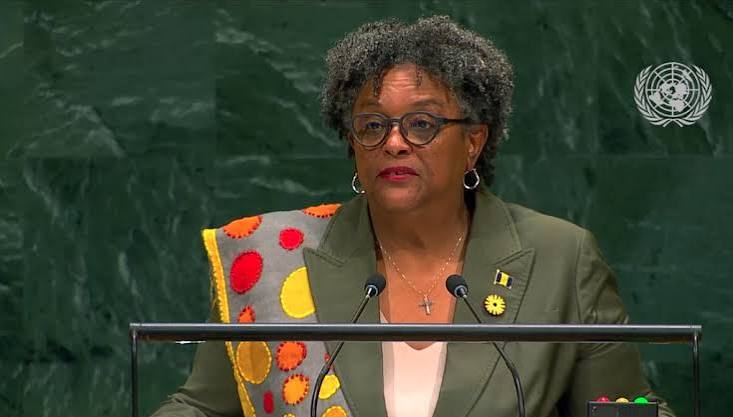
Barbados Prime Minister Mia Amor Mottley used the UN General Assembly to deliver a sweeping challenge to a global system she says is failing ordinary people, warning against war in the Caribbean, attacking entrenched inequality, demanding reform of international institutions and calling for a world in which smaller countries are treated as equals rather than spectators.
While some of the world's most powerful leaders arrived at the United Nations talking about military strength, national power and geopolitical confrontation, Barbados Prime Minister Mia Amor Mottley walked to the same podium with a very different warning.
The world has enough weapons.
What it is running dangerously short of, she argued, is fairness, trust and the willingness to prevent conflicts before people start dying.
In a wide-ranging address to the 81st United Nations General Assembly, Mottley challenged the international community over war, poverty, inequality, artificial intelligence, climate change, debt, reparations and what she described as deep structural unfairness in the institutions governing the world.
Her argument was simple but uncomfortable.
Humanity possesses more knowledge, technology and resources than at almost any point in history, yet millions of people remain trapped by conflict, hunger, debt and inequality.
“We meet at a time when the obstacles confronting human progress are multiplying,” Mottley told world leaders.
She listed obstacles to peace, food, clean water, finance, medicine, education, movement, technology and opportunity.
Then she turned to war.
Mottley said conflicts continue destroying lives even though the international community has more tools than ever to prevent violence and facilitate dialogue.
She pointed to Gaza, the West Bank, Lebanon, Yemen, Sudan and Ukraine as examples of a world increasingly consumed by prolonged conflict.
But one of her strongest warnings concerned her own region.
“The Caribbean must remain a zone of peace,” Mottley declared.
“We cannot accept our region becoming a theatre.”
The warning comes at an especially sensitive moment for the Caribbean as military and political tensions involving the United States, Cuba and other regional actors have intensified.
Mottley did not argue that countries should simply ignore security threats.
Instead, she pushed for diplomacy and international institutions capable of acting before crises become wars.
“The UN must receive the resources and the resolve to act before the guns speak,” she said.
It was a striking line at a General Assembly where military power, wars and threats of further confrontation have dominated several major speeches.
Mottley also turned her fire on the structure of global power itself.
For decades, developing countries have complained that institutions created after the Second World War continue to give disproportionate influence to a relatively small number of powerful states.
Mottley argued that meaningful reform is now essential if the United Nations expects smaller countries to continue trusting the international system.
Without a genuinely equitable rules-based international order, she warned, small states such as Barbados could effectively lose their ability to protect their interests in an increasingly competitive world.
She called for reform of the UN Security Council and changes within the wider UN system.
But her criticism went beyond diplomacy.
Mottley linked today's global inequalities to the historic structures created through colonialism and slavery.
She argued that the same mentality that justified racialized chattel slavery continues to influence unequal power structures within international institutions and the global financial system.
“It is the same mindset,” she said.
Mottley backed the Caribbean's campaign for reparatory justice and highlighted CARICOM's revised Ten-Point Plan for Reparatory Justice.
She said countries demanding reparations were not attempting to escape responsibility for their own development.
Instead, she argued that genuine reconciliation requires confronting the historical economic and social damage created by slavery and colonial exploitation.
Ghana also entered her speech.
Mottley thanked President John Mahama for his engagement with the reparations debate and Africa-Caribbean cooperation.
Her argument was that reparatory justice should not be reduced to a conversation about writing cheques.
It should involve honest engagement with the structural consequences of centuries of exploitation and the inequalities that remain embedded in the international economy.
Mottley also challenged how wealth itself is distributed.
Drawing on the writings of Frantz Fanon, she argued that the question of redistribution identified more than six decades ago remains unresolved.
Growing inequality, she said, now sits at the centre of geopolitical tension, declining trust in institutions and conflict.
She therefore backed proposals for an International Panel on Inequality and rejected the idea that governments should simply stand aside while markets determine outcomes regardless of their effects on ordinary citizens.
Artificial intelligence was another target.
Mottley warned against allowing the rules governing AI to be determined solely by corporations or a handful of technologically dominant countries.
Her position was that a technology capable of affecting every country should not be governed exclusively by the countries and companies powerful enough to develop it first.
Global rules, she argued, should protect human dignity and ensure that the benefits of AI are distributed more equitably.
That message placed Mottley's address within a broader battle taking place at this year's General Assembly.
World leaders are increasingly divided over whether global problems should be addressed primarily through national power or stronger international cooperation.
U.S. President Donald Trump used his own UN appearance to emphasize American strength and defend an aggressive approach to several international conflicts.
UN Secretary-General António Guterres, by contrast, has argued that the world's increasingly interconnected crises require deeper cooperation and reform of international institutions.
Mottley firmly placed Barbados on the multilateral side of that divide.
Barbados is among the countries supporting the newly launched Partners for Multilateralism initiative, alongside Australia, Brazil, Canada, India, Kenya and the European Union.
The initiative seeks to strengthen cooperation on peace, sustainable development, prosperity and human rights at a moment when confidence in international institutions is weakening.
Mottley also used her address to back Guyanese diplomat Carolyn Rodrigues-Birkett to become the next UN Secretary-General.
But perhaps the most important part of her speech was not about who should lead the United Nations.
It was about who the United Nations should serve.
Mottley argued that international institutions cannot rebuild trust while people believe the rules work differently depending on how wealthy, militarily powerful or politically influential a country happens to be.
Her closing message returned to the basic principle running through the speech.
Every human being must be treated as having equal value.
That may sound obvious inside an institution created around the principle of sovereign equality.
Mottley's argument was that the world repeatedly fails to practice it.
Her speech offered no military ultimatum and no promise that one country could dominate another into submission.
Instead, she asked the world's most powerful institution to confront a different kind of threat.
A global order in which ordinary people increasingly believe the system was never designed for them.
And from one of the world's smaller nations came one of the week's most uncomfortable questions:
If humanity already knows how destructive war, inequality and exclusion are, why does the world repeatedly wait until “the guns speak” before deciding to act?